
- Main Page
Topics
- Bible vs. Mrs. White
- Visions Examined
- Top Shockers
- Myths/Fables
- Shut Door
- Health Teachings
- Confusing Statements
- Plagiarism
- 1844 Movement
- Contradictions
- Pioneer Documents
- Online Books
- Videos
- Commentary
- Testimonies
Most Popular Articles
- Solitary Vice
- Head Injury
- Dammon Incident
- Prophet or Profit?
- Oysters and Herrings
Other Resources
- FAQ
- Web Store
- SDA Truth vs. Bible
- Amazing Fiction
- Church of God 7th Day
Ellen G. White: Prophet or Profit?
By Dirk Anderson, last updated Jan. 2022
Most Seventh-day Adventists have heard stories of how the Whites started their ministry "penniless," and how Mrs. White died "in debt." Mrs. White's writings are filled with lessons of self-denial and sacrifice. What few SDAs realize is that her early years of poverty were quickly erased as she and James amassed an enormous fortune in money, assets and real estate. This page will present evidence that Mrs. White enjoyed the luxuries of the "rich and famous." In terms of today's dollars, her income was literally in the millions of dollars!
How did Ellen White amass her great fortune?
 Book Royalties - The vast majority of her income came through royalties on her books. She made well over $100,000 in book royalties in her lifetime. In today's (year 2020) dollars, that is approximately 3.1 million dollars!1
She may have started out penniless in the 1840s, but that situation was soon reversed. By the late 1850s, she was making over $1,000 a year on royalties. Mrs. White earned $11,435 in the decade of 1856 to 1866. In terms of year 2020 dollars, that is $334,312, or over $33,000 per year. Yet these were still lean years compared to what she would make later on. In the 1890s and 1900s she was making $8,000 to $12,000 a year in book royalties. In year 2020 dollars, that amounts to $252,251 to $378,377 a year! That type of income would easily place her among the top 1% of wage-earners in the world.2
 In addition, James wrote books, and although we have no figures on his royalties, it can be presumed the Whites enjoyed the income from his writings as well. James was known as a shrewd and gifted businessman. He wrote a letter encouraging Ellen to write more books, holding out the prospect of increasing their income:
"With the increased demand for our writings...there will be an income of several thousand dollars annually, besides the immense amount of good our writings will do."3
James understood how to generate wealth from their writings. In one letter he wrote to his wife saying: "Our financial matters stand well, and there is wealth yet in our pens."4
Perhaps Ellen's greatest wealth-maker was the book Steps to Christ. Fleming Revell, the non-Adventist publisher, offered Mrs. White a sweet deal: "5 percent royalty on the first 1,000, with 10 percent on all subsequent issues."5 The book sold for 75 cents and within five years, 100,000 copies had been sold.6 After battling with SDA publishers for years over her cut of the royalties, Mrs. White was well-pleased with this royalty-arrangement. She wrote in 1897:
"Steps to Christ was given to Revell. I have received quite a sum of money... more than has come to me from some books; and I think more would come to me if he had more of my books to handle. ... I shall place more books in his hand...for I can receive better satisfaction than I have received from the Battle Creek publishing house."7
10 percent royalties on 100,000 books selling at 75 cents is $7,500. In 2020 dollars, that is $236,485, or about $47,000 per year for just a single book. Exact figures are unknown, but the book likely sold over a million copies in Ellen White's lifetime, generating her an enormous income.
Minister's Salary - The Whites each received a salary from the SDA church. Mrs. White received a salary similar to that paid to ministers. Granted this was not much compared to their book royalties, but both of their salaries were larger than was paid to most ministers in the denomination.
Rental Income - As the Whites acquired real estate, they rented out properties. While it is difficult to assess their rental income, there are a few examples in her letters. In 1878, Mrs. White mentions renting a home she owns for $65/month, which is $1,769/month in 2020 dollars.8 In 1881, she tells Willie to collect rent from two different renters who were late on paying.9 In 1889, she attempts to rent her home in Battle Creek for $12-$15/month ($351-$438/month in 2020 dollars).10 In 1890, she discusses renting out one of her larger properties for $175 ($5,112 in 2020 dollars).11
Other Income - Mrs. White received pay for all the articles she wrote for denominational papers. (Interestingly enough, most other authors contributed their articles gratuitously). The Whites peddled various other merchandise, such as religious pictures. When the "Reform Dress" was being pushed by the Whites in the early 1860s, Mrs. White went to the various churches and sold paper dress patterns for a dollar apiece. That sounds insignificant, but in year 2020 dollars that is approximately $29 a pattern!12
Furthermore, we must remember that Mrs. White lived in an era before the United States' government invented the Personal Income Tax and the Social Security Tax! Therefore, the Whites were able to keep the vast majority of their income.
Evidence of her wealth
 Unlike Jesus, the apostles, and many of the Biblical prophets who were often poor and desolate, Mrs. White lived a life reserved for the wealthiest of her day:
Posh Multi-Million-Dollar Estate - The last fifteen years of Mrs. White's life were spent at Elmshaven, her elegant two-story ranch home in the exclusive Napa Valley area near San Francisco in Northern California. While the estate was purchased for a bargain $5,000 (over $100,000 in today's dollars), if the property were sold today, the beautifully furnished mansion and 74-acre estate would possibly be valued at up to ten million dollars.13 In addition to the mansion, the property included:
- A two-story office building with library and vault
- Two cottages used as living quarters for her staff
- A barn and stable stocked with livestock and equipment
Real Estate Holdings - It's difficult to ascertain the extent of the White's real estate holdings because records are scant. However, here are some of their documented holdings:
- Moved into home in Greenville, Michigan, in 1867, and sold it in 1875.14
- Owned home in Iowa, which was sold in 1875.15
- Owned property near South Bend, Indiana.16
- In 1876, James built a home for the Whites in Oakland, California.17
- In 1877, the Whites purchased a modest four-room home in Healdsburg, California, sometimes referred to as the "Healdsburg place".18 (This was a different property than Elmshaven.) Mrs. White attempted to sell it in 1904 for $3,000.19
- In 1879, the Whites acquired property in the mountains of Colorado known as the "White Ranch." The property included a small cabin.20
- In 1881, the Whites purchased "a 16-room, three-story brick Italiante mansion...a mile and a half from the center of Battle Creek."21 The estate included 30 acres and 200 fruit trees. James paid $6,000 for the property. This mansion is not the modest Battle Creek home that many Seventh-day Adventists are familiar with, the one that is pictured frequently in Adventist media. On the contrary, this was an elaborate mansion, a home reserved for the financial elite. This mansion was sold by Ellen after James' death, and it later burned down.22
- Owned various homes in Battle Creek, Michigan. In 1890, Mrs. White mentions she needs to "rent my two houses in Battle Creek."23 (This was after the Italiante mansion was sold.)
- Owned a small home in the resort town of Petoskey on Lake Michigan.24
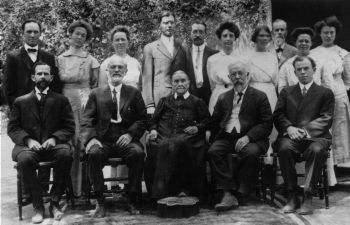 Personal Staff - A large chunk of Mrs. White's income went to pay for her extensive staff, although some of them were paid by the SDA Church. From the 1870s onward, she had six to twelve people assisting her with her writings. W. C. White headed up her editorial staff after 1881. He had his wife, Mary K. White, and Marian Davis assisting him, along with Joseph H. Waggoner, Sara McEnterfer, and Jenny Ings. Others assisted on a part-time basis. This group kept the books, articles, and testimonies churning out.
Mrs. White had an extensive household staff as well. Mrs. White is pictured on the right surrounded by her household and office staff at her Elmshaven estate in 1913. Her large staff of 14 people included a personal nurse (Sara McEnterfer), a cook, a copyist, a seamstress, farm hands, several secretaries and various other office assistants and office personnel. It is uncertain how many of her staff were paid directly by Ellen White, and how many volunteered their labor or were paid by the SDA Church. What is known is that while Mrs. White was preparing her book on the life of Christ in the 1890s, she spent $3,000 on literary "workers."25 In 2020 dollars, that is nearly $100,000.
Lavish Lifestyle - Not only did the Whites earn big money--they spent big! There is also no doubt they spent money lavishly on themselves. Following are a few examples:
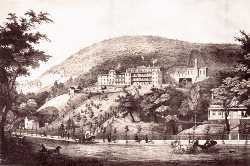
- The Whites were frequent visitors to spas and health resorts, such as Our Home on the Hillside, the Dansville Clinic in New York (pictured on the right). Mrs. White also spent time at the Rural Health Retreat in Saint Helena, Dr. Kellogg's Health Clinic in Battle Creek, and various others health resorts.
-
While criticizing others for wasting their money on photography, the Whites spent freely on photographs at a time when they were quite expensive. A letter written to James in 1876 indicates $500 was spent on a single negative. In year 2020 dollars, that is $12,332!26
- According to eyewitness accounts, Mrs. White "dressed richly." To views photographs of her and her relatives wearing fine clothes and jewelry, click here.
- Mrs. White apparently had an appetite for fine meats. In 1882, she wrote to daughter-in-law Mary Kelsey White, asking her to purchase some "herrings" and "oysters."27 According to Dr. John Kellogg, when she visited the Battle Creek Sanitarium during the next several years, she "always called for meat and usually fried chicken," much to the consternation of Kellogg and the cook who were both vegetarians.28
- Mrs. White was a world traveler during an era when world travel was quite expensive. Not only did she travel across the United States, but she also traveled to Europe and Australia, ostensibly to assist with the work in those locations. She frequently traveled first-class.
Financing the SDA Cause - There is no denying the Whites gave liberally to their cause, the Seventh-day Adventist sect. The Whites gave tithes and offerings to the SDA Church. By 1885, the Whites, by their own estimation, had contributed over $30,000 to the SDA cause over the prior four decades.29 In 2020 dollars, that is around a million dollars. Assuming they gave a liberal 20% of their income, then it can be calculated that in those four decades they earned $150,000, or in 2020 dollars, five million dollars. And those were their leanest years.
Used God to sell her books?
Mrs. White had an incredible advantage in selling her books. She could write a testimony promoting her books, and her loyal followers, thinking the testimony was inspiried by God, would purchase her books and peddle them to others. Notice how she promoted her works:
Not only were the faithful followers exhorted to buy Ellen White's books for themselves and their neighbors, but they also had to pay outrageous prices for them. In 1890, the Norwich Town SDA Church complained about this testimony:
"This testimony appears very significant when we take into consideration the price for which these books are sold. Books as large, and bound equally as well, can be bought for fifty cents per volume. The Testimonies sell for $1.50 per volume. Now here are directions professing to come from a divine source that call upon all to buy these books. If these Testimonies contain the 'revealed will of God,' why not sell them at a 'live and let live' price? Do I need to say more? -- selling Testimonies at $1.50 per volume which call for free contributions! Is this what the 'gift of prophecy' is for, to sell books at an exorbitant price? to 'move the brethren' to contribute freely?"35
Fund-raising
Fund-raising was a central theme of Ellen White's message. In 1849, during a period when Ellen's spirit guides were warning her, "time is almost finished,"36 she implored the brethren to sell all their possessions to fund the Whites' ministry:
"I saw it was the will of God that the saints should cut loose from every encumbrance--dispose of their houses and lands before the time of trouble comes, and make a covenant with God by sacrifice. I saw they would sell if they laid their property on the altar and earnestly inquired for duty."37
Not all of the brethren were pleased to be constantly badgered for money by the Whites. One early Adventist, disgusted with the visions calling for money, decided in 1854 that he would have no part of it:
"I must and will be free of the responsibility of publishing and sending out Ellen's visions to open the hearts of the Br'n to give, and then have that means used so that it would be better to use her own words 'Sunk in the bottom of the Ocean.'"38
By 1857, the Whites had decided the end was not quite so imminent, so Mrs. White toned down her visions, saying God did not need Adventists to part with their homes just yet, but if they were willing to downsize to a cheaper home, the Whites would be glad to collect the difference:
"I saw that at present God did not call for the houses his people need to live in, unless expensive houses are exchanged for cheaper ones."39
She then insisted the wealthy were to cut loose with at least part of their possessions or risk losing their calling:
"But if those who have of their abundance do not hear his voice, and cut loose from the world, and dispose of a portion of their property and lands, and sacrifice for God, he will pass them by, and call for those who are willing to do anything for Jesus, even to sell their homes to meet the wants of the cause."40
In 1859, Mrs. White continued her mantra of "give before it's too late." She used her visions to attempt to convince a man of "considerable means" that God wanted him to fork his money over to the Whites:
"Dear Brother, I saw that the Lord wanted your means which he has lent you. He calls for you to use it to advance His cause. ... I saw that you should work as fast as possible to remove the means which God has lent you from the hands of unbelievers and transfer it to the believers... I saw that the scenes of this earth’s history are fast closing. It will soon all be finished, and what is to be done must be done quickly. "41
Similar fund-raising scare-tactics were used by Ellen throughout the remainder of her ministry. Sadly, the SDA Corporation continues the practice even to this day. The author has heard more than one sermon preached wherein the thought was expressed that it was better to give sacrificially now rather than lose it all during the time of trouble.
Contradicts plain Bible teachings
Mrs. White frequently exhorted her followers to fill the church's coffers with their hard-earned money. Mrs. White gave specific instructions that tithe money was to be used exclusively for the gospel ministry:
"The tithe is set apart for a special use. It is not to be regarded as a poor fund. It is to be especially devoted to the support of those who are bearing God's message to the world; and it should not be diverted from this purpose."42
Mrs. White said tithe was not to go to the poor. What does the Bible teach about tithe money?
"At the end of three years thou shalt bring forth all the tithe of thine increase the same year, and shalt lay [it] up within thy gates: And the Levite, (because he hath no part nor inheritance with thee,) and the stranger, and the fatherless, and the widow, which [are] within thy gates, shall come, and shall eat and be satisfied; that the LORD thy God may bless thee in all the work of thine hand which thou doest."43
The Bible instructs the Israelites to save up their tithe for three years, and then disburse it amongst the Levites, foreign visitors, orphans, and widows. If that is not a "poor fund," then what is? A portion was to go to the ministers (the Levites), but the people were also commanded by God to share their tithe money with those who were poor and could not support themselves.
The great controversy over royalties
 At one time in her career, some brethren urged Mrs. White to lower her royalties so the work could move forward. They presented to her the generous and self-sacrificing example of Uriah Smith, who graciously agreed to lower royalties on his book so the work could go forward. Apparently flabbergasted and humiliated by Smith's example, she responds with a well-timed "vision" to turn the tables upon the publishers:
"I have been shown that some men worked with Elder Smith, in an underhanded manner, in order to lead him to place the lowest possible royalties on his books. Elder Smith was deceived in the object of these men; he thought that they were really trying to advance the cause of God; and they obtained their desire. Then they came to me and to others, telling us that Brother Smith received only so much for his books, and urging that the canvassers would rather handle books that would sell rapidly."But the night after this plea was made, the matter was opened before me. I saw that they had visited Brother Smith and obtained his consent to a low royalty in order that they might present this as that which I and others should do. This was obtaining terms of royalty by fraud. I was shown the spirit that prompted these men to action."44
While we may never know the real motives of the men who suggested she lower her royalties, it is safe to assume that after this stinging testimony, SDA publishers were probably very wary about bringing up the subject of royalties again with Sister White.
In 1885, Mrs. White found herself in a dispute with the publishers of her books. Mrs. White was concerned about the way her book royalties were being handled by the brethren. Mrs. White was upset because she was only getting $0.15 per book sold (in 2020 dollars, that is equivalent to $4.39 per book). Under previous arrangements with her book publishers, Mrs. White got all the profits from the first edition of a book. Profits from later editions (at least the 2nd) were split between the book salesmen and herself. As we will see from the letter below, she viewed the paying of those selling the books, at least for the first edition, to be "unjust."
| Compare and Contrast Gilbert Cranmer--Not a Single Penny
|  Gilbert Cranmer left the Adventists in the early 1860s and started the Church of God (seventh day). He labored in active ministry for that church for more than 40 years. Although not a wealthy man, although supporting a wife and four children, during his 60+ years of ministry he refused to take a salary for his labors, not a single penny!
Gilbert Cranmer...
...never attended health resorts
Gilbert Cranmer didn't just talk about self-denial and sacrifice. |
|---|
In the past, Mrs. White had been accustomed to getting some special deals on the publishing of her books. According to the Nov. 6, 1866, Hope of Israel, “We are credibly informed that her books are all published free; so that she will have all the profit on their sale.” However, by 1885, the situation had changed, and in the following letter Ellen White threatens to take her book publishing business elsewhere:
With reference to my book, I desire to say that I am not complaining because I think the office has been receiving too much for publishing it, but because I am not satisfied with the income it brings to me. Some plan should have been devised whereby more than fifteen cents royalty per copy would come to me. I do not remember that I was ever consulted regarding this matter. I thought that my brethren would guard my interests as sacredly as they would their own interests ...Only the expense of publishing and selling my book, Vol. IV, should have been taken from the profits. The rest should have been saved for the author. No canvassers were needed for Vol. IV. It could have been sold without going to all this expense. I am not satisfied with the result. Those who have felt that they were doing me justice by awarding me fifteen cents for each copy sold have erred in judgment. ...
I will make no rash moves, but I cannot submit to the arrangements made. They are unjust. The money used in paying canvassers for selling the first edition was misspent, for I should have received the profits on that edition. I know where to use this means to the very best advantage, and yet I have nothing to use in any way. I economize in every way possible, and still do not have sufficient to meet running expenses.45
W.C. White was called in to help solve the crisis over royalties. He addressed his mother's concerns in a letter by showing her evidence of the royalties of other SDA authors and telling her "the income from your books is much larger than other authors get."46 Then, in the same letter, he points to the real cause of her financial woes: "buying out Edson so he could go east, the expense of the farm, the schooling of [nieces] Addie and May, the building at St. Helena, and the loan to [niece] Mary Clough."47 Mrs. White made much more than other SDA authors, but she also had significant expenses. These expenses included not only her lavish lifestyle, but also financing her extended family, her farm, her staff, and various church projects. These unbounded expenditures were likely the cause of her financial woes. Perhaps to teach the SDA publishers a lesson, in 1892, Mrs. White took the publishing of her best-selling book, Steps to Christ, to a non-SDA publisher.
Conclusion
Some have tried to paint Ellen White as an impoverished, self-denying prophet. They point to her early ministry when the Whites barely made enough money to survive. They point to the fact that she died "in debt." However, they fail to mention that in today's dollars, her books alone brought her an income equivalent to more than three million dollars. This is not to mention the wealth and real estate amassed by James White. This is not to mention the income from her minister's salary, and the money from the other business enterprises the Whites engaged in. The truth is that according to the living standards of the 1800s, the Whites were enormously wealthy. Yes, they gave liberally of their money to their family and church projects. But they also lived the life of the "rich and famous." Mrs. White visited exclusive spas and health resorts, wore fine clothing, dined on the best food, traveled the world, and finally settled in a posh multi-million-dollar mansion with her staff, including a nurse, a cook, and a seamstress.
Seventh-day Adventism was highly profitable for Ellen White. The question for you to ponder is: Was it Prophet or Profit?
See also
- Used Her Gift to Get Money by D.M. Canright
 More than a Profit, Less than a Prophet Learn more about Ellen White
External links
- Desirer of Wages by Jack Gent
- Mrs. White and Royalties by E.S. Ballenger
- An Examination of Ellen White's Final Will and Testament
- Consumer Price Index Calculator
Citations
2. Mrs. White's earnings were reported by Thomas Hamilton in the November 6, 1866, issue of Hope of Israel vol. 1, no. 12, p. 68. During the 10-year period from 1856-1865, it was estimated she made 1,143.50 per year from royalties, not to mention other income. Hamilton also mentioned "her books are all published free." Inflation was calculated using The Inflation Calculator (see footnote #1). According to former SDA Minister E.S. Ballenger in his article, "Mrs. White and Royalties": "She was receiving from $8,000 to $12,000 a year on the books she wrote while in the employ of the Gen. Conf." $8,000 in 1900 was worth $303,079.73 in 2021. $12,000 in 1900 was worth $ 404,106.31 in 2021 (The Inflation Calculator).
3. James White, Letter to Ellen White, Apr. 18, 1880.
4. James White, Letter to Ellen White, Feb. 18, 1881. In addition to books, James also sold Adventist charts. Ellen White wrote to her family: "...your father was doing business selling charts and books every moment of the time." (Letter 7, 1863 to Henry, Edson and William White).
5. Fleming H. Revell, letter to "Mr. Chadwick," Oct. 17, 1891.
6. Arthur Patrick, "Author," Ellen Harmon White: American Prophet (NY: Oxford University Press, 2014), p. 104.
7. Ellen White, Manuscript 80, 1897.
8. Ellen White, Letter 14, March 8, 1878.
9. Ellen White, Letter 18, December 6, 1881.
10. Ellen White, Letter 19, January 8, 1889.
11. Ellen White, Letter 13b, January 15, 1890.
12. $1 in 1862 was worth $27.71 in 2017. (The Inflation Calculator)
13. The average price of a home in St. Helena in 2001 is reported to be $749,000. (www.realtor.com) According to one resident of St. Helena, "From personal experience, that doesn't buy much of a home. (The very mediocre house my in-laws still rent, a stone's throw from the St. Helena SDA church, is valued at roughly $600,000 -- and it is in a rather sad state of repair.) Having recently toured Elmshaven, and being somewhat familiar with real estate values in that area, I would estimate that the value of Elmshaven would much likely be more than $10,000,000!! Particularly given the amount of extremely coveted vineyard space the grounds of that estate could provide."
14. Gerald Wheeler, James White: Innovator and Overcomer, p. 97 (Review and Herald Publishing Assn, © 2003).
15. Ibid
16. Wheeler, p. 97.
17. Ellen White, Selected Messages Book 3, p. 103, comments inserted by the compilers: "On March 22, James White left Oakland, where they had just built a home...".
18. Arthur L. White, Ellen G. White Volume 3 The Lonely Years 1876-1891, p. 79.
19. Ellen White, Manuscript Releases Vol. 3, p. 269, (Letter 245, 1904, to Elder N. C. McClure, July 12, 1904).
20. Arthur L. White, Ellen G. White Volume 3 The Lonely Years 1876-1891, p. 120.
21. Wheeler, p. 97.
22. Ibid.
23. Ellen White, Letter 88, Apr. 15, 1890.
24. Jerry Allen Moon, "William Clarence (W. C.) White: His Relationship to Ellen G. White and her Work," (PhD diss., Andrews University, 1993), 89, 138.
25. Ellen White, Letter 114 to Mrs. Wessels, July 16, 1896.
26. $500 in 1876 was worth $11,689.50 in 2017. Ellen White, Letter 1a, 1876, p.1. (To James White, March 24, 1876).
27. Ellen White, Letter 16, 1882.
28. J.H. Kellogg letter to E.S. Ballenger, January 9, 1936.
29. Ellen White, Manuscript 35, 1885. The exact amount in 2020 dollars cannot be calculated because it was given over a nearly 40-year period. However, if it was all given in 1885, it would be $876,326.09 in 2020 dollars. Since much of it was given earlier than 1885, the actual amount when converted into 2020 dollars is probably at least a million dollars.
30. Ellen White, Southern Watchman, Jan. 15, 1903.
31. Ellen White, Testimonies, vol. 9, p. 77.
32. Ellen White, Testimonies, vol. 5, p. 681.
33. Ellen White, General Conference Bulletin, Apr. 14, 1901.
34. Ellen White, Testimonies, vol. 4, pp. 390-391.
35. The Claims of Mrs. Ellen G. White, tract No. 1, issued by the SDA Church, Norwich Town, Conn., 1890, http://www.ex-sda.com/newpage25.htm.
36. Ellen White, "A Sketch of the Christian Experience and Views of Ellen G. White (1851)", p. 55, para. 1.
37. Ellen White, "To Those who are receiving the seal of the living God", January 31, 1849, para. 9. Ellen White wrote a letter to Brother Phillips on Oct. 10, 1859, admonishing him: "Those who have property have a duty to do to dispose of their means to God's glory..." (Letter 22, 1859). Ellen White wrote a letter to Brother and Sister Sperry, who had sold land and were moving out West, saying: "Here is an opportunity for you to deny yourself and sacrifice an offering of the best of your substance..." (Letter 4b, 1861) Ellen wrote of Adventists in 1857, "They have been loving the world, loving their farms, cattle, etc. Now Jesus calls them to cut loose, to lay up treasures in heaven..." (Manuscript 2, 1857).
38. J.B. Bezzo, "Messenger of Truth", vol. 1, no. 3, Oct. 19, 1854, p. 2.
39. Ellen White, The Review and Herald, November 26, 1857, para. 30.
40. Ibid.
41. Ellen White, Letter 4, 1859.
42. Ellen White, Review and Herald Supplement, Dec. 1, 1896.
43. Deut. 14:28-29, KJV.
44. Ellen White, Manuscript Releases, Vol. 17, p. 191.
45. Ellen White, Letter written to J. H. Waggoner and C. H. Jones, March 7, 1885, from Healdsburg, California. Letter 15, 1885. Released by Ellen G. White Estate, Washington, D.C. January 22, 1989. Manuscript Releases, Vol. 20, pp. 48-50.
46. W. C. White to E. G. White, Jan. 12, 1885.
47. Ibid.