Patriarchs and Profits
Chapter 3 - Not a Product of Any Human Mind?
by Dirk Anderson
In 1934, L. E. Froom — one of the SDA sect's leading historians — wrote to W. C. White with a direct question: did the people around Ellen White ever bring outside material to her attention while she was writing? The question itself is worth considering. By 1934, an SDA scholar felt the need to ask the son of the prophetess, point blank, whether her books had been fed material from other authors. W. C. White's response wasn't a denial; it was an exercise in damage control that surrendered the entire premise.
In some of the historical matters such as are brought out in Patriarchs and Prophets...the main outlines were made very clear and plain to her, and when she began to develop these topics, she was left to study the Bible and history to get dates and geographical relations and to perfect her description of details. ...
This enabled her to select and appropriate that which was true and to discard that which was erroneous or doubtful.
Regarding the study of books...from the [Review] library Ellen White made selection of books which she considered profitable to read.
It was remarkable that in her reading and scanning of books that her mind was directed to the most helpful books and to the most helpful passages contained in those books. ...
You ask if her helpers brought statements to her attention which they thought would help her in her writings. Nothing of this kind occurred previous to the writing of Great Controversy, Volume IV, at Healdsburg, in 1883 or 1884. Then it was seldom and related to minor details.1
Dressed in the soothing language of filial reassurance, this letter is a damning confession.
First, Willie attempts to sanitize her reliance on "history" books by claiming she consulted them merely to verify dates, geography, and to "perfect her description of details." Exactly how much "perfecting" did Ellen White do with those books? The remainder of this book will demonstrate that Ellen White did plenty of "perfecting" with them. At a minimum, Willie White admits what the sect spent decades denying: his mother sat at a desk with standard reference books open in front of her while writing her "heaven-sent" message.
Second, Willie assures Froom that Ellen operated with supernatural discernment — selecting only what was "true" and discarding everything "erroneous or doubtful." While Willie may have thought that to be the case, this book will prove that it is not. The human authors she copied from were fallible scholars who occasionally got their facts wrong. Ellen White blindly copied their factual blunders, historical misstatements, and outdated theories straight into her own text. She had no discernible divine filter.
Third, Willie claims that God personally "directed her mind" to the "most helpful passages" in the library. Consider the blasphemy buried in that excuse: W.C. White is essentially portraying the Holy Spirit as an accomplice to theft — a divine plagiarism assistant pointing Ellen to the exact pages she ought to steal.
This is as close as Willie would get to admitting the material in the book did not come from visions. To anyone capable of reading between the lines, the truth is glaring: Ellen White operated exactly like any other nineteenth-century compilation writer, sitting down with human reference books, cutting passages, and stitching them together into her own manuscript. That is a fatal admission. Chapter One quoted Ellen White's explicit claim that her narrative was "not the product of any human mind." Yet thirty-six years later, her own son admitted she read books produced by human minds and selected material written by human minds to construct her narrative. Both claims cannot be true. Someone is telling a White lie.
The letter's final paragraph is where the real concession sits. Froom's question was about whether helpers ever brought her material. Willie's answer is not a flat no. It is a no with a date attached: nothing of the kind occurred before the writing of Great Controversy, Volume IV — which he places in 1883 or 1884. After that point, by his own account, it did happen. His defense rests entirely on the two assuring words that follow: seldom, and minor details.
Patriarchs and Prophets was published in 1890 — six years after the date W. C. White himself sets as the beginning of assistant-supplied material entering his mother's writing. Is it true that her assistants “seldom” supplied material and that it was only “minor details”?
The Bookmaker
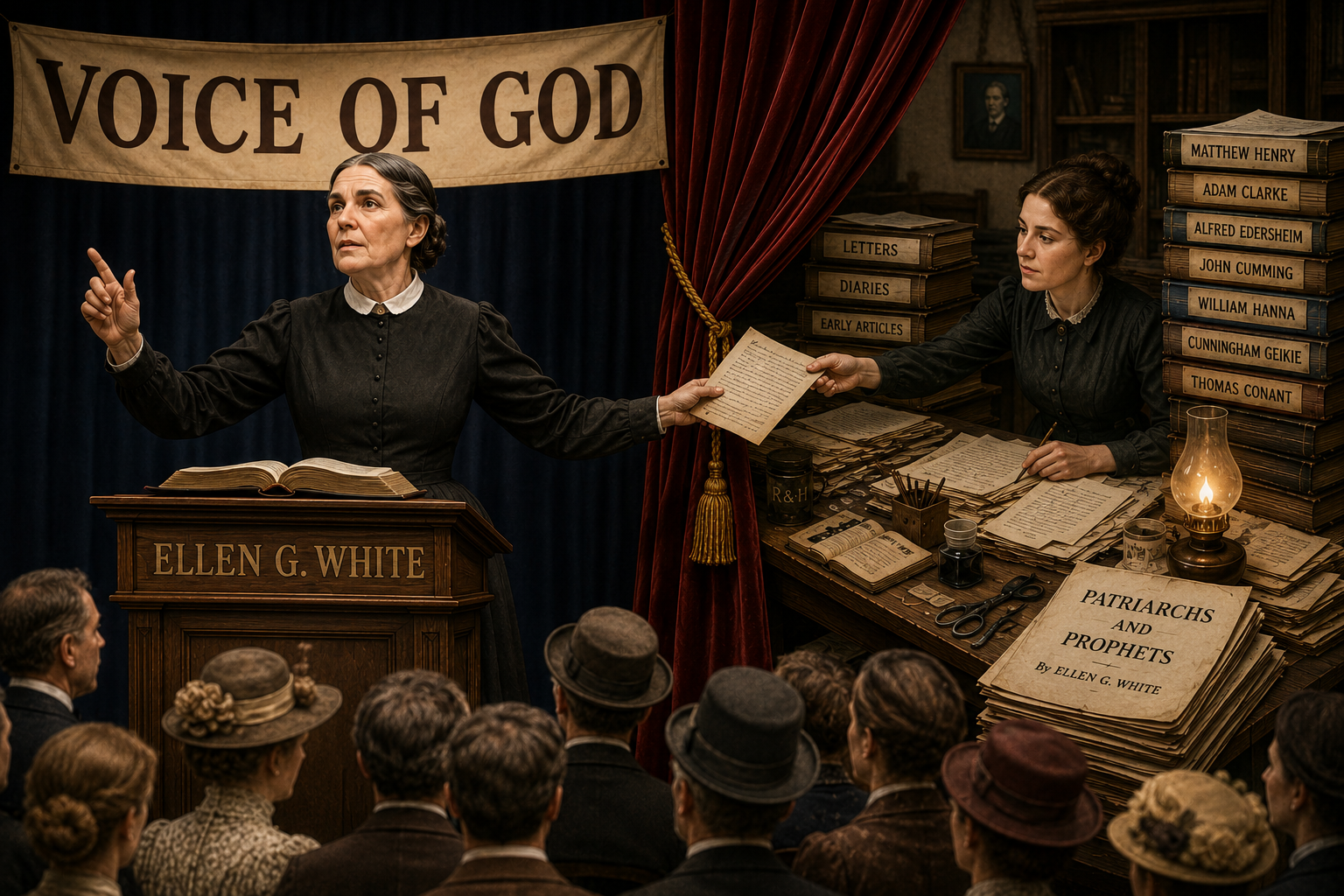
One of the most talented human minds behind the writing of many of Ellen White's most beloved books was Marian Davis.
Ellen White said the contents of Patriarchs and Prophets were traced upon her mind by the Holy Spirit “as indelibly as the law was traced by the finger of God, upon the tables of stone.”2 That is a bold claim for a book whose preparation left behind a paper trail—a trail of an editor, a stack of reference books in her own library, and an author asking for more than mere editorial help.
While Ellen White stood as the public face of divine inspiration, Marian worked behind the curtain, gathering, selecting, arranging, and rewriting material until it became a finished manuscript. The correspondence that survives reveals an editor whose role went well beyond correcting prose. She functioned as an architect of the books themselves.
Consider what Marian Davis was actually doing. In 1884, she described her responsibilities in a letter to W. C. White:
To plan the work, to decide what portions of matter already written should go in the book, and what points should be more fully dwelt upon… the danger that some unguarded expression will be used, in preparing the matter, that will conflict with something previously written, in some other book.3
Notice what this reveals. Davis was not merely correcting grammar or polishing style. She was selecting material, expanding subjects, and, critically, comparing the manuscript against Ellen White's earlier books to prevent contradictions.
Preventing contradictions was no small concern. Ellen White's writings were already keeping corporate leaders awake at night wondering what would be the next inconsistency they would have to smooth over. Publishing any additional contradictions could further damage their prophet's already-crumbling credibility. Hence, one of Marian's key tasks was to keep the expanding body of "inspired" writings internally consistent.
The contrast with the biblical prophets is striking. Isaiah needed no editor to compare his latest prophecies with earlier scrolls. Jeremiah did not employ an assistant to screen his revelations for conflicts with previous ones. If Patriarchs and Prophets was simply a record of what the Holy Spirit traced on her heart, why did it require an editor to check it against her existing publications?
In the same letter, Marian made a request that contradicts the claim of divine origin:
Any information concerning the Douay Bible [sic] will be welcome. (It might be convenient to have these for reference.)4
The Douay is the Roman Catholic Bible, and it carried extensive commentary beneath the text — historical, geographical, and scholarly notes on nearly every passage. Marian wanted it “for reference” while assembling a book its author would market as light given directly from heaven.
White herself made similar requests. Writing from Europe in 1885, in a letter otherwise full of spiritual counsel, she paused to ask her sons for research material:
Tell Mary to find me some histories of the Bible that would give me the order of events. I have nothing and can find nothing in the library here.5
One might wonder if White got more than the "order of events" from those books.
The same letter closes with a postscript that describes the editorial process. Marian had sent a list of corrections, to which White replied:
I have just one minute ago read the letters in which she has specified the improvements to be made in articles for Volume 1 [Patriarchs and Prophets was volume 1 of the Conflict of the Ages series]… That needs to be more carefully worded… I think I can make the articles specified more full; and as I am famous for moralizing, this will be no cross.6
Improvements to be made. Passages more carefully worded. Articles made more full. Then, the author's own description of what she brings to the text — not revelation, but moralizing, at which she is “famous.” None could argue with that. But moralizing does not require a vision or a prophet.
The expansion of the text was managed the same way. Years earlier, Marian had written W.C. White hunting for a fuller version of an existing account:
We are anxious to learn whether an account of Jacob's night of wrestling with the angel has been written since Volume 1… Sr. White has given a very much more full description than is given in Volume 1. Can you give any information concerning such an article, whether it has ever been published, and when, and where?7
The "much more full description" was not descending fresh from heaven. It was a manuscript to be located, retrieved, compared, expanded, and worked into the growing book — the same editorial process that transformed the brief narratives of Spiritual Gifts into the much lengthier Patriarchs and Prophets.
How much of the finished wording belonged to Marian Davis cannot now be determined, but the correspondence already reveals what matters. Patriarchs and Prophets was assembled with editors, reference books, previous manuscripts, historical works, revision, expansion, and careful comparison against Ellen White's earlier publications. That is the production history of the book she later declared had been traced upon her mind by the Holy Spirit "as indelibly as the law was traced by the finger of God."
The Human Minds Behind the Book
The next chapters answer one simple question: Where did the extra-biblical material in Patriarchs and Prophets come from? Not the biblical text itself, but the motives, conversations, descriptions, historical explanations, and countless narrative details that Scripture never records.
To answer that question, those additions will be compared with nineteenth-century commentaries, Bible histories, and devotional works.
How the Comparisons Were Made
The investigation was intentionally conservative. Only books known to have been in Ellen White's library, or readily available to her, were considered.
The comparison focuses on the first twenty-one chapters of Patriarchs and Prophets, covering Genesis from Creation through Joseph. White's earlier account, Spiritual Gifts, volume 3 (1864), serves as a baseline. Material appearing for the first time in the expanded 1890 edition can therefore be isolated and compared with books published during the twenty-six years between the two editions.
Every example included in this study satisfies the same three requirements:
- Genesis does not contain the detail.
- One or more nineteenth-century authors supply it—usually identifying it as an opinion, conjecture, or probable explanation.
- Ellen White presents it as historical fact.
The standards were deliberately strict. Numerous similarities were excluded because they could be explained by common biblical language, shared Christian interpretation, or because they failed one or more of the three tests above.
The first source examined is not from her library. It sat on a shelf in Ellen White's own household.
References and Notes
- W. C. White Letter to L. E. Froom, Dec. 13, 1934 (Selected Messages, Book 3 (1980), 462-463).
- Ellen G. White, Letter 90, 1906.
- Marian Davis to W. C. White, March 26, 1884.
- Marian Davis to W. C. White, March 26, 1884. The Duoay Bible was not listed in the White Estate as being among White's books, but they candidly stated they did not list the Bibles in her possession: "nor have we listed all Bibles...found on the original inventory." A Bibliography of Ellen G. White's Private and Office Libraries, Warren H. Johns, Tim Poirier, Ron Graybill (compilers), Ellen G. White Estate, 3rd ed., April, 1993.
- Ellen G. White, Letter 38, 1885 (to J. E. White and W. C. White, Basel, Switzerland, December 22, 1885).
- Ibid. The corrections concerned Spirit of Prophecy, vol. 1, the predecessor volume to Patriarchs and Prophets.
- Mary A. Davis to W. C. White, February 26, 1879.