Patriarchs and Profits
Chapter 4 - The Columbian Family Bible
by Dirk Anderson
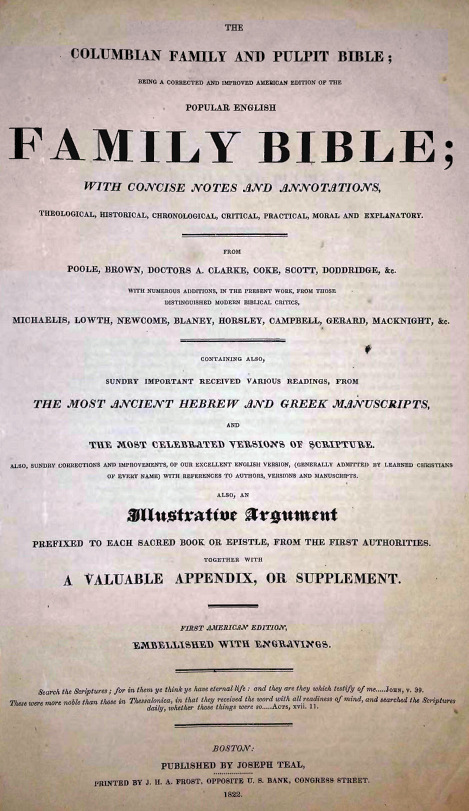
Ellen White owned a copy of the Columbian Family and Pulpit Bible (1822). It was much more than a Bible. Beneath the biblical text ran commentary compiled from Poole, Brown, Coke, Scott, Doddridge, and Adam Clarke, along with notes from other respected commentators (see photo at right).1
In other words, Ellen White did not have to visit a theological library to find these ideas. They were literally printed beneath the verses she was reading. Open Genesis, and there sat the opinions, explanations, and speculations of some of the best-known Bible commentators of her day.
Unlike Ellen White, these men usually admitted when they were guessing. Again and again they wrote, "perhaps," "some think," "it is probable," "the Jews were generally of opinion," or "it is thought." They distinguished between what Scripture actually says and what they believed Scripture might imply.
Ellen White removed the question marks. She routinely turned their possibilities into certainties and presented them as facts revealed to her by God.
Four Things a Vision Cannot Do
The Columbian Bible provides four examples that stand out as being unattributable to a "vision." These involve material that a vision simply cannot produce.
1. The Same Sentence
In this example, Pharaoh has summoned Joseph from prison to interpret his dreams. Genesis records Joseph's humble reply: "It is not in me: God shall give Pharaoh an answer of peace." The biblical text stops there. Ellen White does not. Neither does the commentary beneath the text in her Columbian Family Bible.
| Columbian Family Bible, Gen. 41:162 | Patriarchs and Prophets3 |
|---|---|
| “It is not in me, &c. Joseph, modest and devout, disclaims all honour of the interpretation, and ascribes it to the true cause, the power of God. My knowledge is not greater than those you have consulted; it is God alone can explain these mysteries.” | “Joseph's reply to the king reveals his humility and his faith in God. He modestly disclaims the honor of possessing in himself superior wisdom. ‘It is not in me.’ God alone can explain these mysteries.” |
The same sentence, preceded by the same observation that Joseph modestly disclaims the honor. That is not what Genesis says. It is what the commentary says.
A vision cannot explain why a nineteenth-century sentence written by a commentator appears inside a book whose author insisted it was "not the product of any human mind." The vision did not produce that sentence. The commentary did.
2. Gopher Wood: Solving an Unsolved Hebrew Word
The Hebrew word gopher appears exactly once in the entire Old Testament. No one knows with certainty what kind of wood it was. Bible translators and commentators have debated it for centuries, and even the King James translators declined to guess. They simply transliterated the Hebrew word as gopher.
The commentary in Ellen White's Columbian Family Bible, however, was willing to venture an opinion:
| Columbian Family Bible, Gen. 6:144 | Patriarchs and Prophets5 |
|---|---|
| “Gopher wood, of which the ark was made, is but once mentioned in scripture, and is differently rendered by the learned: by some pine, by many cedar, but by others cypress, a tree very proper for the purpose, being of a firm and durable nature.” | “The material employed in the construction of the ark was the cypress, or gopher wood, which would be untouched by decay for hundreds of years.” |
Notice what happened. The commentator openly admits there is disagreement. Some say pine. Many say cedar. Others say cypress. He then sides with one view because cypress is exceptionally durable.
Ellen White reaches exactly the same conclusion. She identifies the wood as cypress and immediately emphasizes the identical reason—its extraordinary resistance to decay.
This is not the sort of detail someone "sees" in a vision. A vision may reveal an ark made of wood. It does not identify the durability qualities of the wood employed.
3. Seth: She Reproduces the Method, Not Just the Answer
In the case of the cypress wood, SDA apologists may argue that Ellen White simply shared the same view as other commentators. This example goes much further. She does not merely arrive at the same conclusion. She reaches it by following the same line of reasoning.
The commentary beneath Genesis 5:3 asks an obvious question: If Seth was a godly man, why does Scripture say Adam "begat a son in his own likeness"? The answer is found by comparing Genesis 5:1 with Genesis 5:3.
| Columbian Family Bible, Gen. 5:36 | Patriarchs and Prophets7 |
|---|---|
| “More particularly resembling him than his other sons, not only in his outward features, but also in his corruptions... for Adam's image is here plainly opposed to the likeness of God, wherein he is said to be created, ver. 1. And this is fitly said of Seth, to signify, that, although he was a worthy and good man... yet he, no less than the wicked Cain, was begotten and born in sin: and all the difference between him... and the wicked progeny of Cain, was not from the nature they received from Adam, but from the grace infused into them by God.” | “Seth... resembled Adam more closely than did his other sons. He was a worthy character, following in the steps of Abel. Yet he inherited no more natural goodness than did Cain. Concerning the creation of Adam it is said, ‘In the likeness of God made He him;’ but man, after the Fall, ‘begat a son in his own likeness, after his image.’ While Adam was created sinless, in the likeness of God, Seth, like Cain, inherited the fallen nature of his parents... By divine grace he served and honored God.” |
This is not plagiarism of words. It is White copying the exact same multi-step argument used by the commentator in her Bible:
- Seth resembles Adam more than his brothers.
- He is a "worthy" man.
- He inherited the same fallen nature as Cain.
- The difference is divine grace.
- Most importantly, both writers build the entire argument by comparing Genesis 5:1 with Genesis 5:3.
That comparison is not found in Genesis. It is the commentator's method of explaining Genesis. Ellen White follows the same path to the same conclusion.
It gets worse. White not only follows the commentator's reasoning — she assembles the paragraph from multiple sources. The argument above came from her Columbian Bible. The wording in the rest of the paragraph was plagiarized from Alfred Edersheim.
| Alfred Edersheim, Bible History8 | Patriarchs and Prophets9 |
|---|---|
| “his mother significantly called ‘Seth,’ that is, ‘appointed,’ or rather ‘compensation;’ ‘for God,’ said she, ‘hath appointed me another seed instead of Abel.’” “whereas we read of Adam that ‘in the likeness of God made He him,’ it is now added that ‘he begat a son in his own likeness, after his image.’ Adam was created pure and sinless in the likeness of God; Seth inherited the fallen nature of his father.” |
“The name Seth, given to this son, signified ‘appointed,’ or ‘compensation;’ ‘for,’ said the mother, ‘God hath appointed me another seed instead of Abel.’… Concerning the creation of Adam it is said, ‘In the likeness of God made He him;’ but man, after the Fall, ‘begat a son in his own likeness, after his image.’ While Adam was created sinless, in the likeness of God, Seth, like Cain, inherited the fallen nature of his parents.” |
That single paragraph in Patriarchs and Prophets is a composite. The observations that Seth "resembled Adam more closely than did his other sons," was "a worthy character," inherited "no more natural goodness than did Cain," and was changed only "by divine grace" come from the commentary in her Columbian Bible. Edersheim contributes the explanation of Seth's name, Eve's statement that "God hath appointed me another seed instead of Abel," and much of the wording White uses to compare Genesis 5:1 with Genesis 5:3. The comparison itself appears in both sources, but White combined them into a single seamless paragraph.
This is not what a person does after receiving a vision. It is what a writer does with two reference books open on the desk—taking an argument from one, a sentence from another, and weaving them together into a seamless narrative.
A vision might show Seth. It would not show a man comparing two verses of Genesis to construct a theological argument. This is editorial work, not revelation at work.
4. Adam's Death: An Entire Argument, Reproduced in Sequence
Genesis 5:5 explains Adam's post-fall life in one brief verse:
And all the days that Adam lived were nine hundred and thirty years: and he died.
That is all that Genesis says.
The Columbian Bible fills the silence with a small essay. The same essay appears in White's book, with the same premises, in the same order, reaching the same conclusion.
| Columbian Family Bible, Gen. 5:510 | Patriarchs and Prophets11 |
|---|---|
| “Our great progenitor, after living 930 years, resigned his spirit… Besides the grief he bore for his own transgressions, he had the mortification to see a rupture in his family, which ended in the murder of Abel; he was witness to the general corruption which provoked the Almighty to destroy mankind by a deluge of water. He did not, therefore, think, when his life drew near its period, that the sentence of his Creator, which condemned him to death, was terrible. Nature would doubtless shrink at the execution of the decree, but his reason would justify providence in putting a period to a miserable life.” | “When he left Eden, the thought that he must die thrilled him with horror… Filled with the keenest remorse for his own sin, and doubly bereaved in the death of Abel and the rejection of Cain, Adam was bowed down with anguish. He witnessed the wide-spreading corruption that was finally to cause the destruction of the world by a flood; and though the sentence of death pronounced upon him by his Maker had at first appeared terrible, yet after beholding for nearly a thousand years the results of sin, he felt that it was merciful in God to bring to an end a life of suffering and sorrow.” |
While Adam's life span came from the Bible, five extra-biblical correspondences — followed in order — came from the commentator:
- Grief for his own sin
- The murder of Abel
- Witnessing the corruption that led to the Flood
- The death sentence first appearing terrible
- The reasoned acceptance that followed
Two people do not independently construct the same five-step case for why a man came to regard his own death sentence as mercy.
Borrowing Their Problems
The previous examples showed Ellen White borrowing the Columbian commentators' conclusions. The next group show her borrowing their problems.
In each case, the biblical text presents no difficulty at all. The problem exists only in the minds of commentators. They notice an apparent inconsistency, ask how it can be explained, and then propose a solution.
Remarkably, Ellen White answers the very same questions — even though the Bible never asks them. She inherits not only the commentators' conclusions, but also the problems that led to those conclusions. That is exactly what you would expect from someone reading annotated commentaries.
1. The Curse on Canaan
Genesis never pauses to defend God's justice in cursing Canaan. The objection comes entirely from the commentator, who worries that the punishment appears unfair. Ellen White then answers that very objection, using essentially the same explanation: Noah was not pronouncing an arbitrary sentence but uttering a prophecy of what Ham's descendants would become.
The coincidence is revealing. She does not merely share the commentator's answer. She shares his question.
| Columbian Family Bible, Gen. 9:2512 | Patriarchs and Prophets13 |
|---|---|
| “This text, taken in the literal sense, seems to be a reflection upon the dispensations of Providence, and contrary to the principles of common equity, as it inflicts upon the innocent and unoffending the punishment due to the guilty… But this problem may be solved… if we consider the passage as a prophecy, which Noah then uttered… by foretelling, that his violation of filial duty would be retaliated upon him in the wretchedness and degeneracy of his children, and particularly in Canaan's race.” | “The unnatural crime of Ham declared that filial reverence had long before been cast from his soul… These evil characteristics were perpetuated in Canaan and his posterity… The prophecy of Noah was no arbitrary denunciation of wrath or declaration of favor. It did not fix the character and destiny of his sons. But it showed what would be the result of the course of life they had severally chosen.” |
- The commentator asks whether God acted unjustly.
- He answers that Noah was giving a prophecy, not an arbitrary curse.
- Ellen White gives the same answer using much of the same vocabulary.
She adopts the commentator's anxiety about this passage — answering an objection the Bible never raises — utilizing similar vocabulary.
2. Defending Abraham
Abraham tells Pharaoh that Sarah is his sister. While the Bible itself does not comment on this, the Columbian commentators devise a six-part defense. What does White do?
| Columbian Family Bible, Gen. 12:1314 | Patriarchs and Prophets15 |
|---|---|
| “This action of Abram's has been much censured by the ancient fathers; but it should be remembered, that Sarai was in reality his sister, by the father's side:—Abram, however, though not guilty of direct falsehood, was guilty of prevarication; and, by a pusillanimous and unseasonable concealment of the truth, endangered the chastity of his wife; we may, notwithstanding, draw from Abram's conduct this moral reflection, that the brightest of men have their blemishes… since even Abram… was occasionally distrustful of the Divine Providence.” | “Abraham gave evidence that he was not free from human weakness and imperfection. In concealing the fact that Sarah was his wife, he betrayed a distrust of the divine care… He reasoned that he was not guilty of falsehood in representing Sarah as his sister, for she was the daughter of his father, though not of his mother. But this concealment of the real relation between them was deception… Through Abraham's lack of faith, Sarah was placed in great peril.” |
Notice what both writers are doing. Genesis simply reports the event. Neither Moses nor the biblical narrator pauses to defend Abraham's conduct. The commentator does, constructing a point-by-point moral defense. Ellen White follows the same path.
Both writers answer the same objection. Abraham was technically telling the truth because Sarah really was his half-sister. He was therefore not guilty of an outright lie, yet he was guilty of deception by concealing the whole truth. That deception placed Sarah in danger, and it exposed a temporary failure to trust God's protection. Even the concluding moral is the same: one of the greatest men of faith was not free from human weakness.
Genesis records the history. The commentary supplies the moral defense. Ellen White reproduces the defense.
3. Was Abraham Cruel to Hagar?
The next three examples follow the same pattern. Genesis simply records the events. The commentators, however, sense that readers may question the conduct of Abraham and Joseph, so they rush to their defense. Ellen White repeatedly joins the defense, offering essentially the same explanations.
| Columbian Family Bible, Gen. 21:1416 | Patriarchs and Prophets17 |
|---|---|
| “If Abraham must be arraigned according to the custom of the present day, it will be difficult, if not impossible, to acquit him of unfeeling cruelty… The patriarch intended no unkindness to Hagar; all he meant was to restore peace to his family, and this action was warranted by the command of God.” | “The patriarch was thrown into great distress. How could he banish Ishmael his son, still dearly beloved?… The Lord, through a holy angel, directed him to grant Sarah's desire… for only thus could he restore harmony and happiness to his family. Abraham obeyed the angel's word, but it was not without keen suffering.” |
Notice the pattern. The commentator begins with the moral objection: Abraham appears harsh and unfeeling. He then argues that Abraham acted reluctantly, sought only to restore peace to his family, and obeyed God's command. Ellen White follows the same line of defense. Abraham is portrayed as deeply distressed, acting only under divine direction, with the restoration of peace in the household as the ultimate objective.
4. Was Joseph a Tale-Bearer?
| Columbian Family Bible, Gen. 37:218 | Patriarchs and Prophets19 |
|---|---|
| “He saw with grief the misdemeanours of his brethren, and reported them to his father, flattering himself that his salutary reprimands and counsels would be proper motives to correct their behaviour for the future.” | “As Joseph witnessed the evil conduct of his brothers, he was greatly troubled… He could not endure to see them sinning against God, and he laid the matter before his father, hoping that his authority might lead them to reform.” |
Again, Genesis offers no defense of Joseph. The commentator worries that Joseph might appear to be an informer who betrayed his brothers. His solution is to portray Joseph's report as an act of loving concern, intended to bring about their reform. Ellen White reaches the same conclusion, explaining that Joseph reported their conduct because he hoped his father's authority would lead them to repentance.
5. Did Joseph Practice Divination?
| Columbian Family Bible, Gen. 44:520 | Patriarchs and Prophets21 |
|---|---|
| “An unjust conclusion has been drawn from this text by many, who have supposed that Joseph practised the art of divination; but had they understood the true import of the Hebrew word, they would have had little ground for such an opinion.” | “He had never claimed the power of divination, but was willing to have them believe that he could read the secrets of their lives.” |
Genesis never pauses to defend Joseph against the charge of divination. The commentator does. He argues that Joseph never practiced divination at all. Ellen White likewise anticipates the same objection, insisting that Joseph never claimed supernatural powers, but merely allowed his brothers to believe he possessed them. Once again, she answers the same question occupying the commentator rather than one raised by the biblical narrative itself.
6. Potiphar Secretly Believed Joseph
Genesis records a simple sequence of events. Potiphar hears his wife's accusation, and "his wrath was kindled." Nothing suggests he secretly doubted her story.
| Columbian Family Bible, Gen. 40:422 | Patriarchs and Prophets23 |
|---|---|
| “Potiphar, his old master, who was now convinced of his innocence by the confidence he placed in him; though, to conceal the dishonour of his wife, he still kept him in prison.” | “Had Potiphar believed his wife's charge against Joseph, the young Hebrew would have lost his life; but the modesty and uprightness that had uniformly characterized his conduct were proof of his innocence; and yet, to save the reputation of his master's house, he was abandoned to disgrace and bondage.” |
Now read the verse itself:
And it came to pass, when his master heard the words of his wife, which she spake unto him, saying, After this manner did thy servant to me; that his wrath was kindled (Gen. 39:19).
Notice what happened. The biblical text says Potiphar became angry. The commentator found it problematic that an honorable man would condemn an innocent servant, so he invented an explanation: Potiphar knew Joseph was innocent but imprisoned him anyway to protect his wife's reputation.
Ellen White adopts the same explanation and expands it. Joseph, she says, would have been executed had Potiphar actually believed the accusation.
Furthermore, she had a second book in her library making the same excuse: Lives and Lessons of the Patriarchs by John Cumming — an author she frequently plagiarized. Cumming writes:
Potiphar seems to have had strong impression… that Joseph was falsely accused, that his wife was the guilty one, and privately, perhaps, he conveyed this, his own impression, to the jailer; for the jailer's instructions from his master were, to receive Joseph as a prisoner, that outward appearances might be saved, but to treat him as a friend and innocent servant.24
Her Bible said the concealment protected the wife. Cumming said it protected appearances. Ellen White wrote that it was done “to save the reputation of his master's house.” She took Cumming's point-of-view on this.
A third book on her shelf made the same excuse. Thomas J. Conant, in 1868, could not reconcile the sentence with the charge either:
This fact, in connection with the confidence Joseph had before inspired, strengthened by an ingenuous and truthlike assertion of his innocence, may account for the lenity shown him, which is otherwise unintelligible.25
Notice that last clause. A commentator is conceding that the biblical text does not make sense to him as it stands — and inventing a motive to make it fit. Three books did this. Ellen White took their solution and reported it as history.
This is not an additional detail supplied by revelation. It is an attempt to solve a problem the commentator perceived in Genesis—and one that the biblical text never asks to be solved. The commentary's attempt to soften our view of Potiphar becomes part of her inspired narrative.
By now the pattern is unmistakable. The Bible tells the story. The commentators worry about the story. Ellen White worries about exactly the same things. She repeatedly interrupts the biblical narrative to defend Abraham, Joseph, and Noah at precisely the points where nineteenth-century commentators felt compelled to defend them. That is not the fingerprint of independent revelation. It is the fingerprint of literary dependence.
Guesswork Promoted to Revelation
There is a world of difference between saying "perhaps this happened" and saying "this is what happened." Honest commentators know the difference. They mark the boundary between Scripture and speculation with words like "perhaps," "it is thought," and "some suppose." Ellen White repeatedly strips away those warnings. Their conjectures become her revelations.
1. The Serpent Had Wings
| Columbian Family Bible, Gen. 3:126 | Patriarchs and Prophets27 |
|---|---|
| “That the serpent was more mild and gentle… seems to be generally understood; that it did not creep upon the ground, but went with its head and breast reared up… Probably it was of the kind of winged serpents… termed fiery… because they appeared shining like fire, when flying in the air… The devil is thought, therefore, to have made use of this kind of serpent, that he might resemble one of those angels of light.” | “Satan chose to employ as his medium the serpent—a disguise well adapted for his purpose of deception. The serpent was then one of the wisest and most beautiful creatures on the earth. It had wings, and while flying through the air presented an appearance of dazzling brightness, having the color and brilliancy of burnished gold.” |
Notice what disappears. The commentator repeatedly admits he is guessing: "seems," "probably," "is thought." Ellen White reports the same reconstruction as though she had seen it. The serpent no longer probably had wings—it had wings. It no longer appeared to resemble an angel of light—it flew through the air in dazzling splendor. Scripture says none of this. White turns the commentator's imagination into fact.
2. Fire Fell on Abel's Altar
Genesis 4:4 simply says, "The LORD had respect unto Abel and to his offering." It never explains how Abel knew his sacrifice had been accepted. That silence invited centuries of speculation.
| · Adam Clarke, Gen. 4:528 · Columbian Family Bible, Gen. 4:4–529 · Douay Rheims Bible, Gen. 4:430 | Patriarchs and Prophets31 |
|---|---|
| Clarke: “Of the manner in which God testified his approbation we are not informed; it was probably, as in the case of Elijah, by sending down fire from heaven, and consuming the sacrifice.”
Columbian: “The Jews were generally of opinion, that the visible token of the acceptance of Abel's sacrifice was a fire or lightning that came from heaven and consumed it.” Douay: “...we may suppose, by some visible token, such as sending fire from heaven upon his offerings.” |
“‘And the Lord had respect unto Abel and to his offering.’ Fire flashed from heaven and consumed the sacrifice. But Cain… presented only an offering of fruit. There was no token from heaven to show that it was accepted.” |
Ellen White had Adam Clarke's commentary in her library. He begins with a frank admission: "we are not informed." Only then does he venture a possibility — "it was probably" by fire from heaven. The Columbian Bible is equally cautious, attributing the idea to Jewish opinion rather than to the biblical text. The Douay hedges, "we may suppose, by some visible token..." The commentators are careful to distinguish between Scripture and speculation.
Ellen White did not own John Calvin's Genesis commentary. Had she consulted it, she would have found one of Christianity's greatest commentators warning that this very story rested on no scriptural evidence and should be rejected as a Jewish fable:
The Hebrews, according to their manner, report to divinations and imagine that the sacrifice of Abel was consumed by celestial fire; but, since we ought not to allow ourselves so great a license as to invent miracles, for which we have no testimony of Scripture, let Jewish fables be dismissed.32
Ellen White does not merely choose one of the competing opinions. She transforms it into revelation. Every hedge disappears. Probably becomes certainty. Jewish tradition becomes eyewitness history. What careful commentators treated as conjecture, she presents as something the Holy Spirit had shown her.
3. Lamech Was Boasting
Genesis 4:23–24 is one of the most difficult passages in the entire book of Genesis. The meaning of Lamech's speech has puzzled interpreters for centuries, and the commentator beneath the text readily admits it.
| Columbian Family Bible, Gen. 4:2333 | Patriarchs and Prophets34 |
|---|---|
| “To make any sense of this speech of Lamech to his wives, much ingenuity has been exercised… then, by reading these words… with an interrogation, the sense will be, ‘What should I fear?… If Cain be avenged seven-fold, surely, if any one were to slay me, I should be avenged seventy and seven-fold.’ No better sense has been found for this speech.” | “Lamech, the fifth in descent, added polygamy, and, boastfully defiant, he acknowledged God, only to draw from the avenging of Cain an assurance of his own safety.” |
Notice the commentator's candor. "Much ingenuity has been exercised." His proposed solution depends on repunctuating the Hebrew as a question — "What should I fear?" — and even then he cautiously concludes only that "no better sense has been found." It is offered as the least unsatisfactory explanation of an exceptionally obscure text.
Ellen White treats the question very differently. The grammatical uncertainty disappears. The least unsatisfactory reading receives her prophetic approval. Lamech is no longer a figure whose obscure words might be understood as defiant; he becomes a man who is "boastfully defiant."
Once again, a commentator's tentative solution becomes prophetic certainty. Genesis never attributes any motive to Lamech. The commentator guesses. Ellen White presents his guess as revealed history.
4. The Balance Sheet of Temptation
When Potiphar's wife makes her advance, Genesis records Joseph's refusal in a single sentence. The Columbian Bible calculates what was at stake on either side. So does she — using the same terms.
| Columbian Family Bible, Gen. 39:935 | Patriarchs and Prophets36 |
|---|---|
| “He might naturally expect a concealment of his crime, and rewards and indulgences from his mistress; he might still have enjoyed his place, and expected advancement: on the contrary, he could hope for nothing, if he refused, but false accusations, disgrace, and perhaps death.” | “Joseph knew well what would be the consequence of resistance. On the one hand were concealment, favor, and rewards; on the other, disgrace, imprisonment, perhaps death.” |
“Perhaps death” — verbatim — and the whole formula: concealment and rewards on one side, disgrace and death on the other.
5. The Butler Forgot
| Columbian Family Bible, Gen. 40:1437 | Patriarchs and Prophets38 |
|---|---|
| “the conduct of the butler was like too many of the happy and successful in life: he thought no more of his late fellow-prisoner, and Joseph languished two whole years more in prison.” | “but when restored to royal favor, he thought no more of his benefactor. For two years longer Joseph remained a prisoner. The hope that had been kindled in his heart gradually died out.” |
The King James text reads, “Yet did not the chief butler remember Joseph, but forgat him.” He thought no more of is not Scripture's phrase. It is the commentator's invention.
6. Rebekah's "Stratagem"
| Columbian Family Bible, Gen. 27:539 | Patriarchs and Prophets40 |
|---|---|
| “She well knew that Isaac preferred Esau to Jacob… She was determined, therefore, if possible, to prevent it, and by stratagem, get it pronounced upon the head of her younger son.” | “Rebekah divined his purpose… She had in vain tried the effect of reasoning with Isaac, and she determined to resort to stratagem.” |
7. Jacob's Vow Came from a Grateful Heart
| Columbian Family Bible, Gen. 28:2041 | Patriarchs and Prophets42 |
|---|---|
| “This was the natural overflowing of a grateful and pious heart.” | “Jacob was not here seeking to make terms with God… this vow was the outflow of a heart filled with gratitude.” |
8. Why Did Jacob Send Messengers
| Columbian Family Bible, Gen. 32:3, 943 | Patriarchs and Prophets44 |
|---|---|
| “[Jacob] thought it his duty to make use of every prudential method to ensure his safety; he therefore sends this message to Esau, to soften the resentment he might still retain.” “After this vigilant patriarch had done every thing that human prudence could suggest for his deliverance, he throws himself upon his God for protection.” |
“Yet Jacob felt that he had something to do to secure his own safety. He therefore dispatched messengers with a conciliatory greeting to his brother.” “He did all in his power to atone for the wrong to his brother and to avert the threatened danger, and then in humiliation and repentance he pleaded for divine protection.” |
Genesis tells us that Jacob sent messengers to Esau, but it does not tell us why. The text simply records the action: “Then Jacob sent messengers before him to Esau his brother” (Gen. 32:3). The motive has to be inferred from the surrounding circumstances.
The Columbian Family Bible supplies that inference. Jacob was using “every prudential method” available to ensure his safety and to “soften the resentment” Esau might still have felt. Then, after doing “every thing that human prudence could suggest,” Jacob turns to God for protection.
That interpretation appears almost intact in Patriarchs and Prophets. Jacob had “something to do to secure his own safety,” so he sent Esau a conciliatory greeting. After doing “all in his power” to avert the danger, he pleaded for divine protection.
Patriarchs and Prophets does not merely reproduce an event recorded in Genesis. It reproduces the commentator’s explanation of Jacob's motive which Genesis leaves unexplained.
Fraud Alert: According to Uriah Smith's introduction to Ellen White's book, this is the precise value that she added — revealing the "springs of action" behind the biblical narrative. People paid money to purchase a prophet's divine insight into the motives of biblical characters. Little did they realize those motives were coming from a Bible commentary.
9. The Garment of Light
| Columbian Family Bible, Gen. 2:2545 | Patriarchs and Prophets46 |
|---|---|
| “It is the opinion of St. Chrysostom and others, that the bodies of Adam and Eve were arrayed in a luminous garment, that they needed no covering of artificial robes…” | “The sinless pair wore no artificial garments; they were clothed with a covering of light and glory, such as the angels wear.” |
This is more than a shared belief that Adam and Eve were clothed with light. It is the same literary contrast, expressed with the same unusual adjective. The commentator notes that the artificial robes theory was merely an opinion. Ellen White adopts the commentator's language as though it was a fact.
10. “After the Manner of Men”
The parallel here is deeper than a shared phrase. Genesis contains two passages that seem to attribute human limitations to God. In one, He "remembers" His covenant. In the other, He "comes down" to investigate Sodom. The commentator recognizes the theological difficulty and resolves both passages with the same interpretive principle. Ellen White does exactly the same thing.
| Columbian Family Bible47 | Patriarchs and Prophets48 |
|---|---|
| Gen 9:16: “This is spoken after the manner of men, and must not be supposed to indicate forgetfulness in God.” Gen 18:21: “the Omniscient Being was fully apprized of all the crimes committed in Sodom… it is undoubtedly a figurative expression, accommodated to the shallow capacities of the inhabitants of this terrestrial sphere.” |
p. 106: “This does not imply that He would ever forget; but He speaks to us in our own language, that we may better understand Him.” p. 139: “God knew well the measure of Sodom's guilt; but He expressed Himself after the manner of men, that the justice of His dealings might be understood.” |
Notice the pattern. On Genesis 9 the commentator explains that God does not literally remember because He had forgotten. On Genesis 18 he explains that God does not literally descend because He lacks information. In both cases the language is an accommodation to human understanding. Ellen White follows the same reasoning at the same two passages, even preserving the commentator's characteristic expression, "after the manner of men."
This is not a shared story or even a shared doctrine. It is a shared method of interpretation. Faced with the same two anthropomorphisms, both writers apply the same theological solution in the same places. The commentator explains difficult verses. White reproduces his explanations as though it was revealed to her.
And More...
Here are further instances from Genesis 1 to 50 where Ellen White adopts the extra-biblical ideas of the Columbian Bible commentators and occasionally even their very words:
| The Commentator's Conjecture | Ellen White's Assertion |
|---|---|
| The creation landscape, Gen 1:26. “The world being now like a noble palace, ready furnished with all conveniences, the air pure and fit for respiration… the earth diversified with mountains, rivers, and verdant plains… God proceeded to make a more noble creature.”49 | “Its surface was diversified with mountains, hills, and plains, interspersed with noble rivers… The air, untainted by foul miasma, was clear and healthful. The entire landscape outvied in beauty the decorated grounds of the proudest palace.”50 |
| Man not made for solitude, Gen 2:18. “The contemplation of the beauties of nature would have no charms for him, were he deprived of companions to share the blessing with him… as the Septuagint… has it, a second self.”51 | “Without companionship the beautiful scenes and delightful employments of Eden would have failed to yield perfect happiness.… she was his second self.”52 |
| Purpose of Tree of life, Gen 2:9. “The fathers of the primitive church are of opinion” that its fruit maintained the body “without decay” and would “render the earthly bodies of mankind immortal.”53 | “In order to possess an endless existence, man must continue to partake of the tree of life. Deprived of this, his vitality would gradually diminish until life should become extinct.”54 |
| The chill after the Fall, Gen 3:7. “Others have imagined, that upon the fall of man… the air became inclement, and a cold shivering seized their limbs, which made them feel that their bodies stood in need of covering.”55 | “The air, which had hitherto been of a mild and uniform temperature, seemed to chill the guilty pair… and to supply its place they endeavored to fashion for themselves a covering.”56 |
| Hiding from God, Gen 3:8. “While our first parents were in a state of innocence and felicity, the approach of God was heard with joy and gladness… they should hide themselves in the thickest covers of the groves.”57 | “In their innocence and holiness they had joyfully welcomed the approach of their Creator; but now they fled in terror, and sought to hide in the deepest recesses of the garden.”58 |
| Cain's conversation, Gen 4:8. “It is very probable, that, in the course of this conversation, something passed unpleasing to the already irritated mind of Cain.”59 | Supplies the entire dialogue — Cain's reproach, Abel's defense of God's justice, and the rising fury that ends in murder.60 |
| Antediluvian longevity, Gen 5. “Doubtless it was ordered by the providence of God, that… knowledge and religion [be] more speedily propagated, and sciences sooner brought to perfection.”61 | “their advantages for acquiring both religious and scientific knowledge were unrivaled.”62 |
| Enoch's translation, Gen 5:24. By it “God was pleased to comfort virtuous men in that early age with the sure and certain hope of a better life.”63 | “By the translation of Enoch the Lord designed to teach an important lesson. There was danger that men would yield to discouragement… [it] gave hope to man.”64 |
| Angels drove the animals, Gen 6:20. “by the care of God… or by instinct… or perhaps the ministry of angels was employed in bringing them to the ark.”65 | “Guided by holy angels, they ‘went in two and two unto Noah into the ark.’”66 White picked the third option, then deleted "perhaps." |
| The windows of heaven, Gen 7:11. “Or, as it may be rendered the cataracts of heaven; for the rain did not fall in showers, but in floods.”67 | “Water appeared to come from the clouds in mighty cataracts.”68 Adopting a proposed alternative rendering, not the KJV text. |
| A shoreless ocean, Gen 8:1. The survivors were “now floating on the vast billows of an ocean without a shore.”69 | “men looked abroad upon a shoreless ocean”… “flung from billow to billow.”70 |
| The raven, Gen 8:7. “It was a fit messenger, for Noah knew that as soon as the earth was dry it would be allured by the smell of dead carcasses to fly far from the ark.”71 | “they sent out a raven, a bird of quick scent, to discover whether the earth had become dry.”72 |
| Waiting to leave the ark, Gen 8:16. “his piety would not suffer him to leave the ark until he received the command of God, as he had before received it for entering into it.”73 | “As he had entered at God's command, he waited for special directions to depart.”74 |
| First care, Gen 8:20. “God must be served in the first place… God is pleased with free-will-offerings.”75 | “it should be our first care to render our freewill offerings to God.”76 |
| The dispersion, Gen 11:7. “It was necessary they should disperse, for the more speedily peopling the earth, and their scheme was, therefore, wisely defeated by the providence of their Creator.”77 | “This dispersion was the means of peopling the earth, and thus the Lord's purpose was accomplished through the very means that men had employed to prevent its fulfillment.”78 Both assign the dispersion a purpose Genesis 11 itself never states — populating the earth. |
| Fire struck the tower, Gen 11:8. “Some of the Jewish doctors say, that this tower was overturned by a terrible tempest, or burned by a fire from heaven.”79 | “Lightnings from heaven, as an evidence of God's displeasure, broke off the upper portion of the tower.”80 Genesis never says the tower was damaged in any way. It is a Jewish fable. |
| A monument of vanity, Gen 11:8. The tower “long remained a monument of human vanity.”81 | “The monument to their pride became the memorial of their folly.”82 |
| Nahor's idols, Gen 12:1. “From the family of Nahor, which was become idolatrous, Gen. xxxi. 30.”83 | “His brother Nahor with his household clung to their home and their idols.”84 Genesis 12 never mentions Nahor. |
| Souls gotten in Haran, Gen 12:5. Clarke: the phrase “may apply either” to servants “or” to converts, “and in this latter sense the Chaldee paraphrasts understood the passage.”85 | “During their stay in Haran, both Abraham and Sarah had led others to the worship and service of the true God.”86 Clarke offers this only as one of two possible readings, explicitly attributed to the Chaldee paraphrasts. White drops the hedge and the attribution, stating it as settled fact. |
| The dusky Egyptians, Gen 12:14. “it is no wonder that such a woman appeared lovely to the swarthy and sun-burnt sons of Egypt.”87 | “he doubted not that the dusky Egyptians would covet the beautiful stranger.”88 |
| Senior and superior, Gen 13:8. “as superior and elder he might have persisted in his claim… but… proposes a friendly separation.”89 | “Abraham was Lot's senior in years, and his superior in relation, in wealth, and in position; yet he was the first to propose plans for preserving peace.”90 |
| Why Abraham feared, Gen 15:1. “It is natural to suppose that Abram… must be under some dread of their returning and taking ample vengeance on him for their defeat.”91 | “the nations whose forces he had defeated would doubtless renew the invasion of Canaan, and make him the special object of their vengeance.”92 Genesis gives no reason for the “Fear not.” |
| The covenant ceremony, Gen 15:10. “This was a solemn ceremony used among several nations when they entered into any league or covenant.”93 | “employing such forms as were customary among men for the ratification of a solemn engagement.”94 |
| “Secondary wife,” Gen 16:2. Sarai “judges it quite improbable… she therefore prevails upon Abram to take Hagar to be his secondary wife… [that] the divine promise [be] fulfilled.”95 | “Thinking it impossible that a child should be given her in her old age, Sarah suggested, as a plan by which the divine purpose might be fulfilled, that one of her handmaidens should be taken by Abraham as a secondary wife.”96 |
| Abraham's hospitality, Gen 18:2. “This venerable father did not wait the arrival of travellers at his tent, but ran out to meet them, to invite them to rest and refreshment.”97 | “Without waiting for them to solicit favors, Abraham rose quickly… and hastened after them… urged them to honor him by tarrying for refreshment.”98 |
| Abraham the intercessor, Gen 18:23. “an instance of the humanity and benevolence of Abraham that is not to be paralleled in history, except in the compassion of our Divine Redeemer Encouraged by the goodness of his cause, he draws near to God, and begs that the righteous may be saved.”99 | “The spirit of Abraham was the spirit of Christ. The Son of God is Himself the great Intercessor in the sinner's behalf.”100 |
| Lot at the gate, Gen 19:1. Either he held “some magisterial capacity,” “or we may suppose him looking out, like Abraham, at his tent-door, for some opportunity of exercising his hospitality.”101 | “Lot made it one of his duties to guard them at their entrance… lessons that he had learned from the example of Abraham.”102 |
| Lot's daughters, Gen 19:31. “It is natural too to suppose, that the daughters of Lot, having seen the unbounded licentiousness that reigned in Sodom, felt no great horror at the crime of incest.”103 | “The sinful conduct of his daughters was the result of the evil associations of that vile place. Its moral corruption had become so interwoven with their character that they could not distinguish between good and evil.”104 |
| Eliezer named, Gen 24:10. “The servant here mentioned seems to have been Eliezer; whose eldership in dignity and trust is possibly meant, rather than in years.”105 | "Abraham committed it to 'his eldest servant,' a man of piety, experience, and sound judgment…" and she names him Eliezer.106 Genesis 24 never names the servant. |
| Rebekah's consent, Gen 24:58. “No constraint was put upon the will of Rebekah… as the will cannot be forced, the choice should therefore be voluntary.”107 | “None were required to marry those whom they could not love; but in the bestowal of their affections the youth were guided by the judgment of their experienced, God-fearing parents.”108 |
| Esau's taking of two idolatrous wives did not affect Jacob's decision, Gen 27:1. “it is rather extraordinary that his marriage with two idolatrous women should not have prevented his father's partiality in his favour.”109 | “Esau took two wives of the daughters of Heth. They were worshipers of false gods, and their idolatry was a bitter grief to Isaac and Rebekah. Esau had violated one of the conditions of the covenant, which forbade intermarriage between the chosen people and the heathen; yet Isaac was still unshaken in his determination to bestow upon him the birthright.”110 |
| Laban's excuse, Gen 29:27. Jacob was to keep Leah “for the honour of the family.”111 | “the father insisted that Leah should not be discarded, since this would bring disgrace upon the family.”112 |
| Mahanaim, Gen 32:2. “Hosts or camps; probably from the angels appearing like two armies drawn up for his protection.”113 | “two hosts of heavenly angels seemed to encompass him… as if for their protection… Mahanaim—‘two hosts, or, camps.’”114 |
| The timidity of guilt, Gen 32:7. “An instance of the timidity of guilt… the consciousness of having injured his brother still disturbs his mind.”115 | “In his remorse and timidity he sought to avoid men... His sin in the deception of his father was ever before him… the reproaches of an accusing conscience making his journey very sad.”116 |
| The wrestler's identity, Gen 32:24. “Most commentators are of opinion, that it was an angel… but… there are some who suppose it was the eternal Logos, the Son of God.”117 | “It was Christ, ‘the Angel of the covenant,’ who had revealed Himself to Jacob.”118 She takes the minority view here. |
| Simeon and Levi, Gen 34:25. The deed was “an outrage against every principle of humanity… well might he, even on his death-bed, cry out, ‘O my soul! come not thou into their secret.’”119 | “the tidings of their revenge filled him with horror… is shown by the words in which, nearly fifty years later, he referred to it, as he lay upon his deathbed in Egypt.”120 |
| Deborah's journey, Gen 35:8. “This woman came with her mistress from Mesopotamia to Canaan.”121 | “Rebekah's nurse, Deborah, who had accompanied her mistress from Mesopotamia to the land of Canaan.”122 |
| Why Jacob sent Joseph, Gen 37:13. “The parental anxiety of Jacob was such, that knowing the danger… he sent Joseph… little suspecting that their malice… had risen to such a pitch.”123 | “the father began to fear for their safety… Had Jacob known the real feeling of his sons toward Joseph, he would not have trusted him alone with them.”124 |
| Prison severity, Gen 39:20. “during part of which time he was used with the greatest severity.”125 | “At the first Joseph was treated with great severity by his jailers.”126 |
| Why Simeon, Gen 42:24. He was “the principal actor” against Joseph — “The Rabbins even say, that he was the very person who put him in the pit.”127 | “Simeon had been the instigator and chief actor, and it was for this reason that the choice fell upon him.”128 Genesis never says why Joseph chose Simeon. |
| Benjamin's portion, Gen 43:34. Done “to observe whether they would look upon their younger brother with the same envious eye they had done upon himself.”129 | “he hoped to ascertain if the youngest brother was regarded with the envy and hatred that had been manifested toward himself.”130 |
| An eloquent speech, Gen 44:18. “a beautiful mixture of manliness, simplicity and true eloquence; and indeed it was so pathetic and affecting, that Joseph found it impossible to carry on his deceit...”131 | “In words of touching eloquence he described his father's grief… Upon hearing Judah's noble offer… weeping aloud, he cried, ‘I am Joseph.’”132 |
| Struck dumb, Gen 45:3. “his brethren were struck dumb with astonishment.”133 | “His brothers stood motionless, dumb with fear and amazement.”134 |
| Court dangers, Gen 46:34. Declaring themselves shepherds “would procure their being settled in a distinct body by themselves, far distant from the snares of a court.”135 | “Joseph… sought to save his brothers from the temptations to which they would be exposed at a heathen court.”136 |
| Jacob's dim eyes, Gen 48:8. “Either through dimness of sight… Jacob had not as yet noticed the two young men who stood by him: but being told who they were, he desires to embrace them.”137 | “Jacob's eyes were dim with age, and he had not been aware of the presence of the young men… On being told… the patriarch embraced and kissed them.”138 Both writers add that Jacob was specifically unaware of their presence, not merely unable to identify them. |
| Simeon and Levi scattered, Gen 49:7. “the tribe of Levi had no inheritance… only a certain number of cities… The posterity of Simeon had a portion of Judah's inheritance.”139 | “Levi also received no inheritance except forty-eight cities scattered in different parts of the land… this tribe had only a small portion of Judah's lot.”140 |
The White Estate advertises Patriarchs and Prophets as being written by an author with "unusual insights."141 This chapter demonstrates that many of the distinctive ideas of Patriarchs and Prophets did not descend from heaven. They ascended from the pages of her Columbian Bible.
References and Notes
- The Columbian Family and Pulpit Bible (Boston: Joseph Teal, 1822). The title page identifies the notes as drawn “from Poole, Brown, Doctors A. Clarke, Coke, Scott, Doddridge, &c.,” with additions from “Michaelis, Lowth, Newcome, Blaney, Horsley, Campbell, Gerard, Macknight, &c.” All subsequent Columbian citations are to the running commentary, “Practical Observations,” at the verse indicated.
- Columbian Family Bible, note on Genesis 41:16.
- Patriarchs and Prophets, 220, “Joseph in Egypt.”
- Columbian Family Bible, note on Genesis 6:14.
- Patriarchs and Prophets, 95.
- Columbian Family Bible, note on Genesis 5:3.
- Patriarchs and Prophets, 80.
- Alfred Edersheim, The Bible History, Old Testament (London: Religious Tract Society, 1876–87), vol. 1, 20, 22.
- Patriarchs and Prophets, 80.
- Columbian Family Bible, note on Genesis 5:5.
- Patriarchs and Prophets, 82.
- Columbian Family Bible, note on Genesis 9:25.
- Patriarchs and Prophets, 117–118.
- Columbian Family Bible, note on Genesis 12:13.
- Patriarchs and Prophets, 130.
- Columbian Family Bible, note on Genesis 21:14.
- Patriarchs and Prophets, 146.
- Columbian Family Bible, note on Genesis 37:2.
- Patriarchs and Prophets, 209, “The Return to Canaan.”
- Columbian Family Bible, note on Genesis 44:5.
- Patriarchs and Prophets, 229.
- Columbian Family Bible, note on Genesis 40:4.
- Patriarchs and Prophets, 218.
- John Cumming, Lives and Lessons of the Patriarchs Unfolded and Illustrated (London: John F. Shaw, 1865), on Joseph falsely accused.
- Conant, Genesis, note on Genesis 39:7.
- Columbian Family Bible, note on Genesis 3:1.
- Patriarchs and Prophets, 53.
- Adam Clarke, Commentary on the Holy Bible, note on Genesis 4:5.
- Columbian Family Bible, note on Genesis 4:4–5.
- Douay Rheims Bible, commentary by Geo. Leo Haydock, (NY: Bryan Taylor & Co., 1885), note on Genesis 4:4.
- Patriarchs and Prophets, 71.
- John Calvin, Commentary on Genesis, note on Genesis 4:5. See also Keil and Delitzsch Biblical Commentary on the Old Testament, note on Genesis 4:4.
- Columbian Family Bible, note on Genesis 4:23.
- Patriarchs and Prophets, 81.
- Columbian Family Bible, note on Genesis 39:9.
- Patriarchs and Prophets, 217.
- Columbian Family Bible, note on Genesis 40:14.
- Patriarchs and Prophets, 219.
- Columbian Family Bible, note on Genesis 27:5.
- Patriarchs and Prophets, 180.
- Columbian Family Bible, note on Genesis 28:20.
- Patriarchs and Prophets, 187.
- Columbian Family Bible, notes on Genesis 32:3 and 32:9.
- Patriarchs and Prophets, 195-196.
- Columbian Family Bible, note on Genesis 2:25.
- Patriarchs and Prophets, 45.
- Columbian Family Bible, notes on Genesis 9:16 and 18:21.
- Patriarchs and Prophets, 106, 139.
- Columbian Family Bible, note on Genesis 1:26.
- Patriarchs and Prophets, 44.
- Columbian Family Bible, note on Genesis 2:18.
- Patriarchs and Prophets, 46.
- Columbian Family Bible, note on Genesis 2:9.
- Patriarchs and Prophets, 60.
- Columbian Family Bible, note on Genesis 3:7.
- Patriarchs and Prophets, 57.
- Columbian Family Bible, note on Genesis 3:8.
- Patriarchs and Prophets, 57.
- Columbian Family Bible, note on Genesis 4:8–10.
- Patriarchs and Prophets, 71–74.
- Columbian Family Bible, note on Genesis 5 (on the longevity of the antediluvians).
- Patriarchs and Prophets, 82.
- Columbian Family Bible, note on Genesis 5:24.
- Patriarchs and Prophets, 88–89.
- Columbian Family Bible, note on Genesis 6:20.
- Patriarchs and Prophets, 97.
- Columbian Family Bible, note on Genesis 7:11.
- Patriarchs and Prophets, 101.
- Columbian Family Bible, note on Genesis 8:1.
- Patriarchs and Prophets, 100.
- Columbian Family Bible, note on Genesis 8:7.
- Patriarchs and Prophets, 105.
- Columbian Family Bible, note on Genesis 8:16.
- Patriarchs and Prophets, 105.
- Columbian Family Bible, note on Genesis 8:20.
- Patriarchs and Prophets, 105.
- Columbian Family Bible, note on Genesis 11:7.
- Patriarchs and Prophets, 120.
- Columbian Family Bible, note on Genesis 11:8.
- Patriarchs and Prophets, 119.
- Columbian Family Bible, note on Genesis 11:8.
- Patriarchs and Prophets, 123.
- Columbian Family Bible, note on Genesis 12:1.
- Patriarchs and Prophets, 127.
- Adam Clarke, Commentary, note on Genesis 12:5; cf. Matthew Henry, Exposition, on Genesis 12:5.
- Patriarchs and Prophets, 127.
- Columbian Family Bible, note on Genesis 12:14.
- Patriarchs and Prophets, 130.
- Columbian Family Bible, note on Genesis 13:8.
- Patriarchs and Prophets, 132.
- Columbian Family Bible, note on Genesis 15:1.
- Patriarchs and Prophets, 136.
- Columbian Family Bible, note on Genesis 15:10.
- Patriarchs and Prophets, 137.
- Columbian Family Bible, note on Genesis 16:2.
- Patriarchs and Prophets, 145.
- Columbian Family Bible, note on Genesis 18:2.
- Patriarchs and Prophets, 138.
- Columbian Family Bible, note on Genesis 18:23.
- Patriarchs and Prophets, 139–140.
- Columbian Family Bible, note on Genesis 19:1.
- Patriarchs and Prophets, 157–158.
- Columbian Family Bible, note on Genesis 19:31.
- Patriarchs and Prophets, 167.
- Columbian Family Bible, note on Genesis 24:10.
- Patriarchs and Prophets, 171, 173.
- Columbian Family Bible, note on Genesis 24:58.
- Patriarchs and Prophets, 171.
- Columbian Family Bible, note on Genesis 27:1.
- Patriarchs and Prophets, 179.
- Columbian Family Bible, note on Genesis 29:27.
- Patriarchs and Prophets, 189.
- Columbian Family Bible, note on Genesis 32:2.
- Patriarchs and Prophets, 195.
- Columbian Family Bible, note on Genesis 32:7.
- Patriarchs and Prophets, 183, 195.
- Columbian Family Bible, note on Genesis 32:24.
- Patriarchs and Prophets, 196.
- Columbian Family Bible, note on Genesis 34:25.
- Patriarchs and Prophets, 204.
- Columbian Family Bible, note on Genesis 35:8.
- Patriarchs and Prophets, 206.
- Columbian Family Bible, note on Genesis 37:13.
- Patriarchs and Prophets, 210.
- Columbian Family Bible, note on Genesis 39:20.
- Patriarchs and Prophets, 218.
- Columbian Family Bible, note on Genesis 42:24.
- Patriarchs and Prophets, 225.
- Columbian Family Bible, note on Genesis 43:34.
- Patriarchs and Prophets, 226.
- Columbian Family Bible, note on Genesis 44:18.
- Patriarchs and Prophets, 230.
- Columbian Family Bible, note on Genesis 45:3.
- Patriarchs and Prophets, 230.
- Columbian Family Bible, note on Genesis 46:34.
- Patriarchs and Prophets, 233.
- Columbian Family Bible, note on Genesis 48:8.
- Patriarchs and Prophets, 234.
- Columbian Family Bible, note on Genesis 49:7.
- Patriarchs and Prophets, 235.
- Ellen G. White Estate, https://whiteestate.org/audio/84/patriarchs-and-prophets/, extracted Sep. 5, 2026.