
Q&A on Jupiter People
By , last updated Apr.
Your Questions Answered
Could these planets have been elsewhere in the Universe?
With recent scientific discoveries showing the vast number of moons circling Jupiter and Saturn, and with evidence mounting that these planets are completely inhospitable to life, it is painfully obvious that Mrs. White did not have a vision of these planets. Some SDA apologists have attempted to relieve Ellen White of this predicament by conjecturing that Mrs. White must have been viewing planets elsewhere in the universe — not in our own solar system. They claim that since she did not actually name the planets herself in the vision, then the planets could literally be any unnamed planets in the universe. Does this argument hold any validity? Was she actually viewing planets somewhere else in the cosmos?
This argument defies all of the factual evidence about Ellen's vision. As noted in the article, James explicitly wrote in A Word to the Little Flock that Ellen had seen a vision of "Jupiter, Saturn, and I think one more." There was no doubt in James' mind that she was in our solar system. Ellen collaborated with James on this book. When she reviewed it, if she had not seen these particular planets on vision, then she would have objected to James naming them. The fact that James and Ellen both concluded that these were planets in our solar system is definitive proof that they were not elsewhere in the universe. However, there is more evidence.
SDA historian J.N. Loughborough, who interviewed the other eyewitnesses at the event — Joseph Bates and Mrs. Truesdail — claimed both understood the vision to be of our solar system. Truesdail specifically wrote that Mrs. White had seen Saturn and Jupiter. Her statement was published during the lifetime of Ellen White, and once again, Ellen did not object to referring to the planets as "Jupiter" and "Saturn."
Furthermore, every SDA that mentioned this vision during Ellen White's lifetime — and for half a century after she died — applied it to our solar system. None of them ever changed their stance on that subject during their lifetimes. It was only after scientific discoveries undermined the veracity of the vision — showing it to be completely fabricated — that SDAs began inventing outlandish theories to explain it away.
What was the motive behind the vision? According to SDAs, it was given to convince the doubting Bates that Mrs. White was a true prophet. The vision had no other discernible purpose. Bates, an amateur astronomer, compared his knowledge of our solar system to what was revealed in Ellen White's vision and arrived at the conclusion that she was a true prophet because he thought she had no prior knowledge of Astronomy.
Now ask yourself this question: Why would God give Sister White a vision of some other planetary system which, by coincidence, just so happened to have an identical arrangement of planets, rings, and moons that our own solar system was thought to have in 1846, in order to convince Bates that Mrs. White was viewing our own solar system? Are we to believe that God engages in trickery? Are we to believe God selected some other solar system with an identical arrangement of planets, rings, and moons, gave Ellen a vision of it, and then used that to trick Bates into believing that Ellen had an accurate vision of our own solar system? What an absurdity!
Furthermore, to believe this science fiction, we must also believe that neither God nor Ellen's spirit guides ever bothered to correct the misconception during the lifetimes of those involved. In other words, God tricked Bates into believing the vision was of our solar system in order to convince him to believe Ellen White, and then He kept quiet about it and did not tell anyone about the little charade! This is preposterous! It is contrary to God's methods to use trickery (see 2 Cor. 4:2).
The truth, however painful it may be, is that James and Ellen White, Joseph Bates, Mrs. Truesdail, J.N. Loughborough, and many other early Adventists all recognized this vision to be of our own solar system. None of them ever recanted that position. Furthermore, they used this vision repeatedly as proof of Ellen White's prophetic calling. It was only after science proved her wrong that SDA apologists resorted to performing mental gymnastics to explain away her failure rather than accept the bitter truth.
Did Mrs. Truesdail's Memory about the Inhabitants Fail Her?
Same SDAs have enough candor to admit that the vision was of our solar system. However, they are embarrassed by the fact that science has discovered these planets to be inhospitable to life. They attempt to discredit Mrs. White's statement that these planets were inhabited by tall people by casting doubt on Mrs. Truesdail's account.
The Truesdail letter is dated over 40 years after the vision. Mrs. Truesdail was the only eyewitness who said that Ellen White saw inhabitants on Jupiter and/or Saturn. Was she simply a victim of a faulty memory?
Interestingly, SDAs never questioned Mrs. Truesdail's memory while it was believed Jupiter/Saturn were inhabitable. Even more interesting, SDAs never questioned Mrs. Truesdail's memory when she made positive statements about Mrs. White — such as Ellen lofting a heavy Bible in vision. SDAs are fully willing to trust her memory of this early incident. However, whenever any eyewitness makes a statement that shows Ellen White to be a false prophet, SDAs invent all sorts of reasons why we cannot trust those witnesses: faulty memory, has an "axe to grind," possessed by Satan, etc. Why is that? Why is the eyewitness always wrong when revealing something unflattering about Ellen White, and always right when bolstering SDA claims about Ellen White?
Two-and-a-half years after the Bates planetary vision, Ellen White wrote of a planetary vision in the January 31, 1849, publication To Those Who are Receiving the Seal of the Living God. In it she writes:
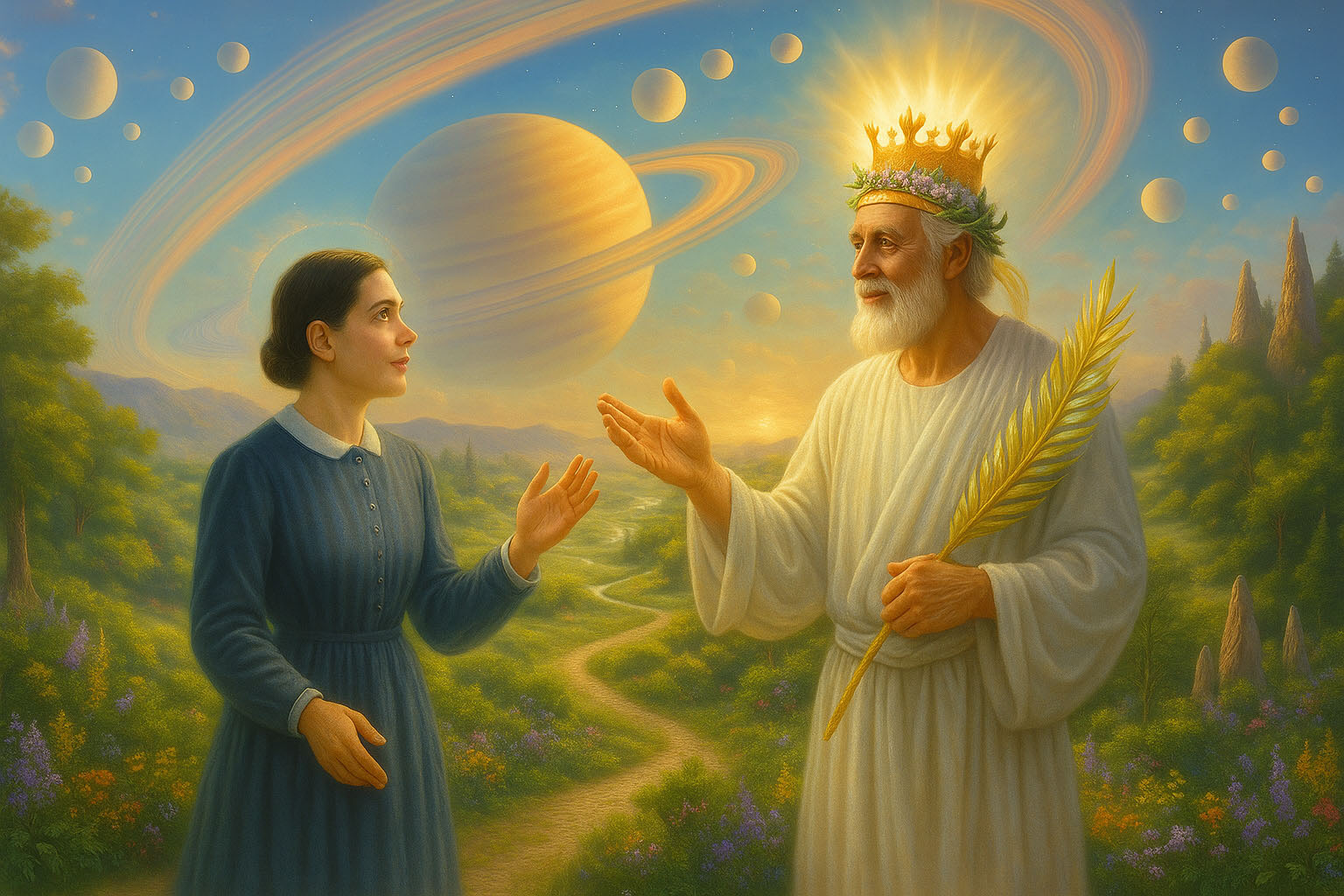
The Lord has given me a view of other worlds. Wings were given me, and an angel attended me from the city to a place that was bright and glorious. The grass of the place was living green, and the birds there warbled a sweet song. The inhabitants of the place were of all sizes, they were noble, majestic and lovely. They bore the express image of Jesus, and their countenances beamed with holy joy, expressive of the freedom and happiness of the place. I asked one of them why they were so much more lovely than those on the earth. The reply was—'we have lived in strict obedience to the commandments of God, and have not fallen by disobedience, like those on the earth.' Then I saw two trees, one looked much like the tree of life in the city. The fruit of both looked beautiful; but of one they could not eat. They had power to eat of both, but were forbidden to eat of one. Then my attending angel said to me—'none in this place have tasted of the forbidden tree; but if they should eat they would fall.' Then I was taken to a world which had seven moons. There I saw good old Enoch.
This appears to be an elongated retelling of her earlier solar system vision. In both there is mention of a "majestic" people, a world free from sin, and an unnamed planet with seven moons. As noted in the quotation at the beginning of the main article, SDA historian A.W. Spalding wrote as if both visions were of the same event. It was not unusual for Mrs. White to write out a vision later with much more detail. If this is truly an elongated version of the original vision, then she is describing meeting "majestic" people on Jupiter, and then seeing Enoch on Saturn — a planet that was believed, at the time, to have seven moons. This interpretation was not invented by critics of Ellen White. It was invented by SDAs! However, when SDAs discovered that Jupiter and Saturn are uninhabitable and do not have a solid surface, they changed their story. They began claiming that Ellen must have seen Enoch on a planet with seven moons in a different vision and Enoch was somewhere else in the universe. How convenient!
The evidence indicates that early Adventists regarded Truesdail as a reliable witness. Ellen White read Loughborough's book and made no known objection to the Truesdail letter. Nearly every point Truesdail made is also made by other eyewitnesses proving they are telling the same story. While memory of recent events can fade with age, often memories from early years remain fixed in the mind. There is no reason whatsoever to doubt Mrs. Truesdail's recollection of this event. Ellen White did not question it, so why should modern SDAs?
Return to Article