
Oysters and Herrings:
Did Mrs. White Practice what She Preached on Diet?
By and , 2008 last updated
Ellen G. White, Letter 93a (1895)
Mrs. White said of her testimonies, "it is God and not an erring mortal who has spoken."1 In a testimony to Elder G.A. Irwin she stated that "those who do not accept the light God has given on health reform...can not represent the truth to others".2 From this statement it is clear — by her own definition — that Mrs. White could not represent the truth to others if she did not follow her own health teachings. This could be taken one step further by asking: If she ignored the light of heaven on meat eating, and thus according to her own testimony could not "represent the truth to others," then how could she hold the position of church prophet — a role whose sole responsibility is to represent the truth to others?
Mrs. White emphasized that eating meat would destroy not only physical and mental health, but also spiritual life. In 1868, she wrote to a meat-eating family to warn them of the terrible danger they were putting their children in.
Your animal propensities have been strengthened, while the intellectual have been weakened. We are composed of that which we eat, and if we subsist largely upon the flesh of dead animals, we shall partake of their nature. You have encouraged the grosser part of your organization, while the more refined has been weakened. ...
Your manner of living has strengthened the animal of your nature, and weakened the spiritual. ... A depraved, stimulating diet is strengthening the animal passions of your children. ...
It is impossible for those who practice the free use of flesh meats to have an unclouded brain, and active intellect. ...
Its [flesh-meat] use excites the animal propensities to increased activity, and strengthens the animal passions. When the animal propensities are increased, the intellectual are decreased. When the animal nature strengthens, the moral grows weaker. The use of the flesh of animals tends to cause a grossness of body, and benumbs the fine sensibilities of the mind. ... The intellectual, the moral and the physical powers are depreciated by the habitual use of flesh-meats. Meat-eating deranges the system, beclouds the intellect, and blunts the moral sensibilities.3
The negative effects of eating meat — spelled out in detail by the prophetess — are as follows:
- Strengthens the animal propensities (appetite, sexual desire, aggression, and impulsiveness)
- Weakens the intellectual propensities (reasoning ability, judgment, conscience, willpower, and self-control)
- Become, in nature, more like an animal
- Encourages one to become grosser in nature (lower appetites and passions)
- Weakens the refined the nature (reason, conscience, and spirituality)
- Strengthens the animal nature (increases the dominance of appetite, passion, and impulse)
- Weakens the spiritual nature
- Strenthens animal passions (the lower desires: appetite, impulse, and sexuality
- Clouds the brain preventing an active intellect
- Intellectual and moral weakness
- Depricates (diminishes) one's physical, intellectual, and moral powers
- Benumbs/Blunts the mind's finer sensitivities (dulling a person’s ability to feel, perceive, and respond to moral and spiritual realities)
This testimony — which the readers believed was coming from heaven — is terrifying in its ramifications. Eating meat animalizes a person and weakens them spiritually. Certainly, of all people, the prophet leading God's last-day people on the narrow path to heaven should not be indulging in something so physically, mentally, morally, and spiritually damaging!
In 1905 Mrs. White wrote:
Is it not time that all should aim to dispense with flesh foods? How can those who are seeking to become pure, refined, and holy, that they may have the companionship of heavenly angels, continue to use as food anything that has so harmful an effect on soul and body?4
Mrs. White said eating meat had a "harmful" effect upon the soul becoming pure, refined, and holy. In this article, evidence will be presented that all the while Mrs. White was the prophetess of the Seventh-day Adventist [SDA] Church, she was secretly "harming her soul" by eating meat.
1863 - I've Stopped Eating Meat!
It all started in June of 1863. Ellen White supposedly received a health reform vision in which she learned it was unhealthy to eat meat, butter, spices, cheese, and other foods and drinks. As early as 1864, she informed her followers that she had stopped using meat almost immediately after her vision:
But since the Lord presented before me, in June, 1863, the subject of meat-eating in relation to health, I have left the use of meat. ... I have lived for nearly one year without meat. ... We have no meat, cake, or any rich food upon our table.5
She clearly stated that she had quit eating meat, had not eaten it for the last year, and it did not appear on her family's table.
Mrs. White's cessation of eating meat in 1863 was immediate: "I at once cut meat out of my bill of fare." However, she then admits "I was at times placed where I was compelled to eat a little meat."6 Does this mean she ate "a little meat" during that first year when she said "I have lived for nearly one year without meat"? And who "compelled" her to eat something so physically, mentally, morally, and spiritually damaging?
Mrs. White wrote to SDA ministers and workers and warned them:
The light which God has given upon health reform cannot be trifled with without injury to those who attempt it; and no man can hope to succeed in the work of God while, by precept and example, he acts in opposition to the light which God has sent. The voice of duty is the voice of God,—an in-born, heaven-sent guide,—and the Lord will not be trifled with upon these subjects. He who disregards the light which God has given in regard to the preservation of health, revolts against his own good, and refuses to obey the One who is working for his best good.
The principles of health reform, right or wrong, which are adopted by him who gives the word of God to others, will have a molding influence upon his work, and upon those with whom he labors. If his principles are wrong, he can and will misrepresent the truth to others...7
This is heavy. The health reform preached by Mrs. White was more than just a rehash of Dr. Jackson's health reforms — it was "light" which God gave to the SDA sect. She was saying, "You don't mess around with light from God." She warned that no SDA worker could hope to succeed if they acted against that light. That means, if Ellen White failed to follow her health reforms, she had no hope of succeeding in her prophetic ministry. Perhaps that is why so many of her followers doubted her. Finally, she said that those who did not follow the health principles, would "misrepresent the truth to others." That is the whole crux of the problem this article will explore. Did Ellen White misrepresent the truth to others for over three decades by defying her own health principles? If so, can she be trusted as a prophet during that period?
1866 - Meat Back on the Table
In February of 1866, Mrs. White reported to her sect how much James was benefiting from their new vegetarian diet:
The reform my husband had made in his diet, previous to his sickness, had a very beneficial influence upon his health. His head was generally free from pain and never felt clearer. By eating no meat...8

Mrs. White presented a public picture of a vegetarian family whose health was blessed by following Ellen's light from heaven on health reform. But what was really happening in private?
In a private letter to Edson in September of the same year, Mrs. White wrote:
Your father is appearing some better. We have killed one wild black squirrel per day. He enjoys it much.9
Eating squirrels in Michigan in the 1860s was considered completely normal. However, the Whites were portraying themselves to their sect as vegetarians with no meat on their table. Not only was meat already back on their table in 1866, it seems as if James' health benefitted from it. Maybe their vegetarian diet was not all it was cracked up to be.
1869 - I've Stopped Eating Meat!
In 1869 Mrs. White insisted she had stopped eating meat and was not cheating:
I have not changed my course a particle since I adopted the health reform. I have not taken one step back since the light from heaven upon this subject first shone upon my pathway. I broke away from everything at once, from meat and butter, and from three meals. ....I left off those things from principle. I took my stand on health reform from principle.10
Mrs. White said her course had not changed by even one particle. In the mid-1800s, a particle was considered the smallest possible unit of matter. By applying it to her "course" (her behavior upon health reform), she is claiming she has not deviated even one percent. She uses this "all-or-nothing" language to project an aura of unwavering consistency in her practice of health reform. Furthermore, Mrs. White said she had "not taken one step back." Is that the honest truth?
The evidence below reveals that Mrs. White deviated more than "a particle" off course. Examine the evidence below to see just how many steps back she really took...
1873 - How About a Little Deer, Duck, and Trout?

Mrs. White claimed to have taken her vegetarian stand in 1863, and yet a decade later she is eating deer, duck, and trout on a trip in the mountains of Colorado:
We expected supplies three days ago certainly, but none has come. Willie went to the lake for water. We heard his gun and found he had shot two ducks. This is really a blessing, for we need something to live upon.11
In reading this report, Willie is on his way down to the lake to fetch water. It seems a little odd that he would be toting a rifle with him on his trip to get water. Perhaps he planned to fetch more than just water. Willie returned with two dead ducks. From this we can gather that it is okay to let the health reform principles slide a little when supplies are short.
In addition to fetching ducks from the lake, the Whites also fetched fish. In her diary, Mrs. White spoke multiple times of her party fishing, catching fish, cooking fish, and "enjoying the trout from the lake."12
The White party also indulged in some deer:

A young man from Nova Scotia had come in from hunting. He had a quarter of deer. ... He gave us a small piece of the meat, which we made into broth. Willie shot a duck which came in a time of need, for our supplies were rapidly diminishing.13
What happened to the stand she had taken upon principle? Apparently there are exceptions to her health rules, at least for herself and her family. Even though Mrs. White deplored the "laxness" of others when it came to obeying her health reforms, she broke the rules herself:
I was at times placed where I was compelled to eat a little meat... When I could not obtain the food I needed, I have sometimes eaten a little meat...14
What does she mean by a little meat? In reading through her diary, there is only brief mention of other foods, like bread, pie, and potatoes. It appears the Whites subsisted on meat during their entire vacation. One day Willie caught fourteen of the "largest trout" Mrs. White had ever seen, and Sister Hall spent all day cooking them.15 Is that a little meat?
1874 - Fish on the Bay
What is a boat ride without some fresh fish? As the Whites sailed across Oakland Bay in 1874, "Brother Chittenden cooked dried corn and fish and made chocolate" for the party to eat.16
1876 - Salmon in Oakland
The White family arrived in Oakland on September 24, 1875. Six months later, James departed for Battle Creek on March 22, 1876, leaving Mrs. White in Oakland with Willie. On April 24, 1876, Mrs. White wrote to James telling him that the family had not had "a particle of meat in the house since you left and long before you left." Given that James left on March 22, this statement implies there were particles of meat in the house during the last six months. It is unknown what particles of meat those were. In the same letter Mrs. White adds, "We have had salmon a few times."17
1876 - Suet?
Back in 1868, Ellen White had eviscerated an SDA couple for defying God by eating animal fat:
You have used the fat of animals which God in his word expressly forbids, and “It shall be a perpetual statute for your generations throughout all your dwellings, that ye eat neither fat nor blood.”18
Whether she realized it or not, this Old Covenant commandment referred to the fat around the organs. Animal fats commonly used in her era were suet (beef) and lard (pork). Mrs. White is clear that this is expressly forbidden in God's law. Did she practice what she prached?
In 1876 Mrs. White wrote the following in a letter to her children:
Food good. I have eaten no cake, but little cheese, but little _____. [This word is not clearly legible in the original handwritten manuscript.]19
In the quote above, the note in brackets is supplied by the White Estate. What is the word that is not clearly legible? Former White Estate associate secretary Ronald Graybill had the opportunity to examine the handwritten document. The mystery word appeared to be "sueit."20 He explains that since Mrs. White often spelled phonetically, she likely meant to write suet. Suet is beef fat. Thus, in 1876 it seems that Mrs. White was eating a little beef fat. Perhaps eating fat that God expressly forbid is acceptable as long as one eats "but little" of the forbidden item.
1878 - Venison for Christmas
Mrs. White told others that temporary lapses in following her health rules indicated a deficiency in Christian experience:
Those who digress occasionally to gratify the taste in eating a fattened turkey or other flesh meats, pervert their appetites... They are controlled by taste, not by principle. ... The lack of stability in regard to the principles of health reform is a true index of their character and their spiritual strength. They are deficient in thoroughness in their Christian experience."21
While she did not permit others to disgress occasionally, her own family appears to have been exempt from that rule also. In 1878, Sister White enjoyed some venison for Christmas:
I suppose you will be interested to know how we spent Christmas... Christmas morning we all took breakfast together--James Cornell; Florence and Clara, their two girls; Brother and Sister Moore and their three children; Sister Bahler and Etta, a girl living with them; and Sister Daniells, our cook, Father, and myself. We had a quarter of venison cooked, and stuffing. It was as tender as a chicken. We all enjoyed it very much. There is plenty of venison in market.22
1878-1879 - Beef: It's What's for Dinner
Getting ill always provided a convenient excuse to partake of some forbidden food item. Since Sister White was frequently ill, this provided her plenty of opportunity. Once while seasick on a boat trip, Mrs. White partook of some beef tea:
I remained on deck until dark, and then went into the cabin, where the pitching of the boat made me very sick. This was on Monday, and I was unable to sit up from that time until Thursday morning, taking but once during that time a little beef tea and cracker.23
In that era, beef tea was considered a health tonic by some, including Florence Nightingale. It was made by chopping lean rump steak into tiny pieces, placing it in a jar with a little water, and simmering it for several hours. It produced a red liquid called myoglobin. It was basically a "blood transfusion by mouth." This is quite astonishing because earlier in this article it was noted that Mrs. White quoted Levitical verses against the eating of animal fat. Those same verses forbid the eating of blood. Ironically, while eating fat is never forbidden in the New Testament, eating blood is (Acts 15:20).
In 1879, Mrs. White wrote again about eating "a few spoonfuls of beef tea."24
1880 - Chicken to Go, Please...
Mrs. White had still not given up eating meat by 1880. The following is an excerpt from a letter she wrote to her sister Elizabeth while traveling:
At eight o'clock we took a portion of the pressed chicken food liberally furnished us by the matron of the sanitarium, put the same in a two-quart pail, and placed it on the stove, and thus we had good hot chicken broth and enjoyed our breakfast. The morning was very cold and this hot dish was very palatable. ... We have plenty of room, good food and plenty of it. Sister McComber scalded up the chicken. Will scald the meat tomorrow morning.25
There appears to have been ample food available at the Sanitarium, yet Sister White ate chicken that was furnished by the Matron of the Sanitarium. Then, she took the pressed chicken with her on her trip and ate it in the train for breakfast: "We again made a nice hot broth of our pressed chicken." "This morning was exceedingly cold but with our hot chicken soup we were excellently provided for."26
Certainly Mrs. White could have planned a vegetarian diet for this trip. This was her fifteenth trip on this route so she knew exactly what to expect. Yet while she indulged in meals of chicken, she advised her followers who were contemplating this journey to "take your lunch baskets with you, well filled with fruits and plainly cooked bread."27 No, they were not permitted to violate the health reform principles and enjoy a little "palatable" chicken. They must follow the health reform and subsist on bread and fruit!
1882 - Oysters and Herrings
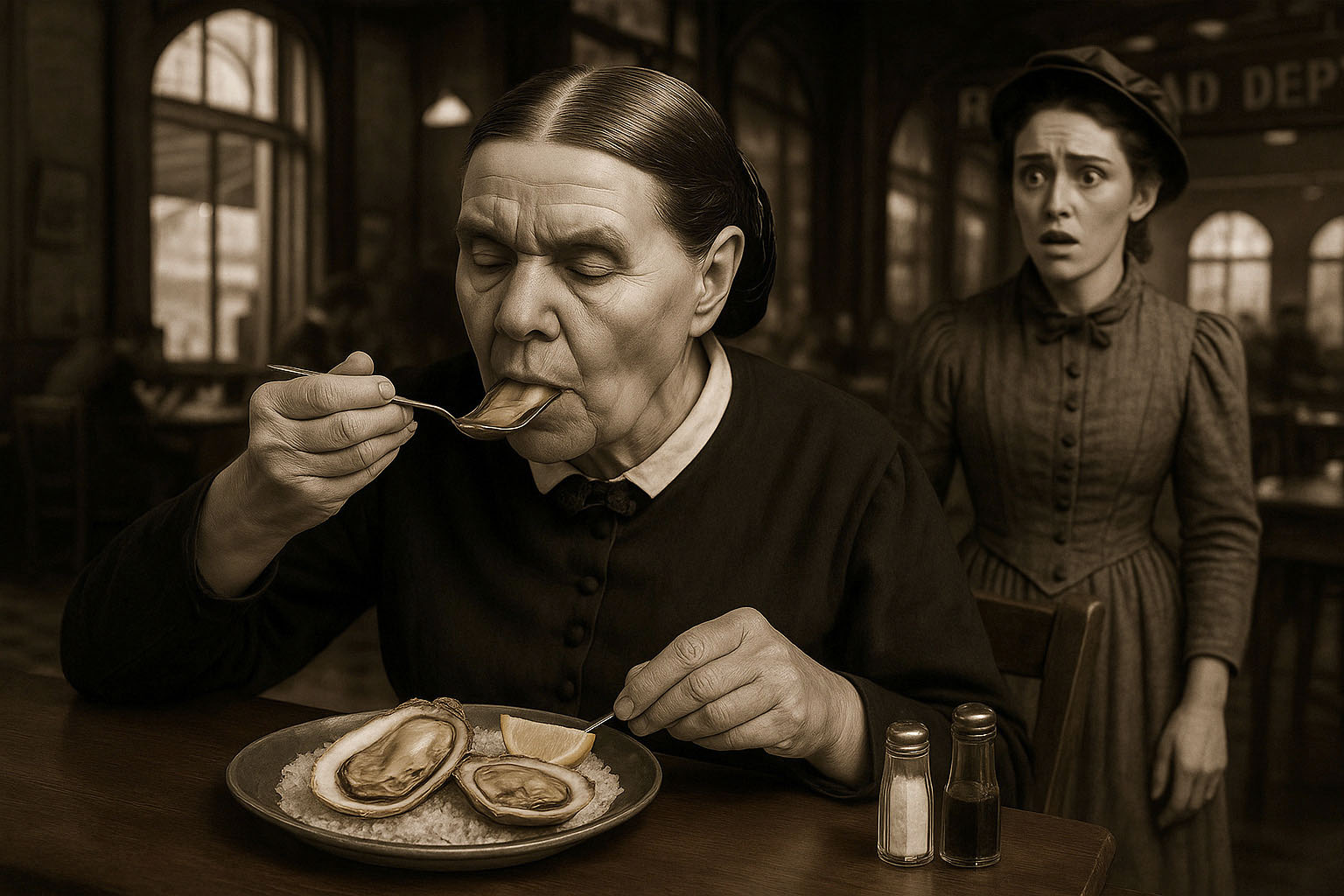
Some find it difficult to believe that Sister White actually ate oysters because her testimonies denigrate those who eat them:
His stronghold seems to be giving way; his hitherto brave heart is growing weak. He is invited to accompany them for a walk, and they lead him to a saloon. Oysters or other refreshments are called for, and he is ashamed to draw away and refuse the treat.28
Mrs. White was still privately eating unclean meat a full thirteen years after her public commitment. In this 1882 excerpt from a letter to her daughter-in-law, Mary Kelsey White, Ellen expresses her fondness for herring and oysters:
Mary, if you can get me a good box of herrings - fresh ones - please do so. These last ones that Willie got are bitter and old. If you can buy cans, say (a) half dozen cans of good tomatoes, please do so. We shall need them. If you can get a few cans of good oysters, get them.29
It seems that this was not a one-time purchase, because Mrs. White refers to Willie's prior purchase of herrings. This letter lends credence to Fannie Bolton's claim below that Ellen White ate oysters.
1884-1891 - Oysters, Beef Steak, Chicken, Fish, Fowl, and Shrimp
In January of 1884, Mrs. White was at the SDA health retreat in St. Helena, California. This was two decades after Mrs. White published her health teachings and her dire warnings about eating meat. The entire purpose of this health retreat was to teach people the SDA sect's health principles, including vegetarianism. Ubelievably, Mrs. White wrote in a private letter that she ate more than a particle of meat while at the retreat:
Meat seldom appears on my table, for weeks at a time I would not taste it, and after my appetite had been trained, I grew stronger and could do better work. When I came to the Retreat, I determined not to taste meat, but I could get scarcely anything else to eat, and therefore ate a little meat. ... The use of meat, while at the Retreat awakened the old appetite, and after I returned home, it clamored for indulgence. Then I resolved to change entirely, and not under any circumstances eat meat and thus encourage this appetite. Not a morsel of meat or butter has been on my table since I returned.30
It's difficult to believe that Ellen White could scarcely find anything else to eat besides meat at this SDA health institution that taught vegetarian principles.
Regardless, notice that she does not say meat never appears on her table. She says it seldom appears, which means she has made more than a particle of deviation from her health reforms.
She does not say she has abstained for years at a time, or months at a time. She has only abstained for weeks at a time.
Finally, her gorging on meat at the retreat seems to have inflamed her appetite for it. But she assures her readers that she has not had a morsel of meat or butter since she left the retreat. Is that true?
Fannie Bolton was Ellen White's secretary and book author. For seven years she worked closely with Sister White in the United States and Australia, often travelling with her. Ms. Bolton reveals the disturbing hypocrisy of Mrs. White on diet:
I was only a simple hearted girl then with the curls down my back, and had been brought up in a truly spiritual home life and I had no idea of duplicity in this, much less in those I truly believed to be the messengers of God.
I left to go with Sr. White on the very day when my brother was to be married. At the depot Sr. White was not with her party, so Eld. Starr hunted around till he found her behind a screen in the restaurant very gratified in eating big white raw oysters with vinegar, pepper and salt. I was overwhelmed by this inconsistency and dumb with horror. Eld. Starr hurried me out and made all sorts of excuses and justifications of Sr. White’s action; yet I kept thinking in my heart, “What does it mean? What has God said? How does she dare eat these abominations?”
On the cars out to California, W. C. White came into the train with a great thick piece of bloody beefsteak spread out on a brown paper and he bore it through the tourist car on his two hands. Sarah McEnterfer who is now with Sr. White as her attendant, cooked it on a small oil stove and everyone ate of it except myself and Marian Davis who I found out afterwards was more the author of the books purported to be Sr. White’s than she was herself.
I was with Mrs. White for seven and a half years like a soul on a rock, because of all kinds of inconsistencies, injustices and chicaneries. I have seen Sr. White eat meat, chicken, fish, fowl, shrimps, rich cake, pies, etc., etc. I cannot go into detail but Sr. Daniells told me she herself had cooked meat for Sr. White on the camp ground. Eld. Horn told me his wife had done the same thing. Sr. Rousseau told me that she too had done so. Dear sister, Sr. White has written that when we do not live up to the testimonies we retract them. She has vitiated [made lifeless] her own claims.31
Ms. Bolton made a remarkably astute observation. Ellen White demolished her own prophetic claims by her duplicitous behavior.
W.C. White later denied Ms. Bolton's oyster story. However, he was not in the restaurant at the time. He did, however, admit to buying a bloody beefsteak which was eaten by Sister White and those with her on the train. He claimed it was eaten because "provisions were low" and "fruit was very expensive." He admitted that when it came to meat, the White family were not "teetotalers" and they ate "flesh meats on long journeys and on camp meeting expeditions."32
Willie's excuse is hardly believable. While fruit may have been difficult to obtain, alternatives did exist. Trains and railway stops in America during that era carried vegetarian foods, such as bread, grains, crackers, dried fruit, and nuts. Those who took health reform seriously would pre-pack vegetarian food for their journey. Willie's excuse is weak, at best. The truth is that — following the prophet's example — they were accustomed to using travel as an excuse to gorge on meat.
1886 - More Meat Whilst Traveling
In 1886, while traveling by sea, Mrs. White complained about the quality of the "meat" served to them by the ship's restaurant, saying it was "dry and tough and tasteless."33 In the same letter she wrote about how excellent the restaurant's tomatoes were. This demonstrates that there were vegetarian alternatives available on the boat. Boats in the 1880s served a variety of vegetarian food, including bread, potatoes, rice, and oatmeal. While meat may have been the main course, a person determined to eat a vegetarian diet could do so.
1887 - What's a Camp-Meeting without Chicken?
According to Dr. John Kellogg, Mrs. White celebrated her return from Europe in 1887 with "a large baked fish." When she visited the Battle Creek Sanitarium over the next several years, she "always called for meat and usually fried chicken," much to the consternation of Kellogg and the cook who were both vegetarians.34
At the various camp meetings she attended, her lax dietary habits became common knowledge, thanks in no small part to her own children. Kellogg recalled once hearing Edson (J.E.) White standing in front of his mother's tent calling out to a meat wagon that regularly visited the grounds:
"Say, hello there! Have you any fresh fish?"
"No," was his reply.
"Have you got any fresh chicken?"
Again the answer was "no," and J.E. bawled out in a very loud voice, "Mother wants some chicken. You had better get some quick."35
Years after his mother's death, Willie told of her difficulty in giving up meat. All the while she told other SDA parents to keep meat away from their children so that they would not become corrupted or animalized, Willie described his mother's difficulty in finding vegetarian cooks, and of lunch baskets filled with turkey, chicken, and tinned tongue.36
1890 - More Oysters!
According to Leviticus 11:10, anything from the waters without fins or scales is "unclean." In addition, oysters have long been considered an aphrodisiac. Surely James White must have recognized this because in 1870, he lambasted those who ate oysters:
What kinds of edibles command the highest price in the market? Those that stimulate this passion, and because they create impure desires. What mean those oyster stews, and crab parties, and terrapin soups, and squab suppers, wild fowls, cloves, and a host of other like things? Eaten, in many instances in high (?low) life, expressly to beget unhallowed desires! Oh! shame, where is thy blush! Do you want more proof? Behold the fertile South. But particulars are too revolting, both as regards the beastly indulgence of whites with blacks, and the number of rakes [immoral men] and harlots among the latter! Our world is literally FULL of sensuality!38
James blasted those who ate oysters because of their supposed power to stimulate "sensual desires" — a huge risk for SDAs trying to preserve their vital force. Yet surprisingly, his own wife fostered a love for these forbidden, unclean creatures. In 1907, SDA physician Dr. Charles Stewart wrote a letter to Mrs. White questioning why she ate oysters:
Three parties, all Seventh-day Adventists, two of them officially connected with the denomination, state for a number of years after you received the light on health reform, that you ate meat and oysters. Two of these persons within the past ninety days told me personally that you ate oysters in their own home, on one occasion as late as 1890. Another stated that he saw you eating oysters in a restaurant.If you deny that you ate oysters and state that the statements of these two men are false, I will make an affidavit to this statement and give you the names of the two persons referred to so that they can be asked for an explanation.39
Mrs. White never denied the statements of the two men who saw her eating oysters. The fact that two other people besides Fannie Bolton witnessed Mrs. White eating oysters lends credence to Bolton's earlier eyewitness testimony.
1891 - Trout Again
In 1891, it seems Mrs. White was eating fish with some regularity:
I wish you could sit down to our good baked trout today. We had a fish last week, nicely stuffed. It was the nicest I have ever eaten. We have another today.40
1894 - 25 Years After Her 1869 Pledge
Mrs. White admits putting meat on her table in Australia, but it was in 1894 that Mrs. White finally gave up meat eating at the insistence of an Australian Catholic woman!
I have a large family, which often numbers sixteen. In it there are men who work at the plough, and who fell trees. These have most vigorous exercise, but not a particle of the flesh of animals on our table. Meat has not been used by us since the Brighton (Australia) Campmeeting (January, 1894). It was not my purpose to have it on my table at any time, but urgent pleas were made that such a one was unable to eat this or that, and that his stomach could take care of meat better than it could anything else. Thus I was enticed to place it on my table. The use of cheese also began to creep in, because some like cheese; but I soon controlled that. But when the selfishness of taking the lives of animals to gratify a perverted taste was presented to me by a Catholic woman, kneeling at my feet, I felt ashamed and distressed. I saw it in a new light, and I said, I will no longer patronize the butchers. I will not have the flesh of corpses on my table.41
Apparently her vision and her heavenly communications with "angels" were not enough to convince Mrs. White to give up meat. It took a Catholic woman begging her to give up meat on the basis that it was wrong to take the lives of animals! It makes one wonder how much confidence she had in her own visions!
1894 - Switched to Fish

In 1896, Ellen White wrote a letter indicating that more than three decades after her spirit guides informed her that it was wrong to eat meat, she finally came to the same conclusion. So what did she do? She explained to her niece that she had switched over to eating fish!
Two years ago [1894] I came to the conclusion that there was danger in using the flesh of dead animals, and since then I have not used meat at all. It is never placed on my table. I use fish when I can get it. We can get beautiful fish from the saltwater lake near here. I use neither tea nor coffee. As I labor against these things, I cannot but practice that which I know to be best for health, and my family are all in perfect harmony with me.42
In 1895, she wrote to Willie asking him to "please get us dried codfish and dried fish of any description" for her and her workmen.43 In 1896, while in Colorado, she wrote of eating "raspberry pies" and "mountain trout."44
Conclusion
Mrs. White did not merely fall short of her own standard—she contradicted it, repeatedly, publicly, and over decades. This was not a momentary lapse, nor an isolated incident forced by necessity. It was a pattern. While warning others that meat would corrupt the body, defile the soul, and disqualify them from representing truth, she herself indulged in the very practices she condemned.
By her own definition, those who “digress” from health reform are “controlled by taste, not by principle,” and are “deficient” in spiritual strength. If that standard is applied honestly, it does not vindicate her—it indicts her. A prophet who excuses in herself what she condemns in others is not clarifying truth—she is obscuring it. A messenger who claims heavenly light while walking in contradiction to it does not strengthen confidence—she destroys it. The evidence is overwhelming.
In the end, the question is unavoidable: If Mrs. White could not live by the light she claimed was from heaven, why should anyone believe that light came from heaven at all?

Mrs. White and Butter
It was noted at the start of this article that Mrs. White said that she had given up eating butter in 1869. In a letter to her son written May 25, 1869, Mrs. White encourages Edson to follow her "strict" example in giving up meat and butter:
We have in diet been strict to follow the light the Lord has given us. You are acquainted with that light, and we trust you will have the fear of the Lord continually before you and will respect the light He has given and be no less strict than we have been. We have advised you not to eat butter or meat. We have not had it on our table. ... All know that we do not put butter on our table. If they see you, our son, eat the things we have condemned, you weaken our influence and lower yourself in their estimation.45
She further stated in 1870:46
No butter or flesh-meats of any kind come on my table.
Again, “Sr. White, ... We heard you ate meat, butter, and cheese. All these things you had condemned we heard were upon your table again.” I told them I had not swerved from my principles of health reform. Butter was not placed upon my table for my family, neither for visitors.
In 1872, she and James bore positive testimony against it:
We bear positive testimony against...butter...47
By 1873, however, they started eating butter again in the Rocky Mountains because they felt it "was less detrimental to health than the use of much salt or sugar."48
In 1874, it appears Ellen and James finally stopped using butter entirely. She wrote the following to her son Willie:
Your father and I have dropped milk, cream, butter, sugar, and meat entirely since we came to California.49
However, later in the same year she admitted in a letter to her son Edson and his wife Emma, "I occasionally ate a little butter in California," but in the same letter she warns them: "You may both venture to indulge your taste and enjoy your butter and fleshmeats, but remember you are sinning against God."50 In other words, "Do as I say, not as I do!"
In 1878, it appears she was back to eating butter again. She asked her son Willie to send her "at least ten pounds when Brother King comes."51
In 1884, she said, "I eat no meat, no butter" and in 1885 she published a testimony stating that no "butter or flesh meats of any kind come on my table;" however, later in 1885, while in Sweden, she admitted taking "bread and butter" to eat at a public meeting, and in Switzerland the following year, she wrote of eating "baker’s bread, hot milk, fresh butter, and a dish of sauce," and while staying at a hotel in England, she mentions purchasing "English thin-sliced bread, buttered as usual."52
In 1889 she claimed, "I do not use butter myself," but in 1890, she picked up some "butter" from Dr. Lay's son-in-law, presumably for eating, but in 1894, she claimed: "We use neither butter nor meat."53
In 1895, though claiming butter was not on her table, she mentions using butter "for cooking purposes":
We purchase butter for cooking purposes from dairies where the cows are in healthy condition, and have good pasture.54
Perhaps cooking somehow makes it less sinful to use butter.
In May of 1901, Ellen White wrote that butter "should not be placed on the table" at SDA sanitariums but at some point it seems that God had changed His mind on butter, because Sister White sent out a testimony taking butter off the banned list:
When the time comes that it is no longer safe to use milk, cream, butter, and eggs, God will reveal this... No extremes in health reform are to be advocated. The question of using milk and butter and eggs will work out its own problem. At present we have no burden on this line.55
Perhaps that time came — when it was no longer safe to use butter — in 1903. 34 years after she supposedly received instruction to stop eating butter, Mrs. White claimed she had finally stopped eating butter:
As for myself, I have settled the butter question. I do not use it.56
Despite that claim, it appears she was eating butter again the very next year in 1904. E.S. Ballenger, a former SDA minister, wrote of Mrs. White contradicting her 1872 testimony against butter:
Mrs. White did not follow her own testimonies. She ate butter at my table 32 years after giving this definite instruction...57
By 1905, after years of taking butter off the table but still cooking with it, she wrote just the opposite advice:
Butter is less harmful when eaten on cold bread than when used in cooking; but, as a rule, it is better to dispense with it altogether.58
In 1907, she said "we have neither meat nor butter on our table," but Seventh-day Adventist corporate president A.G. Daniels, who knew Mrs. White for over 40 years, stated in 1919:59
I have eaten pounds of butter at her table myself, and dozens of eggs. I could not explain that in her own family if I believe that she believed those were the Lord's own words to the world.
The historical record shows Ellen White had more than a “particle” of deviation. It is a documented pattern—repeated, sustained, and often concealed. Publicly, Mrs. White spoke with absolute authority, condemning butter consumption. Privately, she made exceptions for herself and her family.
If her own standard is applied, then her repeated violations disqualify her from the very role she claimed to hold. A prophet who cannot “represent the truth” by her own definition cannot be a prophet of truth at all.
The issue, then, is not butter. It is credibility. It is authority. It is whether the voice claiming to speak for God can be trusted when the evidence shows a persistent gap between proclamation and practice. When the standard she imposed on others is turned back upon her, the conclusion becomes unavoidable: the authority collapses under its own weight. Mrs. White did not merely fail to live up to her health reform—she undermined the very foundation of her prophetic claims.
Mrs. White and Pepper
Mrs. White wrote many statements against the use of stimulants such as pepper. Many SDAs heeded what they thought to be inspired counsel and took black pepper off their tables. In 1868, the prophetess complained that some SDAs were not obeying the "truths" they heard from her about pepper:
People worry and work and gratify the taste and eat pepper, spice and meat and then are sick. Oh, dear! What will move them to act out the truths they have heard?60
In 1883, she instructed the SDA sect:
Food should be prepared in as simple a manner as possible, free from condiments and spices...61
In a sermon in 1886 she said that "pepper and mustard...should not be put into the human stomach."62 Finally, in 1905, she wrote:
Mustard, pepper, spices, pickles, and other things of a like character, irritate the stomach and make the blood feverish and impure.63
Thus, Mrs. White's teachings on pepper can be summarized as follows:
- Pepper is a substance contributing to sickness
- Food should be prepared free of pepper
- Pepper should not be put into the human stomach
- Petter irritates the stomach, making the blood feverish and impure
Did Mrs. White practice what she preached on pepper? In 1863, after her health reform vision the Whites apparently discarded the use of pepper. In 1873, Mrs. White wrote that she had not had "a particle of pepper in the house for ten years."64 However, in the same letter she admitted that she asked her servant to go shopping and get her "a little pinch of pepper" for her beans. Of course, she claimed this violation of her rules was acceptable for health reasons, to "perhaps prevent them from causing me to have the colic."
In 1877, despite saying earlier that pepper makes people sick and their blood impure, she "prepared a cup of weak red pepper tea" for her ailing husband.65 As noted above, in the 1880s, Mrs. White was observed by Fannie Bolton at a restaurant having pepper on her oysters. Finally, in 1905, the same year she published a statement about peppers making the blood feverish and impure, she was in "severe pain" and "called for cayenne pepper."66
In addition, for decades she frequently used and prescribed to others a health tonic that contained cubebs, a pepper similar to black pepper (see Ellen White's Secret Stash). This evidence shows that Mrs. White routinely introduced peppers into her stomach while telling others pepper should never enter the human stomach.
Mrs. White on Cheese: Does Never Mean Never?

In 1868, Mrs. White wrote: "Cheese should never be introduced into the system."67 As noted above, when asked about eating cheese, she denied it in 1870.46
What does the historical record tell us?
In 1873, she admitted eating "a small bit of cheese, as we do sometimes when it is passed to us."68 Apparently, "never" eating cheese gets an exemption when the cheese is passed to you.
In 1876, while travelling, she wrote of having "cheese" in her lunch pail.69 Once again, travelling appears to have exempted the Whites from all dietary rules. She also admitted in 1876 to eating a "little cheese."19 Once again, eating a "little" must have allowed her to bypass her dietary laws.
In 1885, she wrote of having cheese for breakfast in Sweeden.70
In 1890, she wrote of having a breakfast which included "dutch cheese."71
In 1896, she admitted that "the use of cheese also began to creep" onto her table.41 This is a direct contradiction of a statement she wrote four years earlier:
Many a mother sets a table that is a snare to her family. Flesh-meats, butter, cheese, rich pastry, spiced foods, and condiments are freely partaken of by both old and young. These things do their work in deranging the stomach, exciting the nerves, and enfeebling the intellect. The blood-making organs cannot convert such things into good blood. ... The effect of cheese is deleterious. ... The mother should study to set a simple yet nutritious diet before her family.72
If cheese deranged the stomach and enfeebled the intellect, why did she allow it on her table when telling other mothers to keep it off their tables?
In 1901, she admitted having "tasted cheese once or twice," including while at Minneapolis.73
Did Mrs. White Believe Her Own Testimonies?
After reviewing this evidence it is now painfully obvious that Mrs. White failed to follow the very health principles that she claimed to have received from God and insisted others follow. Her health practices were clearly not in line with her health teachings. She either chose to disobey the instruction of God, or perhaps she did not follow her testimonies because they did not come from God at all, but from the writings of other health reformers.
There can be no doubt Mrs. White claimed her insight on meat came straight from her visions:
It was at the house of Brother A. Hilliard, at Otsego, Michigan, June 6, 1863, that the great subject of health reform was opened before me in vision.74
The following statements leave no doubt about her stance on meat-eating:
I do not preach one thing and practice another. I do not present to my hearers rules of life for them to follow while I make an exception in my own case...75
Above all things, we should not with our pens advocate positions that we do not put to a practical test in our own families, upon our own tables. This is a dissimulation, a species of hypocrisy.76
Mrs. White even went so far as to condemn those who ate meat as being unfit for God's service:
No man should be set apart as a teacher of the people while his own teaching or example contradicts the testimony God has given His servants to bear in regard to diet . . . His disregard of health reform unfits him to stand as the Lord's messenger...77
Can we possibly have confidence in ministers who, at tables where flesh meat is served, join with others in eating it?78
There are ministers who in their habits of eating have wholly disregarded the light God has given His people on health reform. Their self-indulgence has weakened their piety and diseased their spirituality. They have set the church members an example of intemperance in eating and drinking...79
Let not any of our ministers set an evil example in the eating of flesh meat. Let them and their families live up to the light of health reform. Let not our ministers animalize their own nature and the nature of their children.80
Jesus had something to say about hypocrites who placed burdensome requirements on others while not obeying those requirements themselves:
...for they say, and do not. For they bind heavy burdens and grievous to be borne, and lay them on men's shoulders; but they themselves will not move them with one of their fingers (Matthew 23:3-4 KJV).
Dietary Hypocrisy
After examining the historical record, the reader must grapple with Mrs. White’s own words. She did not present dietary reform as optional, progressive, or situational. She framed it as a rigid moral absolute—one tied directly to spiritual purity, the indwelling of the Holy Spirit, and even readiness for heaven itself.
If ever there was a time when the diet should be of the most simple kind, it is now. Meat should not be placed before our children. Its influence is to excite and strengthen the lower passions, and has a tendency to deaden the moral powers. Grains and fruits prepared free from grease, and in as natural a condition as possible, should be the food for the tables of all who claim to be preparing for translation to heaven.81
You should be teaching your children. You should be instructing them how to shun the vices and corruption's of this age. Instead of this, many are studying how to get something good to eat. You place upon your tables butter, eggs, and meat and then your children partake of them. They are fed with the very things that will excite their animal passions, and then you come to meeting and ask God to bless and save your children. How high do your prayers go?82
Those who have received instruction regarding the evils of the use of flesh foods...will not continue to indulge their appetite for food that they know to be unhealthful. God demands that the appetites be cleansed, and that self-denial be practiced in regard to those things which are not good. This is a work that will have to be done before His people can stand before Him a perfected people.83
Spend no more money for flesh meat. Every penny expended for tea, coffee, and meats is worse than wasted; for these things injure the physical, mental, and moral powers, greatly clogging and impeding the delicate, living machinery which God has given us for the advancement of His appointed work. To indulge appetite is to work against God.84
No man can become a successful workman in spiritual things until he observes strict temperance in his dietetic habits. God cannot let His Holy Spirit rest upon those who, while they know how they should eat for health, persist in a course that will enfeeble mind and body.85
If Ellen White gave her children meat and butter, then how high did her prayers go?
If she spent money on meat, was she "working against God" while claiming to be the prophet of God?
If God “cannot let His Holy Spirit rest” upon those who knowingly disregard these dietary laws, then what about Ellen White? What spirit was resting upon her for decades while she knowingly disregarded her dietary laws?
The issue is not isolated incidents or difficult travel conditions. It is the collision between her absolute claims and her behavior. Mrs. White declared that meat-eating corrupted the soul, disqualified believers from spiritual service, hindered prayer, and prevented readiness for heaven—yet she herself practiced the very habits she condemned.
By her own standard, the implications are unavoidable. Either her teachings on diet were unreliable, or her personal conduct disqualifies her from prophetic authority. There is no third option.
A true prophet does not bind the conscience of others with divine authority while privately granting themselves exceptions. When the messenger fails their own test—repeatedly and over decades—the message itself must be called into question.