
Edson's Cornfield “Vision:”
Frisson or Figment?
By , Adventist Currents, July
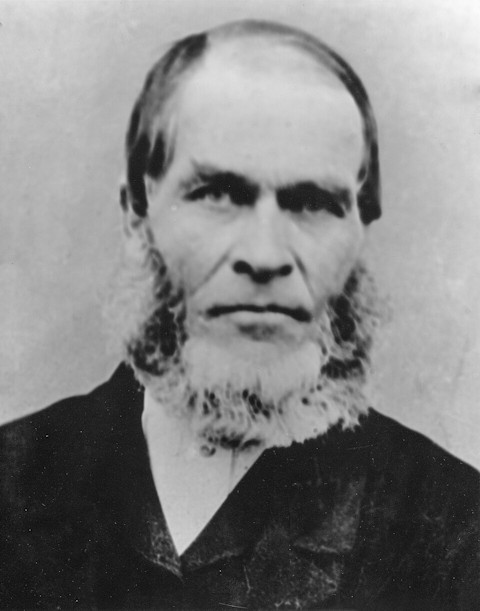
Two recent works have cast some doubt on the reliability of Hiram Edson's autobiographical manuscript relating his experience of October 23, the morrow of the final (1844) Millerite disappointment.1
- The document was written decades after the disappointment and shortly before Edson's death in 1882 at 75 years of age.2
- It did not surface until long after its composition.3
- The manuscript is casually handwritten on the half leaves of a lined yellow notebook, and is neither dated nor signed. Only five pages of the document are extant.
- The text is partially quoted in print for the first time in a 1921 Review and Herald article,4 75 years after the supposed experience it related; however, correspondence about it was exchanged with A.W. Spalding in 1907.5
- Although J.N. Loughborough alludes to Edson's cornfield experience in his two books6 and in a manuscript accompanying the second volume,7 he does not quote the Edson manuscript; and his version of the event differs substantially from Edson's.8
Historians tend to frown on the argumentum ad silentio — an historical deduction based on the absence of available evidence — and for legitimate reasons. Yet, in this case the ubiquitous silence of early publications of this alleged vision is deafening. It acquires particular weight if one takes into account the attitudes that were prevalent before and after the disappointment among the left-wing9 Millerites who later became Seventh-day Adventists. The abundance of supernatural experiences in that period, and the authority attributed to them for the legitimation of specific theological interpretations of contemporary events, has already been adequately documented.10
If Edson had really experienced what he later described, we would find evidence of it somewhere in contemporary or subsequent publications, at least among those for whom it had authenticating value. One needs only observe the use that has been made of it recently in SDA apologetics to realize that the early Sabbatarian Adventists would not have ignored it had they known of the experience. Edson's associates in western New York, O.R.L. Crosier and Dr. F.B. Hahn — whose joint efforts resulted in the publishing of the Day Dawn, their individual articles in the Day Star (directly related to the subject of the "vision"), and in many other papers of the period11 never alluded to Edson's cornfield revelation. Nor did the major figures of Sabbatarian Adventism, including Edson himself, ever refer to his experience in letters, articles, pamphlets or books published before 1892.
Professor P. Gerard Damsteegt, whose approach to writing history (Foundations of the Seventh-day Adventist Message and Mission) clearly betrays his loyalties, finds comfort in using Edson's late-life memory statement as a source because it "does not contradict 1845 source material."12 Let us not forget that it benefits from nearly 50 years of hindsight. But a more careful study shows that Edson's lack of historical perspective led him to inconsistencies. Any evaluation of Damsteegt's work as a whole must keep in mind the method generally used in writing denominational history, in which retrospective statements are given equal weight with primary sources.13 And although this historical research is outstanding in its exhaustive analysis of all pertinent sources, it is marred by a definite apologetic bent. We noted at the beginning of this article that the Edson manuscript reflects later influences, and Damsteegt candidly concedes that possibility.14
The same historian cites only a few sources immediately following the disappointment as confirmations that Edson may have been the original contributor to the emerging "sanctuary" doctrine and other contemporary ideas, but an examination of these sources shows dependence on antecedent thinking stemming from other writers in 1845.
Edson Made No Meaningful Contribution to Adventist Doctrinal Development
Edson's letter to S.S. Snow (dated May 3, 1845, and published in the Jubilee Standard) is such a source. In this document, Edson portrays that time as "the dispensation of the fullness of times" and as the time of the "blotting out of sins." This item would be significant were it not for the fact that his remark followed by at least two weeks the first major article by his close friend and neighbor, O.R.L. Crosier, which related the conclusions of his recent study of atonement typology.15 Crozier attributed his new ideas to recent thinking; and he sent it to Brother Pearson, co-editor of the Hope of Israel, whom he credited with stimulating his mind to a new chain of evidence. He nowhere suggested that Edson give him a lead. We can be fairly certain that Crosier's insights were developed between March 8 and April 4, since his article "Prophetic Day and Hour" (Voice of Truth and Glad Tidings, March 8, 1845)16 contained nothing but strange speculations on various "watches of the night" connected with the parable of the virgins; and was in no way oriented toward the study of seasonal types, or sacrificial symbolism, as subsequent articles overwhelmingly tended to be.
Moreover, there is no absolute certainty that at that time Edson understood the "blotting out of sins" in terms of sacrificial atonement, as did later Seventh-day Adventists. He merely may have been quoting the phrase from the book of Acts (3:19-20) where it is linked with the expected return of Christ. We have no way of assuming that Edson's understanding of the "dispensation of the fullness of times" differed in any form from that of J.D. Pickands on February 12, 1845;17 or from the editorial, "The Types," of October 11, 1844.18 The same expression was used by early Adventists to designate the period following the disappointment; but it was Crosier who identified it for the first time with the antitypical Day of Atonement in his article of February 1846 in the Day Star Extra. And he presented the discourse of Peter on Pentecost as a proof text for this association.19
There is no need to postulate Edson's "vision" as a necessary prelude to his letter to Snow. Its roots are perfectly identifiable in the writing of his immediate contemporaries. So are the roots of Crosier's thinking. It is not unlikely that he found the impetus for his revised conception of the atonement in William Miller's letter to Holmes (dated November 22, 1844), as was suggested by Merwin R. Thurber in a 1976 Review and Herald article.20 But the immediate stimulus for this typology was already present in the Advent Mirror, the Hope of Israel and the Hope Within the Veil.21 Crosier's only originality consisted in his systematization of seasonal types, in his extension of the length of the antitypical Day of Atonement to more than one day or one year, in his highly controversial interpretation of the goat for Azazel, and finally in his veiled substantiation of the shut door doctrine through this typology. Nowhere does Crosier credit Edson for these ideas. When Crosier gave up his doctrine of the sanctuary, he easily could have made Edson his scapegoat had it been inspired by him. He did not.22 He did not even mention Edson in his major autobiographical article written in 1913, although he entered into some detail about the disappointment era.23
Doubts about Edson's Letter
The admitted contradictions between Edson's manuscript and Loughborough's recounting of the experience clearly show that Edson, late in life, wrote much into the original experience. This is typical of the apocryphal elaborations of all pious records. Apocryphal elaborations are often added after the facts and may stem from very noble intentions.
In Loughborough's report, Edson's experience is merely described as "an impression,"24 and its content is limited to the notion that "the Sanctuary is in Heaven." But what need would there be for such a revelation to a generation of predisappointment Millerites who already assumed the existence of such a sanctuary in heaven, from which their heavenly high priest would emerge on the fateful day of October 22, 1844? The very choice of that date shows their prediction was tied to the completion of the atonement.25 In the manuscript that accompanies Loughborough's book, the impression became the semblance of a "distinctly spoken audible voice;" and the added feature of "cleansing" the heavenly sanctuary was recorded.26 Loughborough's letter to Spalding, 13 years later, combined that almost distinct audible impression with the almost distinct audible voice, and recorded the cleansing to be done by Jesus' going into the sanctuary.
In Edson's own manuscript it had evolved into a full-fledged vision incorporating all previous human discovery as part of the total experience:
Heaven seemed open to my view, and I saw distinctly and clearly that instead of our High Priest coming out of the Most Holy of the heavenly sanctuary to come to this earth on the tenth day of the seventh month, at the end of the 2300 days, He for the first time entered on that day the second apartment of that sanctuary; and that He had a work to perform in the most holy before coming to this earth. That He came to the marriage at that time; in other words, to the Ancient of days to receive a kingdom, dominion and glory; and we must wait for His return from the wedding; and my mind was directed to the tenth chapter of Revelation where I could see the vision had spoken and did not lie; the seventh angel had begun to sound; we had eaten the little book; it had been sweet in our mouth, and it had now become bitter in our belly, embittering our whole being. That we must prophesy again, etc., and that when the seventh angel began to sound, the temple of God was opened in heaven, and there was seen in his temple the ark of his testament, etc." 27
The abundance of conjunctions of coordination and subordination which have been underlined [in the paper version], together with elaborate interpretations of things seen, render this description of the "vision" highly suspect. It has all the earmarks of reasoned theology and the details of accumulated discussion. It reflects retrospective elaborations of the ideas advanced. The early believers in the "Bridegroom come-Atonement made" theory did not foresee an extension of the heavenly Yom Kippur beyond one day, but extended it to one year when new time-settings failed. Not until April 1845 did anyone prolong the work of Atonement beyond a year.28
It is therefore unlikely that Edson propounded this idea as early as the 23rd of October 1844 without affecting contemporary thinking. The "Bridegroom theme," as it was developed by Hale and Turner, was an historicization of the parable of the ten virgins, somehow linked with the reception of the Kingdom portrayed in the judicial proceedings of Daniel 7. But these authors nowhere credit Edson with this bizarre theology. Edson wrote all this into his "vision" without much discrimination. The most unlikely element to be found in the vision of October 23 is that which enjoins the disappointed Millerites to "prophesy again before nations and kings and peoples." The application of Rev. 10:8-10 to the bitter experience of disappointment may well be original with Edson, but the branch of Adventists he associated with could not, at that time, possibly have considered a vision that implied an open door of salvation to the whole world as divinely inspired! There is a flagrant contradiction between the parable and an open door; and as long as Adventists maintained the prophetic character of this parable, they were perfectly consistent in advocating a shut door. If Miller's message was indeed the Midnight Cry, the door was irreversibly shut.
The content of Edson's autograph, far from being in harmony with the printed sources of the time, presents serious problems because it lacks a sense of historical development. It telescopes into one supernatural experience a succession of ideas which arose at various times and were sometimes the result of predicaments caused by earlier beliefs.
Hiram the Prophet
There is no doubt about Edson's tendency toward supernatural experiences. He had such before and after the disappointment.29 Indeed, his reputation in this sphere was so well known by his contemporaries that slanderous reports by his enemies attributed to him contemptible forms of behavior incited by visions.30 He is known to have carefully preserved in writing the very words of some early visions of E.G. White.31 He seriously took his dream experiences to be divine revelations.32 The embellishments he may have brought to his own supernatural experiences can well be understood as a form of piety redounding to the divine glory. Moreover, being the chosen instrument of heaven has always been something to be coveted, no matter what form of suffering may cling to that election.
Mrs. White herself has made some comments about a manuscript of Edson's which is not clearly identified. She did not seem to have a high regard for his literary efforts:
You know how it was with Bro. Edson. He wrote much, and he thought that what he wrote should be published. Then the Lord wrought upon his mind, and he gave up the idea, and burned up his manuscript. But he could not let it be, he reproduced his theories, and upon his death, he left money, and charged his wife that she should have his manuscript published. She did not think it essential that the matter should be published as he did, and after she had given the manuscript into the hands of the proper persons for publication, she withdrew it and gave up all the burden of its publication.
Bro. Edson's production was never printed. He was a good man, beloved of all who knew him; but the matter which he had brought together was not the subject that should appear, not meat in due season for the flock of God. It was of a character that would start into life erroneous theories, that would be nourished by human agents, and would bear fruit in dissension and discord.33
Conclusion
In conclusion, it is evident that the "Vision in the Cornfield" is not in evidence in contemporary sources and affected no one at the time. This is not to say that Edson did not receive some sort of illumination on that day, but Edson's memory failed him in relating exactly what happened. In fact, he may have read into that experience ideas that were to arise much later. It would therefore be wise to approach Edson's manuscript with much circumspection. The best that can be said about it is that it has no more than midrashic value in explaining the links between Millerism and the origins of Seventh-day Adventism. It has no bearing on the accuracy of any theological conclusion, ancient or modern; and should be relegated to the level of apocryphal literature to which, without doubt, it belongs.