Ellen White's Debt Hypocrisy
By ,
Ellen White, Letter 94, 1892
Ellen White had very strong opinions about debt.
Debt was a spiritual disease. Debt dishonored God. Debt was Satan's net, set to ensnare souls. It was something to be shunned like leprosy, like smallpox, like a plague on the soul of the believer who contracted it.
She wrote these things publicly and privately. She hammered her own son with them for decades, letter after blistering letter, demanding he keep himself free of financial obligation at virtually any personal cost.
And while she was writing every word of it, Ellen White was herself drowning in debt.
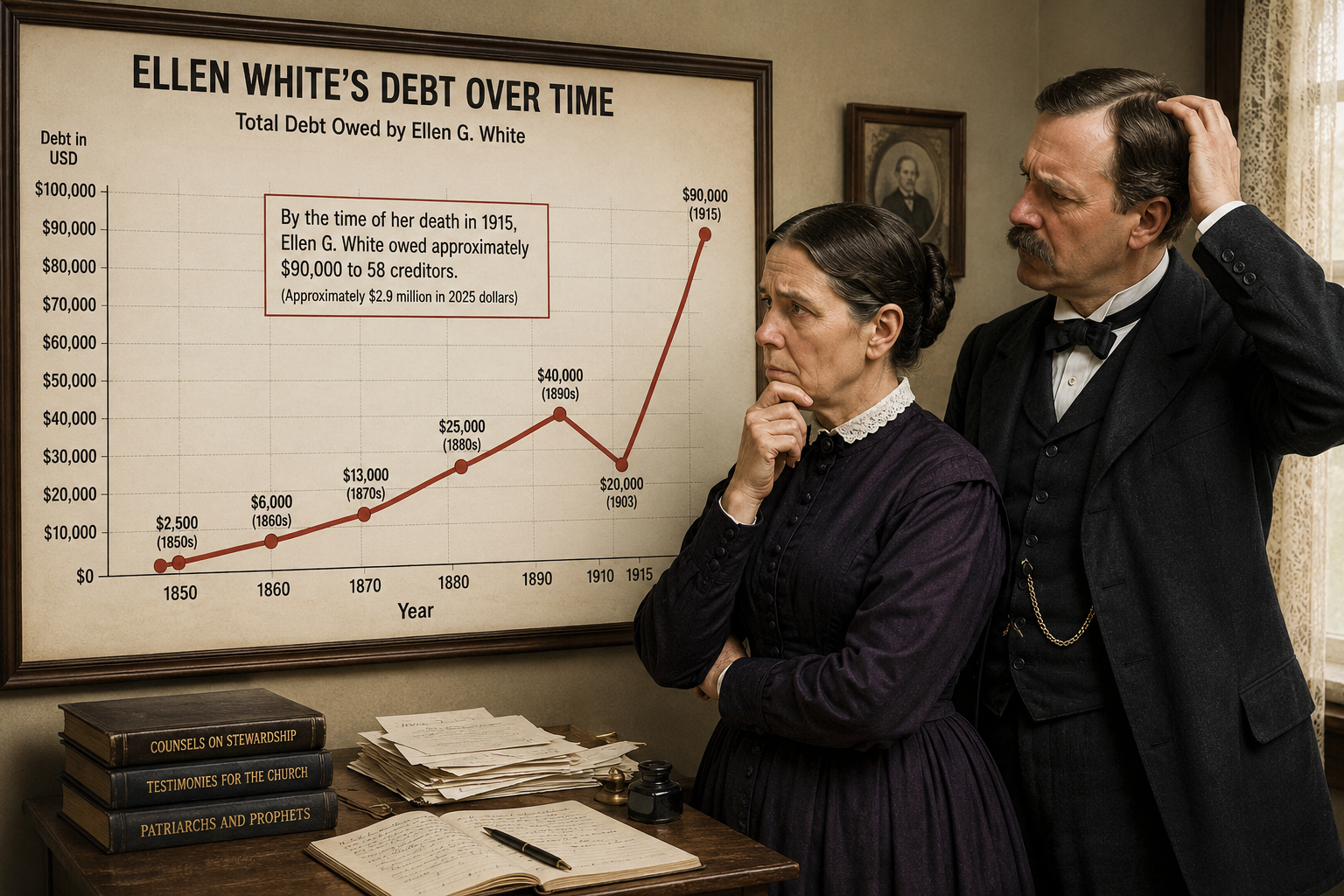
By 1903 she owed $20,000 ($728,735 in 2025 dollars). By the time she died in 1915, she owed approximately $90,000—to fifty-eight separate individuals and companies. The General Conference Corporation stepped in and paid it off, because her estate could not.
The prophet who commanded others to shun debt as they would shun disease died nearly three million dollars in debt in today's money, bailed out by the tithe-payers of the very sect she had spent decades lecturing about the dangers of debt.
This is that story.
Ellen White's Message on Debt
Ellen White wrote prolifically about debt. Her message was surprisingly consistent. She encouraged churches and institutions to pay off their debt as soon as possible. She encouraged sect leaders, her own family, and her followers to avoid debt like the plague. The record speaks for itself.
Public Condemnation of Debt
Mrs. White condemned debt in her books, articles, and testimonies. Her statements on debt are definite:
We should shun debt as we should shun the leprosy.1
God does not want His work to be continually embarrassed with debt. When it seems desirable to add to the buildings or other facilities of an institution, beware of going beyond your means. Better to defer the improvements until Providence shall open the way for them to be made without contracting heavy debts and having to pay interest.2
Let them guard themselves as with a fence of barbed wire against the inclination to go into debt.3
When one becomes involved in debt, he is in one of Satan's nets, which he sets for souls.4
When one voluntarily becomes involved in debt, he is entangling himself in one of Satan's nets which he sets for souls.5
Leprosy. Barbed wire. Satan's net. These are images of danger, entrapment, and spiritual ruin.
Her message was that a faithful believer does not borrow money. A wise person defers improvements and waits for Providence. I wise individual does not go into debt—under any circumstances.
Private Lectures to Her Son
The most sustained and merciless application of this principle was directed at her own son, Edson White.
For decades, Ellen White pursued Edson through her correspondence with an almost obsessive insistence that he stay out of debt. The language escalated year by year, letter by letter.
Keep clear of debt.6
I want you to pledge yourselves to go without food or clothing rather than to incur a debt. Oh, how ashamed I am to be dunned for your debts, Edson, by no less than a dozen persons!7
I could not endure the disgrace of your being overwhelmed with debt. This financial embarrassment you consider your misfortune; but I consider, I know, it is because you will not heed the counsel and warnings of the Spirit of God.8
Your course for years has revealed that you have no horror of debt, but to carry out plans and notions you would run in debt to any one man or one dozen men, without looking ahead to see how these debts might be canceled in the future… You should have been extremely cautious not to go into debt on any account. This we have warned you over and over again not to do…9
For once be determined to never incur another debt. Deny yourself a thousand things rather than run in debt. This has been the curse of your life, getting into debt. Avoid it as you would the smallpox. Make a solemn covenant with God that by His blessing you will pay your debts and then owe no man anything if you live on porridge and bread.10
Never incur a debt. Look upon the temptation to do this as from the devil.11
I feel that I must warn you to keep out of debt. Settle every debt you have, for it is your duty to do this. Do not borrow. Borrowing makes it hard for you… You have given them occasion to doubt you and distrust you, to think that you are unreliable. Do not be a stumbling block to any one.12
Do not again involve yourself in debt. This is Satan's snare for the ruin of your soul.13
Edson, I pray for you, that the Lord may lead you, that I shall not be made very sorry by your involving yourself in debt any longer. The Lord has been dishonored by the hasty movements which have involved you in debt… Build no towers without sitting down and counting the cost… Owe no man anything.14
Go without food. Go without clothing. Live on porridge and bread. Never incur a debt—the temptation is from the devil. Debt dishonors the Lord. Debt makes you unreliable. Debt is Satan's snare for the ruin of your soul.
Extraordinary words from a mother who, while writing them, was herself carrying tens of thousands of dollars in personal debt—and constantly borrowing more.
The Same Lectures, Delivered to Others
Edson was not the only recipient. Ellen White issued the same thunderous warnings to others in the sect—while she was in debt herself.
To a Brother and Sister Hickox, in September 1897—while personally carrying over ten thousand dollars in debt—she wrote:
You must see that one should not manage his affairs in a way that will incur debt. In this country we are on missionary ground, and economy must be practiced on all sides. When one becomes involved in debt, he is in one of Satan's nets, which he sets for souls.4
To a Brother N.A. Davis (August 1897), she was even blunter:
In your letter you complain of the yoke of debt. But there is no excuse for your being in debt. If you would be led by the Lord, you would not incur debt, but led by the devil you will draw money from the treasury which is needed to forward the work in its various branches.15
No excuse for being in debt. Led by the devil.
The year she wrote those words, she was paying interest on ten thousand dollars of debt and could not determine where the money to repay Sister Wessels would come from.
She also told S.N. Haskell—a man who, ironically, she owed money to—that "the very highest kind of education you could give, is to shun debt as you would shun disease."16
Thus, in public testimonies, in letters to her family, and in letters to sect members, White was consistent in her message that debt was dangerous and a satanic trap. Certainly a true prophet of God would maintain their distance from any satanic trap.
The Private Behavior
The private correspondence that never made it into the published Testimonies reveals a financial reality that White's debt never stopped growing.
1867
But we cannot provide the means, for we are already in debt.17
1878
We are in debt and cannot raise means.18
1879
We are in debt to the office of publication three thousand dollars.19
1889
In the same year that she wrote, "No worker should manage his affairs in a way to incur debt," she also wrote, "I am involved in debt—$8,000 [$291,515 in 2025] on which I am paying [7%] interest."20 Was she exempt from her own counsel?
1890
Since my return to America I have invested $1,600 in various branches of the work, expecting that the sale of my books would supply the necessary means; but instead of this, I have been obliged to borrow the money to pay interest upon it.21
1893
I carry a debt of ten thousand dollars upon which I am paying interest.22
I have invested two hundred pounds in Australia, and two hundred in New Zealand. It is all that I can do now, for I am carrying quite a burden of debt.23
Note the year: 1893. This is the same year she wrote to Louis Christie: "You have no horror of debt."24 She was herself ten thousand dollars in debt while accusing another of having no horror of it.
1894 — In Debt to the Man She Lectured to Shun Debt Like a Disease
I am in debt to you $1,200 now…25
That letter was addressed to S.N. Haskell—the same man she told that shunning debt was the highest education one could receive. She owed him $1,200. She did not appear to notice the irony.
1894 — Paying Her Son Willie's Home Loan While Drowning in Her Own Debt
As if her own obligations were not enough, in 1894 Ellen White was also absorbing the personal debts of her son Willie White—the General Conference employee paid to assist her:
I have felt it a duty devolving on me to lift a burden of debt of $1,200 for W. C. White that he might feel free from this harassing perplexity of running behind…26
His home debts and his continual donations make it necessary for him to call upon me for the loan of twelve hundred dollars. I loaned him this amount…27
While carrying $8,000 in her own debt and preaching to the denomination that debt was Satan's snare, she was paying off her son's home loan—adding to her own obligations to relieve his.
1896
At present I am in debt in America several thousand dollars.28
1897 — The Full Picture Emerges
By 1897, the scope of her borrowing had become extraordinary. In a single manuscript she catalogued the web:
I have hired £1,000 from Sister Wessels, for which I am responsible… My place in Healdsburg was mortgaged for twelve hundred dollars. Brother Leneinger's place also was mortgaged for several hundreds. All would have been lost had I not come forward and paid the mortgage. Money was drawn from the Pacific Press, and this leaves me in debt there… Besides the £1,000 borrowed, I am carrying £200 more, and paying 5% interest on it. This has been running three years… Brother Harper loaned me £1,000, which was called for in one year… Brother Haskell loaned me all he possessed, $1,000, and later $500 more. This has all been used to carry forward the work. He needs this money himself, but I have nothing with which to pay him. I depend on my forthcoming book to help me to cancel some of these debts.29
Count the creditors in that single passage: Sister Wessels (£1,000), a second lender (£200 at 5% for three years), Brother Harper (£1,000, called in after one year), the Pacific Press, a Healdsburg mortgage, a Brother Leneinger mortgage she had assumed, and Elder Haskell ($1,500 total—everything he possessed).
Haskell needed his money back. She had nothing with which to pay him. Her repayment plan was a "forthcoming book."
She also disclosed in the same year that she had been carrying a separate $1,000 debt for six years at 7% interest:
I carried that one thousand dollar debt all of six years at seven per cent interest. I hired the money from Brother Smouse.30
I lay up nothing, but today am paying interest on ten thousand dollars [$393,342 in 2025].31
1898 — Six Months Behind on Her Own Workers' Wages
I am now six months in debt to my workers.32
The prophet who thundered that debt dishonors God was six months behind paying the people who worked for her.
In the same year, she admitted in a manuscript that the debt no longer even troubled her:
I have borrowed money to meet the needs of the work, until I am thousands of dollars in debt. But it is not this debt that troubles me now…33
1899
I am at the present time more than ten thousand dollars in debt… I am willing to do as I have been doing in this field—use every dollar I can possibly spare, and then borrow money to invest. The money loaned me by Sister Wessels, one thousand pounds, will have to be returned to her, but where the money is coming from, I am not able to determine. This is in addition to the ten thousand I owe in America.34
I am not at all worried about my debts, although they are heavy.35
More than ten thousand in Australia. Ten thousand more in America. No plan for repayment. And yet, she was not at all worried. She had no "horror" of her own debts. The prophet who told others there was "no excuse for being in debt" had twenty-plus thousand dollars in debt with no plan and no worry.
Ellen White wrote to Edson in September 1899, lecturing him—again—about paying debts before incurring new ones. Then, in the very same letter, she incurred a new debt herself:
I wrote to you in regard to paying your debts before incurring more debts… I spoke in my last letter in regard to the case of Sister Rose. You may draw from the office the sum to cancel that debt and charge to my account, and we will settle that business between you and me.36
She told Edson, pay your debts before incurring more. Next paragraph: charge Sister Rose's debt to my account. She instructed Edson not to incur new debts. Then she incurred a new debt. In the same letter. Without apparent awareness of the contradiction she had just committed in writing.
1900
When writing to Brother and Sister Hart thanking them for a loan, Mrs. White mentioned, "In America I owe nearly ten thousand dollars, in this country nearly five thousand." Two months later she thanked S.N. Haskell for a loan of $5,000.37
1902 - Bailing Out Edson Again
The debt on the Central Manufacturing Company should never have been incurred. ... I was very desirous that the work that Edson had begun in the South should be carried forward, and I thought that if I assumed the debt, it could not then be used as an excuse for oppressing Edson and hindering him in his work. I therefore took this debt upon myself...38
1903
There are so many ways in which to use the little money that comes in that I find it hard to reduce my debt of twenty thousand dollars [$728,735 in 2025]. At present, I am paying about a thousand dollars a year interest.39
I owe twenty thousand dollars, which I have borrowed to invest in the Lord's work.40
I am thousands and thousands of dollars in debt, and I am obliged to keep borrowing continually in order to pay my running expenses.41
1905
I do not begrudge one dollar that I have invested in the cause of God, even though I am obliged to pay a thousand dollars a year interest. It would be a relief to me not to have to pay out so much money for interest.42
I am in debt today because I have done it. It does not worry me a bit.43
It does not worry her a bit. Debt is Satan's net for the ruin of souls. But her debt? Not a bit of worry. Horror over debt is for others to experience, not her.
1908
I became involved in debt, supposing that the sale of my books would certainly let me free in a short time; but there has been a debt of thirty thousand dollars upon which I pay interest of one thousand dollars per year.44
I cannot go any longer in carrying the debt of thirty thousand dollars [$1,093,465 in 2025] that I incurred in building the very first work in Australia.45
In that same letter she wrote: "I have not taken to myself one penny of these gifts that I have put out, to appropriate to myself, not one."45 Whether that is true is anyone's guess. However, she bailed out Willie once and Edson multiple times. Where did that money come from?
In 1899, Mrs. White had advised Edson not to "undertake to make books without studying to see how you can do this without involving yourself in debt, thus burdening your books before they are printed."46 That seems like reasonable counsel, but did she follow it herself?
In 1908, she wrote about a book she had been "instructed to publish" on the "early experiences" of Adventists and asked a wealthy follower: "Will some one loan me, at a low rate of interest, the means to help in doing this work that needs to be done in bringing these things before the people?"47 That same year she wrote to Alexander Gilmore asking for a loan for "several thousand dollars" to "publish these books."48
1910
I, too, am in debt—perhaps more so than many others—and yet I keep at work; and when a necessity for help presents itself, I try to meet it by appropriating means. I do not always stop to inquire whether or not I can afford it.49
I do not always stop to inquire whether or not I can afford it.
This is the same prophet who told Edson not to build "without sitting down and counting the cost."
The Ponzi Scheme
In 1902, Ellen White described the disturbing nature of her financial operation:
I am more than $10,000 in debt today. Well, does that trouble me? No; because those who loan the money say, "I would rather you would have it than the bank. I know that it is perfectly safe; that whenever we call, we shall have our money." But if they are willing to allow me to handle their money, I will do it, and pay them interest on that money—a low interest; and what will I do with it? Well, when they say, "Here is a field to be opened, in this place or that place, cannot you help us?" Why, yes, I can take some of this money and invest it there. Thus we have done in the Southern States, thus we have done in nearly every state where we have been, to advance the interests of the work of God.50
Let us be precise about what this describes.
Ellen White is borrowing money from private individuals—sect members who trust her—on the assurance that their money is "perfectly safe" and available whenever they call for it. She is paying them a "low interest" on these loans. She is then taking that borrowed money and investing it in ministry projects of her own choosing, without institutional oversight or accountability.
She is operating as an unregulated private bank—taking deposits from trusting believers, promising safety and liquidity, and investing the proceeds in ventures that, as her own letters make plain, were generating no reliable return sufficient to repay the principal.
This is the structure of a Ponzi scheme.
Not in the sense that she intended to defraud anyone. But in the precise operational sense: she was using new borrowed funds to service existing obligations, assuring lenders their money was safe, while the underlying investments were illiquid, speculative, and chronically unable to generate the cash flow needed to repay them. By 1897 she admitted she could not determine where the money to repay Sister Wessels would come from.34 By 1903 she was "obliged to keep borrowing continually in order to pay my running expenses."41 By 1908 the debt had reached thirty thousand dollars.44 At death it was ninety thousand.
The lenders who were told their money was "perfectly safe" were ultimately made whole not by Ellen White—but by the General Conference Corporation, using the denomination's institutional funds. They got their money back. But not from her. From the sect's tithe-payers.
The Final Accounting
When Ellen White died in 1915, the full picture finally emerged from the probate records.
Her personal debts totaled approximately ninety thousand dollars—owed to fifty-eight separate creditors ranging from individuals who had lent her a few hundred dollars to others owed more than ten thousand each.51
Ninety thousand dollars. In 2025 terms, roughly three million dollars.
Her estate could not cover it. The General Conference Corporation assumed the debt and retired it entirely, recording total payments averaging $100,724.37.52
The denomination whose members had been told to shun debt as they would shun leprosy paid off the prophet's personal debts from institutional funds. The same corporation that collected tithe from members instructed to avoid the inclination to borrow used those funds to clean up the prophet's financial wreckage after her death.
The Defense That Doesn't Work
The standard SDA response is that Ellen White went into debt for the Lord's work—not for herself—and that this somehow distinguishes her situation from the debt she condemned in others.
This defense collapses on three fronts.
First, her own public statements made no such distinction. She repeatedly told institutions not to go into debt for buildings and improvements—precisely the kind of debt she incurred. She called going into debt to build the Lord's institutions a denial of faith:
These buildings are to represent our faith. They are not to be put up at such an expense that the debt on them will deny our faith.49
Second, she explicitly told Edson that his debts had been incurred while pursuing ministry—and she condemned him for it anyway. Edson's debt was primarily ministry debt. She called it the curse of his life and Satan's snare for the ruin of his soul.
Third, her own testimony destroys the defense. She did not write with the calm confidence of a servant following divine instructions. She wrote with anxiety. She admitted the debt "sometimes worries me."39 She admitted she could not determine where the money to repay Sister Wessels would come from. She admitted she was "obliged to keep borrowing continually."41
This is not someone operating serenely under divine mandate. This is someone in over their head.
Conclusion
Ellen White spent decades condemning debt as leprosy, smallpox, Satan's net, and the curse of a life. She told her son to live on porridge and bread rather than owe a dollar. She told a church leader there was no excuse for being in debt—that debt meant being led by the devil. She told the denomination to guard itself with barbed wire against the impulse to borrow.
Simultaneously, from 1867 to her death in 1915, she was in debt. Every year. Without exception. Borrowing from believers who trusted her assurances that their money was safe. Borrowing from Haskell, who gave her everything he possessed and needed it back and got nothing. Borrowing against book revenues that never fully materialized. Borrowing to pay interest on previous borrowing. Paying off her son's home loan while drowning in her own obligations. And in at least one letter, instructing someone not to incur new debts—then incurring one herself before the ink was dry.
She once admonished a man: "Will you right this wrong, or will you leave this large debt unpaid?"53
The General Conference righted that "wrong" on her behalf, posthumously, with the denomination's institutional funds.
The public rule said: "Shun debt as you would shun leprosy."
The private reality said: "Borrow from fifty-eight creditors and let the General Conference sort it out."
If the testimonies were the voice of God, she certainly didn't act like it.