
Ellen White's Loud Cry Confusion
By , Sep.
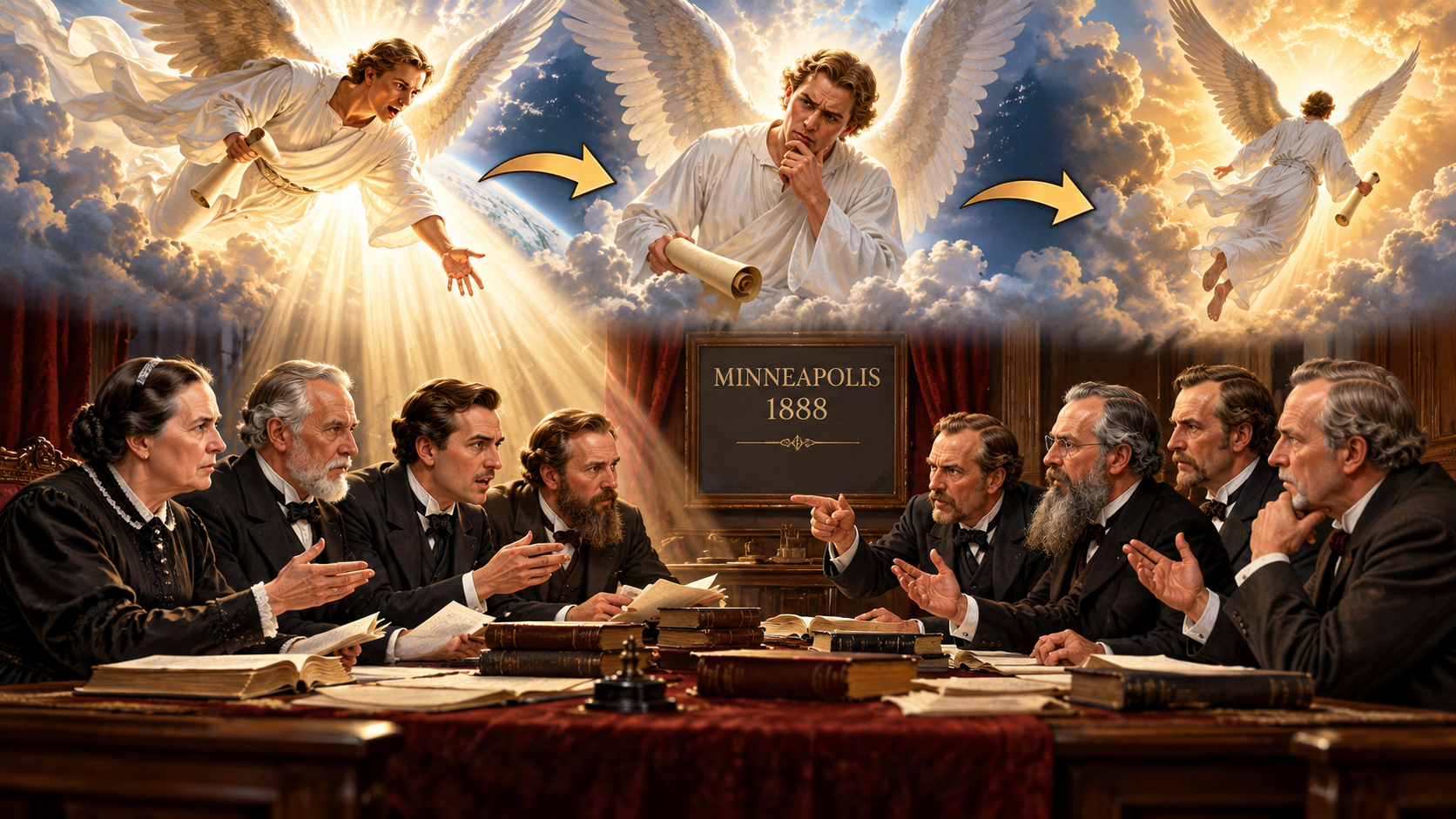
In November 1892, Ellen White made an extraordinary declaration. According to her, the apocalyptic loud cry had already begun in the preaching of the righteousness of Christ associated with the 1888 Minneapolis General Conference session. She connected that message to the third angel and then to the angel of Revelation 18 whose glory would lighten the whole earth.1 That claim deserves to be examined carefully, because it has been a constant source of confusion for Seventh-day Adventists. The more closely the claim is compared with Scripture, SDA history, the Protestant holiness movement, and the later admissions of SDA historians, the more confusing it becomes.
The Statement That Started the Confusion
It all began at the 1888 SDA General Conference meetings. During those sessions, E.J. Waggoner and A.T. Jones presented their views on the righteousness of Christ. Ellen White wrote of that event:
At this meeting I bore testimony that the most precious light had been shining forth from the Scriptures in the presentation of the great subject of the righteousness of Christ connected with the law...2
In 1892, Ellen White made an announcement to the sect in the Review that the loud cry of Revelation had already begun in 1888 with the message of Righteousness by Faith:
The time of test is just upon us, for the loud cry of the third angel has already begun in the revelation of the righteousness of Christ, the sin-pardoning Redeemer. This is the beginning of the light of the angel whose glory shall fill the whole earth.3
There it is. The loud cry had already begun. White explicitly connected the beginning of the loud cry with the revelation of Christ's righteousness, which was being preached in camp-meetings across America by Waggoner, Jones, and White.
SDA General Conference President A.G. Daniells verifies the common understanding that White was making a direct reference to the 1888 message. He explains that it was believed that the "revelation of the righteousness of Christ" at the Minneapolis Conference was the beginning of the loud cry.4 In other words, the 1888 interpretation became part of the official SDA narrative of the loud cry.
The Protestant View
Protestant historicists long interpreted Babylon in Revelation as representing of the papal system, and that the Reformation's preaching of justification by faith was understood as a major exposure of Rome's system of works-based righteousness.5
But how do you get from a broad Protestant historicist understanding of the gospel's role in exposing Babylon to the specific claim that the Minneapolis message of 1888 was the beginning of the final, earth-lightening loud cry?
That is the gap Ellen White's statement has to cross.
The difference is enormous. The first proposition says that the gospel exposes the religious errors of Catholicism. The second says that a particular message preached by two young SDA ministers triggered a denominational crisis constituting the beginning of a final apocalyptic proclamation. The first has a recognizable biblical and Reformation pedigree. The second requires Ellen White's authority, and that is where the wheels begin to come off.
What Exactly Was New About 1888?
Ellen White's defenders frequently speak of the 1888 message as though Jones and Waggoner brought some previously hidden heaven-sent revelation that suddenly appeared in Minneapolis. But the historical record is considerably less convenient.
L. H. Christian, an SDA General Conference vice president, explicitly described the 1888 righteousness-by-faith teaching in these words:
Some may well ask, What was this teaching of righteousness by faith which became the mainspring of the great Adventist revival, as taught and emphasized by Mrs. White and others? It was the same doctrine that Luther, Wesley, and many other servants of God had been teaching.6
The same doctrine. Period.
Not a brand-new doctrine downloaded from heaven in Minneapolis. Not a theological discovery previously unavailable to Protestant Christianity. Christian's own description places the teaching squarely in continuity with Luther, Wesley, and other Protestant teachers.
SDA historian LeRoy Froom amplified the problem. In Movement of Destiny, Froom acknowledged that men outside the Advent Movement were carrying the same general burden and emphasis at approximately the same time, adding that "some fifty men" could be listed who were giving this general emphasis in the closing decades of the nineteenth century and the opening decades of the twentieth.7
That admission matters because it destroys the idea that Seventh-day Adventism possessed an exclusive monopoly on the righteousness-by-faith emphasis.
The nineteenth-century righteousness-by-faith movement, also called the holiness movement, gained momentum after the American Civil War. It spread across America in the 1870s and 1880s, emphasizing Christian holiness, sanctification, deeper spiritual experience, and a stronger emphasis on faith. Whatever one thinks of the movement's theology, the historical point is unavoidable: Adventism did not exist in a theological vacuum. Jones and Waggoner were preaching into a Protestant culture already saturated with discussions of faith, grace, holiness, sanctification, and Christian perfection. At least fifty notable preachers were saying the same thing as Jones and Waggoner. This was not a unique teaching. It was imported into Seventh-day Adventism by Jones and Waggoner. They may have grafted the Sabbath onto it, but it was the identical message, according Froom.
Ellen White puts the nail in the coffin as to whether the 1888 teaching was new light. She states it plainly:
Elder E. J. Waggoner had the privilege granted him of speaking plainly and presenting his views upon justification by faith and the righteousness of Christ in relation to the law. This was no new light, but it was old light...8
Could it be said any more clearly? According to the prophet, it was nothing new.
The Big Claim
At Minneapolis, Jones and Waggoner challenged positions held by older SDA leaders, particularly over the law in Galatians and related questions. Uriah Smith and G. I. Butler opposed aspects of their teaching, and Ellen White eventually threw her support behind the presentation of Christ-centered righteousness by faith.9
But there is a world of difference between saying, "These men preached an important message that Ellen White believed the sect needed" and saying, "These men inaugurated the apocalyptic angel of Revelation 18."
Here is the fundamental problem with Ellen White's 1892 statement. White did not merely praise Jones and Waggoner. She placed their message inside an apocalyptic framework. She said the loud cry had already begun. She called it the beginning of the light of the angel whose glory would fill the whole earth.
That is an enormous prophetic claim.
Revelation 18 Is About More Than Justification
Look at the structure of Revelation 18. The angel descends with great power. The earth is illuminated with his glory. Babylon is declared fallen. The chapter describes Babylon's corruption, her relationship with the nations, her luxury, her sins, her judgment, and the lament of those who profited from her. Then comes the command:
Come out of her, my people, lest you share in her sins, and lest you receive of her plagues (Rev. 18:4).
That is a call to separation from a corrupt religious system. It is an announcement of judgment and a summons to God's people to leave Babylon.
Righteousness by faith can certainly be part of a genuine gospel proclamation. But the text itself does not identify "righteousness by faith" as the content of the angel's message. Ellen White supplied that identification.
That distinction is critical. If someone says, "The gospel is the light that exposes Babylon," there is a recognizable historicist argument worth discussing.
If someone says, "The Minneapolis preaching of Jones and Waggoner was the beginning of the Revelation 18 angel," the question becomes: Where does Scripture identify that event?
The answer is not supplied by Scripture. That identification comes solely from Ellen White's interpretation.
The Loud Cry That Did Not Finish the Work
There is another problem that SDAs have wrestled with for generations.
Ellen White did not describe the 1892 development as a minor theological improvement. She said the loud cry had already begun. She connected it with the angel whose glory would fill the whole earth.
Yet the earth was not filled with the glory of that message. The work did not finish. Christ did not return. The loud cry did not produce the final gathering. In fact, the movement fizzled out. White realized it. She complained in 1899 that the Loud Cry was being "smothered" and ever afterward she referred to it in the future tense, as if it had not started!10
SDA authors have struggled to explain why something that had "already begun" in 1892 was still not complete more than a century later. Later discussions commonly treat the 1888 message as the beginning of a process whose fulfillment was delayed by the sect's failure to accept it fully.11
Did Ellen White's prophecy fail? Not according to her defenders. They point out that White made it clear that it was the SDA people, not her, who were at fault: "if they had obeyed His word, they would today be in the heavenly Canaan."12 While this may have alleviated White of the blame for falsely announcing the arrival of the angel of Revelation 18, it created a strange contradiction of her most famous lines: "like the stars in the vast circuit of their appointed path, God’s purposes know no haste and no delay."13
One can almost feel the pain of sect leaders as they grapple with their failure in 1973:
We believe that the return of Jesus has been long delayed...we believe that this is the heart of the church’s need—understanding and experiencing all that is meant by the phrase, “righteousness by faith.” ... God is waiting for a generation of Adventists who will demonstrate that His way of life can truly be lived on earth, that Jesus did not set an example beyond the reach of His followers... Each member of the Laodicean church needs...a genuine and complete surrender of the life and will to the divine authority of the Bible and of the Spirit of Prophecy... Every member must recognize that he has a part in either hastening or delaying the coming of Christ. Says God’s servant: “When the character of Christ shall be perfectly reproduced in His people, then He will come to claim them as His own” (Christ’s Object Lessons, p. 69).14
It seems that Jesus is delaying His return because...
- SDAs are not living as perfectly as Jesus did
- SDAs are not surrendering to the Bible and Ellen White's writings
When the prophecy failed to deliver, the sect simply moved the goalposts from “God said it was happening” to “God would have done it if SDAs had become perfect and obeyed Ellen White.”
Here is the fatal problem with this interpretation: a prophecy that can be declared fulfilled when it begins, postponed when it fails, and blamed on the followers when it does not happen, is being abused. That is not biblical exegesis. It is a lesson in how to make Ellen White's statements unfalsifiable.
What about Those "Messengers"
There is another historical problem that should not be ignored.
Jones and Waggoner were central figures in the 1888 righteousness-by-faith controversy. Ellen White repeatedly praised their work and described them as having a special message for the sect. However, both men eventually broke with organized Seventh-day Adventism.15
If the men whose message was proclaimed as the beginning of the final loud cry subsequently departed from the denomination that claimed to be God's end-time remnant, then the prophetic identification deserves scrutiny. The messengers themselves obviously lost confidence in Ellen White and the SDA sect.
The Final Irony
The alleged beginning of the final, earth-shaking SDA proclamation turns out, by the testimony of SDA historians themselves, to be deeply embedded in the wider Protestant theological world that White and other SDAs labeled "Apostate Protestantism." Why did God send such an important message to them first instead of his "remnant" church or its prophet?
Conclusion: Compounded Confusion
When Ellen White tied the cosmic descent of the Revelation 18 angel to the 1888 Minneapolis conference, she created a labyrinth of theological and historical confusion that Seventh-day Adventism has spent over a century trying to explain away. The deeper one digs into her 1892 statement, the clearer it becomes that the confusion is not the result of members failing to understand her words—it is the direct consequence of them.
To accept White's declaration as prophetic truth, an SDA is forced to navigate a series of irreconcilable paradoxes:
- The Interpretive Confusion: Scripture presents Revelation 18 as a thunderous, earth-shattering announcement of Babylon's fall and a command to flee apostasy. White stripped the passage of its apocalyptic judgment and reshaped it into an internal denominational struggle over the meaning of Pauline teachings in Galatians.
- The Origin Confusion: White framed Jones and Waggoner's message as a supernatural signal flare sent directly from heaven. Yet SDA historians themselves destroyed that narrative. L. H. Christian conceded it was simply re-hashed Luther and Wesley, while Froom admitted that at least fifty non-SDA Holiness preachers were proclaiming the exact same message across post-Civil War America. Adventism did not initiate a heaven-sent "Loud Cry"; they absorbed it from the Holiness revival.
- The Reversal Confusion: After categorically declaring in 1892 that the Loud Cry had "already begun" in the sect's paper, White herself quietly abandoned that position. After 1899, she repeatedly spoke of the Loud Cry as a future event—leaving the sect with the absurd reality of their prophet walking back her own apocalyptic fulfillment.
- The Prophetic Confusion: An apocalyptic event that "already began" in 1892 simply fizzled out. To insulate the prophet from a failed prediction, sect leadership shifted the blame for White's prophetic blunder away from her into an unfalsifiable guilt trap where the prophecy was declared fulfilled when it started, smothered when it failed, and blamed on the laypeople for failing to achieve sinless perfection. This did not explain how a small group of insubordinate people could frustrate God's plans for a planetary loud cry.
- The Messenger Confusion: The very two men Ellen White anointed as heaven’s heralds of the earth-lightening angel subsequently rejected her prophetic authority, embraced theological errors, and died outside the sect they were supposed to lead into the Latter Rain.
Here lies the ultimate irony that sits at the center of SDA confusion: Ellen White endorsed Jones' and Waggoner's importing of a Protestant holiness doctrine from the group SDAs disparaged as the "Daughters of Babylon," confined the grand role of the angel of Revelation 18 to their sect's doctrinal debate over Galatians, and declared it the start of a global climax that never occurred.
Was she the Spirit of Prophecy? Or the author of confusion? You decide.