
Paradise Lost's Themes Found in Ellen White's Books
By , last updated July
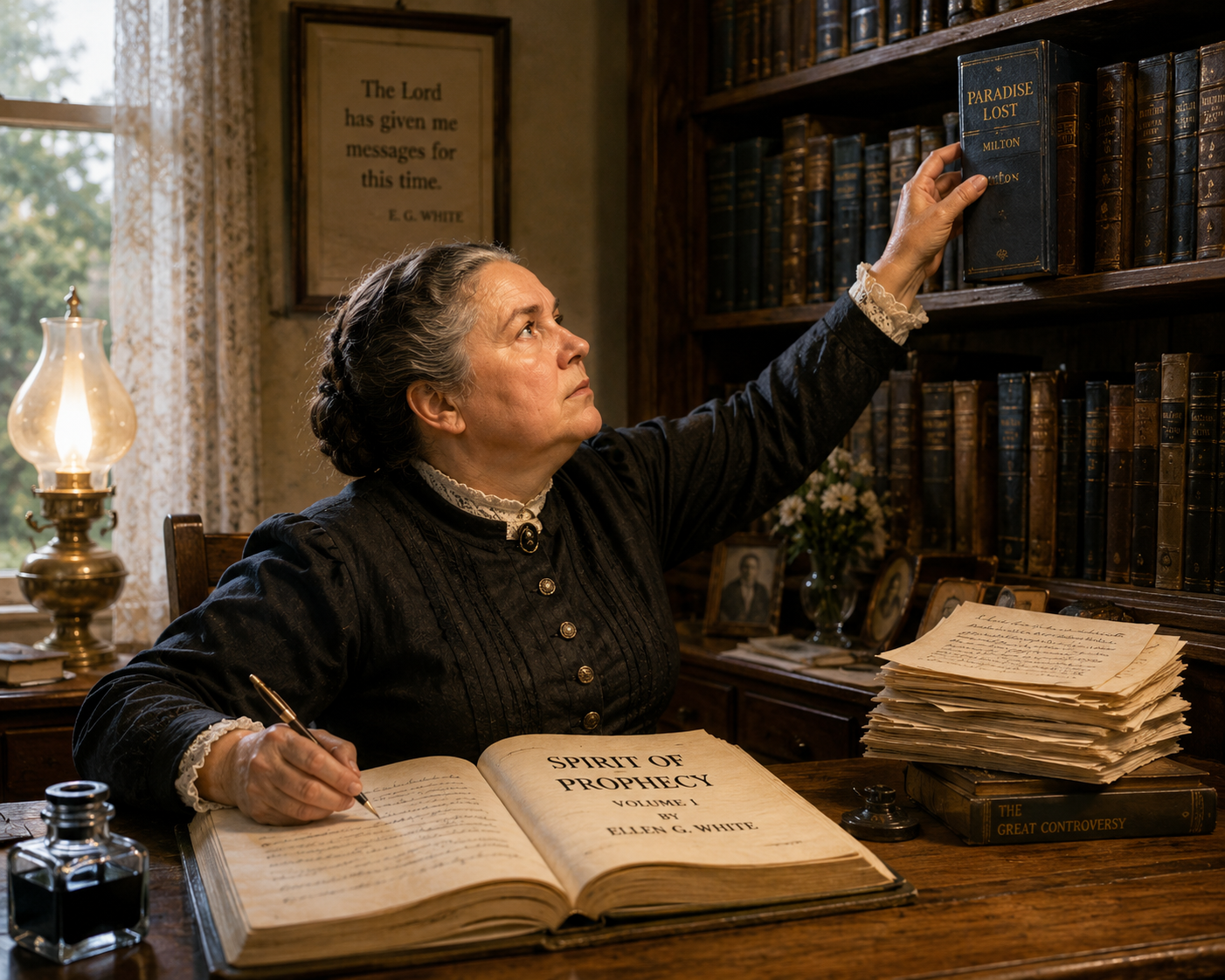
For more than a century, Seventh-day Adventists [SDAs] have been taught that Ellen White was granted privileged access to scenes no human eye had ever seen—Heaven before the fall, the councils of angels, and the inner life of Eden itself. In Spirit of Prophecy (1870) and Patriarchs and Prophets (1890), she presents these accounts not as speculation, but as revelation—divine insight streamed directly from the throne of God.
There is only one problem. Many of the most vivid details in these “visions” are found nowhere in Scripture. But they are found somewhere else.
Decades before Ellen White ever put pen to paper on these subjects, she was given a copy of John Milton’s 1667 epic poem, Paradise Lost.1 That fact, rarely mentioned in Adventist circles, changes everything. Because when her writings are placed side-by-side with Milton’s work, the parallels are undeniable.
What follows is a pattern. From Satan’s post-fall council, to the invented separation of Eve, to the “burnished gold” serpent with wings, to the panoramic vision of human history shown to Adam—the architecture of Ellen White’s “visions” mirrors the narrative framework of Milton’s poem with disturbing precision.
The source of these detailed, extra-biblical “revelations” is not the Bible—and it is not divine inspiration. It is the creative imagination of a seventeenth-century poet. What SDAs have long been told was a supernatural vision is, upon closer inspection, literary dependence.
Parallels to Paradise Lost
While Ellen White only plagiarized directly from Milton in a few instances, she incorporated many of the same extra-biblical scenes, imagery, and themes into her books. The evidence below will demonstrate that the parallels are undeniable.
Satan Holds a Council Meeting After His Fall
In Paradise Lost, Satan and his evil cohorts gather together in a council meeting to plan their work against God.2
Ellen White writes of the same extra-biblical theme, saying that after Satan was expelled from Heaven...
Satan held a consultation with his evil angels.3
The Great Consult: Strategic Centralization
Both authors describe a formal, high-level meeting where the fallen host debates their future. In both accounts, the pivot from physical warfare to the corruption of humanity is the primary outcome. The comparisons below are based upon Ellen White's Spirit of Prophecy, vol. 1, pages 31-32.
- White: "Satan held a consultation with his evil angels... He wished them to consider the matter while he should leave them and seek retirement, to mature his plans."
- Milton (Book 2, Lines 345-348): "There is a place... another World, the happy seat / Of some new Race call'd Man... Thither let us bend all our thoughts, to learn / What creatures there inhabit."
The Solo Volunteer
A striking similarity is the "Heroic Satan" trope, where the leader asserts his superior wisdom and insists on undertaking the dangerous reconnaissance mission alone, while the lesser angels remain paralyzed by fear.
- White: "He told them that he would not entrust any one of them to accomplish this work, for he thought that he alone had wisdom sufficient."
- Milton (Book 2, Lines 465-466): "This enterprise / None shall partake with me."
The Guile vs. Force Theme
Both texts emphasize that because the "war in Heaven" was lost through "force," the new war on Earth must be won through "guile" (deceit).
- White: "He decided that cunning and deceit would do what might, or force, could not."
- Milton (Book 2, Line 346): "By fraud or guile, what force effected not."
Additional Thematic Parallels
| Theme | White (Spirit of Prophecy, vol. 1, 31-32) | Milton (Paradise Lost) |
|---|---|---|
| Satan's Regret | "He shuddered at the thought of plunging the holy, happy pair into... misery." | "Pity could melt / ere I destroy" (Book 4, Lines 388-389). |
| Internal Conflict | "He seemed in a state of indecision... hesitating and wavering." | "Horror and doubt distract / His troubled thoughts" (Book 4, Lines 18-19). |
| The "Last Hope" | "He sought to impress upon them that this was their last and only hope." | "To do ought good never will be our task, / But ever to do ill our sole delight" (Book 1, Lines 159-160). |
| Deceptive Approach | "If he should come boldly... they would not listen... cunning and deceit [must be used]." | "Expanse of stratagem... By fraud or guile" (Book 1, Line 650; Book 2, Line 346). |
The Satanic Jealousy
Both White and Milton expound upon the jealousy of Satan.
The "Impaired" Status: Jealousy Over Preeminence
In both accounts, Satan’s rebellion is not sparked by a general dislike of God, but by a specific "Exaltation Ceremony" where the Son is proclaimed King. This event causes Satan to feel "impaired" or displaced from his own position as a leading archangel.
- Milton (Book 5, Lines 659–669): Satan, though "great in power, in favour, and preeminence," was "fraught with envy against the Son of God" because he "could not bear—through pride—that sight and thought himself impaired."
- White (Spirit of Prophecy, Vol. 1, p. 17): "Satan was envious and jealous of Jesus Christ... He was once a covering cherub... yet he was not satisfied with his position." She describes a gathering where "the King of the universe summoned the heavenly host" to declare the Son's equality.
The Problem of Chronology
Another parallel is that White’s "visions" follow Milton’s specific chronology. In both works, the exaltation of the Son is the direct cause of the War in Heaven. While White’s various writings present a complex timeline, they consistently link the "announcement" of the Son’s preeminence to the internal rot of Satan’s character.
| Element | Milton’s Fiction (Book 5) | White’s "Inspiration" (1SP / 1SG) |
|---|---|---|
| The Event | The Father proclaims the Son "Messiah, King Anointed." | The Father exalts the Son before the assembled host. |
| The Reaction | Satan feels "impaired" (diminished) by the Son’s honor. | Satan is "jealous" and feels his own honor is overlooked. |
| The Motivation | Envy over the Son’s unique "Mission." | Envy over the Son’s unique "Counsel" with the Father. |
Simply a Coincidence?
SDA apologists often claim that White’s description of Satan’s jealousy "makes sense" given the nature of pride. However, the specific narrative catalyst for this jealousy—a formal ceremony where the Father exalts the Son before the assembled host—is a distinct hallmark of Paradise Lost that White mirrors almost exactly. While jealousy is a plausible motive, the literary staging is the "Smoking Gun." The Bible (Isaiah 14, Ezekiel 28) attributes Satan's fall to a desire to be like the Most High in a general sense. It says nothing of an "Exaltation Ceremony" or a specific "King Anointed" proclamation that triggered the coup. White chooses to use Milton's specific plot device—the Father "summoning" the host to settle a question of hierarchy—to drive her narrative forward.
If Ellen White were seeing an independent vision of the War in Heaven, why does the 'Heavenly Courtroom' look and sound exactly like the political drama of a 17th-century English epic?
The Education and Warning of Adam and Eve
While the Book of Genesis is silent regarding any angelic interaction with Adam and Eve prior to the Fall, both John Milton and Ellen White describe an extensive period of celestial instruction. This "angelic visitor" trope is a cornerstone of Milton's narrative structure, which White appears to have adopted as historical fact. The comparisons below are based on Spirit of Prophecy, vol. 1, pages 32-34.
The Angelic Curriculum: War and Creation
In Paradise Lost (Books 5 through 8), the angel Raphael spends a significant amount of time educating Adam on matters of the spirit realm and the physical world. White's "visionary" account mirrors this exact curriculum.
- The War in Heaven: Milton devotes Books 5 and 6 to the rebellion and fall of Satan. White similarly writes: "They also gave them the sad history of Satan’s rebellion and fall."
- The Creation of the World: Milton’s Raphael explains the mechanics of creation in Books 7 and 8. White parallels this, noting that the angels and the holy pair discussed "their new discoveries of the beauties of nature... and they had many questions to ask relative to many things which they could but indistinctly comprehend."
The Warning Against Separation
A pivotal Miltonic invention is the warning that Eve's safety is linked to her physical proximity to Adam. Milton uses this to create dramatic irony, a theme White replicates almost verbatim despite the lack of any biblical basis for such a warning.
- Milton (Book 8, Lines 563-564):
"...she deserts thee not, if thou
Dismiss not her, when most thou need'st her nigh..." - White:
"The angels cautioned Eve not to separate from her husband in her employment; for she might be brought in contact with this fallen foe. If separated from each other, they would be in greater danger."
The Final Admonition: Love and Obedience
Both narratives conclude the angelic visit with a final, solemn charge to remain loyal to the Creator. The definition of love as synonymous with obedience is a central Miltonic theme that became a foundational tenet of SDA theology through White.
- Milton (Book 8, Line 635):
"...first of all
Him whom to love is to obey, and keep His great command..." - White:
"God... required implicit obedience from all in Heaven and on earth... but he could not harm them while they yielded obedience to God’s command."
Another Coincidence?
SDAs will argue that Ellen White received her intel from Heaven and that it was only coincidentally similar to Milton. For example, they claim that it makes sense that God would send someone to visit Adam and Eve and warn them. However, the Bible is not just "silent" on these visits; it is structurally opposed to them. In Genesis, Adam and Eve appear to be surprised by the consequences of their actions. By adding a "Miltonic Curriculum" (teaching them about the War in Heaven, the Fall of Satan, and the Physics of Creation), White changes the nature of the Fall from childlike innocence (the Biblical view) to intellectual rebellion (the Miltonic view). This isn't just "filling a gap"; it's changing the theology of the human race to match a 1600s poem.
Conclusion: Fictional Architecture as Inspired Fact
The "Smoking Gun" in this section is the presence of Raphael’s shadow throughout White's writings. From the specific topics of conversation (War and Creation) to the extra-biblical warning about Eve "wandering" from her husband's side, the "inspired" writings of Ellen White follow the fictional narrative arc of Paradise Lost with startling precision. By incorporating Milton’s poetic devices into her theology, she effectively transformed 17th-century religious fiction into 19th-century "divine revelation."
Descriptions of Eden
There can be no doubt that Ellen White was following Milton's writings as she wrote her description of Eden:
| Milton, Paradise Lost, Book 4 | White, Patriarchs and Prophets |
|---|---|
| ...amid them stood the Tree of Life, High eminent, blooming Ambrosial Fruit Of vegetable Gold... Flours of all hue...the mantling vine Layes forth her purple Grape, and gently creeps Luxuriant... (218-220; 256; 259-260) | There were lovely vines, growing upright, yet presenting a most graceful appearance, with their branches drooping under their load of tempting fruit of the richest and most varied hues. ... There were fragrant flowers of every hue in rich profusion. In the midst of the garden stood the tree of life, surpassing in glory all other trees. Its fruit appeared like apples of gold and silver... (p. 47) |
SDA Defense
SDA apologists often attempt to dismiss the parallels in the descriptions of Eden by claiming these are "obvious" features of any garden. However, a forensic analysis of the text reveals that White is not merely describing a garden; she is adopting Milton’s specific aesthetic palette and botanical anomalies.
1. The "Vegetable Gold" vs. "Apples of Gold" – The apologists claim that "fruit" is a generic term. But Genesis never describes the fruit of the Tree of Life as having a metallic appearance. This is a purely Miltonic invention used to convey "Ambrosial" glory.
- Milton (Book 4, Line 220): Describes the fruit as "vegetable Gold."
- White (p. 47): Describes the fruit as "apples of gold and silver."
If White were seeing a literal tree in vision, why does her description align with the specific 17th-century poetic metaphor of "metallic fruit" instead of something biological? The Bible says the fruit was "good for food," not that it looked like jewelry.
2. The "Upright Vine" Anomaly – In the natural world (and the post-Fall world), vines are creepers. Milton, however, imagined an unfallen Eden where vines grew upright and luxuriant. White adopts this specific, counter-intuitive botanical detail.
- Milton (Book 4, Line 259-260): "...the mantling vine / Layes forth her purple Grape, and gently creeps Luxuriant [upright/spreading]."
- White (p. 47): "There were lovely vines, growing upright, yet presenting a most graceful appearance, with their branches drooping..."
The Bible (Genesis 2-3) says absolutely nothing about the posture or growth habits of the vines. The idea of an "upright vine" is a specific creative choice by Milton to show that nature did not yet need support. White captures this exact, unique image.
3. The "Every Hue" Verbal Fingerprint – SDA apologists claim that White's use of "flowers of every hue" is simply generic. However, it is the collocation (the way the words are put together) that matters.
- Milton: "Flours of all hue" (Line 256).
- White: "flowers of every hue" (p. 47).
While "hue" is a common word, both authors use it as the primary descriptor for the diversity of Edenic flora in the exact same paragraph where they discuss the metallic fruit and the upright vines. This isn't just a "vague correspondence"—it is a replicated scene.
The apologists' argument fails because it ignores the Cumulative Probability. While any one person might describe a flower as having a "hue," only someone following Paradise Lost would describe a garden containing:
- ...fruit resembling precious metals...
- ...surrounded by upright, luxuriant vines...
- ...and flowers described specifically by their "hue."
To claim this is "coincidence" or "biblical" is to ignore that all of these details are completely absent from the Bible.
The Anatomy of the Fall: A Miltonic Blueprint
In Spirit of Prophecy, vol. 1, pages 35-42, Ellen White provides a highly descriptive account of the temptation and fall of Adam and Eve. When compared to Book 9 of Paradise Lost, it becomes clear that the "inspired" vision follows the exact narrative inventions, psychological motives, and extra-biblical descriptions found in Milton's epic.

The "Beautiful" Serpent: Wings and Burnished Gold
The Bible (Genesis 3) describes the serpent only as "subtle." It says nothing about its color, its ability to fly, or it possessing wings. However, Ellen White’s description mirrors John Milton’s poetic inventions with startling verbal precision.
The Invention of Wings: Milton introduces winged serpents in Book 7. White subsequently incorporates this into her "inspired" account as a literal fact of Edenic history.
- Milton (Book 7, Lines 482-484):
"...some of Serpent kinde / Wondrous in length and corpulence involve’d / Thir Snakie foulds, and added wings." - White (Patriarchs and Prophets, p. 53):
"The serpent was then one of the wisest and most beautiful creatures on the earth. It had wings, and while flying through the air presented an appearance of dazzling brightness..."
The "Burnished Gold" Description: While the Bible is silent on the serpent's color, Milton chooses a metallic, golden aesthetic. White uses the exact same specialized adjective ("burnished") and color palette.
- Milton (Book 9, Lines 501-504):
"With burnisht Neck of verdant Gold, erect / Amidst his circling Spires... pleasing was his shape, / And lovely, never since of Serpent kind." - White (Spirit of Prophecy, Vol. 1, p. 35):
"...his appearance was bright, resembling burnished gold. He did not go upon the ground, but went from place to place through the air..."
The verbal overlap of "burnished gold" and the specific anatomical addition of "wings" serve as a literary fingerprint. By presenting Milton's 17th-century poetic flourishes as "revealed" truths, White transformed a work of fiction into a historical reality for her followers.
White Got the Idea from Isaiah?
In an attempt to defend Ellen White’s claim that the serpent in Eden had wings, apologists appeal to Isaiah’s “fiery flying serpent” and argue that the curse in Genesis implies a prior ability to fly. This argument fails on textual, contextual, and logical grounds.
1. The Curse Does Not Imply Prior Flight – Genesis 3:14 states, “on your belly you shall go.” This does not imply the serpent previously flew. That is an assumption—not an inference. Biblical curses regularly describe humiliation, not anatomical transformation. Kings are brought “down to the dust,” enemies “lick the dust,” yet no one argues they literally crawled beforehand. The language describes degradation of status, not loss of wings.
2. The False Dilemma – The claim that the serpent must have either “walked or flown” is a textbook false dilemma. Other possibilities exist:
- A creature already moving in a serpentine manner
- Upright or elevated movement later reduced to crawling
- A symbolic curse emphasizing humiliation
Genesis offers no anatomical description. The apologist fabricates one.
3. Isaiah’s “Fiery Flying Serpent” is Prophetic Imagery, not Zoology – The appeal to Isaiah 14:29 collapses under context. The phrase “fiery flying serpent” (Hebrew saraf me‘ofef) belongs to prophetic-poetic language:
- saraf (“burning one”) is associated with venom and judgment
- “flying” often conveys speed, suddenness, or terror—not literal anatomy
Isaiah 14 is a taunt against Philistia, using escalating imagery (serpent → viper → fiery flying serpent) to intensify threat. It is not describing Eden, creation, or the anatomy of the Genesis serpent. Isaiah 30:6 uses the same language, and Numbers 21:6 refers to “fiery serpents” that bite—never fly. No biblical text describes their wings, structure, or appearance.
To read Isaiah back into Genesis is anachronistic and hermeneutically indefensible. Scripture nowhere connects Isaiah’s imagery to Eden.
4. Ellen White’s Description is not Biblical—It is Miltonic – The decisive problem is not that Ellen White describes a serpent—it is how she describes it:
It had wings, and while flying through the air presented an appearance of dazzling brightness, having the color and brilliancy of burnished gold.
This is not drawn from Scripture. The Bible never describes:
- A winged serpent in Eden
- A serpent of dazzling brightness
- A serpent of burnished gold
But these exact elements appear together in John Milton’s Paradise Lost—wings, flight, radiance, and singular beauty. This is not a vague parallel; it is a cluster of specific, extra-biblical details found in Milton’s poem and reproduced in Ellen White’s account.
5. Methodological Collapse – The defense ultimately exposes its own inconsistency:
- Genesis is silent → speculation is allowed
- Isaiah is poetic → treated as literal anatomy
- Milton is dismissed → yet his imagery is reproduced
- Ellen White expands the story → declared authoritative
This is not exegesis. It is conclusion-driven reasoning—importing whatever is necessary to defend a predetermined outcome.
Isaiah provides no support for a winged serpent in Eden. Genesis does not describe one. The curse does not require one. The only place where all these features converge—wings, flight, dazzling brilliance, and ornamental description—is in Milton’s Paradise Lost.
Ellen White did not recover a lost detail of Genesis. She repeated a literary one.
The Extra-Biblical "Separation Scene"
There is no indication in the Bible of any separation between Adam and Eve. In fact, Genesis 3:6 clearly states that Adam was with Eve at the time of the temptation:
And when the woman saw that the tree [was] good for food, and that it [was] pleasant to the eyes, and a tree to be desired to make [one] wise, she took of the fruit thereof, and did eat, and gave also unto her husband with her; and he did eat. (KJV)
Nearly every English translation explicitly states that Adam was with Eve at the time, and there is no indication in any translation that they were separated. Here are some more examples:
... She also gave some to her husband, who was with her, and he ate it. (NIV)
...she also gave some to her husband who was with her, and he ate. (ESV)
...she gave also to her husband with her, and he ate. (NASB)
...she gave also unto her husband with her, and he did eat. (ASV)
The idea of a separation between Adam and Eve is unbiblical and was imagined by Milton in Book 9 of his fictional account of Eden. Eve separates from Adam in order to work in another area of the Garden, and the serpent finds her alone. Ellen White follows Milton's fictional theme and has Eve separate herself from Adam:
But absorbed in her pleasing task, she unconsciously wandered from his side. On perceiving that she was alone, she felt an apprehension of danger, but dismissed her fears, deciding that she had sufficient wisdom and strength to discern evil and to withstand it. Unmindful of the angels' caution, she soon found herself gazing with mingled curiosity and admiration upon the forbidden tree.4
Milton invented a fictional "separation scene" to create dramatic tension and White enhanced it into a moral failing on Eve's part.
- White: "Eve, unconsciously at first, separated from her husband... This the angels had cautioned her not to do... that strange voice should have driven her to her husband’s side."
- Milton (Book 9, Lines 385-386): "Thus saying, from her husband's hand her hand / Soft she withdrew... and like a Wood-Nymph light."
Adam a Milquetoast?
SDA apologists have resorted to the claim that Adam must have been absent because his silence would otherwise be awkward or nonsensical. In other words, they abandon the text and rewrite the scene to make it match what their prophet wrote. The problems with this argument are fatal.
1. The “With Her” Problem – The greatest obstacle is the text itself. Genesis 3:6 states that Eve “gave also unto her husband with her (Heb. immah – with her, in her company, beside her).” This is not ambiguous language. In Hebrew, this construction denotes physical presence, not prior association. Eve did not later find Adam and give him fruit. She gave it to him while he was with her. There is no grammatical way to read separation into this verse without overriding the syntax. The text does not say Adam was “elsewhere” or “arrived later.” To escape this, the apologist must invent an invisible time gap the text never mentions. That is not interpretation; it is insertion.
The surrounding context reinforces this reading. In Genesis 3:1–5, the serpent addresses Eve using plural pronouns (“you”), which several commentators have noted may indicate that more than one person was present during the exchange.5 While not decisive on its own, this observation aligns naturally with the explicit statement that Adam was “with her.” It certainly does not support the idea that he was somewhere else entirely.
2. The Silence Fallacy – The argument that Adam’s silence proves his absence is pure speculation. Biblical narratives are routinely concise, spotlighting key speakers while omitting bystanders. For example, in Genesis 22, Isaac speaks twice and Abraham barely responds, yet no one argues Abraham was absent. Silence in Hebrew narrative does not imply absence. Adam’s silence is not a problem to solve—it is the point. He stood there and failed. That theological tension is precisely what later writers found intolerable. Both John Milton and Ellen White resolved the discomfort the same way: they removed Adam from the scene. That is a rewrite of history.
3. “Beguiled Me,” Not “Us” – Eve’s statement, “The serpent beguiled me,” proves only that she was the one deceived—not that Adam was absent. In fact, 1 Timothy 2:14 confirms the distinction: “Adam was not deceived, but the woman being deceived was in the transgression.” That fits perfectly with Adam being present yet not deceived—watching, understanding, and still choosing to participate. His guilt is not diminished by presence; it is intensified by it.
Eve's singular language employs Hebrew confession formulas. Hebrew responsibility language is individual. For example, Nehemiah prayed, "I and my father's house have sinned." He took personal responsibility ("I"), but he was confessing on behalf of an entire generation of Israelites who had been unfaithful.
- Bible: No separation mentioned; Adam is “with her.”
- John Milton, Paradise Lost (1667): Entire narrative built on their deliberate separation.
- Ellen White: “Eve… separated from her husband… This the angels had cautioned her not to do.”
That is not a minor embellishment—it is a foreign storyline. Both Milton and White make the separation the critical precondition of the fall. Scripture does not. The so-called “Milquetoast Defense” exists for one reason: to protect that extra-biblical narrative from the plain reading of the text. It fails because the text it tries to escape is still there: Adam was with her.
Serpent Praises Eve's Beauty
According to Milton's novel, the Serpent praised Eve for her beauty:
Fairest resemblance of thy Maker faire,
Thee all things living gaze on, all things thine
By gift, and thy Celestial Beautie adore (9:538-540)
Ellen White picks up this extra-Biblical thought in her writings:
But the serpent continued, in a musical voice, with subtle praise of her surpassing loveliness; and his words were not displeasing.6
The Argument of Speech: "The Fruit Gave Me Reason"
A major "smoking gun" is the reason Eve believes the serpent. In both Milton and White, the serpent explains that he obtained the "power of speech" and "higher wisdom" by eating the forbidden fruit. This provides the "evidence" Eve needs to doubt God’s warning of death.
- White: "He stated that by eating of the fruit of the tree forbidden them was the reason he had attained the power of speech."
- Milton (Book 9, Lines 599-601): "...ere long I might perceive / Strange alteration in me, to degree / Of Reason in my inward Powers, and Speech / Wanted not long, though to this shape retained."
The Psychology of the Fall: Intoxication and Exhilaration
Both authors describe Eve's immediate reaction to the fruit not as guilt, but as a physical and mental "high"—a state of unnatural excitement and exhilaration.
- White: "She... imagined she felt the quickening power of a new and elevated existence... a pleasing, exhilarating influence."
- Milton (Book 9, Lines 791-793): "Greedily she ingorg'd without restraint... hight'nd as with Wine, jocond and boon."
Shock of Adam
Notice how Milton describes Adam's shock and horror when he realized what had happened:
Astonied stood and Blank, while horror chill
Ran through his veins, and all his joynts relax'd (890-891)
White incorporates this bit of fiction into her account:
An expression of sadness came over the face of Adam. He appeared astonished and alarmed.7
Adam’s Motive: Romantic Suicide
In Genesis, Adam simply eats the fruit when given it. Milton, however, portrays Adam as a tragic hero who chooses to die rather than live without Eve. White adopts this "Romantic Suicide" motive, emphasizing Adam's lack of faith and his "strong love" for Eve over God.
- White: "He reasoned that Eve was a part of himself; and if she must die, he would die with her; for he could not bear the thought of separation from her... he decided to brave the consequences. He seized the fruit and quickly ate it."
- Milton (Book 9, Lines 907-914): "And mee with thee hath ruin'd, for with thee / Certain my resolution is to Die... How can I live without thee... Our State cannot be sever'd, we are one, / One flesh; to lose thee were to lose my self."
The Physical Aftermath: Temperature and Censuring
Following the Fall, both authors describe the physical world changing (the air turning chilly) and the psychological shift toward "censuring" or blaming one another—details missing from the Genesis account.
- The Chilly Air: White describes "the air... seemed to chill them." Milton writes of the "chilly air / Now gentle, now from North... to avoid / The piercing Cold" (Book 10, Lines 1056-1069).
- Mutual Accusation: White notes that "Adam censured Eve’s folly in leaving his side." Milton concludes Book 9 with: "Thus they in mutual accusation spent / The fruitless hours" (Book 9, Lines 1187-1188).
Conclusion: The Literary Ancestry of Spirit of Prophecy
From the serpent’s "burnished gold" appearance to the specific theological argument that the fruit imparted "speech," and finally to Adam's romantic resolution to die with Eve, the narrative details in Spirit of Prophecy are profoundly Miltonic. These are not merely shared themes; they are shared literary inventions that Ellen White presented as divine revelation.
The Prophetic Panorama: Adam's Vision of the Future
In Milton's fictional account, Adam is shown these future events:
- Cain and Abel (10:423-465)
- Diseases (10:466-555)
- Defilement and corruption (10:556-637)
- War, violence, and crime (10:638-711)
- Noah and the flood (10:712-901)
- The Tower of Babel (11:13-104)
- Abraham and Moses (11:105-269)
- Jesus and Christianity (11:270-551)
In Spirit of Prophecy, vol. 1, pages 51-52, Ellen White describes a detailed vision given to Adam regarding the future of his race. This mirrors the climax of Paradise Lost (Books 10-12), where the Archangel Michael takes Adam to a high mountain to show him a preview of future history. Both accounts move from the Expulsion to the Flood, and ultimately to the first advent of Christ.
To Adam were revealed future, important events, from his expulsion from Eden to the flood, and onward to the first advent of Christ upon the earth. ... Adam was carried down through successive generations and saw the increase of crime, of guilt and defilement, because man would yield to his naturally strong inclinations to transgress the holy law of God. He was shown the curse of God resting more and more heavily upon the human race, upon the cattle, and upon the earth, because of man's continued transgression. He was shown that iniquity and violence would steadily increase; yet amid all the tide of human misery and woe, there would ever be a few who would preserve the knowledge of God and would remain unsullied amid the prevailing moral degeneracy. Adam was made to comprehend what sin is--the transgression of the law. He was shown that moral, mental, and physical degeneracy would result to the race, from transgression, until the world would be filled with human misery of every type.
The Extra-Biblical Framework: The Vision from the Hill
There is no scriptural record of Adam receiving a chronological vision of the next 4,000 years of history. This is a narrative device Milton used to "justify the ways of God to men" by showing the eventual victory of the Messiah. White incorporates this fictional device as a literal prophetic event.
- White: "To Adam were revealed future, important events, from his expulsion from Eden to the flood, and onward to the first advent of Christ..."
- Milton (Book 11, Lines 356-358): "I am sent / To shew thee what shall come in future dayes / To thee and to thy Ofspring..."
The "Condescension" and "Humiliation" of Christ
Both authors focus heavily on the concept of the Khenosis (the emptying/humiliation) of Christ. They use nearly identical vocabulary to describe the Son of God "condescending" to take on human nature to elevate humanity.
- White: "The Son of God to condescend to take human nature, and thus elevate, through his own humiliation, all who would believe on him."
- Milton (Book 12, Lines 249-251): "...all this and more / shall be fulfill'd, when as the time shall be / for him to leave his Father's bosom and condescend... in low humiliation."
The "Few vs. the Many" Remnant Theme
A central theme in both visions is the progressive moral failure of the masses. Despite the sacrifice, both Milton and White emphasize that only a "faithful few" will be saved, while the "many" choose the path of degeneracy.
- White: "Only a few would avail themselves of the salvation... The many would not comply... they would prefer sin and transgression."
- Milton (Book 11, Line 808): "...The few... who yet remain'd / uncorrupted in a world of vice."
Progressive Physical and Moral Degeneracy
In both Paradise Lost and Spirit of Prophecy, Adam is shown that sin causes a physical and mental "decay" of the human race over generations. They both expand the curse to include the earth and the animal kingdom (cattle), a detail that emphasizes the total ecological collapse caused by the Fall.
| Theme | White (1SP 51-52) | John Milton (Book 11) |
|---|---|---|
| Successive Generations | "Adam was carried down through successive generations, and saw the increase of crime..." | "He saw a spacious Plaine, whereon were tents / of various hue... there was strife and many a bloody deed" (Lines 556-559). |
| Curse on the Earth/Cattle | "He was shown the curse of God resting more and more heavily... upon the cattle, and upon the earth." | "All things... to thir first elements / Shall turn... Earth shall be all to fire" (Lines 898-900). |
| Types of Misery | "...until the world would be filled with human misery of every type." | "A Lazar-house it seemd, wherein were laid / Numbers of all diseas'd, all remedies / of ghastly Spasm, or racking torture" (Lines 479-481). |
The Definition of Sin as "Transgression of Law"
While this is a biblical concept (1 John 3:4), the way it is introduced in the vision is highly Miltonic. In Paradise Lost, Michael explains to Adam that the multiplication of sins will lead to the multiplication of laws. White uses this exact context to explain Adam's "comprehension" of sin during the vision.
- White: "Adam was made to comprehend what sin is—the transgression of the law."
- Milton (Book 12, Lines 285-288): "So law can discover sin... but not remove, / Save by those shadowie expiations."
Summary of Borrowed Structure
The "Smoking Gun" in this section is the structural imitation. Ellen White does not just share Milton's theology; she shares his specific narrative construct—that Adam was shown a panoramic history of the world ending in Christ's advent. By adopting Milton's "History of the World" fiction, she elevated a 17th-century literary device to the status of a divine prophetic vision.
The Heavenly Council: Orchestrating the Plan of Salvation
In Spirit of Prophecy, vol. 1, pages 45-48, Ellen White describes a dramatic series of meetings between the Father and the Son. This sequence mirrors the "Council in Heaven" described in Book 3 of Paradise Lost, where the legal and emotional framework of the Atonement is established before an audience of anxious angels.
The Ritual of Casting Crowns
In both narratives, the announcement of man’s ruin (and the subsequent cost of the plan to save him) triggers a specific, synchronized ritual of grief among the angelic host. In Revelation, crowns are worn by the Twenty-Four Elders (Rev 4:4), the Redeemed (James 1:12), and Christ (Rev 19:12). However, the Bible consistently distinguishes "angels" from "elders." Holy angels are described with wings, robes, or shining countenances, but never with crowns. Milton and White use the casting of angelic "crowns" as the gesture to signify a moment of cosmic sorrow and "hushed" heavenly music—a detail found nowhere in the Genesis account.
- White (Spirit of Prophecy, Vol. 1, p. 42): "The news of man’s fall spread through Heaven—every harp was hushed. The angels cast their crowns from their heads in sorrow."
- Milton (Book 3, Lines 350-352): "Adoration senseless fledge / They feel, and with solemn adoration down they cast / Thir Crowns inwove with Amarant and Gold."
White copies the choreography of Milton. By placing crowns on the heads of standard angels and having them cast those crowns in response to the Fall, White is not recounting a biblical scene. She is following the theatrical stage directions laid out by John Milton two centuries earlier. This is a clear instance of Miltonic tradition being "canonized" as divine vision.
Both authors link the cessation of heavenly music ("harps hushed" vs. Milton’s "mute" choir in Line 217) with the physical act of discarding their royal status (crowns) in response to the Fall. White adopts Milton’s dramatic staging, turning a poetic metaphor into a literal historical event.
The Suspenseful Silence and Angelic Anxiety
Both Milton and White describe a period of intense heavenly tension. In the Bible, there is no mention of "sorrow filling Heaven" or angels waiting in "intense anxiety" for the Father and Son to finish talking. In Paradise Lost, this is the "mute" silence of the heavenly choir as they realize the cost of man's fall.
- White: "The anxiety of the angels seemed to be intense while Jesus was communing with his Father... Sorrow filled Heaven, as it was realized that man was lost."
- Milton (Book 3, Lines 217-218): "He ask'd, but all the Heav'nly Quire stood mute, / And silence was in Heav'n."
The Father’s Light
White describes Jesus being "shut in by the glorious light" of the Father three times. This reflects Milton’s visual of the Father as an "inaccessible" fountain of light that even angels cannot look upon directly, necessitating the Son as the mediator.
- White: "Three times he was shut in by the glorious light... and the third time he came from the Father his person could be seen. His countenance was calm."
- Milton (Book 3, Lines 375-382): "Fountain of Light, thy self invisible / Amidst the glorious brightness... but through a cloud / Drawn round about thee like a radiant Shrine."
The Voluntary Substitution: "Life for Life"
The core of the Miltonic "Plan" is the legalistic offer of the Son to take the sentence of death upon himself. Both authors use the specific terminology of a "ransom" and the Son "standing between" the Father's wrath and the sinner.
| Dramatic Element | Ellen White (1870) | John Milton (Book 3) |
|---|---|---|
| The Offer | "He... offered to give his life a ransom, and take the sentence of death upon himself." | "Behold mee then, mee for him, life for life / I offer, on mee let thine anger fall" (Lines 236-237). |
| The Mediation | "Jesus told them that he would stand between the wrath of his Father and guilty man." | "I shall... appease thy wrath... For him I shall dye" (Lines 211, 221). |
The Insufficiency of Angelic Sacrifice
A unique extra-biblical plot point in both narratives is the angels offering their own lives to save man, only to be told that their lives are not "of sufficient value." This highlights the "infinite" nature of the debt—a key Miltonic theological emphasis.
- White: "Angels... would yield their glory, and give their life for perishing man. But... the life of an angel could not pay the debt."
- Milton (Book 3, Lines 210-212): Milton describes the Father asking if any angel will be the "mortal change," but none are found "worthy" or "sufficient" until the Son speaks.
Adam's Offer of Self-Sacrifice
A poignant, extra-biblical moment occurs in both texts where Adam, realizing the cost to the Son of God, pleads to bear the punishment himself. This portrays Adam as a tragic, sympathetic figure—a classic Miltonic characterization.
- White: "When Adam and Eve realized... they plead to die themselves, or to let them and their posterity endure the penalty... rather than that the beloved Son of God should make this great sacrifice."
- Milton (Book 10, Lines 830-832): "On mee, mee only, as the sourse and spring / Of all corruption, all the blame lights due; / So might the wraith!"
The "Note Higher": Songs of Praise
Once the plan is accepted, both authors describe a specific musical shift in Heaven. They both describe the angels striking their harps and singing a new song that is "higher" or more intense than any they had sung before.
- White: "They touched their harps and sung a note higher than they had done before, for the great mercy and condescension of God..."
- Milton (Book 3, Lines 365-371): "Then Crown'd again thir gold'n Harps they took... thir sacred Song... more tuneful Sounds / Than any yet heard in Heav'n."
The "Brooding" Satan: A Physical Transformation
White's description of the fallen Satan (with his "chin resting upon his left hand") is a direct literary reference to the "Melancholy Satan" or "The Thinker" pose popularized in Miltonic art. Furthermore, the receding forehead and "loose flesh" reflect 19th-century phrenological views that moral decay leads to physical "debasement"—a theme Milton pioneered by having Satan progressively transform from a bright angel into a "toad" and finally a "serpent."
- White: "His chin was resting upon his left hand. He appeared to be in deep thought... every good quality was debased."
- Milton (Book 4, Lines 31-32): Satan is seen "With hellish rancor imminent... Distract / His troubled thoughts, and from the bottom stir / The Hell within him."
Summary
The "Smoking Gun" in this section is the interpersonal drama. The Bible presents the Plan of Salvation as a mystery revealed; Milton and White present it as a negotiation. By describing the internal "struggle" of the Father and the "three-fold" pleading of the Son, White transformed Milton’s poetic dramatization of the Atonement into a literal historical event for the Adventist movement.
The First Sacrifice: Emotional Trauma and Typology
In Spirit of Prophecy, vol. 1, page 53, Ellen White describes Adam performing the first animal sacrifice. This scene is entirely absent from the biblical record but is a central narrative device in Milton’s Paradise Lost to explain the "Covenant of Grace" through physical typology.
Witnessing the First Death
The Bible does not record Adam’s reaction to the first death. White’s description of Adam’s "painful ceremony" and his horror at seeing the "writhing" victim is a direct echo of Milton’s "Lazar-house" and death scenes in Book 11, where Adam is first introduced to the physical reality of mortality.
- White: "It was the first time he had witnessed death. As he looked upon the bleeding victim, writhing in the agonies of death..."
- Milton (Book 11, Lines 462-465): "But have I now seen Death? Is this the way / I must return to native dust? O sight / Of terrour, foul and ugly to behold!"
The Sacrifice as a "Perpetual Reminder"
Both authors emphasize that the sacrifice was not just a legal requirement, but a psychological tool to remind Adam of the "magnitude" of his crime. They both use the concept of the animal prefiguring the Son of God.
- White: "This ceremonial offering... was to be a perpetual reminder to Adam of his guilt... nothing less than the death of God’s dear Son could expiate [it]."
- Milton (Book 12, Lines 290-292): "...they may learn / Bulles and Goats cannot purge / Sin, but Religious rites which may informe / Them of a better Cov'nant."
The "Star of Hope" Amidst Ruin
White uses the specific metaphor of a "star of hope" appearing to Adam to illuminate the "dark and terrible future." This mirrors the conclusion of Milton's epic, where Michael’s revelations give Adam "peace of mind" and a "glimmer" of the future victory of the "Seed."
- White: "...there appeared a star of hope to illuminate the dark and terrible future, and relieve it of its utter hopelessness."
- Milton (Book 12, Lines 546-551): "...then to the fierie darts / Will be a shield... and to the faithful / Death is the Gate of Life."
Mediated Communion: The End of "Direct" Access
White notes that after the Fall, "direct, free and happy" communion ended, and God would only communicate through "Christ and angels." This is the exact structural shift of Paradise Lost; in the beginning, God walks with Adam, but after the Fall, only Michael (an angel) and the "internal" Spirit (Christ) provide guidance.
| Thematic Element | Ellen White (1870) | John Milton (Books 11/12) |
|---|---|---|
| Direct Communion | "To Adam in his innocency was granted communion, direct, free and happy..." | "I had the privilege... to see God face to face" (Bk 11, L 311). |
| The New Mediator | "God would communicate to man through Christ and angels." | "Henceforth the Mediator... shall be the only way" (Bk 12, L 230). |
| Sacrificial Association | "Blood of beasts... associated in the minds of sinners with the blood of the Son of God." | "Shadowie expiations... pointing to the sacrifice of the Just" (Bk 12, L 291). |
Summary: The Literary "Star of Hope"
By assigning Adam the role of "priest of his own household" and describing his internal guilt as he slays the first victim, White is not reading from Genesis—she is reading from the "Protestant Epic" tradition established by Milton. She takes Milton’s creative attempt to explain the origins of the sacrificial system and presents it as a visionary truth.
Lucifer as the Pre-Fall Name of Satan
In her writings, Ellen White used the name Lucifer as if it was the proper name of Satan before his fall from grace. She explained how Lucifer became Satan in her book Patriarchs and Prophets:
Thus it was that Lucifer, “the light bearer,” the sharer of God’s glory, the attendant of His throne, by transgression became Satan, “the adversary” of God and holy beings and the destroyer of those whom Heaven had committed to his guidance and guardianship.8
This framing did not come from the Hebrew or Greek biblical texts, which use the term lucifer strictly as an astronomical metaphor for a mortal Babylonian king. Instead, White adopted the extra-biblical narrative in Paradise Lost.9 Milton popularized the idea that "Lucifer" was the glorious personal name of the chief archangel before his pride corrupted him, while "Satan" (the Hebrew word for adversary) was the title he assumed only after his expulsion from heaven.10
White repeatedly asserted that she was shown these heavenly scenes and pre-creation councils in visions from God. After obtaining Paradise Lost in the early 1880s, she repeatedly calls Satan "Lucifer" as if she is hearing him being called that name in the pre-fall heavenly councils. Yet, her narrative is framed entirely within the 17th-century imagination of Milton. In Paradise Lost, Milton explicitly dictates that the rebel archangel was stripped of his glorious heavenly name—Lucifer—due to his rebellion, and was renamed Satan (the "Adversary") in heaven. The archangel Raphael explains this name change in Book V:
"Satan, so call him now, his former name
Is heard no more in Heav’n; he of the first,
If not the first Arch-Angel, great in power,
In favour and preeminence..." (Book V, lines 658–661)
His name on Earth
Lucifer, though marked by heaven no more. (Book V, lines 760-761)
By adopting Milton's fictional linguistic device as literal spiritual history, White's "visions" did not reveal ancient realities; rather, they mirrored Milton.
Conclusion
The evidence demands a reassessment of Ellen White's writings. When we peel back the layers of her Edenic "visions," we do not find the fingerprints of the Divine; we find the distinct, unmistakable ink of John Milton.
Whether she was lifting Milton’s trivial fictions—like the specific hue of the forbidden fruit—or importing his theological errors—such as the unbiblical separation of Eve from Adam—the pattern remains the same: Paradise Lost served as the uncredited blueprint for her "Inspired" History. If the details of White’s "visions" are tethered to the creative imagination of a seventeenth-century poet, then they cannot simultaneously be the product of "heavenly scenes" shown to her by God. To accept these passages as divine revelation is to ignore the obvious: The voice behind the vision wasn't the Holy Spirit—it was a poet from London.