
The "Saints" are not Seventh-day Adventists
By , June 2012, last updated Nov.
In one of her visions, Ellen G. White predicted that during the end times, "the saints" would be "an obscure people, but little known to the Catholics." Yet history tells a very different story about her own sect. Far from being obscure, the Seventh-day Adventist denomination has maintained high-profile interactions with the Papacy for decades—exchanging gifts, attending ecumenical meetings, and even entering joint ventures with Catholic institutions. This article examines Ellen White’s 1850 vision in light of these facts and asks a simple question: If the saints are to be "obscure," how can Seventh-day Adventists possibly fit that description?
Vision of the Saints
In a vision Ellen White saw on October 23, 1850, she explains who the "saints" are:
I saw that the nominal churches and nominal Adventists, like Judas, would betray us to the Catholics, to obtain their influence to come against the saints. The saints will be an obscure people, but little known to the Catholics, but the church and nominal Adventists will know of our faith and customs, and will betray the saints and report them to the Catholics as those who disregard the institution of the pope—that is, they keep the Sabbath and disregard Sunday.1
This vision proves the Seventh-day Adventists are not "the saints" that will be persecuted during the end times. Instead, Ellen White says that the saints will be "an obscure people" or relatively unknown to the Catholics.
SDA Church Well-Known to Catholicism
Today, the SDA sect cannot possibly be described as an "obscure people" to the Catholic Church. The Seventh-day Adventist Church has been well-known to the Catholic Church for a long time. By the late 1800s, Seventh-day Adventists were already being mentioned in Catholic publications.2 At that time, the SDA Church was staunchly anti-Catholic in their rhetoric, but they softened in the late 1900s. In 1977, Religious Liberty Director Bert Beach (pictured on left) strengthened ties between the two hierarchical churches by presenting a golden friendship medallion to the Pope (see news report in the Review on the left).
Through continuing dialogue and participation in numerous ecumenical meetings, the relationship between the Papacy and the SDA Church has continued to grow even stronger over recent decades.
In January, 1999, at an ecumenical meeting in St. Louis, Missouri (USA), a local newspaper reported:
The pope continued the theme of unity at his final ceremony Wednesday evening at the Cathedral Basilica of St. Louis, where representatives of many faiths - Judaism, Hinduism, Seventh-day Adventists - joined him in prayer.3
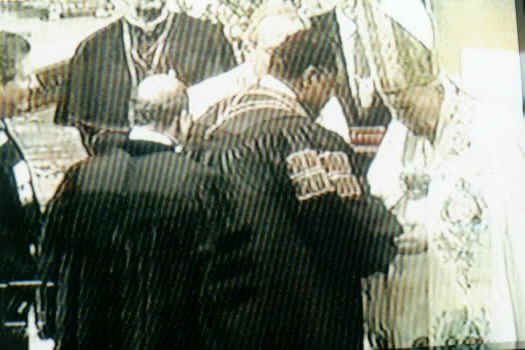
At that meeting, pastor B.T. Rice of the Northside SDA Church (pictured on the right) presented a proclamation and a banner to the Pope entitled "Faith Beyond Walls" promoting the newfound unity between the two churches. Exemplifying the close bond between Seventh-day Adventism and the Papacy, Pastor Rice spoke to the congregation, addressing the Pope with the reverent title, "Pope, your Holiness."4

In 2000, after 15 years of "dialogue aimed at better understanding of the teachings and practice of the Catholic and the Adventist Churches," the SDA Church signed a "pact" with the Papacy in Warsaw, Poland.5 Apparently the SDA Church is not very "obscure" to the Catholic Church, having spent 15 years in "dialogue aimed at better understanding."
In 2002, "Bert Beach of the Seventh-Day Adventists" was invited to attend a Vatican "inter-religious observance" at Assisi.6 On October 12, 2016, SDA Religious Liberty leader Ganoune Diop attended an ecumenical meeting at the Vatican where he met Pope Frances (as pictured on the left).7 Rather than being "obscure" to the Catholics, the Seventh-day Adventists are active partners with Rome in promoting the goals of ecumenical unity.
SDA Corporation Was a Business Partner with Roman Catholicism
In 1995, PorterCare Adventist Health System of Colorado, USA, entered into a "partnership" with the Roman Catholic Sisters of Charity Health Services and formed a new corporation called Centura Health. The Merger was publicized in the Catholic Newspaper Our Sunday Visitor.8 The joint venture ended in 2023, after 27 years of partnership.
SDA Church No Longer an "Obscure" Sect
The SDA sect is anything but obscure to the Catholics. In 2024, the SDA sect boasted a membership of 23,684,237 adherents. At that time it was actively working in 212 nations.9 SDA adherents outnumber Catholics in at least five of those nations.10 Adventists claim their healthcare system is "the largest not-for-profit Protestant healthcare provider" in the United States.11 Seventh-day Adventists also have the "largest Protestant Christian school system in the world" with "a total of 6,709 educational institutions operating in over 100 countries around the world with over 1.2 million students worldwide."12
Today, Seventh-day Adventism is well-known through-out Christianity for its eccentric teachings, its claim of exclusive ownership of "the truth," and its agressive proselytizing of other Christians. To illustrate how well they are known to Catholics, the Catholic Church's web site publishes more than a dozen articles challenging what they describe as the "strange ideas" of Seventh-day Adventism.13 Seventh-day Adventism and its "strange ideas" are very well-known to Catholics.
Conclusion
In a vision, Ellen White said the "saints" who would be persecuted for their beliefs in the Sabbath were "obscure" to the Catholics. If one accepts this as a true vision from a true prophet, then one must also concede that Seventh-day Adventists are not "the saints." It is, in fact, impossible for them to be "the saints" because they are by no means "obscure" to Catholicism. The SDA sect is well known to Catholicism and to the Pope. The two organizations dialogue together, work on ecumenical goals together, exchange gifts with each other, and even do healthcare business together.
Either Ellen White's vision was a falsehood, or else "the saints" are not Seventh-day Adventists. You decide.