
The Sword of Fire Myth
By ,
Ask any Seventh-day Adventist [SDA] about the 1902 Battle Creek fires, and you will likely hear a stirring testimony: that God's chosen messenger, Ellen G. White, predicted the destruction of the denomination's most prized institutions — the Review and Herald publishing house and the Battle Creek Sanitarium — before a single ember had fallen. It is a compelling story. A prophetess warns of divine judgment. The institutions burn. Ellen White's prophethood is forever vindicated. Case closed.
Except, of course, it isn't.
Like many of Adventism's most cherished narratives, the legend of Ellen White's "Battle Creek prophecy" turns out to be considerably more interesting — and considerably less miraculous — once one actually examines the historical record. What one finds when the curtain is pulled back is not simply a prophet warning of imminent destruction, but rather a tangled web of church power struggles, suspiciously convenient timing, possible arson, and — perhaps most damning of all — a prophetess who wrote her most dramatic "predictions" after the buildings had already burned to the ground.
I. Power Struggle Between Daniells and Kellogg
To understand the fires of 1902, one must first understand what was happening inside the SDA sect at the time — because what was happening was nothing less than an all-out, bare-knuckled corporate power struggle. This was not a gentle theological disagreement settled over Sabbath potluck. This was an institutional demolition derby, and the stakes were the very soul — and real estate — of the SDA Church.
On one side stood General Conference President Arthur G. Daniells, backed by the prophetess Ellen White, her son W.C. White, professor W.W. Prescott, and evangelist S.N. Haskell. On the other stood Dr. John Harvey Kellogg — physician, health reformer, breakfast cereal pioneer, and by any honest accounting, the most powerful single individual in the sect at the time. At the height of his influence, Kellogg employed over 2,000 workers at his Battle Creek institutions alone, while the entire rest of the General Conference employed only 1,500.1 That's right. The doctor running the sect's primary hospital complex had more employees than the sect itself.
Kellogg's allies included the firebrand Alonzo T. Jones, a General Conference Committee member and 1888 Messenger formerly endorsed by Ellen White. However, as his doubts about White's gift grew, he drifted into Kellogg's orbit.
The board of the Review and Herald was packed with men who prioritized the Review's commercial success and Kellogg’s medical "empire" over Daniells' desire for decentralization. I. H. Evans, President of the Review & Herald, was a pragmatist who often sided with Kellogg's "commercial" vision. He initially pushed to publish The Living Temple because it would be a bestseller and bring in much-needed revenue for the struggling plant. W. C. Sisley, Vice President, was a close associate of Kellogg’s who had designed and built many of the medical missionary buildings. His loyalty was firmly with the "Battle Creek" establishment. A. R. Henry, a former leader who had earlier been "dismissed" after defying Ellen White, sided with Kellogg and still held significant sway. Perhaps the most significant ally Kellogg had at the Review and Herald was his own brother, Henry W. Kellogg, who served as the Business Manager and Treasurer of the publishing house. These men were anti-Daniells and viewed the General Conference’s attempt to control the Review as an overreach.
To consolidate his own power within the SDA corporation, Daniells was desperate to break Kellogg and his allies. The battleground was Battle Creek, Michigan — the denominational nerve center that Daniells was hell-bent on abandoning. His goal was simple: relocate the General Conference headquarters and the Review and Herald publishing house to the Washington, D.C. area, away from Kellogg's gravitational pull. As Daniells plainly put it in a letter that year: "Dr. Kellogg has an imperious will which must be broken."2 Not negotiated with. Not accommodated. Broken.
The Theological Powder Keg: The Living Temple
Layered on top of the corporate turf war was a theological crisis that gave the conflict its religious veneer. When Daniells arrived from Australia to take the General Conference reins in 1901, he was, by his own account, supposedly alarmed to hear expressions floating around Battle Creek like "a tree-maker in the tree" and God "in all of nature."3 Kellogg had been developing and promoting what his critics called pantheism — the idea that God was not a personal being enthroned in heaven, but was instead diffused through all of nature and even within the human body itself. W.A. Spicer, a newly appointed General Conference secretary who had just returned from years of missionary work in India, labeled it as the philosophical backbone of Hinduism and was reportedly stunned to find it being taught in Battle Creek.4 Of course, Kellogg and his allies dismissed these charges as ludicrous, viewing them as more politically-inspired than theologically accurate.
By 1902, Kellogg had completed his book, The Living Temple. He proposed selling 500,000 copies to help finance the rebuilding of the Sanitarium and retire other SDA church debts. This would have been a massive financial boon for the SDA sect. Based on 1903 advertisements, Kellogg set the price at $1.00 per copy. Kellogg offered to cover the publishing costs himself (through the Sanitarium’s resources and his own royalties). Thus, the entire $1.00 from every sale was pure profit for the sect. Had 500,000 copies been sold, the revenue would have been $500,000 or around ~$19,000,000 in today's dollars. That is nearly as much as the SDA sect collected in global annual tithe in 1903!
Daniells privately conceded the book was a fundraising masterstroke. However, there was one small problem: Kellogg. If Kellogg had successfully moved 500,000 copies of The Living Temple, he wouldn’t have just been a famous doctor anymore—he would have effectively become the de facto leader of the SDA movement, rendering Daniells and the General Conference (GC) administration virtually obsolete. He would have eclipsed Ellen White as the sect's leading author by a large margin. Her books were only selling at one tenth that rate. Once Daniells and White realized they would be marginalized, they were ready to destroy Kellogg at any cost. The Living Temple itself would provide the perfect weapon for them to do just that.
After Kellogg completed the manuscript, Professor W.W. Prescott carefully reviewed the book, providing a six-and-half-page report of corrections needed, but never even hinted that the book contained pantheistic ideas (see Kellogg Interview, pp. 9-11). Daniells, a church administrator and not a theologian, took it upon himself to start criticizing the book, claiming that Kellogg was "grazing about very close to pantheism."5 His ally, W.W. Prescott then discovered some questionable passages in which Kellogg wrote that "God is the explanation of nature — not a God outside of nature, but in nature" and that "God himself enters into our bodies in the taking of food."6 Based on their insistence, the General Conference Committee voted to suppress the book. For a moment, it looked as if Daniells had succeeded in crushing Kellogg.
Kellogg, undeterred, ordered a private printing of 5,000 copies through the Review and Herald press, who were happy to comply. The plates were set, the copies were printed and waiting — and then, on December 30, 1902, the unthinkable happened. The Review and Herald building burned to the ground, destroying both the plates and the printed copies.7 What a coincidence!
The 1901 Session: Where It All Boiled Over
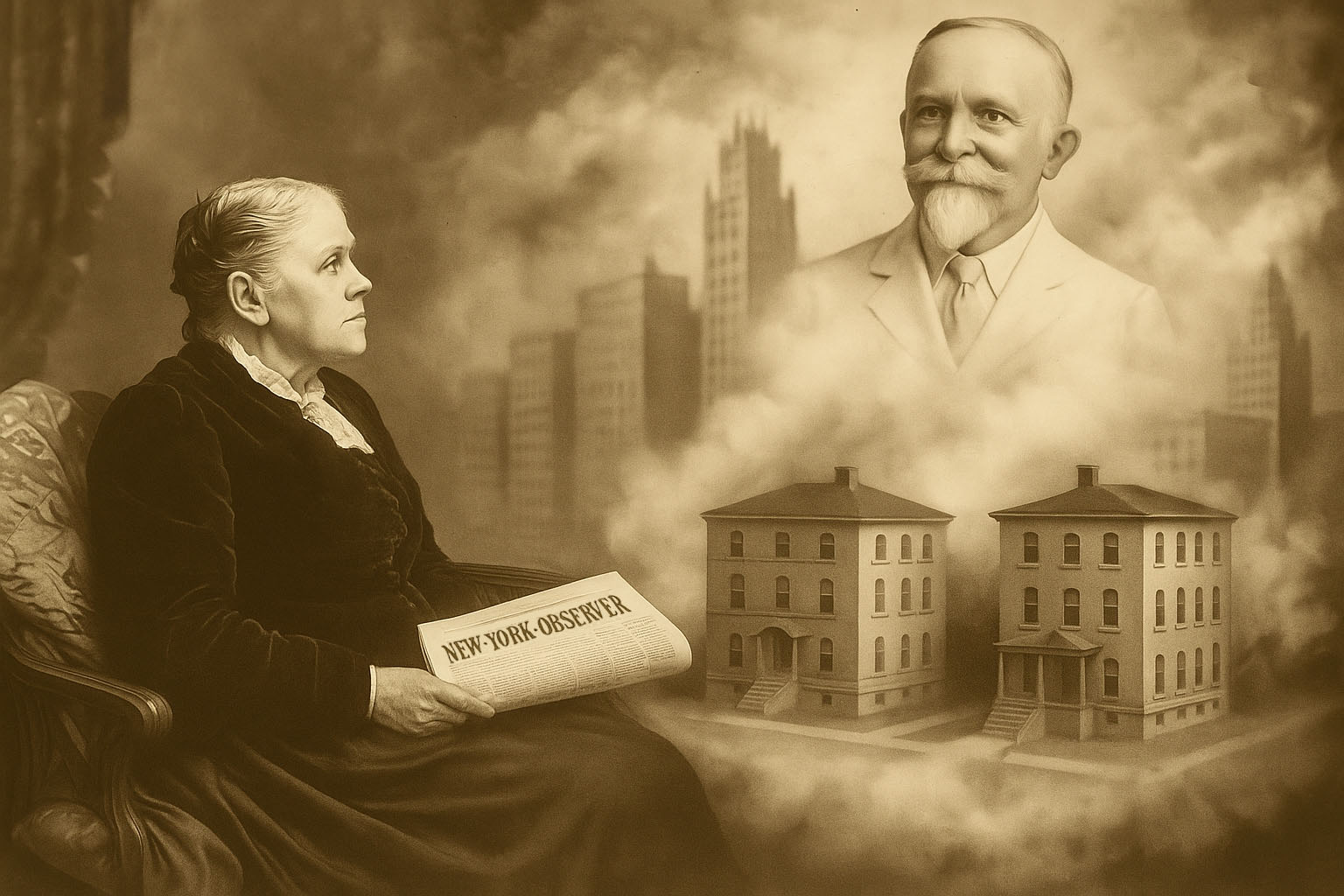
Mrs. White's problems with Battle Creek began after the 1888 General Conference session in Minneapolis where she reversed her vision-inspired position on the law in Galatians 3 and sided against the sect's "old guard." These men were, for the most part, stationed in Battle Creek. The battle only intensified after sect leaders exiled her to Australia. Her letters to leaders in Battle Creek and at the Review and Herald reveal her unmitigated rage at their practice of ignoring her books, placing other books ahead of hers, paying themselves salaries consistent with their business (more than the minister's salary that she was paid), and other complaints. It was not uncommon for her to warn them of judgement, as she did for nearly all who opposed her will. These warnings never entailed any specifics, and similar warnings can be found throughout her writings.8
By 1901, Ellen White returned to the United States and was ready to confront those who opposed her will in Battle Creek. All her pent-up emotions were about to flare up into an inferno. The flashpoint was the 1901 General Conference Session — a meeting so contentious that Ellen White herself publicly denounced Kellogg from the floor. Conscious of her rapidly declining influence in the sect, she lashed out like a cornered animal against her chief Battle Creek rival. She had, according to reports, spent hours in what she described as agonized prayer before delivering a blistering rebuke of the doctor's consolidation of power — power that she so desperately craved. Following Daniells' lead, she warned that the sect was making a mistake by centering so many institutions in Battle Creek where Kellogg was so beloved. She lashed out at Kellogg's success in drawing so many workers to his sanitarium:
For the last fifteen or twenty years, light has been given that our people, by crowding into Battle Creek, have been leaving their home churches in a weak state.9
It was also at this juncture that the Review and Herald's commercial expansion became a source of rage. By 1901, the Review had grown into the largest printing operation in the state of Michigan,10 and was taking on outside commercial work to accommodate its growing presses. Ellen White was incensed, denouncing the publication of what she called "soul-destroying theories of Romanism and other mysteries of iniquity."11 In October of 1901, she fired off a letter to the Review's management that containing this remarkable passage:
The Lord looks upon this action on your part as helping Satan to prepare his snare to catch souls. God will not hold guiltless those who have done this thing. He has a controversy with the managers of the publishing house. I have been almost afraid to open the "Review," fearing to see that God has cleansed the publishing house by fire.12
Five months later, the Sanitarium burned. Fourteen months after that letter, the Review and Herald burned. Whether one sees the hand of God in that, or the hand of someone who had read Ellen White's letters and decided to be the sword of God, is a subject of ongoing debate. For now, it is sufficient to note the context: this "prophecy" was not issued into a theological vacuum. It was issued in the midst of one of the most bitter institutional brawls in SDA history, by a woman who was squarely allied with the faction that stood to benefit most if those buildings were torched.
Daniells, for his part, was not subtle about his objectives. For the General Conference's reorganization effort, he declared that the "guiding principle had been the decentralization of authority."13 Decentralization wasn't about giving more power to local leaders. It was about moving the power center of the sect out of Battle Creek, away from Kellogg's influence. When those buildings conveniently burned, Daniells collected the insurance proceeds and relocated headquarters to Takoma Park, Maryland — precisely where he had wanted to go all along.
This is the context in which Ellen White's supposed "predictions" must be evaluated. Not as the words of a detached heavenly messenger delivering messages from on high — but as the rhetoric of a deeply invested partisan in a brutal power struggle, who happened to be on the winning side when the smoke finally cleared.
II. The Timeline Problem: Prophecy by Hindsight
The SDA legend of Ellen White "predicting" the Battle Creek fires rests on a foundation that begins to crack the moment one actually examines the dates on her letters. There is precisely one documented statement Ellen White made before the fires: her October 1901 letter threatening that God might "cleanse the publishing house by fire."14 No other specific forewarning of judgement by fire was written until after the buildings were already smoldering ruins. As noted earlier, White constantly threatened individuals she thought were opposing her with "judgment," so those statements have no bearing on this discussion.
The One Genuine Pre-Fire Statement — And What It Actually Was
To understand Ellen White's famous fire comment, one must read the letter that contains it in its entirety — not merely the single sentence that SDA apologists have polished into a prophetic credential. The full letter, read to the Review and Herald board in November 1901, is a document of extraordinary fury. It is a scorched-earth broadside against the Review's management, written by a woman engaged in a bitter power-struggle with them.
Her grievances were institutional, financial, theological, and deeply personal. She was furious that the Review was printing commercial non-SDA material she considered spiritually contaminating — "the soul-destroying theories of Romanism and other mysteries of iniquity."15 She was furious that General Conference President Daniells had written to her requesting approval for an addition to the Review's building — a request she shot down with blunt contempt: "No, no, no."16 She was furious that church resources were being concentrated in Battle Creek—where Kellogg was king—instead of dispersed to mission fields of her choosing. She accused the Review's managers of transgressing God's law, betraying His cause, making the institution "a den of thieves," and corrupting the minds of young workers by placing "Satan's sentiments" before them.
It is at the boiling climax of this tirade — not as a calm prophetic utterance, but as the rhetorical peak of a blistering institutional rebuke — that she drops the fire line: "I have been almost afraid to open the Review, fearing to see that God has cleansed the publishing house by fire."17
Read in context, this is not a prophecy. It is a threat. It is the literary equivalent of a furious parent telling a child, "Keep this up and you'll see what happens." The letter goes on to warn: "Unless there is a reformation, calamity will overtake the publishing house, and the world will know the reason."18 This is conditional language — the standard grammar of prophetic warning, not prophetic prediction. She was not announcing a future event. She was issuing an ultimatum, and the threat of fire was the rhetorical cudgel she chose to do it with.
Fourteen months passed between that letter and the fire. During that entire period, no new specific warning was issued, no date was given, no building was named, and no action was taken by the sect to protect or evacuate its facilities on the basis of divine forewarning. If God had genuinely revealed the coming destruction of the sect's most important publishing facility, one might reasonably expect a somewhat more urgent response than fourteen months of complete silence.
The "Sword of Fire": A Dream Told After the Fact
The crown jewel of the Ellen White prophecy claim is her famous vision of "a sword of fire stretched out over Battle Creek." This is the image that has electrified SDA storytelling for over a century. Whether or not Mrs. White actually had a divine vision is anyone's guess. The crux of the problem is this: she did not report it in writing until after the fact.
The earliest recorded written account of this appears in Letter 37, 1903 — a letter written February 28, 1903, after both major fires had already occurred. She interpreted the fire as a judgment for SDAs not obeying her:
This was before the plant was burned. ... I was instructed that there was so manifest a disregard of the word of God, given in the Testimonies of His Holy Spirit, that the Lord would turn and overturn, visiting Battle Creek with His judgments.19
Thus, after the fact, she floated a self-serving claim that the fires were a result of disobedience to her testimonies. The message was clear. Obey Ellen White or you too will get burned.
Arthur White, dates the vision to the fall of 1902 — specifically around the Elmshaven council meeting of October 19, 1902.20 The Review and Herald burned on December 30, 1902. That means, at best, the vision occurred roughly ten weeks before the fire. However, the first written record of it appeared after the fire, in the letter above dated February 28, 1903. Therefore, there is no way to confirm that the vision actually occurred before the fire.
Ellen White essentially confirmed this chronology at the April 1903 General Conference session, where she described the vision this way:
I was in distress while the council was in session, laboring to get the right matter before the meeting... It was then that I saw the representation of danger — a sword of fire turning this way and that way. I was in an agony of distress. The next news was that the Review and Herald building had been burned by fire.21
Notice the sequence she describes: council meeting, then vision, then news of the fire. But there is no contemporaneous letter, no telegram, no published statement, no warning of any kind sent to Battle Creek in the ten weeks between October and December 1902. The vision — if it occurred at all — was apparently kept entirely to herself until after the buildings burned. A warning that is never delivered to the people it is meant to warn is not a warning. It appears more like a memory conveniently invented after the fact to boost her own prophetic standing.
The Post-Fire Letter Avalanche
After the fires occurred, Ellen White's pen became remarkably productive on the subject of prophetic forewarning. Letters piled up, each one establishing — retrospectively — that she had seen all of this coming. The documented paper trail tells a story of its own:
February 28, 1903 — Two full months after the Review fire, Ellen White wrote her first letter on this subject to her allies, Brother and Sister Haskell, claiming that "in the fall" she had seen a "sword of fire" over Battle Creek."22 This is the first time this vision appears in writing.
April 14, 1903 — In the Review and Herald, Ellen White declared: "Many here know what I said to them — that we must not center so much in Battle Creek; that if we did not take heed, God's judgments would visit Battle Creek."23 This is a classic rhetorical maneuver: the vague, undocumented claim that she had warned people beforehand. "Many here know" is not a citation. It is an appeal to collective memory that cannot be verified, challenged, or cross-examined. Not a single pre-fire letter containing this specific warning has ever been produced.
May 1, 1903 — Writing to the Battle Creek Church: "God's judgments have fallen upon our institutions in Battle Creek."24 This is purely retrospective theological interpretation. Declaring a fire to be "the judgment of God" after it has occurred requires no prophetic gift whatsoever. Many "preachers" in every religion have done exactly this after any disaster.
July 1, 1903 — Writing to Daniells and Prescott to urge the move to Washington, Ellen White declared: "Seeing that Battle Creek has been visited in so signal a manner by the judgments of God, I know whereof I speak."25 Note the direction of the logic carefully. She is using the fires — now six months in the past — as retroactive proof that her counsel to relocate to Washington was divinely ordained. The fires have ceased to be events she predicted and have become a credential for a political position she and Daniells already held before a single building burned.
October 1903 — Writing to physicians and administrators: "The judgments of God have been visited upon Battle Creek."26 Ten months after the Review fire. The same post-hoc vein, still being mined.
The Unfalsifiable Prophet
There is a principle in logic called falsifiability: a claim is only meaningful if it could, in principle, be proven wrong. Ellen White's Battle Creek "prophecy" fails this test completely. Her pre-fire statement was buried in an angry institutional letter and was vague enough to apply to virtually any calamity. Her post-fire letters claimed she had warned people beforehand, but offered no verifiable documentation. Her "sword of fire" vision was first committed to writing only after the buildings it supposedly foreshadowed had already burned.
Arthur White admitted a detail that cuts to the heart of the matter. When the Sanitarium fire occurred in February 1902, Ellen White received the news by telegram. She had apparently written a manuscript counseling against rebuilding in Battle Creek, but it "was not sent to Kellogg at that time."27 That is the official SDA account. The prophetess had a relevant message, and she sat on it.
A prophet who withholds her prophecies until after the predicted events occur has not demonstrated foreknowledge.
III. A Very Convenient Fire
The ancient Roman legal principle cui bono — "who benefits?" — is among the first questions any competent investigator asks when a crime is suspected. When the Review and Herald Publishing House burned to the ground on the night of December 30, 1902, it is a question worth asking with considerable seriousness. Because the list of people who stood to benefit from that fire is not long. It is, in fact, remarkably short — and every name on it sits squarely within the Daniells-White faction of the SDA power structure.
The Book That Burned
To appreciate just how convenient the Review fire was, one must understand precisely what was sitting inside that building when it ignited. Dr. Kellogg had written The Living Temple — a brilliant work on physiology and theology. The Review thought it would be a best-seller. Given Kellogg’s international fame as a physician, the Review expected the book to be a massive success both inside and outside the denomination. The Review was facing massive debt, and the Review Board, led by I.H. Evans, saw the book as a "financial savior." They calculated that if they sold 50,000 copies, the profits could pay off a significant portion of the Sanitarium’s rebuilding costs. This would solidify Kellogg's standing within the SDA denomination.
The Daniells-led General Conference had reviewed and formally voted to suppress Kellogg's book due to what they characterized as pantheistic content.28 Kellogg, undeterred and characteristically defiant, withdrew the book from consideration as a church venture and placed a personal order with the Review and Herald to print 5,000 copies at his own expense.29 The plates were set. The galleys were ready. The copies were printed and awaiting distribution.
On the verge of Kellogg's victory, the building burned to the ground — with the plates and all printed copies inside it.30 Kellogg's and the Review's defiance of Daniells was utterly defeated.
The loyal SDA, of course, will read this as proof of divine intervention. God stepped in to beat down those who dared to disobey the General Conference. However, thinking readers will realize the powerful motives behind this event. Arson investigators know that destruction of materials in a fire is a primary indicator of motive.
The Inspection That Should Have Made It Impossible
The timeline of December 30, 1902 adds another layer of suspicion that SDA historians have quietly acknowledged. The official account, published in the Review and Herald of January 6, 1903, confirms that on the very morning of the fire, Fire Chief W.P. Weeks and the building's head electrician conducted a thorough, room-by-room inspection of the entire facility — examining the wiring, the machinery, and all potential ignition hazards — and pronounced everything in "satisfactory condition." The inspection was conducted specifically because insurance coverage was up for renewal on January 1. It was insured for $100,000 (roughly $3.8 million today). While this did not cover the full value of the plant and inventory, it was a massive "exit fund."31
The building was declared fire-safe in the morning. By 7:30 that evening, it was an unquenchable inferno. The fire started in the basement engine room — precisely the area that would have been most accessible to someone who entered after the inspection was complete and the day shift had gone home.32 A skeleton night crew was present, but the building was largely empty. Daniells himself was working late in his office in the adjacent West Building — the one structure that did not burn. What an amazing coincidence!
Fire investigators will recognize the pattern immediately. A building declared structurally safe in the morning, igniting catastrophically in the evening from the basement, with maximum destruction of the main structure while a single adjacent building — the one housing the General Conference offices — survives intact. These are not the hallmarks of an accidental electrical fire. They are the hallmarks of a fire deliberately set after normal business hours, in the most combustible area of the building, by someone who knew the layout and waited for the inspection to clear the premises.
The Fire Chief's Damning Observation
Perhaps the most striking piece of physical evidence comes from Fire Chief Weeks himself. After fighting not just the Review fire but multiple SDA institutional fires in Battle Creek, Weeks made a statement that was preserved in a letter from contemporary witness B.P. Fairchild to Arthur L. White, written in 1965: "There is something strange about your SDA fires, with the water poured on acting more like gasoline."33
The SDA faithful have historically interpreted this remark as evidence of the supernatural — divine fire that water could not quench. The more forensically alert reader will recognize it as a trained fire professional's description of accelerant behavior. When water applied to a burning structure appears to intensify rather than suppress the flames, it is a classic indicator that a flammable liquid accelerant — such as gasoline, kerosene, or industrial solvent — has been used. The Review and Herald was a printing facility; it stored ink, solvents, and industrial chemicals in considerable quantity, any of which could have been exploited by someone who knew the building. The fire's behavior, as described by the chief who fought it, is entirely consistent with accelerant use.
It is worth pausing here to note the provenance of this quote. It was not preserved by a critic of the sect. It was preserved by Arthur White — Ellen White's own grandson — who included it in his authorized account of the fire. Even the official SDA biography cannot escape the fire chief's bewildered observation that something about these fires was not normal.
Dense, Oily Smoke — and a Basement Origin
Contemporary accounts of the fire's initial stages describe "dense, oily smoke" filling the hallways before the flames became visible.34 Oily, dense smoke is precisely the kind produced by petroleum-based accelerants igniting in an enclosed space. Standard paper and wood fires produce grey or brown smoke. Black, oily smoke suggests something far more flammable was burning in that basement before the fire spread upward through the elevator shafts and ventilation system to consume the rest of the building.
The official SDA account acknowledges the fire originated "in the basement in the original engine room, and under the dynamo room."35 A basement engine room, after hours, after a morning inspection, producing oily black smoke before flames were reported: this is either an extraordinary coincidence or the starting point of a deliberately set fire by someone who knew exactly where to place it for maximum effect and minimum early detection.
The Perfect Storm of Motive, Timing, and Opportunity
Pulling back to view the complete picture, what emerges is a confluence of motive, timing, and opportunity that strains the credibility of any purely accidental explanation. The Daniells faction had every institutional reason to want the Review out of Battle Creek: it would break Kellogg's grip on the sect's publishing infrastructure, force the relocation to Washington that Daniells had been agitating for, and — as a bonus — destroy the printed copies of a book that was causing a theological crisis. The fire accomplished all three objectives simultaneously.
The timing was exquisite. Kellogg's book was ready to ship. The General Conference had just failed to stop it through legitimate means. The insurance was days from renewal, guaranteeing that the building would be covered when it burned. The morning inspection provided a clean alibi: the building was certified safe, removing any question of negligence. The fire started after hours, in the basement, in a building that had just been pronounced structurally sound. The adjacent General Conference offices survived untouched.
No one was ever arrested. No formal arson investigation produced charges. The SDA corporation collected the insurance proceeds and relocated to Takoma Park, Maryland — precisely where Daniells had always wanted to go. Ellen White immediately began writing letters claiming she had foreseen all of this. Kellogg's book was eventually republished by an outside printer in a run of only 3,000 copies, its momentum broken, its mass distribution permanently derailed.36
Everyone on the Daniells-White side of the power struggle got exactly what they wanted. The building was torched and Kellogg humiliated. And everyone was left wondering, was Daniells the real sword of fire?
IV. The Sanitarium Fire: Kellogg's Empire Ablaze
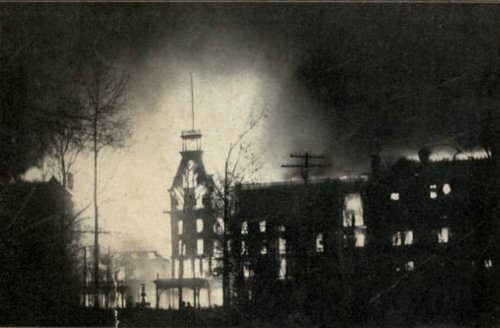
The Battle Creek Sanitarium fire of February 18, 1902 preceded the Review and Herald fire by ten months, and it is in many ways the more instructive of the two events. The Sanitarium was not merely a hospital. Under Dr. Kellogg's three decades of direction, it had become the crown jewel of the entire SDA medical empire — a world-renowned complex that attracted the rich and the famous from across the country. Mary Todd Lincoln had been a patient. Ira Sankey, the celebrated evangelist, was actually in the building the night it burned.37 The Sanitarium was Kellogg's personal monument. It was the most visible symbol of his dominance over the denomination that Daniells was determined to break.
At 3:48 a.m. on February 18, a guest named Joseph Kein and his wife were awakened by a strange thumping sound. Opening their door, they found black smoke drifting down the corridor.38 By the time fire crews arrived, the building was already beyond saving. The fire tore through the elevator shafts and ventilation system with terrifying speed, engulfing the five-story main structure and then jumping across the street to destroy the hospital building as well. In two hours, it was over. The greatest fire in Battle Creek history had reduced Kellogg's magnificent "San" to rubble. The property loss was estimated at between $300,000 and $500,000 — against a total insurance payout of just $148,500.39 The Sanitarium was catastrophically underinsured.
This last point deserves emphasis. The standard motive cited in insurance arson cases is the desire to collect on an over-insured property. The Sanitarium was the opposite: its insurance covered less than half its value. If someone set the Sanitarium fire to collect money, they were spectacularly bad at financial planning. But if someone set it to destroy Kellogg's institutional power base and humble him in the dust, then the fire was a roaring success.
An Explosion of Chemicals at 4 a.m.
Contemporary newspaper accounts of the Sanitarium fire are informative. A report published the following day in the Columbus Enquirer-Sun stated matter-of-factly that "the cause of the fire is said to be an explosion of chemicals."40 Other accounts placed the point of origin in "a bath room in the lower part of the building, probably about the furnace."41 A medical facility the size of the Battle Creek Sanitarium stored considerable quantities of pharmaceutical and chemical compounds — precisely the kind of materials that, if deliberately ignited, would produce a fast-moving, difficult-to-suppress fire of the sort that Chief Weeks later described as behaving like accelerant.
The fire's behavior was consistent with this. It "got beyond control and into the elevator shaft," reported one witness, after which "stopping it then was beyond all human agency."42 The flames "shot up the elevator shaft to the roof like rockets" and the building was, within hours, a total loss. Rapid, vertical spread through elevator shafts and ventilation systems — the same pattern seen in the Review fire ten months later — is a known characteristic of fires in which an accelerant has been used to establish a fast-burning initial fuel load in a lower section of a building.
It also bears noting that Kellogg was conveniently absent. He was traveling on the West Coast when the fire broke out, learning of it when his train reached Chicago on the return journey. He had no opportunity to fight the decision-making that immediately followed the disaster.43 Before he arrived, newspapers were already reporting that the new Sanitarium would be rebuilt in Berrien Springs — away from Battle Creek, exactly as Daniells and Ellen White desired. Kellogg arrived home at 5 a.m. the next morning and immediately convened a board meeting to reverse that narrative, insisting on rebuilding in Battle Creek bigger than before.44 He would spend the next year defying Ellen White and doing exactly that.
The Bellboy Who Confessed — Then Didn't
The most explosive piece of human evidence in the entire Battle Creek fire saga is a detail that SDA historians have handled with extraordinary delicacy: an SDA bellboy who worked at the Sanitarium confessed to setting the fire — and then recanted.45
Medical historian Howard Markel, whose extensively researched biography The Kelloggs: The Battling Brothers of Battle Creek examined the fires in considerable depth, noted that suspicions about the fires have never fully dissipated. As the Adventist Today noted, "even to this day suspicions still linger that the Elders were behind the blazes of these two buildings in Battle Creek, if not directly, but by inciting one of the faithful to carry out the destruction."46
A confession, followed by a recantation, is one of the most classically problematic patterns in criminal investigation. Confessions are recanted for many reasons — fear of prosecution, social pressure, church loyalty, threats from interested parties. In the context of a tightly knit religious sect whose most powerful figures had publicly declared the fires to be divine judgment, the pressure on any individual who had set or witnessed the setting of the fire to recant would have been immense. The confession happened. The recantation happened. Neither fact erases the other.
Ellen White: No Prediction, But Plenty of Explanation
It is critical to note what Ellen White did not do regarding the Sanitarium fire: she did not predict it. Not in any letter, not in any manuscript, not in any vision communicated to anyone before February 18, 1902. Her sole pre-fire comment referencing fire — the October 1901 letter threatening divine cleansing — was directed explicitly at the Review and Herald publishing house, not at Kellogg's medical institution.47 The Sanitarium fire, which occurred first, was not the subject of any documented prophetic warning whatsoever.
This is a problem that SDA apologists have quietly sidestepped. Ellen White's supposed prophetic credentials in the Battle Creek fire narrative rest almost entirely on the Review fire, because that is the one institution she had explicitly threatened in writing. The Sanitarium — Kellogg's house, the one that burned first — she never predicted at all. Yet SDA tradition bundles both fires together under the umbrella of her prophetic foreknowledge, as though a threat directed at one building in 1901 constitutes a fulfilled prophecy for a completely different building that burned more than a year earlier.
What Ellen White did do, five days after the Sanitarium burned, was write to the Druillards expressing concern that people would "put their own construction on this accident, and will act the part of Job's comforters, searching for something to condemn in Dr. Kellogg."48 Within weeks she had abandoned that posture entirely, interpreting the fire as divine judgment against Kellogg's institutional empire and issuing counsel against rebuilding.49
The Aftermath: A Rash of Convenient Fires
The Sanitarium and the Review and Herald were not the only SDA properties to burn in 1902. Over the course of that year, a number of other sect-owned facilities in Battle Creek were destroyed by fire as well. The cumulative effect of this concentrated wave of fires was the removal of the physical and financial obstacles that had prevented the relocation Daniells had been demanding. Daniells collected insurance proceeds and moved the General Conference headquarters to Takoma Park, Maryland.50 The denomination even chartered a new Adventist-owned Sanitarium in 1904, which opened in 1907 — the very year Kellogg was disfellowshipped.51
The fires solved, in a single year, every major institutional problem the Daniells faction had been unable to solve through legitimate governance. The buildings that symbolized Kellogg's power were gone. The insurance money funded the relocation. The theological crisis created by The Living Temple was deferred when the plates were incinerated. And Ellen White, who had threatened one of those buildings with divine fire fourteen months before it burned, spent the following year producing a steady stream of letters confirming that God had done exactly what she said He would do — to a different building than the one she mentioned, ten months before the one she did mention, without a single pre-fire warning issued to the institution she claimed divine foreknowledge about.
Four Theories, One Conclusion
Four explanations have been proposed for the Battle Creek fires.
- God destroyed the buildings to force stubborn SDAs to follow White's and Daniells' desire to relocate.
- Someone within the sect — an over-zealous believer inspired by White's rhetoric, or a more deliberate operative in Daniells' gang — wielded a literal sword of fire to torch corporate buildings and collect the insurance.
- Someone outside the sect, aware of the denomination's internal desire to relocate, and anxious to rid Battle Creek of the much-hated SDAs, helped things along.
- The fires were random accidents that coincided with extraordinary precision with the exact moment Daniells needed them most.
Any combination of the above explanations may be true. The reader is invited to evaluate these theories in light of all the evidence presented in this article: the confession and recantation, the accelerant-like fire behavior described by the fire chief, the basement origins, the chemical explosion reported at the Sanitarium, the destruction of Kellogg's book plates, the perfectly timed insurance renewal, the undamaged General Conference offices, and the fact that every single outcome of these fires benefited precisely one faction in a vicious institutional power struggle.
V. Aftermath: Fireproof Buildings, More Threats
When the smoke finally cleared over Battle Creek in 1902, the two most powerful men in the SDA power struggle responded in ways that revealed everything about their respective characters. Daniells triumphed and moved the General Conference to Takoma Park, Maryland, exactly as planned. Kellogg, defiant to the last, drew up architectural plans for a new Sanitarium on the train home from Chicago and immediately set about rebuilding bigger, better, and this time, explicitly fireproof.52
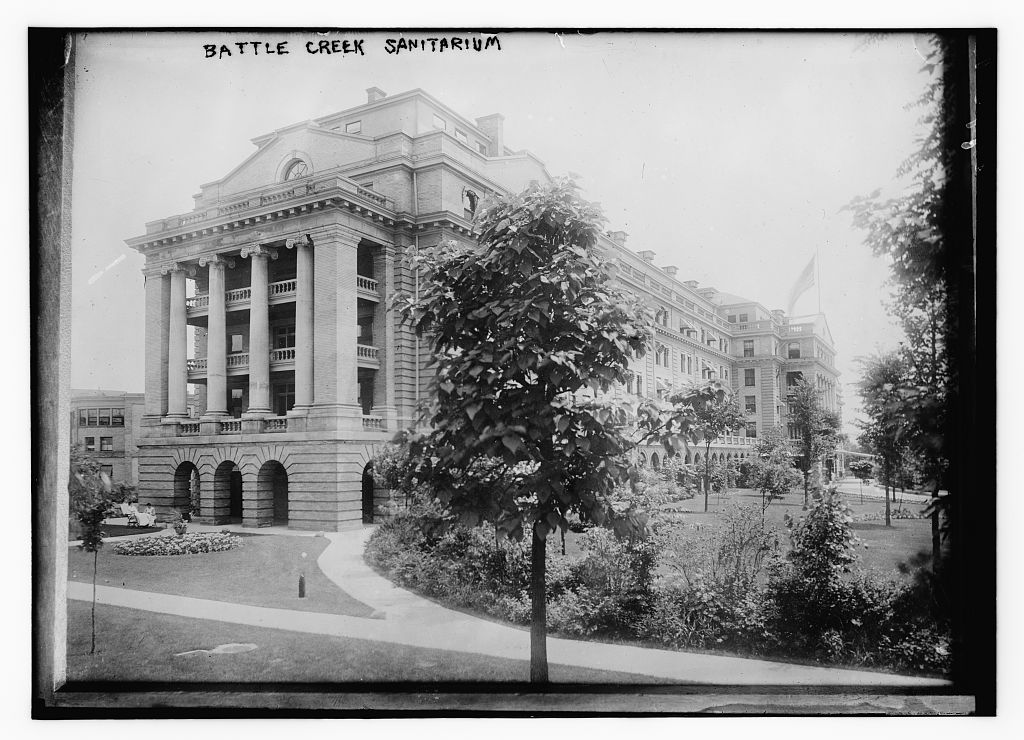
The new Battle Creek Sanitarium, which opened on May 31, 1903, was a six-story brick-and-concrete structure stretching 550 feet along Washington Avenue, with three wings, a solarium, a palm court, and accommodations for hundreds of guests.53 Kellogg had learned his lesson about how easily fires can be set. He built a monument that could not be burned down and is still standing today. He even built a fire station directly across the street. The implicit message was hard to miss. If any of Daniells' hoodlums wanted to drive Kellogg out of Battle Creek with fire, they were going to need a different strategy.
Just weeks before the new building was dedicated, the Sanitarium's wooden barn was burned to the ground. Ellen White's close friend and intelligence source, Lucinda Hall, was an eyewitness:
…had just returned to Rosetta's as the fire bell rang, and in a few moments a blaze appeared which we thought was East Hall. We started in that direction and discovered it was the barn. While passing the crowds I heard a woman's voice saying, ‘I hope they will not dynamite the new building.’ There seems to be a fear and uncertainty about everything. It was cruel work not only to burn up so many horses but to endanger the lives of two human beings, one barely escaping.54
The citizens of Battle Creek were not wondering whether God had burned the barn. They were wondering whether they would dynamite Kellogg's new "fireproof" building. The word on the street was not providence — it was arson.
Prescott: Wielding a Prophet He Didn't Believe In
Meanwhile, W.W. Prescott — Review and Herald editor, Daniells ally, and one of the chief proponents of the relocation campaign — delivered a remarkable address at the Battle Creek Tabernacle on May 18, 1903, published in the Review and Herald the following day. Standing before a congregation of SDAs he was trying to persuade to abandon Battle Creek, Prescott invoked Ellen White's authority with full rhetorical force:
Those who are familiar with the circumstances of our work and our institutions here, especially for the last ten or fifteen years, need not be reminded of the many words of warning and instruction which the Lord has sent to us through His chosen mouthpiece, until the judgment of God has fallen upon us for our failure to obey.55
"His chosen mouthpiece." Strong words from a man who, within a decade, would privately conclude that Ellen White was not verbally inspired by God at all. By 1910, when Prescott was asked to assist with revisions to The Great Controversy, the experience became, in the words of SDA historian Alberto Timm, "a decisive factor in leading Prescott to the assumption that the Scriptures were verbally inspired but not Ellen White's writings."56 By 1915 he was writing private letters expressing serious concerns about her inspiration. By 1919 he was openly questioning her authority at the SDA Bible Conference in Washington, D.C.57
In other words: the man who stood before the Battle Creek congregation in 1903 and declared that God had destroyed their institutions for failing to heed "His chosen mouthpiece" had, within seven years, privately reached the conclusion that the mouthpiece in question may not have been divinely chosen at all.
Yet Another False Prophecy
For her part, Ellen White showed no sign of retiring her judgment rhetoric once the relocation to Washington was accomplished. If anything, the fires of 1902 had demonstrated to her just how effective the threat of divine judgment could be as a tool of leverage. In 1905, emboldened by her success in trouncing Kellogg in round one of their battle, she amped up her rhetorical fire, obviously antagonized that Kellogg rebuilt and that SDAs were again funnelling money to his projects instead of her projects:
But the time is drawing nigh when the judgments of God will be more signally seen in Battle Creek. The cause of God has suffered great hindrance because the talents entrusted to His people have not been used in the work of proclaiming the truth... Saith the Lord, When I visit them for their iniquity, I will punish them for all their greed, and their worldliness, as the Gentiles. I will not spare, unless they repent.58
Was Kellogg's Sanitarium destroyed by God? Apparently Ellen White's "god" was incapable of demolishing a fireproof building. No divine visitation ever came. Kellogg and the impenitent citizens of Battle Creek went about their lives as usual, no longer afraid of this lying prophet.
In fact, in the years immediately following Ellen White's 1905 warning, Battle Creek did amazingly well. The cereal industry that Kellogg had incubated at the Sanitarium exploded into a national phenomenon. Kellogg's rebuilt sanitarium was lauded as the most celebrated medical institution in the Midwest. It was expanded and continued to run it for decades. Over time, Ellen White's failed prophecy was forgotten, buried beneath tales of a sword of fire.
The Prophet's Double Standard: A Study in Hypocrisy
In the years immediately following the Battle Creek fires, a long list of SDA institutions were destroyed by fire. Yet none of these later disasters were publicly proclaimed to be judgments of God.
| Year | Institution | Location | Impact | Ellen White's Response |
|---|---|---|---|---|
| 1904 | Hinsdale Sanitarium | Hinsdale, Illinois | Major fire caused significant damage shortly after the sanitarium was established | No declaration of divine judgment; no prophetic forewarning claimed |
| 1905 | New England Sanitarium | Stoneham, Massachusetts | A devestating fire destroyed the wooden portion of the main building | No declaration of divine judgment; no prophetic forewarning claimed59 |
| 1906 | Oakwood College | Huntsville, Alabama | The "Old Mansion House," the primary administrative and residential building, was completely destroyed | No declaration of divine judgment; institution personally supported by Ellen White |
| 1906 | Pacific Press | Mountain View, California | The April 18 earthquake and subsequent fire devastated the sect's primary West Coast publishing house | No declaration of divine judgment against a publishing house she had personally championed |
| 1907 | Walla Walla College | College Place, Washington | A massive fire destroyed South Hall, the boys' dormitory, a major blow to the Northwest educational system | No declaration of divine judgment; no prophetic forewarning claimed |
| 1908 | Knowlton Sanitarium | Quebec, Canada | Total loss after fire swept through the main structure | No declaration of divine judgment; no prophetic forewarning claimed |
| 1910 | Paradise Valley Sanitarium | National City, California | Fire destroyed the main building of a sanitarium personally selected and promoted by Ellen White | No declaration of divine judgment against an institution she had personally endorsed |
| 1911 | Caterham Sanitarium | Surrey, England | Devastating fire hit a key institution in the European medical missionary expansion | No declaration of divine judgment; no prophetic forewarning claimed |
| 1914 | New England Sanitarium | Melrose, Massachusetts | Major fire caused extensive damage to the main facility | No declaration of divine judgment; no prophetic forewarning claimed |
| 1915 | Mount Vernon Academy | Mount Vernon, Ohio | Fire destroyed the main academy building just weeks before Ellen White's death | No declaration of divine judgment; Ellen White died July 16, 1915 |
The pattern is impossible to miss. When the buildings of Kellogg, the Review and Herald management, and the broader Battle Creek establishment burned in 1902, Ellen White produced a sustained, year-long torrent of letters, articles, and public declarations interpreting the fires as divine judgment for disobedience, greed, and failure to heed her warnings. When SDA institutions that she had personally championed, or that were aligned with the faction she supported, burned in the years that followed — not a word. No divine judgment. No prophetic forewarning retroactively claimed. No sword of fire. Just silence.
Oakwood College was an institution for Black SDAs that Ellen White personally supported and promoted. When it burned, God apparently had nothing to say about it. Paradise Valley Sanitarium in California was a facility she had personally identified and endorsed. When it burned, the divine commentary was conspicuously absent.
Perhaps of greatest significance was the 1906 burning of The Pacific Press, the sect's West Coast publishing counterpart to the Review and Herald. On April 18, 1906, the brick building housing the facility in Mountain View was severely damaged by an earthquake. The management hastily built a wooden building to continue publication, but it was destroyed on July 20 by a fire of "unknown origin."60
Over $100,000 (roughly $3.5 million today) worth of finished books were lost. This included massive stocks of The Ministry of Healing (published just a year prior in 1905) and The Desire of Ages. Also burned up was the high-quality artwork that Ellen White had personally invested in for her books. Many of the original woodcuts and paintings used for the illustrations were destroyed. Ellen White? Silent.
The SDA owners — who had been printing some commercial material before the fire — were apparently spooked by these disasters. They no doubt recalled that sword of fire torching the Battle Creek publishing house. To avoid that sword in the future, they decided to print only SDA material henceforth. However, that move did not totally preserve them from fires. The International Branch of the Pacific Press—located in College View, Nebraska—was completely destroyed by fire in February 1916.61
In summary, the idea that institutional fires represent divine judgment for institutional sin was a principle White applied selectively to buildings belonging to people she was fighting with. It was never applied to buildings belonging to people she agreed with. This is not the behavior of a prophet delivering consistent divine truth. This is the behavior of a partisan leveraging supernatural authority selectively to advance her own agenda.
Conclusion

This fiery war had two clear winners. The first was A. G. Daniells. The destruction of Battle Creek accomplished what years of administrative struggle could not. His great rival, John Harvey Kellogg, was publicly humiliated, his institutional empire crippled, and the denomination’s center of power was successfully relocated to Washington, D.C. From that new headquarters Daniells consolidated authority and presided over the Seventh-day Adventist corporation for nearly two decades.

The other major beneficiary was Ellen White. Only a few years earlier she had returned from an embarrassing exile in Australia, her influence diminished and her authority increasingly questioned. The Battle Creek disasters provided the perfect opportunity to restore her standing. By framing the fires as divine judgments, she transformed institutional catastrophe into prophetic validation. The events were used to weaken Kellogg—her most popular rival within Adventism—and to redirect denominational “means” toward the projects and priorities she championed.
Adventist storytellers later romanticized the episode with dramatic language about a prophetic vision of a “sword of fire” hanging over Battle Creek. In retrospect, the symbol is fitting. The real sword that cut down Kellogg’s influence and reshaped the denomination was wielded not by heaven, but by Ellen White and A. G. Daniells, who skillfully used the fires to eliminate their rivals and secure supreme control over Seventh-day Adventism.