
Ellen White's Secret Stash
By , Oct.
Jesus, Matthew 23:3 NIV
During the 1800s medicinal tonics and tinctures in the United States were unregulated. Some contained poisons like mercury, while others contained narcotics such as opium or cocaine. In her writings, Mrs. White routinely denounced drug medicines and their ingredients. However, few Seventh-day Adventists are aware that Mrs. White had a secret stash of drug and herbal medicines that her family used and she prescribed to others.
Cholera Mixture
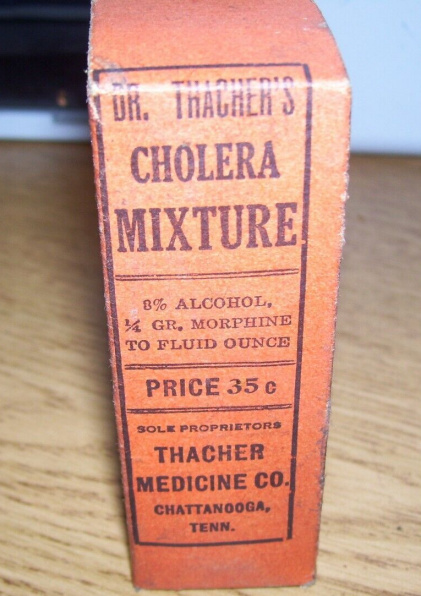
Cholera is a deadly disease and cholera epidemics killed millions of people worldwide in the nineteenth century. Mrs. White never had cholera, but James contracted it in 1865, and their son Edson got cholera in 1866. Thankfully, both survived. During that era, dubious health potions were concocted to relieve the symptoms of cholera. One concoction Mrs. White apparently viewed favorably was called Cholera Mixture. It was used to address the symptoms of cholera, such as diarrhea, vomiting, and nausea. This tonic typically included brandy and opium.1 In 1861, Mrs. White wrote to her helper Jenny Fraser asking her to make a pint of cholera mixture:
Jenny, please find the recipe, if you can, to make cholera mixture, and get the preparations to make only a pint. After you have made it, don’t part with it, but let any that wish make it themselves, as we have done. I do not wish to be without it. Father and mother will often want it to use.2
The fact that Ellen's parents used the cholera mixture "often," even when they did not have cholera, suggests that it was an important part of the family's routine healthcare regimen. It is uncertain from this statement whether Ellen intended to use the opium-laced tonic herself as a self-care measure during the frequent cholera outbreaks, but it is apparent that she was providing it for her parents.
In 1893, when a doctor came over to remove some of Ellen White's teeth, the doctor was so rattled after the operation that her hands were shaking. Sister White provided the ailing physician with "cholera mixture."3 It is apparent Mrs. White kept a supply of the opium-laced mixture in her home. She also took it with her on her travels. In 1898, she lamented that their supply of cholera mixture had been left behind in Brisbane, Australia.4
The following conclusions can be made about Mrs. White's use of cholera mixture:
- She kept a supply in her home
- She provided it to others (including her parents, who used it "often," and a visitor to her home)
- She kept a supply with her while traveling
- It is unknown if she used it on herself
Of possible interest to SDAs is that a small but significant number of individuals using opiates experience delusional thoughts and hallucinations.5 One of the more significant side effects of opiate usage is dysphoria or sadness, which could result in depression.6
Tells Others Not to Use Opium
In her writings, Sister White opposed the use of narcotics. She called opium a "poison" that "stupefies the brain, and unfits the mind for the service of God."7 She said the use of opium should be discontinued because it was "hurtful, and ruinous to the physical, mental, and moral powers."8 Despite the fact that she handled opium (as well as alcoholic drinks), she wrote a testimony to the church to do the opposite of what she was doing:
The only safe course is to touch not, taste not, handle not, tea, coffee, wines, tobacco, opium, and alcoholic drinks.9
She called opium and laudanum (a mixture of opiates and alcohol found in most cholera mixtures) "life and health destroying drugs."10 She warned that opium would reduce the "vital forces" of an individual because the body would have to expend energy "to rid the system of this poisonous drug."11 She admonished SDAs to "educate away from drugs," and instead treat the sick with "nature's remedies," which she outlined as "pure air, pure water, and healthful exercise." While she quietly gave drugs to others, she wrote that physicians should not "resort to drugs."12 She wrote:
Every additional drug given to the patient, whether it be opium, or some other poison, will complicate the case, and make the patient's recovery more hopeless. The drugs given to stupefy, whatever they may be, derange the nervous system. An evil, simple in the beginning, which nature aroused herself to overcome, and which she would have done had she been left to herself, has been made ten-fold worse by drug-poisons being introduced into the system, which is a destructive disease of itself, forcing into extraordinary action the remaining life-forces to war against and overcome the drug-intruder.13
In conclusion, while warning others to avoid the evil and poisonous opium, and while warning others to not even touch it, she kept a supply of cholera mixture at her home and administered it to others.
Mrs. Temple's Renovating Remedy
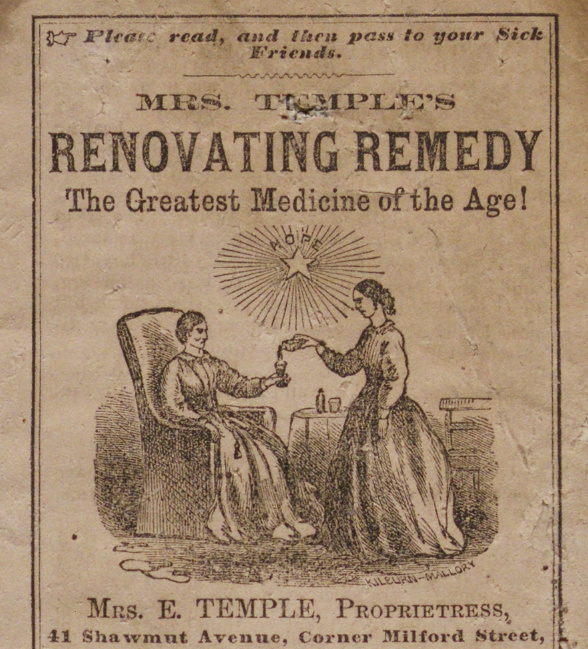
In the 1860s, SDA Elizabeth Temple marketed a tonic called "Mrs. Temple’s Renovating Remedy" which supposedly cured a wide variety of diseases. The actual ingredients are unknown, but according to Ron Graybill, Mrs. White had the recipes for both cholera mixture and Mrs. Temple’s Remedy handwritten in the back of her diary. According to Graybill, the cholera mixture recipe included brandy and laudanum. On the other hand, Mrs. Temple's recipe appears free of alcohol and drugs. Her recipe included Genetain [Gentian], bloodroot, cubebs, snakeroot serpent[aria, Aristolochia serpentaria L.].14 It appears Mrs. White thought highly of this tonic and prescribed it for others.
- In 1876, Mrs. White was headed to a camp meeting and asked her daughter-in-law Mary to send her "Mrs. Temples’ powder, about as much as you can put in envelope"15
- In 1882, Mary White writes that she will send Mrs. Temple's remedy to Sister White16
- In 1890, Mrs. White prescribed "Mrs. Temple's remedy" to "Rheba" and "Mabel"17
- In 1893, Mrs. White prescribed "Mrs. Temple's remedy" to "Brother Whalin"18
- In 1895, Mrs. White's secretary Fannie Bolton started using "Mrs. Temple's remedy," possibly at Mrs. White's request19
- One of Mrs. White's secretaries reported that Sara McEnterfer brewed the recipe for Mrs. White and that Sister White drank it "quite frequently"20
Although Sister White no doubt wished to improve the health of herself and others with this remedy, the ingredients raise some serious concerns. Snakeroot, which was used by Native Americans as a snake bite remedy, is a known carcinogen and can cause kidney damage.21 Because of safety concerns, this substance was banned from herbal remedies by the US FDA in 2000, and by the EU in 2004. Mrs. White's spirit guides apparently did not make her aware of just how dangerous longterm use of this substance was.
Another ingredient of interest to SDAs is cubebs. While cubeb (piper cubeb or Java pepper) has some health benefits, it is a spice from the pepper (piperaceae) family and is similar to black pepper, although somewhat milder. Anyone familiar with Mrs. White's writings will recognize that she was opposed to humans partaking of peppers. She wrote that "pepper, spices...irritate the stomach and make the blood feverish and impure."22 While admitting using pepper in her own diet at times, Sister White wrote in the sect's paper that pepper "should not be put into the human stomach."23 While she was prescribing pepper tonics for others, she wrote that peppers and spices were not good for the health:
This is the effect of the use of mustard, pepper, and spices, tea, coffee, and all of these drugs. For a time they seem to have a good effect, quickening the circulation, but it is not a healthful quickening, and a reaction is the result.24
Medical dictionaries list cubebs as a stimulant. Mrs. White wrote that "all stimulating food" does "only harm."25 If stimulating foods "do only harm," and cubebs are stimulating peppers, then why did she prescribe something that does "only harm" to ill people? On the other hand, if cubebs do indeed help sick people, then her statement about stimulants doing "only harm" is false.
For years SDA Sanitariums endeavored to follow Ellen White's inspired instructions by being careful to not provide any food or remedies to patients that contained peppers or spices. Likewise, in obedience to the prophet, many SDA families took black pepper off their tables. All the while, Mrs. White was not only using black pepper herself, but was prescribing pepper-laden tonics to others. In conclusion, even though she told others that pepper and spices were not good for health, would irritate the stomach and make the blood impure, and should not be put into the stomach, she prescribed a tonic containing cubebs to ill people and frequently used it herself.
See also