
The Year-Day Mirage:
The Thread that Unravels Great Controversy
By
Ellen White, Great Controversy (1888), 456
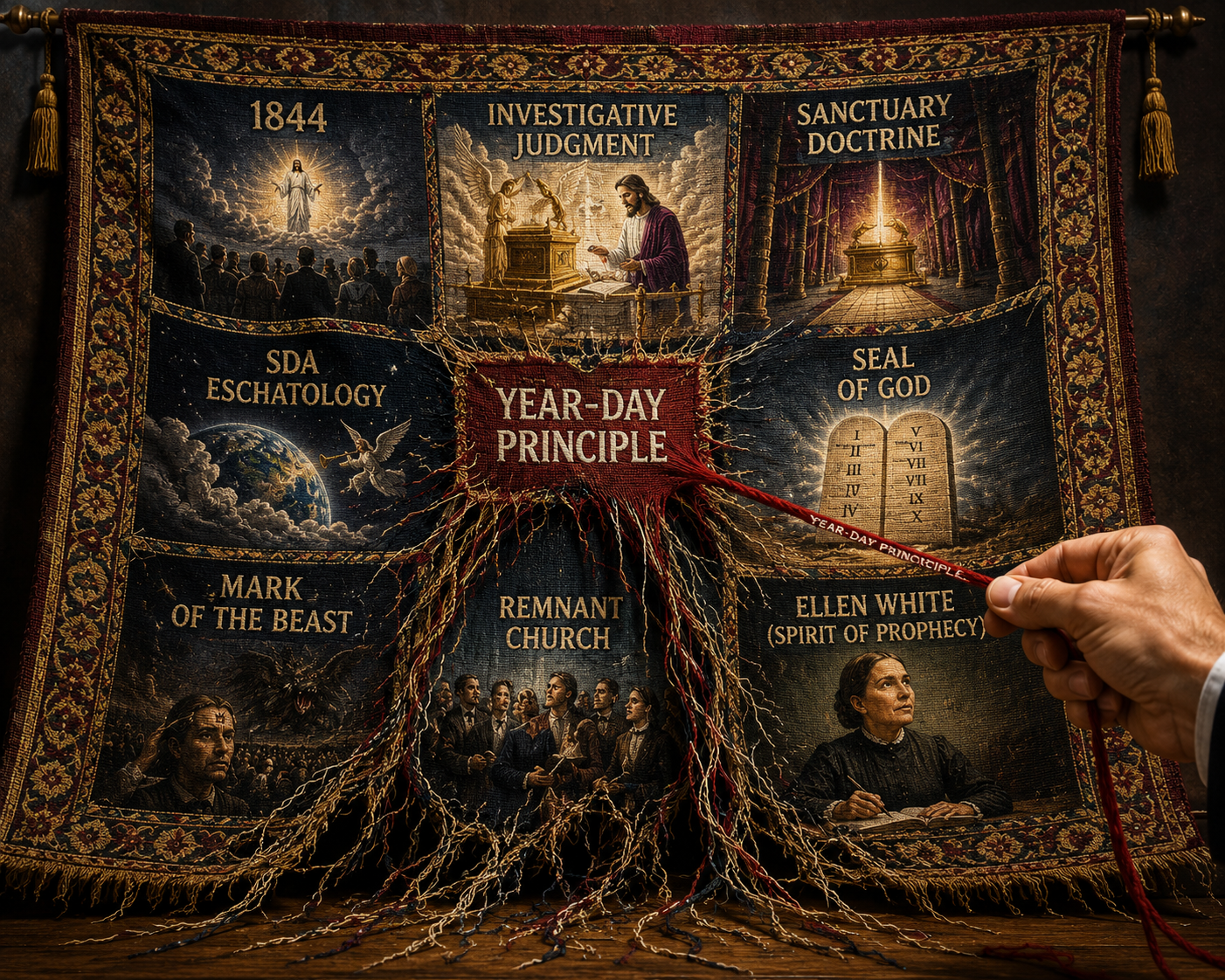
Seventh-day Adventism has a load-bearing doctrine. Remove it, and nearly everything else comes crashing down. Seventh-day Adventist [SDA] prophet Ellen White's epic book Great Controversy describes her vision of the great conflict Christ and Satan — the 1,260 years of papal persecution, the Investigative Judgment, the cleansing of the heavenly sanctuary, Seventh-day Adventism as the remnannt church, and the 2300 years of Daniel 8:14 terminating on October 22, 1844. All these rely upon a single assumption: that prophetic days should be converted into years. This theory is labeled the year-day principle. The problem is that the Bible never actually teaches such a principle.
SDAs are taught that the day-year principle is an unshakeable biblical law, but the concept is entirely manufactured. Refined by a thirteenth-century monk, the theory was largely ignored until Protestant Reformers weaponized it—stretching the 1,260-day timeline into 1,260 literal years to provide the historical runway needed to brand the Roman Papacy as the Antichrist. Mainstream Protestants eventually abandoned the theory as untenable, but it found an eager heir in William Miller, who used it to confidently predict that Christ would return in 1844.
When that calculation yielded the public fiasco of the Great Disappointment, Ellen White did not expose the error; she canonized it. Instead of refuting a broken methodology, she defended it, built her entire Great Controversy around it, and certified it as divine revelation. Every major timeline in Seventh-day Adventism hinges on this single mathematical assumption. Pull this one thread, and their entire prophetic tapestry instantly unravels. So, let's pull it!
Proof Texts Do Not Prove Year-Day Principle
The Bible does not state that a prophetic day always equals a year. Only two verses are ever cited for the rule, and notice what they actually are.
Numbers 14:34 and Ezekiel 4:6 do not enunciate a principle. They are specific, one-time judicial sentences handed down against two specific rebellious generations.
Numbers 14:34
After the number of the days in which ye searched the land, even forty days, each day for a year, shall ye bear your iniquities, even forty years, and ye shall know my breach of promise (Num. 14:34).
The first proof text for the year-day principle comes from God's judgment upon unbelieving Israel. After the twelve spies spent forty days exploring Canaan, the nation refused to trust God's promise and rebelled. As punishment, God declared that Israel would wander in the wilderness for forty years—one year for every day the spies had searched the land.
Notice what is happening. God is not teaching His people how to interpret prophecy. He is pronouncing a judicial sentence. The punishment is deliberately designed to mirror the offense. Every day of unbelief becomes one year of wandering. By explicitly tying each year of judgment to each day the spies spent in Canaan, He transformed the sentence into a memorable object lesson. But an object lesson is not a rule of biblical interpretation.
Nothing in the passage suggests that future readers should convert prophetic days into years whenever they encounter numbers in Daniel or Revelation. God does not say, "Let this be the rule for interpreting prophecy." He says, in effect, "For this judgment, each day will represent a year." SDAs takes a one-time judicial sentence delivered to one generation of Israelites and transform it into a universal hermeneutical principle governing every prophetic time period in Scripture. The text does not support that kind of leap.
Ezekiel 4:6
And when thou hast accomplished them, lie again on thy right side, and thou shalt bear the iniquity of the house of Judah forty days: I have appointed thee each day for a year (Eze. 4:6).
The second pillar supporting the year-day principle is Ezekiel 4:6. At first glance, the verse appears compelling: "I have appointed thee each day for a year." But when the passage is read in context, it becomes clear that God is not establishing a universal method for interpreting prophecy. He is explaining a single symbolic act that Ezekiel was commanded to perform.
Ezekiel was instructed to build a miniature model of Jerusalem, portray its siege, lie on his side for a prescribed number of days, eat measured food, and drink measured water. Every element of the chapter is symbolic. The prophet was acting out God's coming judgment on Israel. The day-for-year correspondence belongs to that dramatic object lesson; it is not presented as a timeless rule for interpreting every prophetic number found elsewhere in Scripture.
Notice what God actually says: "I have appointed thee each day for a year." He does not say, "Whenever future prophets speak of days, interpret them as years." The instruction is directed specifically to Ezekiel and explains only how his prophetic sign was to function. It is no more a universal interpretive principle than God's commands in the same passage for Ezekiel to lie on his side or cook his bread over dung.
The silence of later Scripture is equally revealing. Daniel never appeals to Ezekiel's sign-act when recording his own visions. Gabriel carefully explains the ram, the goat, the horns, and the kingdoms represented in Daniel's prophecies, yet he never suggests that the time periods should be converted into years because of Ezekiel 4:6. Jesus never taught such a principle. Neither did the apostles. If Ezekiel had truly established the master key for interpreting prophetic chronology, it is remarkable that the Bible itself never uses it that way.
Ezekiel 4:6 therefore proves only one thing: in that particular symbolic demonstration, God assigned one day to represent one year. Turning that one-time instruction into a universal rule for interpreting Daniel and Revelation requires making assumptions the Bible never makes.
Not a Principle
The flaw in the year-day principle is surprisingly simple. In both Numbers 14:34 and Ezekiel 4:6, God explicitly assigns a day to represent a year for one specific purpose. He does not announce a new rule for interpreting biblical prophecy. There is a world of difference between saying, "In this case, a day represents a year," and saying, "Whenever you encounter prophetic days, convert them into years." The former is what Scripture says. The latter is what Miller—and later Ellen White—needed Scripture to say.
Imagine a road map that says, "One inch equals one mile." No one would conclude that every inch in every map, blueprint, or drawing ever produced must also equal one mile. The scale applies only because the author expressly assigned it to that map.
Or suppose I tell my son, "For every minute you're late tonight, you'll be grounded for one day." Have I just established a universal law that minutes always equal days? Of course not. When I text him the next afternoon and say, "I'll be there in five minutes," he doesn't expect me to arrive five days later. The punishment was tailored to one particular offense; it was never intended to redefine the meaning of time itself.
Numbers 14 and Ezekiel 4 function the same way. They record two unique judicial pronouncements in which God deliberately matched the punishment or symbolic act to the circumstances. Neither passage claims to establish a timeless interpretive principle. Neither tells future readers how to decode Daniel or Revelation. Neither is ever cited elsewhere in Scripture as a rule for interpreting prophetic chronology.
Yet this is the slender thread upon which the entire year-day theory hangs. Two isolated passages describing two unique historical events were quietly transformed into a universal law of prophetic interpretation—a law the Bible never states, never repeats, and never applies outside those two specific contexts. That leap is not exegesis. It is assumption. And upon that assumption, William Miller built 1844, and Ellen White built Seventh-day Adventism.
Does Daniel 8 Actually Teach 2,300 Years?
This is the question that has troubled SDA scholars for decades. What does Daniel 8:14 actually say?
And he said to him, "For two thousand and three hundred evenings and mornings then the sanctuary shall be restored to its rightful state" (Dan. 8:14 RSV).
Notice what is missing. The passage never says "years." It never hints at "years." It doesn't even use the ordinary Hebrew word for "days." The KJV translators supplied that word to smooth the English. Daniel actually wrote "evening-morning" — a unique expression that naturally recalls the daily morning and evening sacrifices, not a span of 2,300 years.
This omission is significant because Daniel knew perfectly well how to write "years" — the Hebrew word shanah — when he meant years. The word appears throughout the Old Testament, and Daniel himself uses it in the very next chapter when he speaks of Jeremiah's prophecy of "seventy years" (Dan. 9:2).1 If God intended to reveal a period of 2,300 years, Daniel possessed the vocabulary to say exactly that. Instead, he recorded "2,300 evening-mornings."
That leaves the year-day principle with a serious problem. The doctrine does not arise from Daniel 8. It must be imported into Daniel 8 from somewhere else. The reader must first assume that "evening-morning" really means "days," then assume those days are symbolic, then assume symbolic days must represent years, and only then does the famous date of 1844 emerge. None of those steps comes from the text itself.
If God intended His people to discover the Investigative Judgment in Daniel 8, why did He not simply say "2,300 years"? Why inspire wording that naturally points readers in an entirely different direction? A principle that supposedly unlocks the meaning of Bible prophecy ought to rest on what Scripture plainly says.
Ellen White's "pillar" doctrines depend upon replacing the words Daniel actually wrote with words he never wrote, and then assigning those replacement words a meaning the text itself never suggests.
Temple Language
Another problem with extending the "2,300 evening-mornings" into A.D. 1844 is that the expression itself is unmistakably temple language. Throughout Daniel 8 the discussion centers on the tamid (daily sacrifice), the sanctuary, its desecration, and its eventual restoration. The answer—"2,300 evening-mornings"—naturally corresponds to that temple setting. Morning and evening sacrifices belonged to the Jerusalem temple. They did not continue into the Christian era, much less into the nineteenth century. The Second Temple was destroyed by the Romans in A.D. 70, and with it the entire sacrificial system came to an end. Why, then, would God describe a period terminating in 1844 using terminology whose natural meaning belonged to a sacrificial system that had ceased nearly eighteen centuries earlier? The straightforward explanation is that Daniel's prophecy concerns the interruption and restoration of the temple services themselves. The SDA interpretation asks readers to carry temple language nearly two millennia beyond the temple's destruction and then relocate its fulfillment to an invisible event in heaven. Nothing in Daniel 8 itself suggests such a transition.
Does Gabriel Teach the Principle?
This question should settle the matter. Daniel 8 is not a mysterious vision left without explanation. God specifically dispatches the angel Gabriel for one purpose: "Make this man to understand the vision" (Dan. 8:16). Gabriel's assignment was not merely to identify symbols, but to explain them.
And explain them he does. The ram is Media and Persia (Dan. 8:20). The goat is Greece (v. 21). The great horn is its first king. The four horns are four kingdoms arising after him. The little horn's rise, character, military power, blasphemy, and destruction are all carefully interpreted (vv. 23-25). Nearly every significant feature of the vision receives an inspired explanation.
Yet when Gabriel reaches the one element upon which the entire SDA system ultimately rests—the 2,300 evening-mornings—he never tells Daniel that the number should be converted into years. He never hints that "days" secretly means "years." He never quotes Numbers 14 or Ezekiel 4. He never establishes a year-day principle. He simply leaves the number exactly as it was given.
Think about that for a moment. If God intended the most important chronological prophecy in history to span more than two millennia, requiring an invisible mathematical conversion before anyone could understand it, why would the very angel sent to explain the vision fail to explain the conversion?
But Gabriel never even hints that evening-mornings means anything other than that. Instead, nineteenth-century interpreters supplied the missing explanation themselves. William Miller invented it because it added to his arsenal of "proofs" that the end would come in 1844. Ellen White later endorsed his reasoning. The year-day principle, therefore, does not come from Gabriel's interpretation. It comes from human interpretation imposed upon Gabriel's interpretation.
Can Anyone Discover 1844 Without Grooming?
Try a simple experiment. Hand the book of Daniel to a hundred intelligent Christians who have never attended an SDA prophecy seminar. Give them no commentary, no Clear Word Bible, no copy of The Great Controversy, no evangelist with a prophecy chart, and no explanation of the year-day principle. Ask them to read Daniel 8 from beginning to end and answer one question:
What happens after the 2,300 evening-mornings?
How many of those hundred readers would conclude that Jesus entered the Most Holy Place of a heavenly sanctuary on October 22, 1844, to begin an Investigative Judgment?
The answer is obvious: not one.
Reading Daniel by itself, they would naturally conclude that a sanctuary connected with the vision's historical setting would be restored after roughly 2,300 evening-mornings—whether understood as 2,300 literal days (about six years) or 1,150 morning-and-evening sacrifices (about three years).2 Either interpretation remains rooted in the ancient world. Neither naturally jumps two thousand years into the future, lands on October 22, 1844, and relocates the action into an invisible room in heaven.
To arrive there, the reader must first be taught that evenings-mornings means "days." Then, he must be taught that "days" secretly mean "years" based upon two entirely unrelated passages from Numbers and Ezekiel. Then he must be taught how to calculate the starting date, which comes from an unrelated vision in the next chapter. Then he must be taught that the sanctuary is not the temple, but heaven. Then he must be taught that the cleansing is not a cleansing at all, but an Investigative Judgment. Every step is supplied by the Great Controversy, not Daniel.
That is the real test of an interpretation. If nobody can discover it by reading the passage, but everyone can arrive at it after being carefully instructed how to read the passage, then the conclusion does not arise from Scripture. It arises from the interpretive system imposed upon Scripture. The road to 1844 is not found in Daniel. It is found in Great Controversy.
Where Was This Principle for 1,800 Years?
If the year-day principle is genuine, it is one of the most important interpretive rules God ever gave. It transforms days into years, turns 2,300 into 1844, identifies the Antichrist, establishes papal supremacy, creates the Investigative Judgment, and undergirds nearly the entire prophetic system of Seventh-day Adventism.
So one obvious question demands an answer: Why didn't God ever tell anyone?
Jesus never taught it. During His longest prophetic discourse (Matthew 24), where He discussed the destruction of Jerusalem, the last days, and His return, He never hinted that prophetic days should be converted into years. Paul never taught it when writing about the man of sin. Peter never mentioned it. John—the very man who wrote the 1,260 days, forty-two months, and time periods upon which Adventism depends—never once tells his readers that those numbers should be read as years instead of days. Nor does Gabriel, the angel specifically sent to explain Daniel's vision.
Nor did the apostles' immediate successors understand it. The early church fathers who commented on Daniel and Revelation simply read the time periods as they appeared. Justin Martyr interpreted the "time, times, and half a time" without performing day-for-year arithmetic. Irenaeus understood it as three and a half literal years.3 Neither writer gives the slightest indication that Scripture contained a hidden mathematical code waiting to be unlocked.
The mechanical conversion of stated days into years does not emerge until Joachim of Fiore in the late twelfth century, more than a thousand years after Revelation was written, and only became popular during the Protestant Reformation as a convenient way to stretch prophetic periods across the history of the papacy.4
If this is the key that unlocks the end of the world, Heaven kept it in a drawer for eighteen hundred years and only handed it to Miller — a "freemason of the highest degree" — in the 1830s.
Where Is the Principle in Jewish Apocalyptic Literature?
The year-day principle supposedly unlocks Daniel's greatest time prophecies. Yet the Jews who actually produced apocalyptic literature seem never to have heard of it. The Dead Sea Scrolls preserve copies of Daniel alongside numerous apocalyptic writings, calendrical texts, and prophetic commentaries. Books such as 1 Enoch, Jubilees, 4 Ezra, and 2 Baruch are filled with symbolic visions interpreted by angels, yet nowhere do they teach that prophetic days automatically represent years. They simply read the numbers as they stand.
If the year-day principle were really God's established method for interpreting apocalyptic prophecy, its complete absence from the very literature that grew out of Daniel's world is astonishing. The people closest to Daniel never mention it. The writers of Jewish apocalyptic never use it. The Dead Sea Scrolls never explain it. Gabriel never teaches it. It finally appears centuries later, not as an ancient Jewish rule of interpretation, but as a medieval and Reformation-era method developed to solve chronological puzzles. That is a difficult pedigree for a doctrine upon which Ellen White builds virtually her entire prophetic system.
Where Does the Principle Apply?
Even if a reader grants, for the sake of argument, that God sometimes used a day to represent a year, one enormous problem remains: Who decides when to make the conversion? Scripture never gives such a rule.
Should the four hundred years of Genesis 15:13 become 146,000 years? Should Jeremiah's seventy years become 25,200? Is Jonah's three days actually three years? Is Revelation's half-hour of silence (Rev. 8:1) really seven and a half days? Is the Millennium 1,000 years, or 360,000? SDAs rightly treat all of these as literal time periods. But on what biblical basis? If symbolic visions automatically convert adjacent time expressions into years, why do these remain untouched? The Bible never tells us. The rule is applied only where someone wants a larger number.
Ellen White's interpretation collides head-on with the very passage she claimed to explain. She repeatedly taught that the 1,260-year period "began with the establishment of the papacy, A.D. 538, and terminated in 1798."5 But Daniel says something entirely different. The little horn wages war against the saints "until the Ancient of Days came" and judgment was given to the saints, when "the time came that the saints possessed the kingdom" (Dan. 7:21-22, 25-27).6
That event is the Second Coming, when Christ returns and His people receive the kingdom (cf. Matt. 24:30). It did not happen in 1798. The saints did not inherit the kingdom in 1798. Christ did not return in 1798. Yet Ellen White insisted the prophecy ended there because her chronology required it to. Daniel says the little horn's persecution continues until the kingdom is given to the saints. Ellen White says it ended decades before any of that occurred. Scripture and Ellen White cannot both be right.
The publisher's note appended to The Great Controversy ties the 1260-day period explicitly to Revelation 11:2, 12:6, and 13:5, treating them all as a single, interchangeable 1,260-year block.7 But this historicist consolidation creates a fatal mathematical paradox. According to Revelation 13:5, the forty-two months (1,260 days) represent the active duration of the first beast’s authority to speak blasphemies and wage war. If that period ended in 1798 with the “deadly wound,” and that wound was healed — as modern SDA apologists universally argue — by the 1929 Lateran Treaty, then a restored beast demands a restored timeline.8 Because the text explicitly links the forty-two months to the beast's active exercise of authority, consistency dictates that a resurrected beast must log a second 1,260-year lease on power. Adding 1,260 years to 1929 lands the final crisis in the year 3189 — a timeline that utterly obliterates White's relentless claims of an imminent end. The prophetic framework she certified as settled fact is only coherent for as long as nobody opens a Bible to check the math.
What Happens When it is Removed?
Remove the year-day principle and something remarkable happens. Daniel 8 suddenly becomes straightforward and makes perfect sense.
All agree that the vision pertains to the Medo-Persian and Greek empires. The little horn arises in that historical setting. The daily sacrifices cease. The sanctuary is desecrated. After 2,300 evening-mornings it is restored. No 1844. No Miller. No Investigative Judgment. No nineteenth-century prophetess.
The events fit naturally into the desecration and restoration of the Jerusalem temple during the persecution of Antiochus Epiphanes. Judas Maccabeus rededicated the temple in 165 B.C., roughly three years after its desecration — a verifiable historical event, sitting precisely where the vision's own chronology places it if the “evening-mornings” are read as the sacrificial units the surrounding verses are actually talking about.9 The remarkable thing is that the text, read plainly, requires no secret conversion principle. The interpretation arises directly from the text itself rather than having to import Miller's interpretive system.
What Was Ellen White Doing With All of This?
A sincere but uncritical Bible student, working alone with no supernatural claims and no angelic company, might be forgiven for inheriting an interpretive framework that was already circulating in his religious culture. That is roughly what happened to William Miller.
Ellen White was not in that position, by her own account. She claimed direct visions from God. She claimed, of the very book in which this doctrine appears in its most developed form, that “while writing the manuscript of Great Controversy… I was often conscious of the presence of the angels of God.”10 If there was ever a moment for one of those angels to do what Gabriel himself never did — clarify, correct, or simply confirm the actual meaning of “evening-morning” in Daniel 8:14 — this was it. It never happened. Instead, what she produced was Miller's uncorrected arithmetic, restated as angelic-inspired instruction. Magically, the "2300 days" became "2300 years," ending in 1844.11
White applies the principle to other time periods as well:
The periods here mentioned — ‘forty and two months,’ and ‘a thousand two hundred and threescore days’ — are the same, alike representing the time in which the church of Christ was to suffer oppression from Rome. The 1260 years of papal supremacy began with the establishment of the papacy in A.D. 538, and would therefore terminate in 1798.12
Forty pages later: “The 1260 days, or years, terminated in 1798.”13 And again, over a hundred pages after that:
The forty and two months are the same as the ‘time and times and the dividing of time,’ three years and a half, or 1260 days, of Daniel 7 — the time during which the papal power was to oppress God's people… and terminated in 1798.14
From 1884 to 1911, in every version of Great Controversy, White interprets “days” and “years” as interchangeable — the exact conflation Gabriel never made, Daniel never made, and the Hebrew text never authorizes.
Could Have Corrected It
At the very start of her ministry, Ellen White could have corrected the problem, but didn't. In recollecting the history of her movement, she wrote:
Wm. Miller and those who were in union with him supposed that the cleansing of the sanctuary, spoken of in Daniel 8:14, meant the purifying of the earth… therefore we looked for that event at the end of the 2300 days, or years. But after our disappointment the Scriptures were carefully searched with prayer and earnest thought… light poured in upon our darkness… Instead of the prophecy of Daniel 8:14 referring to the purifying of the earth, it was now plain that it pointed to the closing work of our High Priest in Heaven.15
Right after the Great Disappointment, Adventists opened their Bibles to discover where they went off the rails. A supposed prophetess of God was attending them, providing visions to confirm their findings. This was the moment to challenge the assumption that “2300 days = 2300 years.” Instead, the calculation survived completely intact. What changed was the event attached to the end of the math. She called that “light.” It wasn't.
What This Says About the SDA Prophetess
Ellen White did not invent the year-day theory. She put her prophetic stamp of approval upon it. Then, she built the shut-door doctrine, the investigative judgment, and the entire doctrine of the heavenly sanctuary's cleansing on top of arithmetic that does not survive contact with the Hebrew text it claims to interpret. Her Bible studies did not reveal the problem. Her visions did not enlighten her. It never came up in her chats with angels while writing Great Controversy.
White built the Great Controversy playbook of end-time events upon a flawed principle. Pull on that string, and the whole tapestry comes unraveled.