
Ellen White's Least Known Prophecy
By ,
Ellen White, New Year's Day, 1890 — Manuscript 24, 1891
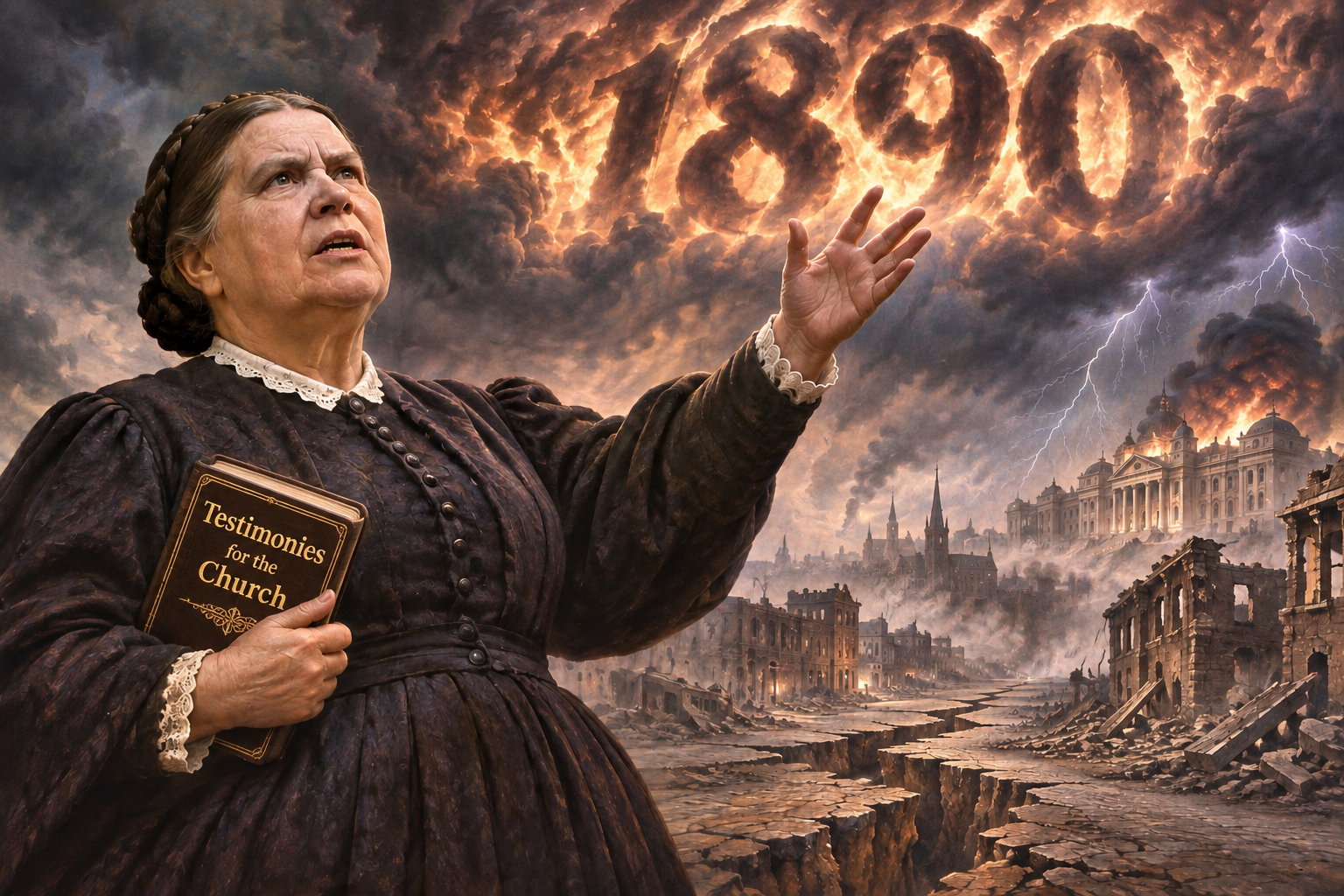
Most people ring in New Year’s Day with resolutions for the year ahead. Ellen White rang in 1890 with an apocalyptic doom forecast. On or about January 1, 1890, she declared that the coming year would bring mass mortality, crimes surpassing any on record, devastating earthquakes, cities burying their inhabitants alive, and lordly palaces collapsing into heaps of ruin—insisting that the vials of God’s wrath were already being poured out upon the earth.1 Unlike her usual vague, undated warnings about “troubled times ahead,” this was a bold, time-stamped prediction of global catastrophe.
Why have you never heard of this prophecy? That is the whole point. Had any of it come true, Seventh-day Adventists would have shouted it from the rooftops for the next hundred years as undeniable proof of their prophet’s inspiration. Instead, her estate kept the manuscript in a vault for an entire century, finally releasing it quietly into print in 1990 buried among hundreds of other miscellaneous releases. The reason for the hundred-year suppression is obvious when you read the prophecy. 1890 came and went without the promised apocalypse, turning White’s New Year’s prophecy into textbook proof of a false prophet (Deut. 18:22).
The Predictions
Here is the core of Ellen White's 1890 prediction:
There are soul-destroying superstitions in our world in 1890. ... Preceding the great sign of the coming of the Son of man, there will be signs and wonders in the heavens.
I expect that during the year 1890 there will be great mortality. There will be crimes greater than any now on record. There will be weeping and lamentation and woe. During the past year, 1889, there has been brought to us almost daily the news of disasters by sea and by land—unusually destructive fires; earthquakes burying cities and villages with their inhabitants; railway accidents most terrible; tornadoes and floods that destroyed an immense amount of property, including the terrible Johnstown and Williamsport floods, which destroyed more than two thousand lives. ... Already sprinklings from the vials of God's wrath have been let fall upon land and sea, affecting the elements of the air. The causes of these unusual conditions are being searched for, but in vain.
God has not restrained the powers of darkness from carrying forward their deadly work of vitiating the air, one of the sources of life and nutrition, with a deadly miasma. ... Cholera and unexplainable diseases have broken out. Diphtheria, raging to a limited extent, is gathering its harvest of precious little ones, and seems to be almost uncontrollable. ...
Earthquakes in various places have been felt, but these disturbances have been very limited. This year we may expect to have more. During the year that has just closed, whole cities have become nearly extinct. Thousands of people have been buried in the bowels of the earth. ...
Terrible shocks will come upon the earth, and the lordly palaces erected at great expense will certainly become heaps of ruins. The earth's crust will be rent by the outbursts of the elements concealed in the bowels of the earth. These elements, once broken loose, will sweep away the treasures of those who for years have been adding to their wealth by securing large possessions at starvation prices from those in their employ. And the religious world, too, is to be terribly shaken, for the end of all things is at hand.2
Notice the opening line. White warns of "soul-destroying superstitions in our world in 1890." This was the most accurate statement she made. More on this later.
1890 Predictions Compared to 1890 Facts
Each of Ellen White's 1890 predictions will be compared to historical facts to determine whether or not she was a legitimate prophet of God — one with supernatural insight into the future.
Claim #1: "Great Mortality" in 1890?
1890 did open with elevated deaths. In late 1889, the so-called "Russian flu" — the 1889–1890 influenza pandemic, often called the first modern flu pandemic — swept westward across Europe. American newspapers had been tracking it since early December. The first U.S. cases were reported in New York in mid-December, and on December 28, 1889 — days before White wrote — newspapers reported the first American death.3 In the first week of January 1890, New York City logged a record 1,202 winter deaths. American mortality from the pandemic peaked in the week ending January 12, 1890 — roughly eleven days after White put pen to paper.4
In plain English, Ellen White “prophesied” great mortality for 1890 while the 1889–1890 influenza pandemic was already splashed across the front pages of American newspapers and Americans were dying. That is not supernatural foresight—that is reading the morning paper and calling it a vision from God. That is not prophecy — that is stepping outside in the middle of a downpour and announcing that God just told you it is going to rain.
The disease driving the death toll that winter was influenza, known to every newspaper reader in America as "la grippe." White never names it. She lists cholera, diphtheria, and "unexplainable diseases." It is like throwing a handful of darts and hoping at least one sticks.
Was 1890 the year of "great mortality" White foretold? The chart below answers that. It shows the official crude death rate for England and Wales, as recorded by the Registrar-General, for 1890 and the five years on either side.5 In 1890, 19.5 people died for every 1,000 living, a little above the decade's average of about 18.8, because the influenza wave was already underway when White wrote. But 1886 had exactly the same rate, and 1891 was worse at 20.2. Massachusetts, which kept the best death records in America, recorded 19.8 per 1,000 for 1890, in the same range. No apocalyptic spike stands out on the chart, and nothing in it suggests "weeping and lamentation and woe" or the vials of God's wrath.
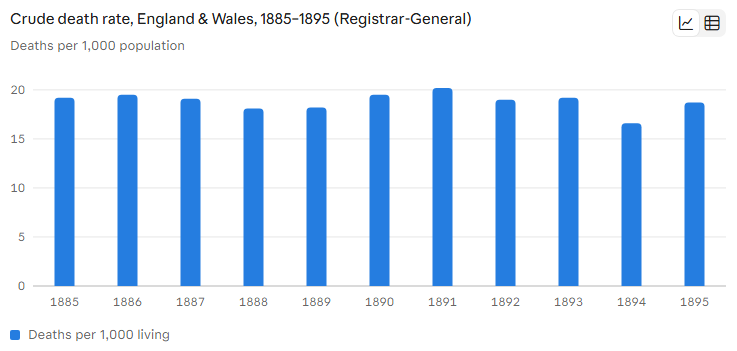
The year White singled out for great mortality was an ordinary Victorian year. The pandemic did what pandemics do: it burned out. The wave that was already cresting when she wrote was the wave that soon receded. It did not signal the end of the world. It was one pandemic in a long line of pandemics. After the first few weeks of the year, 1890 settled into the ordinary, pre-antibiotic mortality of the Victorian era.
Verdict on "Great Mortality"
 Failed. Mortality was within the norm for that decade.
Claim #2: The "Deadly Miasma"
White did not merely predict disease. She explained it. According to the prophetess, God had stopped restraining "the powers of darkness" from "vitiating the air ... with a deadly miasma." The resulting diseases were "drops from the vials of God's wrath," and their causes "are being searched for, but in vain."
Every clause of that explanation was false, even by the standards of 1890.
Miasma was a dead theory. The idea that disease arises from poisoned air was the medical orthodoxy of the early nineteenth century. By 1890 it had been dismantled by germ theory. Robert Koch had identified the cholera bacterium in 1883–84.6 Friedrich Loeffler isolated the diphtheria bacillus in 1884. White was not reporting a heavenly revelation about air. She was reciting obsolete medicine and throwing in demons to make it sound more ominous.
The causes were not "searched for in vain." The causes had been found. As early as 1886, the journal Nature reported that during Spain's cholera epidemic, the disease never became truly dangerous in cities with a pure water supply.7 Cholera was a water problem, not a sky problem. Fix the water, stop the cholera. No exorcism required.
To be fair, cholera did flare again in 1890 — in the villages around Valencia, Spain, in June.8 But a regional outbreak in the one country in Europe with a long record of contaminated urban water is not a sign of the end. It is a sign of bad plumbing.
The Diphtheria Irony
Then, White declared that diphtheria, "gathering its harvest of precious little ones," seemed "almost uncontrollable." She framed it as a drop of divine wrath released through demonic air pollution.
In December 1890 — in the very year she was prophesying about — Emil Behring and Shibasaburo Kitasato published their landmark paper in Berlin demonstrating that serum from immunized animals could neutralize the toxin. Behring followed a week later with his diphtheria paper. The diphtheria antitoxin was born.9 Behring would receive the first Nobel Prize in Medicine in 1901 for it.
The results were staggering. By 1897, the Board of Health in Detroit — in White's own home state of Michigan — reported a death rate of about 12.6 percent among diphtheria patients treated with antitoxin, versus nearly 35 percent among those without it.10 Children who would have died, lived.
So the year White said diphtheria was "almost uncontrollable" is the year science learned how to control it. The supposed vial of God's wrath turned out to be a toxin from a bacterium, and it was defeated not by repentance, not by Sabbath-keeping, not by health reform, but by German bacteriologists injecting guinea pigs. It seems that the prophetess was the one purveying "soul-destroying superstitions."
Verdict on "Miasma"
Failed. Cholera and diphtheria were caused by bacteria identified by 1884, not by Satan's miasma, and the diphtheria antitoxin arrived in 1890.
Claim #3: Earthquakes
Wrong about the Past
Before we even reach the prediction, notice White's description of the year just ended. During 1889, she wrote, there were "earthquakes burying cities and villages with their inhabitants." "Whole cities have become nearly extinct. Thousands of people have been buried in the bowels of the earth."
That is a claim about the past — and it is false.
The two significant earthquakes of 1889 are well documented. On July 28, the Kumamoto earthquake struck southern Japan. Japan's National Museum of Nature and Science puts the toll at about 20 dead and more than 50 injured.11 On July 11, the Chilik earthquake struck the Tien Shan mountains of Central Asia. It was enormous in energy — seismologists estimate its magnitude at about 8 — and it caused heavy damage across a wide, thinly populated mountain region. Yet despite having the largest magnitude of the region's nineteenth-century quakes, it caused fewer deaths than the earlier Verny (1887) and Belovodskoe (1885) earthquakes. The Russian geologist Ivan Mushketov, who surveyed the damage, counted 97 dead.12 Ninety-seven is not "thousands buried," and the Tien Shan villages were not "nearly extinct."
No seismological catalog records an 1889 earthquake that buried thousands of anyone. The only 1889 disaster that came close to wiping out a town was the Johnstown Flood — which was a flood, caused by a dam, and which White had already listed separately in the same paragraph. Either she conflated a dam failure with an earthquake, or she inflated the news to fit her apocalyptic mood. Either way, a woman claiming to see the future could not accurately describe the immediate past.
And... Wrong about the Future
"This year we may expect to have more." So what did 1890 deliver?
The seismological record for 1890 contains two noteworthy damaging earthquakes. On July 11, 1890, a magnitude ~7.2 earthquake struck the Tash–Shahrud area of the eastern Alborz mountains in northern Iran, destroying mountain villages and triggering landslides; in the village of Tash only a single house was left standing. Deaths numbered roughly 150–200.13 On December 12, 1890, an earthquake near Pati in Central Java brought down many houses and killed and injured "several" people, according to the Indonesian catalogue of destructive earthquakes.14
Every death in those villages was a real tragedy. But measure them against what White wrote: cities "nearly extinct," "thousands of people ... buried in the bowels of the earth," the earth's crust "rent," palaces turned to "heaps of ruins." Two regional earthquakes killing less than 200 people in total. By her own yardstick, 1890 was a quieter year than the one she was complaining about.
Did 1890 bring the escalating earthquakes White expected? The chart below shows every recorded earthquake death in the NOAA Global Significant Earthquake Database for the decade around 1890.15 The answer is no. 1890 recorded only 171 earthquake deaths, nearly all from a single quake in a remote corner of northern Iran, which makes it one of the quietest years of the decade. Four of the surrounding years were at least fifteen times deadlier: 1885, 1887, 1891, and 1893, when one earthquake in Iran killed about 18,000. 1889, the year White claimed "thousands of people have been buried in the bowels of the earth," was quieter still, with fewer than 150 recorded deaths. The years when earthquakes actually buried thousands came before and after her prediction, not on the year she named.
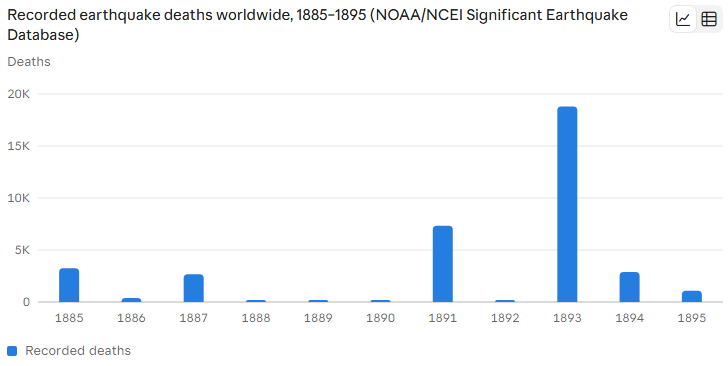
White's year of seismic doom turned out to be one of the calmest of its decade.
Verdict on "Earthquakes"
Failed. 1890 was relatively quiet in terms of earthquake deaths.
Claim #4: Lordly Palaces into Heaps of Ruins
"The lordly palaces erected at great expense will certainly become heaps of ruins."
In 1889, the year White was predicting imminent wrath, George Washington Vanderbilt II broke ground on the Biltmore House in Asheville, North Carolina — a 250-room château built over six years by roughly 1,000 workers. It was completed in 1895. It is still the largest privately owned home in the United States.16 It was never reduced to rubble. It is not even cracked. You can buy a ticket and tour it this weekend.
The Gilded Age was the golden age of "lordly palaces erected at great expense." The Vanderbilts, the Astors, and their peers spent the 1890s building more of them, not digging out of them. The prophetess said their ruin was certain. Perhaps so, but not in 1890.
Verdict on Palaces
Failed. None were recorded as destroyed in 1890.
Claim #5: The Wrath That Hit the Wrong People
White's prediction ends with a chilling declaration about the targets of God's coming wrath. The upheavals, she wrote, would "sweep away the treasures of those who for years have been adding to their wealth by securing large possessions at starvation prices from those in their employ." The message was unmistakable: God was about to strike down the wealthy men who had built their fortunes by exploiting the poor. Their accumulated treasures would be swept away. Their day of reckoning had arrived.
White pointed to the Johnstown Flood of May 31, 1889, as evidence that these judgments were already beginning, but that was a poor choice.
The South Fork Dam belonged to an exclusive fishing and hunting club whose members included some of Pittsburgh's wealthiest businessmen, among them Andrew Carnegie, Henry Clay Frick, and Andrew Mellon.17 When the dam failed, its floodwaters tore through Johnstown, killing more than 2,200 people. Who were the victims? Not the millionaires who owned the dam. They were the working families of an industrial town—the very sort of people whose poverty and exploitation White claimed God was about to avenge.
What happened to the wealthy men whose fortunes God was supposedly sweeping away? They kept every dollar. Carnegie, Frick, Mellon, and their club escaped both financial liability and divine wrath,18 while over 2,200 working-class residents downstream lost their homes, their children, and their lives. Calling the Johnstown Flood God’s judgment on the rich is worse than a factual blunder—it is moral blindness. White took a tragedy where millionaire negligence killed the poor and left the millionaires untouched, and declared it proof that God was finally punishing the wealthy. Her example is completely backwards.
There is another oddity. White claimed that the causes of these disasters were "being searched for, but in vain." Yet the cause of the Johnstown Flood was already being publicly investigated and reported. Within days, newspapers were identifying the South Fork Club's responsibility; a coroner's inquest examined the dam's deficiencies, and engineering reports documented its failures.19 This was no mysterious act of divine judgment whose cause baffled investigators. It was a human catastrophe involving a dam, its owners, and decisions that had deadly consequences.
Regardless of White's confusion over the event or its cause, the bottom line is that the wealthy exploiters suffered no serious harm in 1890.
Verdict on the Wealthy
Failed. Wealth of the rich was not washed away in 1890.
Claim #6: "Crimes Greater Than Any Now on Record"
This is the vaguest of White's predictions, and vagueness was her a friend who saved her many times in the past. There is no historical record of 1890 producing crime on a scale unmatched in human history. It was an ordinary industrial-era year of murders, robberies, labor violence, and corruption.
The chart below shows the official homicide rate for England and Wales, the most consistently recorded crime of the era, for 1890 and the five years on either side.20 In 1890 the rate was 1.17 homicides per 100,000 people, lower than every year from 1885 through 1888, including 1888, the year Jack the Ripper terrorized London. The whole decade shows violent crime falling, not rising, and 1890 sits in the middle of that decline. Across the Atlantic, the United States kept no national crime statistics at all. The only count was a tally the Chicago Tribune compiled from newspaper reports, and even contemporary criminologists did not trust its figures before 1892. Even taken at face value, that tally shows a gradual climb through the 1890s with no spike in 1890: every year that followed was higher. White singled out 1890 for unprecedented crime, but the record shows an ordinary year.
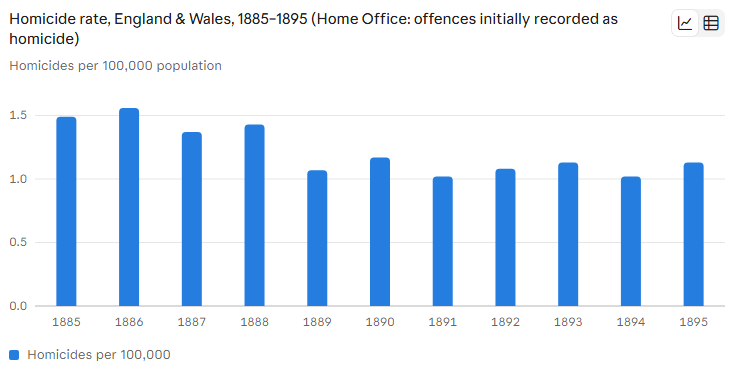
Homicide rates in 1890 were lower than in the mid-1880s, with no record-breaking crime wave.
Verdict on "Crimes"
Failed. Crime was not exceptional in any way.
Claim #7: "Religious World ... Terribly Shaken, for the End of All Things Is at Hand"
White closed her New Year's forecast with two final claims: "And the religious world, too, is to be terribly shaken, for the end of all things is at hand." The first is a prediction about religion in her own day. The second is a prediction about the end of the world.
Was the Religious World Shaken in 1890?
If anything, the opposite happened. The 1890 U.S. census was the first to survey American churches in depth.21 When the Census Bureau surveyed religious bodies again in 1906, the share of Americans who belonged to a church had risen by 6.4 percentage points, and Americans had built, on average, eight new churches every single day for sixteen years.21 That is not a religious world terribly shaken. It is a religious world on a building boom.
The only event remotely approaching a "shaking" occurred when Latter-day Saint president Wilford Woodruff issued a Manifesto advising against any future plural marriages.22 But that was a policy change by one cult under pressure from federal law, not a shaking of "the religious world." The Latter-day Saints, like nearly every other American religious body, kept right on growing. 1890 was a remarkably ordinary year in American religion.
Outside America the picture was the same. In May, Protestant missionaries gathered in Shanghai for one of the largest missionary conferences of the century, as their numbers in China kept climbing. The nearest thing to a religious upheaval in 1890 was the Ghost Dance movement on the American plains, which ended in the tragedy at Wounded Knee. Ironically, its prophet had promised that a great natural disaster would soon sweep away his people's enemies, another apocalyptic prediction for 1890 that never came to pass.
Was the End "at Hand" in 1890?
White borrowed the phrase "the end of all things is at hand" from 1 Peter 4:7. But Peter did not attach it to a calendar year, a list of disasters, and a forecast of record crime. White did. She wrote it the words as the climax of her predictions for 1890. One hundred thirty-six years later, the end of all things is still not here.
Watch What She Did, Not What She Said
The most telling evidence comes from White herself. If she truly believed in January 1890 that "the end of all things is at hand," her actions over the next twenty years show no sign of it.
Less than two years later she sailed for Australia, arriving in Sydney on December 8, 1891, and stayed nine years.23 There she built her own home, "Sunnyside," at Cooranbong in 1895; helped launch the Avondale school, which opened in 1897; and pushed for the founding of the Sydney Sanitarium at Wahroonga.23
She returned to America in 1900, settled at her California estate, Elmshaven, and went right on building. In 1904 she borrowed $2,000 from a bank to help secure the Paradise Valley Sanitarium near San Diego, over the reluctance of the sect's corporate leaders. The Glendale Sanitarium near Los Angeles followed. In May 1905 she pressed the church to buy Loma Linda, which she insisted must become not only a sanitarium but an "educational center." It became the College of Medical Evangelists, a medical school, and today it is Loma Linda University.24
People who believe the world is about to end do not establish sanitariums. They do not build homes, found boarding schools, and launch medical colleges whose students will need years of training before they treat a single patient. A medical school is a long-term bet on the future. White made that bet over and over, on two continents, for two decades after declaring that the end of all things was at hand. Her actions show that she expected the world to keep going. On that point, at least, she was right. Her prophecy was a debacle.
Verdict on "The End of All Things"
Failed. The religious world grew in 1890, the end did not come, and White spent the next twenty years building institutions for a future she said was nearly over.
The Scorecard
| What White Said | What Actually Happened | Verdict |
|---|---|---|
| Great mortality in 1890 | Influenza was already underway when she wrote; peaked within two weeks; then subsided. Overall mortality in 1890 was unremarkable. | FAILED |
| Diphtheria "almost uncontrollable" | Antitoxin discovered in 1890. Death rates slashed within a few years. | FAILED |
| Disease caused by demonic "miasma" | Germ theory had already identified the bacteria. Miasma was obsolete medicine. Demonic cause was superstition. | FAILED |
| Causes "searched for in vain" | Cholera's cause was known. Johnstown's cause — a neglected dam — had been front-page news in June 1889. | FAILED |
| Thousands buried by earthquakes in 1889 | False. No 1889 earthquake comes close; Kumamoto killed about 20. | FAILED |
| Escalating earthquakes in 1890 | 1890 was a relatively quiet year for earthquakes. | FAILED |
| Lordly palaces certainly ruined | No palaces ruined in 1890. | FAILED |
| Wrath upon exploitative rich men | Did not happen in 1890. | FAILED |
| Crimes greater than any on record | No such crime wave recorded. | FAILED |
| Religious world "terribly shaken" | A very ordinary year in the religious world. | FAILED |
| End of all things "at hand" | 136 years and counting. White herself spent the next two decades building schools and sanitariums. | FAILED |
| Final score: 0 of 11 predictions fulfilled | ||
Not one specific, testable element of the prediction came true in the year she named. The only element that touched reality was the one she copied from the newspaper.
Final verdict on seven claims
Not one was fulfilled the way White said it would. This was a prophetic debacle that failed every test. The Bible says:
When a prophet speaks in the name of the LORD, if the thing does not happen or come to pass, that is the thing which the LORD has not spoken (Deut. 18:22, NKJV).
By that standard, Ellen White is a false prophet.
Theological Confusion
Ellen White declared that "sprinklings from the vials of God's wrath have been let fall upon land and sea." The "vials of God's wrath" are the seven last plagues of Revelation 15–16. The White Estate understood that perfectly well, which is why it released this passage under the heading "The Seven Last Plagues."
But according to White's own eschatology, the plagues cannot fall until probation closes. In Early Writings she was explicit:
It was impossible for the plagues to be poured out while Jesus officiated in the sanctuary; but as His work there is finished, and His intercession closes, there is nothing to stay the wrath of God.25
Furthermore, in The Great Controversy she writes: "When Christ ceases His intercession in the sanctuary, the unmingled wrath threatened against those who worship the beast ... will be poured out."26 Revelation itself says no one could enter the temple until the plagues were finished (Revelation 15:8). The plagues come after the door of mercy shuts — not before.
In 1890, according to SDA doctrine, Jesus was still officiating in the heavenly sanctuary — as He supposedly had been since 1844, and as SDAs say He still is today. So by White's own rule, it was "impossible" for the vials to be poured out. Yet here she is, reporting that they were being sprinkled. Not poured — sprinkled. "Drops." A little wrath, as a sample. Revelation knows nothing of a free trial period for the seven last plagues. White invented one to make the evening news fit her end-time paranoia.
The confusion runs deeper still. In the same document, the disasters are "drops from the vials of God's wrath" — and also the work of "the powers of darkness" whom God "has not restrained." So which is it? Is God pouring the vials, or is Satan poisoning the air? White assigned the same flu season to both.
"But It Was Only a Diary Entry!"
Ellen White has one escape hatch: the 1890 prediction was "just a diary entry," her private musings, never meant as prophecy. It sounds reasonable until you look at how the sect has always treated White's diaries.
White said her diaries were inspired. She did not regard her diary as a place for private opinion. Describing how she worked, she wrote: "In the night I am aroused from my sleep, and I write in my diary many things that appear as new to me when read, as to any who hear them. If I did not see the matter in my own handwriting, I should not think my pen had traced it."27 By her own account, her diary was where she channelled revelations from other realms.
Her "inspired" books were built from her diaries. White's literary assistant, Marian Davis, whom White called "my bookmaker," assembled her books by mining White's private papers. White explained: "She gathers materials from my diaries, from my letters, and from the articles published in the papers."28 That is how The Desire of Ages was put together, along with other works SDAs revere as inspired. Diary material that made it into a book became "Spirit of Prophecy." No one in the sect argues that those passages are "just diary entries."
The White Estate still mines her diaries for "inspired" books. Its 1979 daily devotional This Day With God was drawn, in the Estate's own words, from "her extensive daily writings and diaries," along with letters and manuscripts.29 Millions of SDAs have read those diary entries every morning as messages from God's prophet.
SDAs count unpublished manuscripts as prophecy when they seem to come true. The sect's favorite "fulfilled prophecy," that White foretold the 1906 San Francisco earthquake, rests entirely on unpublished manuscripts. In 1902 and 1903 she wrote that "San Francisco and Oakland are becoming as Sodom and Gomorrah, and the Lord will visit them in wrath."30 Those lines sat in her files until after the earthquake, when they were then pulled out as proof of her prophetic gift.
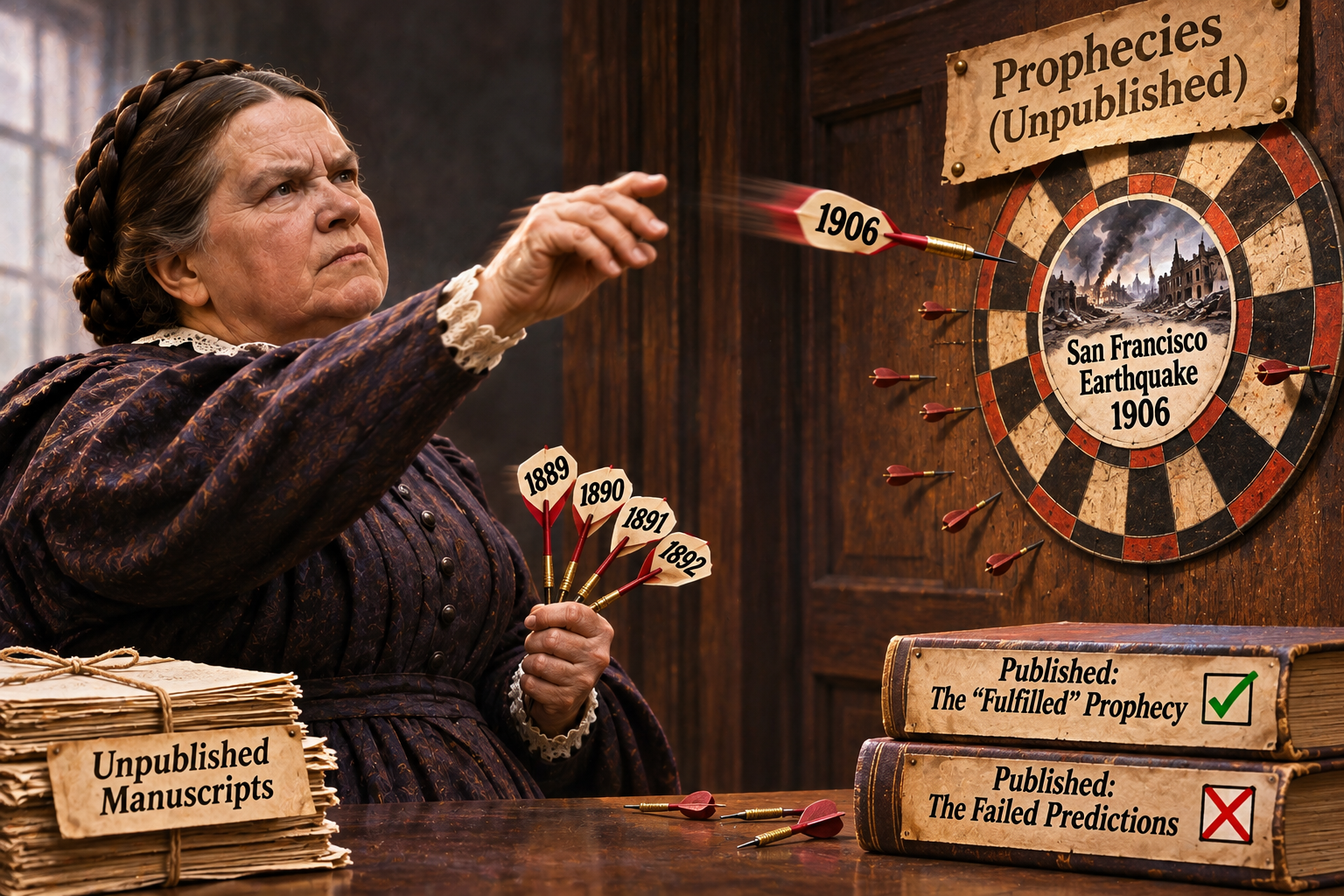
So the rule seems to be this: when an unpublished manuscript appears to come true, it is prophecy. When an unpublished manuscript fails, it was "just a diary entry." That is not a standard. It is heads-I-win, tails-you-lose. In this case the defense collapses, because the White Estate did not treat the 1890 passage away as idle musing. It published it, more than once, under the headings "Prediction of Disasters in 1890" and "The Seven Last Plagues."1
It is like throwing darts behind closed doors, then bringing out the board when one sticks and boasting of your aim, never mentioning the darts that missed the board entirely. San Francisco got carried out to the public. 1890 became Ellen White's least known prophecy.
Conclusion
It is painfully obvious that Ellen White did not have any inkling about what was going to happen in 1890 other than what she could surmise from reading the daily papers.
She opened her prediction with a warning about "soul-destroying superstitions." She was right, of course. Demons poisoning the air. Sample drops of the seven last plagues, falling before probation closed. The end of the world at hand. Those were indeed superstitions — and every one of them was penned by her.
See also
- Ellen White Versus Geology — White's coal-and-oil theory of earthquakes and volcanoes
- Ellen White's Hygienic Restaurant Fiasco — Another divine mandate that collapsed against reality
- From Vision to Vexation: — Ellen White's Shocking Statements about the SDA People