
Ellen White's Early Visions Pervert the Scriptures
By ,
Ellen White, Review and Herald, Mar. 25, 1902
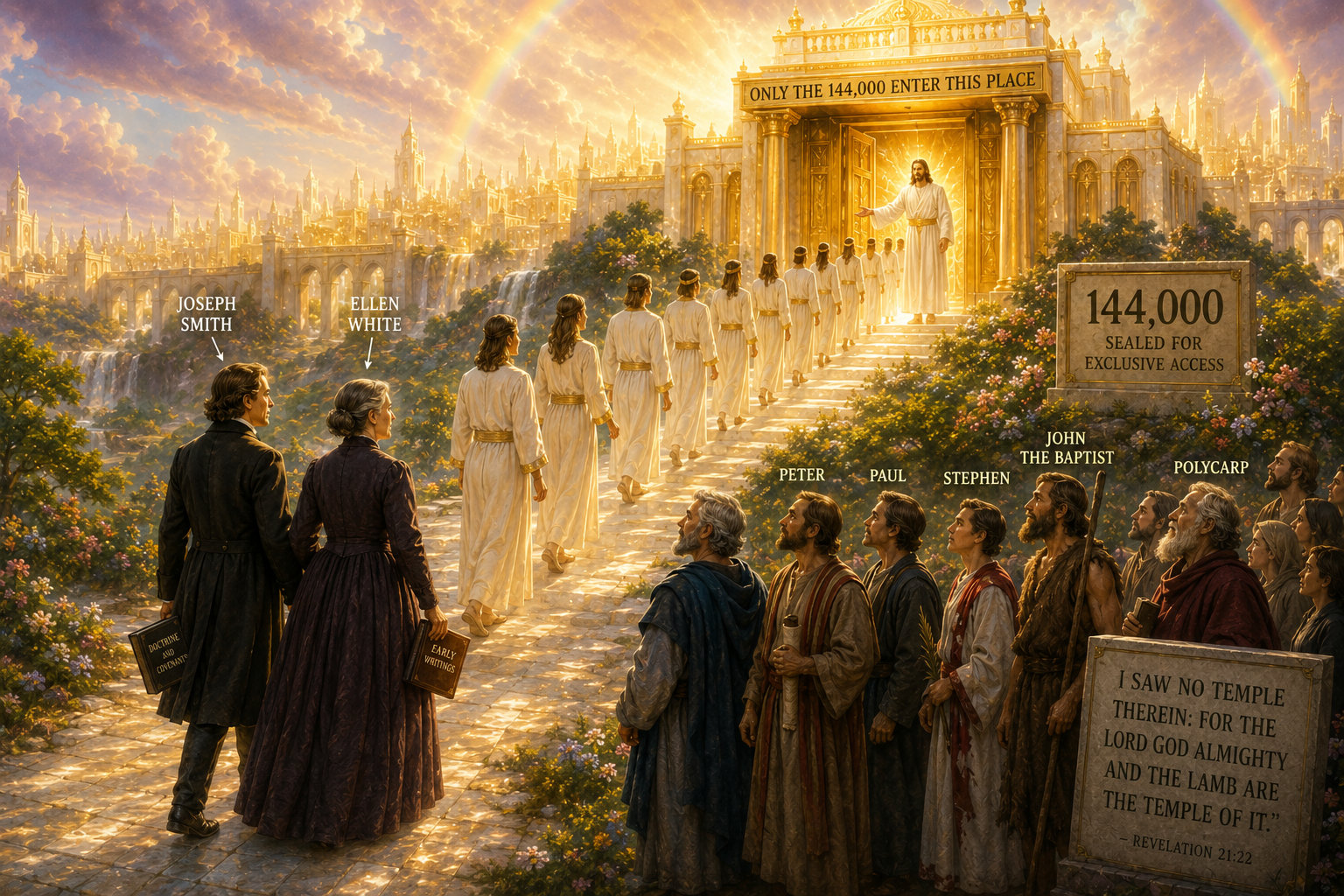
Ellen White's prophetic career began with visions of heaven — and those early visions contain serious problems that call into doubt her prophetic calling. They contradict the apostle John's description of the New Jerusalem. They contradict the apostle Paul's theology of direct access to God through Christ. They create a spiritual caste system in the afterlife that has no basis in Scripture. And one vision is strikingly similar to Mormon prophet Joseph Smith's writings. This article will examine two of White's early visions to document that Ellen White perverted the Scriptures and put a false construction on the Word of God.
The Two Visions
The first appeared in a letter dated December 20, 1845 and published January 24, 1846. Ellen Harmon was seventeen years old at the time. The second appeared in A Word to the Little Flock (1847). Both describe journeys to the heavenly city and the New Earth. Both contain material that cannot be reconciled with the New Testament.
Problem 1: The Temple That John Said Wasn't There
The apostle John's vision of the New Jerusalem is one of the most specific and detailed passages in the entire book of Revelation. In Revelation 21, John describes the holy city descending from heaven, and then adds with unmistakable clarity:
I saw no temple in it, for the Lord God the Almighty and the Lamb are its temple (Rev. 21:22).
No temple. Period. The reason given is profound: the physical temple was always a symbolic placeholder for the presence of God. In the New Jerusalem, God's presence is direct and unmediated. The symbol is no longer needed because the reality has arrived. God Himself and the Lamb are its temple. There is nothing to replace.
Ellen saw it differently. In her 1845 vision, she described a glorious temple on the New Earth, located on Mount Zion outside the city, supported by seven pillars of transparent gold set with pearls, into which Jesus personally admitted only the 144,000: "only the 144,000 enter this place."1 In her 1847 vision she described entering a temple inside the Holy City — "In the city I saw a temple, which I entered" — with a multi-room floor plan including a Holy Place, a veil, and a Most Holy Place containing the ark and the ten commandments.2
John said there was no temple in it. White described two — one inside the city, one outside it. This is not a minor interpretive difference. John's statement is not symbolic. He saw no temple. He explained why. White contradicted him directly in two of her earliest recorded visions.
SDA apologists typically respond that Revelation 21:22 does not preclude a temple outside the city walls, and that White's earthly Mount Zion temple in the 1845 vision satisfies this geographic escape route. This defense has two fatal problems. First, John's statement is not geographic — it is theological. He is not saying the temple moved to the suburbs. He is saying God's direct presence makes a temple unnecessary. Second, and decisively, the 1847 vision places White's temple explicitly inside the city: "In the city I saw a temple." The apologist's geographic escape hatch applies to the 1845 vision but is destroyed by the 1847 vision. Both visions cannot be true simultaneously, and neither is consistent with John.
Problem 2: The Smith Blueprint Surfaces in White's Visions
Ellen White's 1845 vision of the Mount Zion temple, located outside the Holy City and accessible only to the 144,000, traces directly to Mormon Joseph Smith's theology of Zion. On August 3, 1831, Smith and eight elders — including Sidney Rigdon — assembled at Independence, Missouri to dedicate the spot for a literal Temple of the Lord on Mount Zion. Smith's Doctrine and Covenants explicitly commanded Rigdon to "write a description of the land of Zion" and to "consecrate and dedicate this land, and the spot for the temple unto the Lord."3 Smith subsequently published detailed architectural plans for multiple temples to be built in the city of Zion, including "the House of the Lord for the Presidency of the High and most Holy Priesthood... upon Mount Zion, the city of New Jerusalem."4 In 1843 Smith wrote a poem describing 144,000 saints on Mount Zion in the heavenly city, and in May 1844 — just months before White's first vision — he declared: "There will be 144,000 Saviours on Mount Zion, and with them an innumerable host that no man can number."5
White's 1845 vision reproduces this Smithian framework with striking fidelity. The Eastern Argus of Portland, Maine — White's hometown — had reported on the Mormon Zion movement as early as October 14, 1831, describing the saints leaving Babylon on their way to Mount Zion.6 White grew up in the same city where that report appeared. The parallels between Rigdon's 1831 description of the journey to Zion and White's 1845 vision are too specific and too numerous to dismiss as coincidence. Researcher Phyllis Watson documented them in systematic detail:7
| Element | Joseph Smith / Sidney Rigdon (1831) | Ellen G. Harmon / White (1845) |
|---|---|---|
| Destination | Journey to Mount Zion | Journey to Mount Zion |
| Description of territory | Description of "the land of Zion" | Description of "the land of Zion" |
| Landscape: flora | Meadows full of flowers | "I saw a field full of flowers" |
| Landscape: fauna | Wild game and wolves | "All kinds of beasts" and a wolf |
| Landscape: forest | Entered timbered forests | Entered dark woods |
| General impression | "The glory of the place" | "The glory of the place" |
| Trees around the temple | "The fir tree, the pine tree, and the box together, to beautify the place of His sanctuary" — D&C 58:50 | "All kinds of trees around the temple to beautify the place; the box, the pine, the fir" — Day Star, Jan. 24, 1846 |
| Temple location | Temple on Mount Zion, city of New Jerusalem | Temple on Mount Zion |
| Saints' arrangement | Saints laid off in "perfect squares" around temple precincts | "The 144,000 stood in a perfect square" |
| Who enters the temple | 144,000 saints on Mount Zion | "Only the 144,000 enter this place" |
| City descends from heaven | "The Lord hath brought down Zion from above" — D&C 84:100 | "The great city, it's coming down from God, out of heaven" |
| Saints work the earth in Zion | Farms and gardens laid off around the city for the saints — History of the Church, vol. 1, p. 358 |
Saints "go out into the field by the houses to do something with the earth" |
| Patriarchs encountered | Abraham, Isaac, Jacob, Noah, Daniel on Mount Zion — History of the Church, vol. 1, pp. 229, 233 |
"We saw good old father Abraham, Isaac, and Jacob, Noah, Daniel" |
The tree parallel is the most striking item in this table. The same three species — fir, pine, box — deployed in the same grammatical function ("to beautify the place of His sanctuary" vs. "to beautify the place") around the same structure on the same mountain. This is not a mere coincidence. It is a copied description.8
It is worth noting that when James and Ellen White republished the material from A Word to the Little Flock in Experience and Views in 1851, the 1845 Mount Zion temple vision was quietly omitted — apparently because its Mormon origins had become an embarrassment.9
Problem 3: The Veil That Christ Already Tore
In the 1847 vision, White's journey through the heavenly sanctuary is structured as a multi-stage progression through physical barriers. An angel carries her to the Holy City. She passes through a door before reaching the first veil. The veil is raised and she enters the Holy Place. Jesus then raises the second veil to admit her to the Most Holy Place.2
This physical architecture — closed rooms, raised veils, restricted access, sequential admission by divine permission — is precisely what the Epistle to the Hebrews declares obsolete. The author of Hebrews, writing in the first century, describes what Christ accomplished on the Cross:
Therefore, brethren, since we have confidence to enter the holy place by the blood of Jesus, by a new and living way which He inaugurated for us through the veil, that is, His flesh, and since we have a great priest over the house of God, let us draw near with a sincere heart in full assurance of faith (Heb. 10:19-22).9
The veil has been torn. Not raised temporarily. Torn — inaugurating a permanent, new, living way of direct access. Every believer now has assured entry into the presence of God through the finished work of Christ. There is no second veil. There is no sequential admission process. There is no moment where access depends on Jesus physically raising a curtain on your behalf. Hebrews does not present this as future; it presents it as accomplished. "We have confidence." Present tense. Established at the Cross.
Problem 4: The Spiritual Caste System
The most offensive feature of Ellen White's 1845 vision is the creation of a spiritual hierarchy among the redeemed. As the saints approach the temple on Mount Zion, White puts these words into the mouth of Jesus:
Only the 144,000 enter this place.1
White then notes with apparent satisfaction: "And we shouted Hallelujah." Outside this exclusive temple stand the martyrs — those who died for Christ, whose robes are marked with red, who suffered the ultimate earthly sacrifice. They are redeemed, but they cannot enter the temple. It is not for them.
This contradicts the entire theological arc of the New Testament which is about the demolition of spiritual barriers. The veil in the Jerusalem temple was torn from top to bottom at Christ's death — a dramatic divine statement that the era of restricted access to God's presence was permanently over. Paul declares that in Christ "there is neither Jew nor Greek, there is neither slave nor free man, there is neither male nor female; for you are all one in Christ Jesus" (Gal. 3:28). John's vision of the New Jerusalem describes gates that are never closed, nations walking in the light of God's glory, and the direct dwelling of God among all His people (Revelation 21:3, 25). No tier system. No VIP zone. No section reserved for an elite group.
White's vision rebuilds the barrier. It creates, in eternity, exactly what the Cross abolished — a restricted holy space accessible only to the qualified few, while the remaining redeemed stand outside. The martyrs who gave their lives for Christ — including the apostles — cannot enter this building. What White describes looks precisely like a permanent spiritual caste system embedded in the very architecture of the New Earth.
Conclusion
The earliest visions of Ellen White — the foundational platform on which her prophetic career was built — pervert the Scriptures and teach people to put a false construction on the words of God. Thus, in her own words, she fulfilled "Satan's studied plan."
See also
- Ellen White's False Gospel — How White replaced the New Testament gospel with a system of works and perfectionism
- The Investigative Judgment — The 1844 doctrine built on the same heavenly sanctuary architecture White's visions describe