
Biography of Ellen G. White
By , last updated
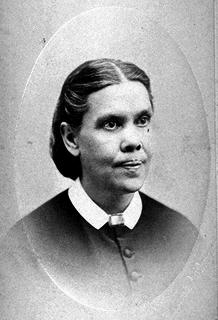
Founder of Seventh-day Adventism
Ellen Gould Harmon and her twin sister Elizabeth were born in Gorham, Maine, on Nov. 26, 1827, as the youngest of eight children. Her parents were devoted members of the Methodist Episcopal Church. Her father was a maker and seller of hats. As a child, Ellen assisted him in this business. Because her father used mercury in his hat-making process, Ellen was quite possibly exposed to dangerous levels of mercury as a young teen. Eventually, Ellen's father moved the family to Portland, Maine, where Ellen grew to maturity.
Traumatic Brain Injury
When Ellen was nine years old, another child threw a stone that hit Ellen in the face. She suffered severe trauma to the brain, was in a coma for three weeks and was at risk of death. The brain injury severely damaged her health and she was unable to continue her formal education past the 3rd grade. Although unable to attend formal school, she received some tutoring at home.
Entanglement with Millerism
In 1840, at the tender age of 13, Ellen heard the preaching of farmer-turned-Baptist-preacher William Miller announcing the imminent return of Jesus. She was terrified by his portrayal of the imminent return of Christ to judge the world in wrath. Shortly afterward, she accepted Jesus as her Savior. She and her family joined the growing Millerite movement and became outspoken advocates of it. On June 26, 1842, she was baptized by immersion in Casco Bay, Portland, into the Methodist Church. Her family would eventually be expelled from that church due to their vocal advocacy of Millerism. When a date of October 22, 1844 was set for the return of Christ, her family looked forward with great expectancy to that date and to Christ pouring out his wrath upon all those who rejected Miller's date.
First Hallucination
When Christ did not come as predicted, she and her family were bitterly disappointed. During the ensuing chaos among the Millerites following the Great Disappointment, she had the first of hundreds of hallucinations which were mistaken by some to be "visions from God." Her first hallucination occurred in December 1844, just a few weeks after she turned 17. It took place in Portland, Maine, at the home of Mrs. Elizabeth Haines. She saw the "Advent people" traveling on a high, narrow path toward the New Jerusalem. If the Advent people denied the light behind them, they would fall off the path into the "dark and wicked world below." For those who fell off, she stated that it was "impossible to get on the path again."
This hallucination contained no new light. It was what many of the Millerites thought and taught at that time. They believed that the door of salvation was shut upon those who never accepted Miller's teaching and those who recanted their belief in his delusional teaching. Most Adventists quickly abandoned these ideas in 1845.
During this time of great religious fervor, hallucinations were not uncommon. In the mid-1840s, Ellen was one of five Millerite visionaries operating in or near Portland, Maine.
Brush with the Fires of Fanaticism
After the Great Disappointment, some Millerites went to fanatical extremes. One of Ellen White's close friends, Israel Dammon, became a lightening rod for fanaticism. His home became a magnet for Millerite fanatics in Portland, Maine. The meetings in his home grew in attendance and noise, disturbing the peace in his neighborhood. Ellen was one of the visionaries featured at Israel's meetings. Ellen and others were known for shouting at the devil, and the meetings could get quite intense. After Israel was arrested for disturbing the peace, Ellen distanced herself from him. Later, their friendship ended when he rejected her claims to prophethood.
Sabbath Teaching
Ellen adopted the Sabbath teaching of Joseph Bates. Initially, Bates regarded Ellen's hallucinations as little more than the byproduct of her sickly condition. However, after she had a hallucination on his favorite subject—Astronomy—he was more open to Ellen and they became fast friends.
Learning of the Sabbath from Bates, she began keeping it from 6pm Friday to 6pm Saturday. Her parents would later accept the Sabbath teaching along with her older brother Robert, who died in 1853. Her sister Sarah was the only member of her family to formally join the Seventh-day Adventist Church after its formation in 1863. None of her other siblings ever joined the church, although her sister Mary may have accepted some of the teachings of the sect.
James White
Ellen met her future husband, Elder James White, shortly after the Disappointment. The two travelled around the Northeastern United States, continuing to warn people of the imminent return of Christ. Ellen set several more dates for the return of Christ which, of course, failed. Rumors started circulating because the two were travelling together, so they decided to get married to stop the rumors—though James still regarded marriage as a "wile of the devil." On Aug. 30, 1846, James and Ellen were united in marriage. Together they labored in the Adventist cause for the remainder of their lives.
Up until 1851, the Whites and Bates continued to advocate the shut door of salvation. This doctrine taught that the door of salvation had been shut on not only the world, but upon all Christians who rejected William Miller's delusional message. According to Bates, during this period, God was supposedly testing the Adventists to see whether or not they would accept the Sabbath doctrine. Those who accpeted it would receive the Seal of God and be saved, and those who rejected it receive the Mark of the Beast and would be lost. In Bates' mind, it was quite simple: all the end-time prophecies of the book of Revelation centered upon his Sabbatarian group and their struggles against Sunday-keepers. Ellen and James bought into Bates' peculiar teachings and Ellen began having visions promoting his ideas as truth. When Jesus did not return in 1851 as Bates had predicted, the Whites discarded the shut door and James scrubbed Ellen's visions to make her false statements disappear.
Humble Beginnings
At first, the Whites lacked monetary support, and often had to deprive themselves of the bare necessities of life to continue their ministry. James often worked in the fields by day, and worked on writing tracts in the evening. In later life, through royalties gained from the sale of Mrs. White's books, the Whites became quite prosperous. In terms of today's money, Mrs. White's income would have been measured in the millions of dollars. In addition to living a life of luxury, Mrs. White often used her great wealth to help the needy and support the various causes of the SDA corporation.
Health Reformers
Initially, the Whites had little interest in health reform. They ate pork, drank wine, and overworked. However, after the death of one child and near-death of another, they become suddenly interested. They obtained the books of the famous and controversial health reformer James Caleb Jackson. Later, they travelled to his clinic and spent several weeks learning his methods.
Prior to this, Ellen White claimed to have had a vision on health reform in 1863. Her followers were anxious to hear what new light from heaven God had for them. However, after a long delay, when she finally started speaking and writing about it, her followers bitterly complained that it was merely a rehash of Dr. Jackson's teachings.
For the next several decades, Ellen focused her attention on health and creating their own clinic—the Battle Creek Sanitarium—that would one day eclipse Jackson's clinic. Mrs. White increased her fortune by peddling various books and magazines in which she sold Jackson's health reforms to her followers as "light from heaven."
Family Problems
The marriage of James and Ellen was sometimes rocky. At one point, when their travels had separated them, Mrs. White confided of their difficulties to a friend:
I think he [James] would be satisfied if he had the entire control of me, soul and body, but this he cannot have. I sometimes think he is not really a sane man, but I don't know. Letter to Lucinda Hall, DG 269, as quoted in George Knight's Walking with Ellen White, 75
Ellen White had four sons—Henry, James Edson, William Clarence, and John Herbert. John Herbert and Henry died while they were yet children. Mrs. White found Edson to be much more difficult to control than Willie. "Ellen often reminded him that his life was 'a mistake,' 'worse than useless' and 'a failure'." Ronald Graybill, Power of Prophecy (unpublished manuscript, 1983), 66. (Now published and available on Amazon).
James and Ellen White preached and ministered together in the Seventh-day Adventist Church until James' death on Aug. 6, 1881. In Ellen's later life, Willie would become her counselor, leading some to suspect she and her writings were under his influence.
1888: Discovers the Protestant Gospel Message
One of the most amazing transitions in Ellen White's life was when she discovered the Protestant Gospel Message in 1888. Reversing her position on the law, she adopted the teachings of A.T. Jones and E.J. Waggoner. Her writings began to reflect more of the Protestant Gospel Message after 1888.
After 1888, Ellen White became increasingly critical of the leaders of the SDA sect. Finally, they exiled her to Australia to lower the volume of her criticism. However, she continued to send a steady stream of criticism by mail from Australia. She returned from Australia in 1900 to crush her opposition in Battle Creek and move the sect's headquarters to Washington, D.C.
Later Years
Mrs. White became a nationally known speaker on the subject of temperance. She was a gifted speaker, sometimes speaking to crowds of 20,000 or more people without the use of a microphone.
Over her lifetime, with the assistance of book author Marian Davis and professional editor Fannie Bolton and other staff members, Ellen published 55 books and 4,500 articles. Much of the material in her major books was plagiarized from other Christian authors, mostly non-Adventist. Perhaps the most famous book to appear under her name is Steps to Christ, which has been translated into over 165 languages and has sold over 100 million copies.
On July 16, 1915, Mrs. White passed away. Mrs. White died in debt, having spent all of her vast fortune. Her last words were, "I know in whom I have believed. God is love. He giveth His beloved sleep."
Chronology
- 1827, Nov 26
- Born at Gorham, Maine.
- 1836
- Traumatic Brain Injury at Portland, Maine.
- 1840, March
- First heard William Miller present the delusion of Christ imminent return.
- 1842, June 26
- Baptized and accepted into Methodist Church.
- 1844, Oct 22
- Disappointed when Christ did not come.
- 1844, December
- First vision (hallucination).
- 1845, Early
- Started having visions confirming the shut door of salvation.
- 1845, Spring
- Trip to eastern Maine where she met James White.
- 1846, Aug 30
- Married James White.
- 1846, Autumn
- Accepted seventh-day Sabbath.
- 1847, Aug 26
- Birth of first son, Henry Nichols.
- 1848, Apr 20-24
- Attended first conference of Sabbathkeeping Adventists at Rocky Hill, Connecticut.
- 1848, Nov 18
- Vision to begin publishing work
- 1849, Jul 28
- Birth of second son, James Edson.
- 1851, June
- Ellen's last shut-door vision, at Camden, New York.
- 1851, July
- First book published, A Sketch of Experience and Views, with all references to the shut door omitted.
- 1854, Aug 29
- Third son, William Clarence, born.
- 1855, Nov
- Moved to Battle Creek, Michigan.
- 1858, Mar 14
- "Great Controversy" vision at Lovett's Grove, Ohio.
- 1860, Sep 20
- Fourth son, John Herbert, born.
- 1860, Dec 14
- Death of John Herbert at three months from illness.
- 1860, Oct 1
- Corporate name "Seventh-day Adventist" was chosen.
- 1863, May
- Official date for organizing the General Conference of Seventh-day Adventists.
- 1863, June 6
- Health reform vision at Otsego, Michigan.
- 1863, Dec 8
- Death of eldest son, Henry Nichols, at Topsham, Maine, from illness.
- 1864, August-September
- Visited James C. Jackson's clinic, Our Home on the Hillside, Dansville, N.Y., where she acquired her health message.
- 1866, Sep 5
- Opening of Western Health Reform Institute—forerunner of Battle Creek Sanitarium.
- 1881, Aug 6
- Death of James White.
- 1882
- Early Writings published, containing sanitized versions of her earlier writings.
- 1884
- Last recorded public vision, at Portland, Oregon, camp meeting.
- 1885, Aug. 7
- Departed from her mission trip to Christian Europe.
- 1887, Summer
- The Great Controversy published.
- 1887, Aug. 3
- Departed on Europe after her mission trip to Christian Europe.
- 1888, Dec.
- Discovered the gospel message of salvation by faith in Christ at a church conference in Minneapolis.
- 1891, Sep 12
- Exiled to Australia.
- 1892
- Steps to Christ published.
- 1895, December
- Moved to her Sunnyside home at Cooranbong.
- 1898
- The Desire of Ages published.
- 1900, August
- Returned from exile in Australia and settled at Elmshaven (October).
- 1909, April
- Traveled to Washington, D.C., for General Conference session (her last trip east) at age 81.
- 1915, Feb 13
- Fell in her Elmshaven home and broke her hip.
- 1915, July 16
- Died at the age of 87.