
Mercury Poisoning of Ellen White
By , last updated Nov.
Was Ellen White the unfortunate victim of mercury poisoning? If so, could it account for some of the unusual health and psychological problems she experienced throughout her life?
Mercury Poisoning Symptoms
Mercury is a deadly poison associated with a variety of physical, mental, and psychological problems.
Symptoms of mercury poisoning begin with concentration and attention problems and progress to anxiety, agitation, excessive emotions, impaired motor function, impaired memory, depression, hallucinations, tremors, slurred speech, and mental retardation.1
Mercury poisoning was first identified during Ellen White's era. The phrase "mad as a hatter" was used as early as 1829. However, the medical industry did not officially recognize the problem until 1860. Nevertheless, the symptoms were well-known even before the medical establishment admitted the problem:
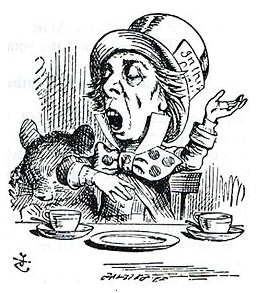
mercury poisoning in the 19th century
(drawing by Sir John Tenniel)
Hat makers in the nineteenth century began to develop neurological and psychiatric disorders, manifested by weakness, tremors, and personality changes. It was due to the water-soluble mercury nitrate they used to soften and shape animal furs such as beaver pelts. This process was called 'felting.' Mercury from the felting solution was absorbed through the skin, and the vapors it gave off were inhaled, leading to mercury poisoning.2
According to Arthur White, Ellen's father "Robert found his work as a hatter more prosperous than his farming, and the family moved sometime between 1831 and 1833 to the city of Portland, where he could give his full time to his trade."3
Arthur White goes on to describe how Robert Harmon carried on his hat-making business inside the Harmon home:
"The inside of the house was equipped for hatmaking. The animal pelts he bought would soon begin their transformation into fur top hats. First he would lay the pelt on a table and with a stout brush rub in a solution of mercuric nitrate. This highly poisonous solution was necessary to make the infinitesimal barbs on each strand of fur become more pronounced. Then with either large shears or a scraping knife he would remove the fur from the skin and place it in a stack. After the hair had been laboriously picked out of the fur, the most difficult part of the process began. A device resembling a violin bow but five or six times as big was brought down over the table. Snapping the catgut on the pile of fur on the bench separated, scattered, and gradually deposited the particles in a smaller and finer sheet. Each sheet represented one hat. With further manipulation, the fibers hooked themselves together into what ultimately became the fur fabric of the hat. The rest of the process is difficult to describe, but Ellen eventually learned the simplest part of it, which was shaping the crown of the hat."4
Arthur White reveals that Ellen was involved in the Harmon hat-making operation, and her father used a solution containing toxic mercury. Ellen writes:
"Our father was a hatter, and it was my allotted task to make the crowns of the hats, that being the easiest part of the work. I also knit stockings at twenty-five cents a pair. My heart was so weak that I was obliged to sit propped up in bed to do this work; but day after day I sat there, happy that my trembling fingers could do something to bring in a little pittance for the cause I loved so dearly."5
Since Robert Harmon soaked his material in a mercury-containing solution, as many hatters of that time-period did, it is nearly certain that Ellen came into contact with that material as she sat in her bed making crowns for the hats. It is highly probable she incurred some degree of mercury poisoning.
When mercury is upon any open surface it can continually leak toxic fumes into the environment, causing health problems for those who breathe it. Ellen was at risk of breathing these fumes from the hats her father produced and from his hat-making materials and equipment in their home. To put the extreme danger of mercury toxicity into perspective, when a thermometer breaks and a tiny amount of mercury leaks out, the U.S. Environmental Protection Agency advises parents to keep children away from the spill, and to throw away all garments that come into contact with the mercury.6
The danger of mercury poisoning was not limited solely to the ones applying the mercury solution. Anyone who had contact with the freshly treated pelts could be poisoned. In fact, according to one study, the risk actually increased for those who worked with the pelts immediately after they were treated. Mrs. Lindon Bates studied fur cutters in New York City in the early 1900s. She visited workers who had been involved in the use of mercury nitrate to treat furs to prepare them for use in felt making. The mercury nitrate combined with the pelts to produce keratin nitrate and mercury vapor. The workers who brushed the mercury nitrate solution onto the furs did not show the worst effects; rather, those in the drying rooms and the shippers showed worse effects. The shippers were the worst afflicted because they worked in areas of dried bundles of packaged furs in the storage rooms where the furs continued to emit mercury.7
Young Ellen Exhibits Symptoms of Mercury Poisoning
When Ellen was a young girl, she endured an astounding list of health problems that correlate to a high degree with known mercury poisoning symptoms. The following list of symptoms are all widely recognized signs of mercury poisoning. These are taken from her own biography wherein she recalls events during her teen-age years:
- Trembling hands: Mrs. White recollects that she had "trembling fingers" when she worked on her father's hats. According to scientists, "the earliest and most frequent symptom" of mercury poisoning "is a fine tremor (shaking) of the hand."8 The trembling was so intense that it interfered with her ability to complete her school work: "My nervous system was prostrated, and my hand trembled so that I made but little progress in writing..."9
- Concentration and attention problems: One of the initial signs of mercury poisoning is difficulty in concentrating. Ellen said she found it difficult to attend school, admitting "it seemed impossible for me to study and to retain what I learned."10 Memory issues are also an early sign of mercury poisoning. However, she blamed the cause of these issues on an earlier head injury.
- Dizziness: Another sign of mercury poisoning is "dizziness/acute, chronic vertigo".11 Mrs. White recollects that, as a young girl, when she attempted to study, "dizziness would seize me."12
- Coughing: A variety of respiratory problems are caused by inhaling mercury fumes, and "symptoms usually begin with cough..."13 Mrs. White laments that she was unable to study because "I had a bad cough, and my whole system seemed debilitated."14
- Anxiety: Young Ellen seemed to struggle with anxiety. When she first heard of the return of Christ, she "was seized with terror" and "could scarcely sleep for several nights".15 One can only sympathize with the terror she experienced:
My sufferings of mind were intense. Sometimes for a whole night I would not dare to close my eyes, but would wait until my twin sister was fast asleep, then quietly leave my bed and kneel upon the floor, praying silently, with a dumb agony that cannot be described. The horrors of an eternally burning hell were ever before me.16
- Depression: Mercury disrupts neurotransmitter function and can lead to neuroinflammation, which is associated with depression. Symptoms can include mood disturbances, persistent sadness, loss of interest in activities, fatigue, and other symptoms typical of clinical depression. Mrs. White wrote of being depressed for most of her life. Ellen writes of her teen-age struggles with depression: "A terrible sadness rested on my heart. I could not think of anything I had done to cause me to feel sad...I wandered needlessly in darkness and despair..."17
- Weakness: As noted in the quote above, Ellen's heart was so "weak" she worked on the hats from her bed. When called upon to travel, she laments: "I felt too weak and despondent to make any special effort for myself..."18
- Fainting: Another sign of mercury poisoning is "fainting spells."19 When attempting to study her schoolwork, she complained of "faintness."20
- Speech Impairment: Speech disorders are common with mercury poisoning. Mrs. White writes of being "struck dumb", unable to speak for a day, but she attributed this symptom to the power of God.21
- Obsession: Severe neuropsychiatric effects of mercury poisoning can include delusions and obsessive thoughts. These can take on a religious nature, particularly if the individual already has strong religious beliefs. This includes intense religious preoccupations, delusions of being a prophet or receiving divine messages, and other forms of religious obsession or paranoia.
Older Ellen Constantly Battling Mercury-Related Health Problems?
Researcher Max Chugg compiled a list of 17 health conditions Ellen White claims to have endured as an adult.22 While Mrs. White blamed some of these upon assaults from Satan, we will compare this list to a list of mercury-poisoning symptoms compiled by Dr. Hal Huggins and other scientists, to see if there is a more rational cause:
| Ellen White's Complaint | Mercury-Poisoning Symptom |
|---|---|
| 1. Neuralgia of the nerves | Nervous Disorders23 |
| 2. Inflammatory rheumatism | Rheumatoid arthritis24 |
| 3. Malaria (symptoms include fever, chills, headache, sweats, fatigue, nausea and vomiting) | Metal fume fever - "Occurs in the acute phase of mercury vapor toxicity and is manifested by fatigue, weakness, fever, chills, dizziness, headache, abdominal cramping"25 |
| 4. Bleeding of the lungs | Lung damage26 |
| 5. Oppressed lungs | Asthma27 |
| 6. Brain fever (Sciatica) | Sciatica (Brain fever)28 |
| 7. Hip and spine difficulties | Painful joints, osteomyelitis29 |
| 8. Kidney problems | Chronic kidney disease, infection30 |
| 9. Dropsical consumption | Lung damage31 |
| 10. Right lung decayed | Lung damage32 |
| 11. Left lung considerably diseased | Lung damage33 |
| 12. Fainting fits | Fainting spells34 |
| 13. Dropsy | Heart and kidney damage35 |
| 14. Heart disease | Heart problems, chest pains, angina, heart attack36 |
| 15. Paralysis (and Numbness) | Paralysis, Numbness37 |
| 16. Swollen face and gums | Swollen gums, swollen lymph nodes38 |
| 17. Loose teeth | Loosening of teeth39 |
Of the 17 major health complaints reported by Mrs. White, virtually every one of them could have been triggered by mercury poisoning. There are many other minor complaints reported by Mrs. White that could be caused by a wide variety of factors, but could also be signs of mercury poisoning. For example, Mrs. White frequently complained of an inability to sleep. Insomnia is frequently cited as a symptom of mercury poisoning.40
Mrs. White wrote in one testimony published 1867, "The blood rushed to my brain, frequently causing me to reel and nearly fall. I had the nosebleed often, especially after making an effort to write."41 "Dizziness" and "epistaxis" (nosebleed) are both symptoms of toxicity from mercury exposure.42
A Cause of the Visions?
One symptom sure to raise concern amongst Seventh-day Adventists is that mercury poisoning can trigger hallucinations:
In severe cases, mercury poisoning can cause psychosis. Psychosis interferes with a person's thinking, emotions, memory, communication, behavior and interpretation of reality. When sufficiently impaired in all these areas that they can not meet the ordinary demands of life, a person is psychotic. Psychotic people often have very disorganized behavior which may be childlike or infantile, an inappropriate mood for the situation they are in, poor ability to control their impulses, speak in an incoherent jumble of words, and may have delusions and hallucinations (usually without an understanding of the fact that these are not real).43
It is unknown whether Ellen White's mercury exposure was significant enough to have played a direct role in any of her visionary episodes, and it would be wise to tread carefully in this regard. As Dr. Numbers explains, it is "unnecessary and unwise to assume that this malady would account for all of her unusual behavior."44 It may be the case that the cause of the visions was more indirectly related to mercury, as this quote from Dr. Andrew Cutler would suggest:
Mercury can impair the brain's electrical regulation and cause epilepsy (either grand mal or petit mal varieties).45
This would complement modern research which suggests Mrs. White may have been the victim of temporal lobe epilepsy. The mercury may have been a trigger for Mrs. White's epileptic-like seizures, which were interpreted by those around her as "visions" from God.
Hysteria or Mercury Poisoning?
At one point, Mrs. White complained she "suffered much with the teethache, and ague in the face."46 Toothaches are a common symptom of mercury poisoning, as are various nerve problems. "Ague in the face" is not a term commonly used today. An 1868 Medical reference book indicates "ague in the face" is a problem affecting...
...the nerves of the face scalp and integuments of the head but most usually the face on one side or the other. ... It is confined mostly to weak nervous persons more frequently affecting females than males and then those of weak and delicate constitutions and hysterical temperaments.47
More than one physician acquainted with Ellen White considered her to be afflicted with a condition commonly called "hysteria." Doctors in the 1800s were unfamiliar with all the nuances of mercury poisoning, but today doctors know that "seizures are a well-known feature of mercury toxicity (as are so many of the other physical and mental features of 'hysteria'...)"48 In fact, Sigmund Freud "frequently misdiagnosed mercury poisoning as hysteria...the similarity of severe clinically defined hysteria to mercury poisoning is striking: from visual field constriction to gastric pains to numbness and paralysis and mental disturbances."49 Therefore, it is possible that Ellen White's physicians, like their contemporary Sigmund Freud, misdiagnosed Mrs. White's hallucinations and other unusual symptoms to be hysteria, when in fact they may have been triggered by mercury poisoning.
Violent Temper
One of the psychological effects of mercury poisoning is that the victim has "a pathological fear of ridicule and often" reacts "with an explosive loss of temper when criticised."50 Those who knew Ellen White were well-acquainted with her harsh treatment of others. Her temper manifested most violently when she or James or her testimonies were criticized. She could not tolerate any criticism. D.M. Canright explains:
I saw that her revelations always favored Elder White and herself. If any dared question their course, they soon received a scathing revelation denouncing the wrath of God against them.51
Conclusion
Unfortunately, there are no "typical" symptoms of mercury poisoning that could easily be used to classify Mrs. White's condition beyond all possibility of doubt. Effects vary considerably depending upon one's age, weight, rate of exposure, type of mercury, and route of exposure (inhalation, skin, etc.).52 However, since her father was a hatter who used mercury to prepare his hats, and since she assisted him, at least for a while, in his business, she was definitely at risk for exposure to the poison. While many of the symptoms Mrs. White experienced could have had multiple causes, the sheer number of commonalities between her symptoms and mercury poisoning symptoms would suggest she had at least a mild exposure to mercury. If this is the case, it is sad and unfortunate and Mrs. White is deserving of our deepest sympathy. Furthermore, this could, in part, explain some of the unusual physical symptoms and psychological behaviors exhibited by Mrs. White throughout her prophetic career.