
The Mystery of Enoch
By ,
For decades, Seventh-day Adventists [SDAs] have looked to Enoch as the perfect man whose character exemplifies the preparation required for translation. But to build this towering symbol, prophetess Ellen G. White dramatically expanded his story far beyond the few verses offered in Genesis. This article reveals that her inspired account is marred by staggering chronological errors. Even more troubling, her writings reveal shocking parallels to prophet Joseph Smith of Mormonism. Was Ellen White's story of Enoch gleaned from divine visions, or a was it fairy tale built on dubious sources?
Enoch the Adventist
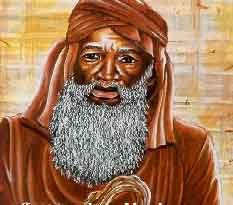
Enoch is an all-important figure in the writings of Ellen White. Despite the fact the Bible only mentions him in a handful of verses, White mentions him hundreds of times in her writings. According to her, Enoch attained such a perfection of character that allowed God to take him to heaven. Therefore, Enoch is an apt representation of what all SDAs need to strive to attain before their translation into heaven at the second coming of Christ.
Perhaps part of the reason Mrs. White identified so closely with Enoch is that she believed him to be an Adventist like herself. In 1904, she wrote: "Enoch was an Adventist."1
So close was her connection with Enoch that she imagined she held a conversation with Enoch on a mysterious planet with seven moons:
Then I was taken to a world which had seven moons. There I saw good old Enoch, who had been translated. On his right arm he bore a glorious palm, and on each leaf was written 'Victory.' Around his head was a dazzling white wreath, and leaves on the wreath, and in the middle of each leaf was written 'Purity,' and around the wreath were stones of various colors, that shone brighter than the stars, and cast a reflection upon the letters and magnified them. On the back part of his head was a bow that confined the wreath, and upon the bow was written 'Holiness.' Above the wreath was a lovely crown that shone brighter than the sun. I asked him if this was the place he was taken to from the earth. He said, 'It is not; the city is my home, and I have come to visit this place.' He moved about the place as if perfectly at home.2
Unraveling the Mystery of Ellen White's Enoch
Clue #1 - The City
In her vision, Mrs. White said Enoch told her "the city is my home." What city was Enoch talking about? A clue is found in one of her Testimonies:
But Enoch's heart was upon eternal treasures. He had looked upon the celestial city. He had seen the King in His glory in the midst of Zion.3
The first clue is that Enoch looked upon a celestial city named Zion.
The Mormon Connection
Not surprisingly, Enoch was also an all-important figure to Mormon prophet Joseph Smith. In fact, Smith was sometimes referred to under the pseudo-name of "Enoch." Like Mrs. White, Smith elaborated greatly upon the life of Enoch. In his writing entitled Pearl of Great Price, Smith describes how Enoch founded a city named Zion:
And Enoch continued his preaching in righteousness unto the people of God. And it came to pass in his days, that he built a city that was called the City of Holiness, even ZION.4
Enoch built a city named Zion. Beginning to sound familiar? Of course, this city was on earth, not heaven. However, Smith explains that after a while, this earthly city became a celestial city:
And it came to pass that the Lord showed unto Enoch all the inhabitants of the earth; and he beheld, and lo, Zion, in process of time, was taken up into heaven. And the Lord said unto Enoch: Behold mine abode forever.5
According to Smith, Enoch's city of Zion was moved to heaven and became the celestial city where God abode. Returning now to those quotes from Ellen White:
I asked him [Enoch] if this was the place he was taken to from the earth. He said, 'It is not; the city is my home...'6
But Enoch's heart was upon eternal treasures. He had looked upon the celestial city. He had seen the King in His glory in the midst of Zion.7
It seems like more than a coincidence that both Sister White and Brother Smith added the extra-biblical idea of Enoch's celestial city of Zion to their accounts of his life. But the coincidences do not end there.
Clue #2 - Enoch the Christian
According to Mrs. White, Enoch was not only an Adventist, but also a Christian:
Enoch was a representative of Christ as surely as was the beloved disciple John. ... That God who walked with Enoch was our Lord and Saviour Jesus Christ. He was the light of the world then just as He is now. Those who lived then were not without teachers to instruct them in the path of life; for Noah and Enoch were Christians.8
Adam, repentant and converted, was a Christian; Abel was a Christian; Enoch was a Christian; Noah was a Christian; Abraham was a Christian.9
Mrs. White describes Enoch as being a Christian thousands of years before the first Christians were called such at Antioch in the first century A.D.10 To be a Christian, biblically speaking, is to believe in the historical death, burial, and resurrection of Jesus Christ, to confess Him as Lord, and to be united with Him through baptism. None of these conditions could have been met by individuals who lived thousands of years before the incarnation.11
The claim that Enoch and other Old Testament figures were "Christians" is not supported by the Bible. Scripture does not apply the term Christian retroactively to anyone in the Old Testament, nor does it describe them as possessing the defining elements of New Testament Christian faith. The patriarchs are described as men of faith who trusted in God’s promises (Heb. 11:7–13), yet the same passage explicitly states that they “received not the promise” but saw it “afar off” (Heb. 11:13).
Moreover, Scripture never identifies a pre-incarnate appearance of Christ in Genesis 5. The text simply states that “Enoch walked with God” (Gen. 5:22–24), without defining any details of that communion. To assert dogmatically that “the God who walked with Enoch was our Lord and Saviour Jesus Christ” goes beyond the biblical text and enters the realm of speculation. Thus, to label these men as “Christians” is both historically and biblically inaccurate.
Another Mormon Connection
One of Joseph Smith's fundamental teachings about Enoch was that he was a Christian. In fact, in the following quote Enoch is going around and preaching Jesus Christ, calling people to repent and be baptized:
And he also said unto him: If thou wilt turn unto me, and hearken unto my voice, and believe, and repent of all thy transgressions, and be baptized, even in water, in the name of mine Only Begotten Son, who is full of grace and truth, which is Jesus Christ, the only name which shall be given under heaven, whereby salvation shall come unto the children of men, ye shall receive the gift of the Holy Ghost, asking all things in his name, and whatsoever ye shall ask, it shall be given you.12
Is the fact that both Joseph Smith and Ellen White taught that Enoch was a Christian merely another mysterious coincidence?
Clue #3 - Enoch's Visions
In Patriarchs and Prophets Mrs. White informs her followers that Enoch was given visions of the future:
Through holy angels God revealed to Enoch His purpose to destroy the world by a flood, and He also opened more fully to him the plan of redemption. By the spirit of prophecy He carried him down through the generations that should live after the Flood, and showed him the great events connected with the second coming of Christ and the end of the world.13
In prophetic vision he was instructed concerning the death of Christ, and was shown His coming in glory, attended by all the holy angels, to ransom His people from the grave. He also saw the corrupt state of the world when Christ should appear the second time—that there would be a boastful, presumptuous, self-willed generation, denying the only God and the Lord Jesus Christ, trampling upon the law, and despising the atonement. He saw the righteous crowned with glory and honor, and the wicked banished from the presence of the Lord, and destroyed by fire.
Enoch became a preacher of righteousness, making known to the people what God had revealed to him. Those who feared the Lord sought out this holy man, to share his instruction and his prayers. He labored publicly also, bearing God's messages to all who would hear the words of warning. His labors were not restricted to the Sethites. In the land where Cain had sought to flee from the divine Presence, the prophet of God made known the wonderful scenes that had passed before his vision.14
Notice six points from the above quotes:
- Enoch received visions of the future, of many generations
- Enoch went to preach in the land of Cain
- Enoch was shown the flood
- Enoch had a vision of the death of Christ
- Enoch was shown the second coming of Christ
- Enoch saw the righteous crowned with glory
What was the source of Mrs. White's information on these six extra-biblical elements?
More Mormon Connections
Not surprisingly, Joseph Smith wrote about all six of the above items in Pearl of Great Price, Moses chapter 7:
- Received visions of the future: Verse 4—...and he said unto me: Look, and I will show unto thee the world for the space of many generations. ... 23—...Enoch beheld, and lo, all the nations of the earth were before him; 24—And there came generation upon generation...
- Went to preach to Cain's people: Verse 12—And it came to pass that Enoch continued to call upon all the people, save it were the people of Canaan, to repent;
- Was shown the flood: Verses 34, 38—And the fire of mine indignation is kindled against them; and in my hot displeasure will I send in the floods upon them, for my fierce anger is kindled against them. ... But behold, these which thine eyes are upon shall perish in the floods; and behold, I will shut them up; a prison have I prepared for them.
- Was shown the death of Christ: Verse 55—And the Lord said unto Enoch: Look, and he looked and beheld the Son of Man lifted up on the cross, after the manner of men;
- Was shown second coming: Verse 60—And the Lord said unto Enoch: As I live, even so will I come in the last days, in the days of wickedness and vengeance... (1 Enoch, quoted by Jude in Jude 1:14-15, also describes Enoch having a vision of the return of Christ)
- Saw righteous crowned: Verse 56—"...the saints arose, and were crowned at the right hand of the Son of Man, with crowns of glory..."
The parallels between the writings of Joseph Smith and Ellen White on Enoch are simply too improbable to ignore. It appears that Mrs. White did not receive her teaching on Enoch from the Bible or from her spirit guides but from the Mormons.
Clue #4 — Enoch as the Perfectionist Template
White's use of Enoch as a holiness standard for end-time translation is more than a theological error and reversal of centuries of Protestant teaching — it is another parallel to the theology of Joseph Smith.
In the Book of Moses, Smith's expansion of Genesis, Enoch's entire city achieves translation precisely because they attained a sufficient level of collective purity and righteousness: they were "pure in heart," "of one heart and one mind," and "dwelt in righteousness" — and as a result the entire City of Holiness was taken to God (Moses 7:18-19) LDS teaching drawn directly from Smith makes the end-time application explicit: the latter-day Saints must attain "the standards of righteousness of Enoch's people" before the promised reunion between the modern church and Enoch's translated city can occur, and "when men should keep all my commandments, Zion should again come on the earth."15
Compare this to White's parallel declaration:
Enoch's life and character, which were so holy that he was translated to heaven without seeing death, represent what the lives and characters of all must be, if, like Enoch, they are to be translated when Christ shall come.16
White is not following the Bible or the Gospel of Christ. First, White claims Enoch was translated because he became "so holy" — as though holiness were the qualifying achievement that earned divine transport. Then she declares that every end-time Christian must replicate this level of holiness. Must. And the whole proposition hangs on a condition: "if... they are to be translated." Translation is not secured by the finished work of Christ. It is contingent on the finished work of the believer in attaining holiness equal to that of Enoch.
Both Smith and White use Enoch's achieved holiness as the required standard for end-time translation. Both frame it as a condition that the final generation must meet. Both attach it to the Second Coming. The Bible — in Hebrews 11:5-6, the New Testament's definitive commentary on Enoch — attributes his translation not to achieved holiness but to faith. Not perfection achieved through decades of behavioral compliance. Faith.
Neither Smith nor White followed the biblical text. Smith invented a false teaching and White followed it.
Copied the Spurious Book of Jasher
Mrs. White went beyond Joseph Smith and fabricated additional teachings about Enoch that did not originate from the Bible. Her description of the light upon Enoch's countenance (PP 86) matches a similar description from the Book of Jasher:
| Patriarchs and Prophets | Book of Jasher |
|---|---|
| After remaining for a time among the people, laboring to benefit them by instruction and example, he [Enoch] would withdraw, to spend a season in solitude, hungering and thirsting for that divine knowledge which God alone can impart. Communing thus with God, Enoch came more and more to reflect the divine image. His face was radiant with a holy light, even the light that shineth in the face of Jesus. As he came forth from these divine communings, even the ungodly beheld with awe the impress of heaven upon his countenance. (p. 86) | 3:20. And he [Enoch] did in this manner for many years, and he afterward concealed himself for six days, and appeared to his people one day in seven; and after that once in a month, and then once in a year, until all the kings, princes and sons of men sought for him, and desired again to see the face of Enoch, and to hear his word; but they could not, as all the sons of men were greatly afraid of Enoch, and they feared to approach him on account of the Godlike awe that was seated upon his countenance; therefore no man could look at him, fearing he might be punished and die. |
White's Original Contribution
Modern SDA apologists have been forced to admit that Ellen White plagiarized heavily, but their defense is to argue that she added some inspired, valuable add-ons to the material she stole. Well, here is a case where White didn't borrow from Smith or Jasher. Her extra-biblical chronology of events involving Enoch and the ark's construction appear to come from her own visions. This allows the reader to test not only the validity of her visions, but also the believability of the argument that she added value to the material she plagiarized from others.
White mangles the biblical timeline by claiming Enoch was alive on earth while the ark was being built:
God determined to purify the world by a flood; but in mercy and love He gave the antediluvians a probation of one hundred and twenty years. During this time, while the ark was in building, the voices of Noah, Enoch, and many others were heard in warning and entreaty. And every blow struck on the ark was a warning message.17
She places Enoch's departure as occurring "just before" the flood:
Enoch's translation to Heaven just before the destruction of the world by a flood, represents the translation of all the living righteous from the earth previous to its destruction by fire.18
She even wrote that Enoch was taught by Noah:
Enoch first received instruction from Noah, and he observed the law of God, and served him with singleness of heart.19
Did Enoch preach while the ark was being built? Did he receive instruction from Noah? Was he translated "just before" the flood? According to the biblical genealogy in Genesis 5...
Here is the Biblical timeline in Genesis 5 for reference:
| Person | Born | Died |
|---|---|---|
| Adam | 0 | 930 |
| Seth | 130 | 1042 |
| Enos | 235 | 1140 |
| Cainan | 325 | 1235 |
| Mahalaleel | 395 | 1290 |
| Jared | 460 | 1422 |
| Enoch | 622 | 987 (translated) |
| Methuselah | 687 | 1656 |
| Lamech | 874 | 1651 |
| Noah | 1056 | 1656 (flood) |
The numbers in that table are simple arithmetic — the kind a child with a third-grade education and a Bible could perform in five minutes. Enoch was translated in year 987. Noah was born in year 1056. They missed each other by 69 years. The ark's construction began around year 1536. Enoch had been gone for 549 years before the first plank was cut. The flood came in year 1656 — 669 years after Enoch's translation. "Just before the flood" by 669 years is not a rounding error. It is a falsehood.
This is the precise scenario SDA apologists have demanded: a passage where White is not borrowing from Smith or Jasher, where the content derives from her own claimed visionary experience, and where it can be tested against the plain text of Scripture. The apologist argument is that while White borrowed freely, her visions added genuine inspired value to the material. The test is now before us. What her visions added — independent of any known source — is a timeline that contradicts Genesis three times.
A genuine prophet of God, shown in vision the actual events of antediluvian history, would not have placed Enoch on earth during the construction of an ark that began five centuries after his translation. She would not have had Enoch receiving instruction from a man who was not yet born when Enoch left the earth. She would not have placed his translation "just before" an event that occurred more than six and a half centuries later. White's unique contribution to her plagiarism of Smith and Jasher was catastrophically wrong.
Conclusion
The pattern across this article is consistent: borrowed mythology presented as revelation, chronological errors that contradict Scripture, and a theological framework that replaces the New Testament's grace with Smith's works-based performance.
When her writings are compared with extra-biblical sources, particularly those of Joseph Smith, the parallels become too numerous and specific to ignore. Like Smith, Ellen White portrays Enoch as a Christian prophet, a visionary of the second coming, and a resident of a celestial city called Zion. These ideas are absent from the Bible but common in Mormonism. Her uncritical reliance on such material undermines the claim that her account was derived from divine revelation. The evidence instead exposes a pattern in which borrowed mythology, historical error, and theological errors are proclaimed as divine revelation — revealing Ellen White’s account of Enoch to be, quite literally, a White lie.