
Did Ellen White Know More than Bible Translators?
By and , last updated Mar.
James White, Life sketches of Elder James White and His Wife (1880), 329
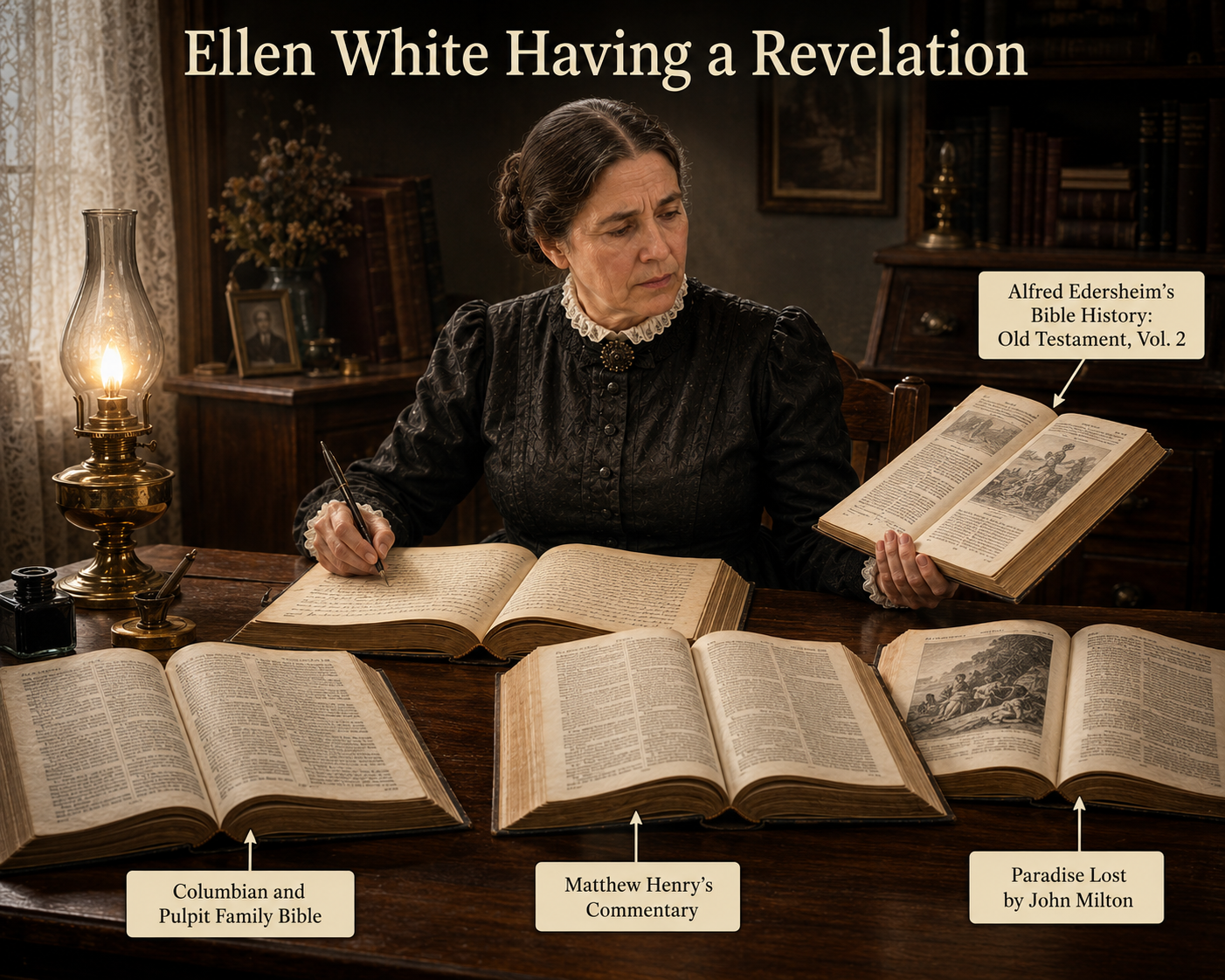
One myth that is heard on occasion within Seventh-day Adventist [SDA] circles is that Ellen White had special, divine insight into the Scriptural text, and that she was able to perceive the meaning of the original languages better than the translators of the KJV Bible. Her Grandson, Arthur White, explains this supposed supernatural ability:
Careful students of the original Bible languages have often observed that the insights the visions gave to Ellen White led her again and again to catch meanings more in keeping with the original text than is reflected in the King James Version, which she constantly used. Her acceptance of the newer translations as they became available supports this point.1
Is this true? Did Ellen White receive supernatural revelations that enabled her to comprehend the meaning of Bible texts better than the translators of the KJV Bible?
Did White Know More Than KJV Translators?
Significantly, Arthur provides no evidence to substantiate that Ellen had this supernatural ability. He does not provide a single verse to prove his point. Therefore, his argument has no evidence to support it. In fact, a dozen examples below will illustrate that Ellen White had no more insight than the average reader of the KJV Bible.
1. Is Satan Named Lucifer?
According to Ellen White, the pre-fall name of Satan is Lucifer. Starting in 1883, she used the name Lucifer at least 208 times in her original writings.2 She frequently cites Isaiah 14:12 as a reference to the pre-fall name of Satan:
Lucifer had said, “I will be like the Most High” (Isaiah 14:12, 14)...3
While Arthur White would have us believe his grandmother knew more than the translators of the KJV, Ellen was apparently unaware that the name Lucifer is not in the original Hebrew text of Isaiah 14:12. So where did the name "Lucifer" come from?
The transformation of the word "Lucifer" from a common astronomical term into the proper name of the Devil is one of the most fascinating linguistic swaps in religious history. In short: Lucifer was never a Hebrew name for Satan. It was a Latin translation of an astronomical metaphor describing a pagan king, which was later adopted by early theologians, capitalized by English translators, and ultimately cemented into the cultural consciousness by classic literature.
The Hebrew Original: A Taunt Against a King
The origin of the name lies in Isaiah 14:12. In this passage, the prophet Isaiah is writing a "taunt-song" (or proverb) directed at the hubris and ultimate downfall of the King of Babylon.4 The original Hebrew text (transliterated) reads:
"Eyk naphalta mishamayim, helel ben-shachar..."
The word helel literally means "shining one" or "brilliant one," while ben-shachar means "son of the dawn." Together, this refers directly to the planet Venus—the "morning star"—which shines incredibly bright at dawn but is quickly swallowed up and "cast down" by the rising sun.5 Isaiah was using a natural metaphor: just like the morning star boasts of its height only to vanish when the sun rises, the proud King of Babylon boasted of his god-like power only to be dragged down to the grave.
The Greek and Latin Translations
When the Hebrew Bible was translated into Greek (the Septuagint) around the 3rd century BC, translators rendered helel ben-shachar as heosphoros, the literal Greek term for the "dawn-bringer."6
In the late 4th century AD, Jerome translated the Bible into Latin (the Vulgate). Here is how the Vulgate translates Isaiah 14:12:7
Quomodo cecidisti de caelo lucifer qui mane oriebaris corruisti in terram qui vulnerabas gentes
Jerome translated the Greek heosphoros into the standard Latin word for the morning star: lucifer (literally, "light-bearer" or "dawn-bringer," from lux, meaning "light," and ferre, meaning "to carry/bring").8 At this point, lucifer was still a common noun, not a proper name. In fact, the Latin Vulgate uses the word lucifer in several other places to refer to bright, holy things, including the brightness of morning in Job 11:17 and even Jesus Christ in 2 Peter 1:19:9
We have also a more sure word of prophecy; whereunto ye do well that ye take heed, as unto a light that shineth in a dark place, until the day dawn, and the day star [Vulgate: lucifer] arise in your hearts.
The Patristic Leap
The jump from an astronomical metaphor to the Devil himself was bridged by early Christian theologians, most notably Origen and Tertullian in the 2nd and 3rd centuries.10 They began reading the Old Testament through a highly spiritual, double-prophetic lens, noticing striking parallels between Isaiah 14:12 ("How art thou fallen from heaven...") and New Testament statements about the fall of Satan, such as Luke 10:18 ("I beheld Satan as lightning fall from heaven").
The Church Fathers argued that the King of Babylon was merely an earthly shadow of a spiritual reality, concluding that the "shining one" who fell was actually Satan. Because the Latin Vulgate was the primary Bible of Western Europe for over a thousand years, readers constantly saw the word lucifer associated with this heavenly fall, gradually transforming the common noun into a proper noun.
The KJV and John Milton
By the time English translations were produced, the association was absolute. The King James Version (1611) chose not to translate helel back into English as "morning star." Instead, they transliterated the Latin Vulgate's word directly into the text as a capitalized proper name: "How art thou fallen from heaven, O Lucifer, son of the morning!"11
Finally, John Milton's epic masterpiece Paradise Lost (1667) — a book much-used by Ellen White — popularized the dramatic narrative that "Lucifer" was the glorious, beautiful name of the archangel before his pride corrupted him, and "Satan" (Hebrew for "adversary") was the title he took after his fall.12 This literary work permanently cemented "Lucifer" in the English-speaking imagination as the official, pre-fall name of the Devil.
Therefore, it is evident that "lucifer" is not a proper name and was never intended to be used as a proper name for the devil. If White had indeed been privy to supernatural knowledge regarding the original Bible text, if she had indeed witnessed scenes in heaven before the fall of mankind, then she would have known that the devil was not named Lucifer.
2. Isaiah 14 Is Addressed to the King of Babylon, Not Satan
The problem runs deeper than the name Lucifer. Ellen White repeatedly treated Isaiah 14 as a literal historical account of Satan's rebellion in heaven. But Isaiah himself tells us exactly who the prophecy concerns:
Thou shalt take up this proverb against the king of Babylon... (Isa. 14:4).
That should settle the question. The prophet does not introduce a vision about Satan. He introduces a taunt song directed against a proud human ruler. Throughout the chapter the subject is mocked for his arrogance, his downfall, and his death. The nations rejoice that their oppressor has fallen. His body is cast into the grave. Then Isaiah asks:
Is this the man that made the earth to tremble, that did shake kingdoms? (Isa. 14:16).
Isaiah calls him a man.13 Satan is not a man, nor is the devil buried in a royal tomb among earthly kings (vv. 18-20). Every clue in the chapter points to an earthly monarch whose pride brought about his humiliation.
Even the famous expression "Helel ben Shahar" ("shining one, son of the dawn") fits naturally into that context. Rather than revealing the devil's forgotten heavenly name, Isaiah appears to be employing imagery familiar to the Babylonian world—a brilliant morning star that briefly ascends the sky before quickly disappearing beneath the horizon. Many scholars also see an allusion to ancient Near Eastern mythology involving the Babylonian god Helel, son of Shahar, whose failed attempt to exalt himself perfectly illustrates the Babylonian king's own pride and collapse.14 Isaiah's point is satire, not biography.
None of this denies that Scripture elsewhere teaches Satan's pride and fall. It simply means that Isaiah 14 is not the passage doing so. Rather, it is a rebuke addressed to a "man" — the Babylonian King. It is a denunciation of the pagan Babylonian gods he trusted—Helel and Shahar. Ellen White repeatedly cited this chapter as though it were a straightforward historical narrative of Lucifer's rebellion in heaven. If her visions truly provided divine insight into Scripture, why did they never correct one of the most common interpretive assumptions inherited from Christian tradition?
3. Who Founded Nineveh?
Genesis 10 records the rise of the earliest post-Flood civilizations. In the King James Version, Genesis 10:11 reads:
Out of that land went forth Asshur, and builded Nineveh, and the city Rehoboth, and Calah... (Gen. 10:11).
According to the KJV, Asshur, the son of Shem, left Shinar and founded Nineveh. Ellen White not only accepted this reading, she expanded upon it with additional historical detail:
This is the special message that God bade his servant Jonah bear in the ancient and populous city founded by Asshur, the son of Shem, who "went forth" from "the land of Shinar" about the time of the dispersion from Babel, "and builded Nineveh."15
Notice what White has done. She is no longer merely quoting Scripture. She confidently supplies historical details never found in the biblical text, describing Asshur's migration from Shinar and dating the founding of Nineveh to the time of Babel's dispersion.
The problem is that the underlying Hebrew almost certainly does not say Asshur founded Nineveh. Modern translations correctly understand that the Hebrew indicates the subject of Genesis 10:11 is Nimrod, not Asshur:
From that land he went to Assyria and built Nineveh, Rehoboth Ir, Calah (NKJV).
The nearest antecedent of "he" is Nimrod, introduced in the immediately preceding verses as the founder of Babel and the beginning of the Mesopotamian kingdoms.16 This reading is reinforced elsewhere in Scripture. Micah 5:6 even calls Assyria "the land of Nimrod"—a description that makes perfect sense if Nimrod established its principal cities, but not if Asshur did.
In other words, Ellen White's "inspired" history simply repeats the traditional KJV rendering and then builds an elaborate narrative upon it. Rather than correcting a translation problem through divine revelation, she unknowingly reinforces it. Her account of Asshur founding Nineveh is not a supernatural revelation, but a KJV translation blunder that she was unable to detect.
4. Wrong About Mary Magdalene
If Ellen White literally witnessed Christ's resurrection scenes in vision, one would expect her account to clarify Scripture—not simply repeat the limitations of the King James Version. Yet her description of Mary Magdalene's first encounter with the risen Christ does exactly that.
Describing the morning of the resurrection, White wrote:
But now in His own familiar voice Jesus said to her, "Mary." Now she knew that it was not a stranger who was addressing her, and turning she saw before her the living Christ. In her joy she forgot that He had been crucified. Springing toward Him, as if to embrace His feet, she said, "Rabboni." But Christ raised His hand, saying, "Detain Me not; for I am not yet ascended to My Father..."17
Notice what White claims happened. Mary attempted to embrace Jesus, but He stopped her before she actually touched Him. That interpretation follows the traditional KJV wording of John 20:17: "Touch me not."
The Greek text, however, says something quite different. Jesus did not tell Mary not to touch Him; He told her to stop clinging to Him.18 The action had already begun. This is how nearly all modern versions describe it:
NASB: "Stop clinging to Me..."
ESV: "Do not cling to me..."
NIV: "Do not hold on to me..."
NKJV: "Do not cling to Me..."
NLT: "Don't cling to me..."
The distinction is important. According to the Greek, Mary had already reached Jesus and was holding onto Him when He gently instructed her to let go. White's account removes that contact entirely. She has Jesus stopping Mary with an uplifted hand before she ever touches Him—a scene derived from the KJV translation rather than the original text.
This creates another serious problem for White's prophetic claims. She repeatedly insisted that she was shown scenes from Christ's life by divine revelation. Yet when her description can be tested against the original language of Scripture, it reproduces the same misunderstanding found in the English Bible she used. Instead of correcting the KJV, her "vision" simply echoes it. Once again, her inspiration proves to be no more reliable than the nineteenth-century English translation sitting on her desk.
5. A Fake Timeline Built on a Grammar Mistake
If Ellen White possessed genuine supernatural insight into the biblical languages, 2 Thessalonians 2:9 is exactly where it should have appeared. Instead, she misunderstood the KJV word "after," treating it as a temporal sequence rather than a statement of manner, misidentified the antecedent of a crucial pronoun, and then built an entire prophetic timeline on that grammatical mistake.
1. She Mistook a Preposition of Manner for a Marker of Time
The KJV translators rendered the Greek kat' energeian as "after the working of." In seventeenth-century English, however, after often meant according to or in the manner of, not following in time. Scripture uses the same construction elsewhere: Christ is a priest "after the order of Melchizedek" (Heb. 5:10), meaning according to or in the likeness of Melchizedek — not that He appeared chronologically after him. Likewise, the Greek preposition kata with the accusative describes the manner or character of an action, not its timing. Paul was explaining how the lawless one would come — empowered by Satan — not establishing a prophetic timetable. Modern translations correctly remove the ambiguity:
The coming of the lawless one is according to the working of Satan, with all power, signs, and lying wonders (2 Thess. 2:9 NKJV).
Ellen White, however, misunderstood the archaic KJV wording. She treated "after the working of Satan" as though it meant chronologically after the rise of modern Spiritualism:
The developments that were to take place in the future were to be "after the working of Satan with all power and signs and lying wonders."19
Paul, in his second letter to the Thessalonians, points to the special working of Satan in spiritualism as an event to take place immediately before the second advent of Christ. Speaking of Christ's second coming, he declares that it is "after the working of Satan with all power and signs and lying wonders." 2 Thessalonians 2:9.20
In Paul's second epistle to the Thessalonians... He speaks of Christ's coming as an event to immediately follow the work of Satan in spiritualism in these words: "Even him, whose coming is after the working of Satan..."21
Her meaning is unmistakable. Ellen White interpreted the word after as a chronological marker, teaching that Christ would return after the rise of modern Spiritualism. But that is not what Paul wrote. The apostle was describing the nature of the lawless one's coming, not placing Christ's return on a prophetic timeline. White's prediction rests on a grammatical misunderstanding.
2. She Reversed Paul's Entire Subject
The second mistake is even more serious. Read verses 8 and 9 together without inserting preconceived ideas:
And then shall that Wicked be revealed... Even him, whose coming is after the working of Satan with all power and signs and lying wonders. (2 Thessalonians 2:8–9, KJV)
The antecedent could hardly be clearer. The pronoun "him" refers back to "that Wicked" — Paul's title for the Man of Sin, the Antichrist. Verse 9 is simply continuing the description begun in verse 8. Paul is explaining how the Antichrist comes: according to the working of Satan, accompanied by counterfeit miracles, signs, and lying wonders.
Ellen White completely reversed Paul's meaning. She lifted the phrase "whose coming is after the working of Satan" out of its context and applied it to Christ's Second Coming. In doing so, she transferred the subject from the Antichrist to Christ Himself and transformed Paul's warning about Satan's counterfeit messiah into a timetable for Jesus' return.
This is not a minor interpretive disagreement. It is a fundamental grammatical error. Paul was describing the satanic credentials of the Man of Sin. Ellen White turned the passage into a prophecy that Christ would return only after the rise of modern Spiritualism. Her entire prophetic timeline depends upon assigning the subject of the sentence to the wrong person.
3. She Repeated Both Errors for Thirty-Five Years
This was not an isolated mistake. Ellen White repeated the same two interpretive errors — the temporal reading of "after" and the reassignment of Paul's subject from the Antichrist to Christ — for more than three decades. The identical interpretation appears in:
- Review and Herald (April 15, 1875)
- Signs of the Times (April 12, 1883)
- Patriarchs and Prophets (1890), p. 286
- Acts of the Apostles (1911), p. 266
This is significant. During those thirty-five years, her writings were revised, expanded, republished, and carefully edited, yet the underlying grammatical mistakes remained untouched. If God was illuminating the biblical text for His prophet, why was the same misreading carried forward from one publication to the next?
4. Her Own Writings Contradict Her Chronology
The issue deepens. In 1900, she cited the exact same verse but used the word in its proper sense: "Strife for the supremacy is after the working of Satan."22 A genuine, fixed divine revelation does not wobble depending on which manuscript or compiler was on the desk that day.
5. The Failed Spiritualism Timeline
The grammatical errors above would be serious enough if they merely produced a bad commentary on Paul's words. They did far more than that. They produced a failed prophetic timeline.
White repeatedly taught that the rise of modern Spiritualism was the great prophetic sign immediately preceding the Second Coming. The "special working of Satan in spiritualism" was, in her words, "an event to take place immediately before the second advent of Christ."23
History, however, took the opposite course. American Spiritualism peaked in the late 19th century and was rapidly declining by 1900. After a brief surge following the First World War — driven by grieving families attempting to contact fallen soldiers — it collapsed. By 1920, it had lost its cultural foothold permanently.24
The movement's own official statistics trace this rapid decline: the National Spiritualist Association of Churches recorded approximately 12,000 members across 280 congregations in 1946. By 1950, membership dropped to 7,801 across 186 congregations. By 2010, just 84 remained.25 Organized Spiritualism in North America today is a tiny fragment of its 19th-century footprint.
Meanwhile, the sect founded on White's writings grew in the exact opposite direction. The North American Division of Seventh-day Adventists alone reported over 1.28 million members in 2025.26 SDAs in North America now outnumber the adherents of Spiritualism — the movement she claimed would immediately usher in the end of the age — by well over a hundred to one.
The sign she pointed to came and went over a century ago. The Second Coming she promised would follow "immediately" has not occurred. An author with divine access to apostolic Greek does not need thirty-five years to discover that "after" is not a stopwatch. A prophet with genuine foresight does not anchor the end of the world to a 19th-century fad that would spend the next hundred years fading into obscurity.
6. Unicorn or Rhino?
In 1880, Ellen White wrote about Balaam's prophecy:
God brought them out of Egypt; he hath, as it were, the strength of a unicorn." The rhinoceros is one of the most powerful of animals, and Balaam uses this creature as a figure to show how vain it is for any earthly power to array itself against the Most High. God had accomplished his will in bringing Israel from bondage and idolatry in Egypt, notwithstanding the opposition of Pharaoh and his hosts. It would be safer for lesser animals to attack the powerful unicorn, than for finite man to seek to turn aside the purposes of the Infinite One.27

White quotes from the KJV, which uses "unicorn" in Numbers 23:22, 24:8.28 The Hebrew word (re'em) refers to a now-extinct wild ox, likely the aurochs—a powerful bovine that went extinct in 1627. This animal, common in the Near East during the time of Moses, was viewed as a symbol of power in that culture. The eminent Hebrew scholar Robert Alter translates it as "wild ox."29 Most modern translations, such as the ESV, NIV, NASB, and NRSV also use "wild ox."
Ellen White makes a double mistake here. The KJV's "unicorn" was already a mistranslation, but she compounds this by claiming it refers specifically to a rhinoceros. The re'em (aurochs) was native to the Middle East. However, rhinoceroses are not native to Israel/Palestine and would have been unknown to the biblical authors in this context. Thus, she made an incorrect translation even worse, demonstrating a profound lack of supernatural "insight."
7. Mark was Barnabas' Nephew
In the KJV Bible, Paul refers to John-Mark as "sister's son to Barnabas" (Col. 4:10). Ellen White wrongly assumed this meant that Mark was the nephew of Barnabas. In her writings, White repeatedly follows the KJV nomenclature and refers to Mark as the nephew of Barnabas. For example, in 1911 she wrote in the Review:
Barnabas himself was “of the country of Cyprus;” and now he and his fellow worker, Paul, accompanied by John Mark, a nephew of Barnabas, visited this island field.30
The relationship between Mark and Barnabas is defined in the Greek text of Colossians 4:10 by the term anepsios. While the King James Version (1611) famously mistranslated this as "sister's son" (nephew), modern scholarship and linguistic consensus have clarified that the relationship was actually that of cousins.
In Koine Greek, the distinction is technically precise. If Paul had intended to describe a nephew, he likely would have used a compound phrase like huios tes adelphes ("son of the sister") or the specific term adelphidous. The choice of anepsios specifically denotes a cousin—a fact reflected in nearly all modern translations, including the RSV, NKJV, ESV, NIV, and NASB. The Greek Lexicon clarifies this:
anepsios... a cousin. In the NT, it specifically refers to a first cousin (Col 4:10). The term is well-attested in documentary papyri and the Septuagint to distinguish cousins from other close kin.31
Once again, this proves Ellen White had no supernatural or divine insight into the Biblical text but relied upon a faulty KJV translation.
8. Colossians 2:14: The Record of Debt, Not the Ceremonial Law
In several instances Mrs. White used Colossians 2:14 to argue that the ceremonial law was nailed to the cross. For example:
This ritual law, with its sacrifices and ordinances, was to be performed by the Hebrews until type met antitype in the death of Christ, the Lamb of God that taketh away the sin of the world. Then all the sacrificial offerings were to cease. It is this law that Christ "took ... out of the way, nailing it to His cross." Colossians 2:1432
But there is a law which was abolished, which Christ "took out of the way, nailing it to his cross." Paul calls it "the law of commandments contained in ordinances." This ceremonial law, given by God through Moses, with its sacrifices and ordinances, was to be binding upon the Hebrews until type met antitype in the death of Christ as the Lamb of God to take away the sin of the world. Then all the sacrificial offerings and services were to be abolished.33
These passages make clear that Ellen White believed the "handwriting of ordinances" in Colossians 2:14 referred to the ceremonial or ritual law. While there is no argument that the ceremonial system has ended, a careful examination of this verse reveals that it speaks of something quite different—namely, the record of sins.
The Greek Term Cheirographon
The critical word in this passage is the Greek cheirographon, which appears only once in the entire New Testament. This term does not mean "law" but rather "handwritten document" or "certificate of debt." In extra-biblical Greek literature and legal documents, cheirographon was consistently used to denote a promissory note, a record of indebtedness, or a signed acknowledgment of obligation.34 Significantly, the word for "law" (nomos) never appears anywhere in the book of Colossians, suggesting that Paul's focus is not on the abolition of any legal code but on the cancellation of human sin debt before God.
The Scholarly Consensus
Leading New Testament scholars consistently interpret Colossians 2:14 as referring to the record of sins, not to the Mosaic law. James D. G. Dunn, in his commentary on Colossians and Philemon, states:
The expunging of the record confirms that none of these transgressions is any longer held 'against us.' This does not mean, however, that the underlying decrees or regulations cease to have force, that is that the law no longer functions as God's yardstick of right and judgment; there is no contradiction here with Rom. 2:12-16. It is simply that the record of the transgression has been erased—another way of saying, 'he forgave us all our transgressions'... Once again we should just note that it is not the law which is thought of as thus destroyed, but rather its particular condemnation of transgressions, absorbed in the sacrificial death of the Christ.35
Peter T. O'Brien, in the Word Biblical Commentary, emphasizes that what was nailed to the cross was not the law that defined right and wrong, but the certificate of debt we incurred by violating that law.36
Douglas J. Moo, writing in the Pillar New Testament Commentary, reinforces this interpretation: "Paul imagines God taking the statement of debts and nailing it to the cross of Christ... In causing him to be nailed to the cross, God (the subject of the verb) has provided for the full cancellation of the debt of sin that we have incurred."37 Moo's analysis highlights that the cross dealt with man's guilt, not with God's moral standards.
Context and Meaning
The immediate context of Colossians 2:14 confirms this interpretation. Verse 13 states:
When you were dead in your transgressions and the uncircumcision of your flesh, He made you alive together with Him, having forgiven us all our transgressions.
The subject at hand is forgiveness of sins—the removal of guilt—not the abolition of divine law. Verse 14 then explains how this forgiveness was accomplished: by canceling the record of our offenses and nailing it to the cross.
The verb "having canceled out" (exaleipsas) means to wipe away or erase completely, as one would erase writing from a document. Ancient documents were written on papyrus or vellum with ink that sat on the surface and could be wiped clean. The metaphor is powerful: God has completely erased our record of sins. As SDA scholar Samuele Bacchiocchi notes, "What was nailed to the Cross was not the 'law—nomos' but the cheirographon... what God destroyed on the Cross was not the legal ground (law) for our entanglement in sin, but the written record of our sins."38
Ellen White's interpretation of Colossians 2:14 as referring to the ceremonial law does not align with the Greek terminology, the immediate context of the passage, or the consensus of biblical scholarship. If White possessed supernatural insight into the Greek text, she would have recognized that cheirographon does not mean "ceremonial law" but "certificate of debt"—the record of our sins that Christ canceled at Calvary.
9. Balaam: Prophet of God—or Pagan Diviner?
Ellen White claims that Balaam was “once a good man and a prophet of God.”39 This assertion goes far beyond anything the Bible actually says. If Ellen White had divine insight into Hebrew, it is doubtful she would have ever made such a wild conjecture.
It is true that 2 Peter 2:16 refers to Balaam as a “prophet.” But in the Koine Greek, this is a functional description, not a moral endorsement. The same passage immediately condemns him for madness and corruption. The Greek word for "prophet" in the New Testament does not imply a prophet of God. A "prophet" could just as easily be evil (Matt. 7:15; 1 John 4:1; Rev. 16:13).
Nowhere does Scripture affirm Balaam as a true prophet of God in the same sense as Moses, Samuel, or Elijah. In fact, the Old Testament gives Balaam a very different title:
Balaam also the son of Beor, the soothsayer, did the children of Israel slay… (Joshua 13:22).
The Hebrew word qosem (soothsayer/diviner) is never used of a legitimate prophet of God. It is consistently associated with pagan occult practice (Deut. 18:10–14).40 This is not a minor detail—it is a categorical identification.
The rest of Scripture confirms this negative assessment:
- He “loved the wages of unrighteousness” (2 Pet. 2:15)
- He is condemned for greed (Jude 11)
- He taught Israel to sin (Rev. 2:14)
- His way was “perverse” before God (Num. 22:32)
Not one passage describes Balaam as a former faithful prophet who later apostatized. That narrative is entirely absent from Scripture.
The reality is much simpler—and much more damaging to White’s claim: Balaam was a pagan diviner whom God temporarily used, not a prophet who fell. God has often used wicked men to accomplish His purposes. That does not make them His prophets.
By recasting Balaam as a “prophet of God,” Ellen White reveals her lack of understanding of the underlying Hebrew and Greek. As a result, she embellished the story of Balaam with her own imagination.
10. "Conversation" Means Conduct — Not Talking
When the King James translators wrote "be ye holy in all manner of conversation" (1 Peter 1:15), they were not talking about talking. In 1611, "conversation" meant one's entire manner of life—conduct, behavior, the whole walk of a person—rendering the Greek anastrophe, which every lexicon defines as conduct, behavior, or way of living, not verbal speech.41 That is why every modern translation abandons the archaic word:42
- "be holy in all your conduct" (ESV)
- "be holy in all you do" (NIV)
- "be holy in all your behavior" (NASB)
Peter commanded holiness of life. He said nothing about idle chatter.
Ellen White did not know this. Over and over, across decades of writing, she seized the obsolete English word and read it exactly as a nineteenth-century reader ignorant of the Greek would—as a command about speech. Worse, she did not merely fold speech into conduct as one part of the whole; she emptied the verse of its actual meaning and refilled it with talking:
When you do this, you will be holy in all manner of conversation. You will not indulge in jesting and joking and in trifling conversation.43
Peter's sweeping call to a holy life becomes, in her hands, a rule against jokes. She did it again, and again, and again:
Will not those thus cleansed by the Holy Spirit manifest it by the words spoken? Will they not be holy in all manner of conversation?44
No guile will be found in our lips. We will be holy in all manner of conversation.45
They should be much in secret prayer, that they may be holy in all manner of conversation... that there be no tale-bearing, no false accusation, but only such themes of conversation as will elevate and ennoble those who hear and take a part in it.46
Notice what she tethers to the verse each time: "the words spoken." "Our lips." "Tale-bearing." "Themes of conversation." "Those who hear." In every instance she reaches instinctively for the vocabulary of speech — because she believed, wrongly, that speech was what Peter was commanding. The Greek anastrophe never once enters her thinking. It could not, for she had no access to it. She had only the English word "conversation," three centuries out of date, and she took it at its Victorian face value.
SDA apologists will say that speech is, after all, a part of conduct — that she was not strictly wrong. That observation is true; but White did not treat speech as part of holy conduct in these quotations. She treated it as the whole of it. While White dealt extensively with holy conduct elsewhere, in the passages cited above, she narrowly applied Peter's command to verbal communication. That is not the emphasis of anastrophe. It is the misreading of the 1611 KJV — the exact error that divine insight into the original would have prevented.
11. Wielding a Warning Against Corruption—While Reciting a Corruption
Revelation 22:18-19 is the Bible's curse against tampering with the text: a solemn warning that if anyone adds to the words of the book, God will add to him the plagues, and if anyone takes away from the words, God will take away his reward. Ellen White reached for this passage to thunder against those who "misconstrue and put a forced, half truthful, and mystical construction upon the oracles of God." She quoted it at length, then drove the point home in her own voice:
The testimony of the Alpha and Omega in regard to the punishment for making non-essential one word spoken by the mouth of God, is the fearful denunciation that they shall receive of the plagues that are written in the book; their names shall be taken out of the book of life, and from the holy city.47
The phrase she leans on—"take away his part out of the book of life"—is found in virtually no Greek manuscript of Revelation. The genuine text reads "take away his part from the tree of life" (Greek xylou, tree).
The error is one of the most notorious in the history of the Bible. When Erasmus assembled the first printed Greek New Testament in 1516, his single manuscript of Revelation lacked the last six verses. To fill the gap, he back-translated them from the Latin Vulgate—and the Vulgate line he was copying had itself corrupted ligno ("tree") into libro ("book"). Erasmus rendered that Latin blunder back into Greek, the mistake passed into the Textus Receptus, and from there into the King James Version. Every modern critical text—and every honest translation—reads "tree of life."48 The "book of life" at Revelation 22:19 is not Scripture. It is a mistake unique to the KJV.
White elevated this precise wording into a theological absolute. She called it "the testimony of the Alpha and Omega"—the voice of the eternal God. She warned that to slight "one word spoken by the mouth of God" is to forfeit one's salvation. And the word she was sacralizing as the very mouth of God—"book"—was the one word in the passage that did not come from the mouth of God at all, but from the pen of Erasmus.
The irony is breath-taking. In the very sentence where White brands it damnable to treat as "non-essential one word spoken by the mouth of God," she is transmitting a word that God never spoke—a corruption of the sacred text produced by a rushed sixteenth-century editor. She raised the sword against textual tampering and, in the same motion, ran herself through with it.
White absorbed Erasmus's mistake and stamped it with the authority of God. A prophet with supernatural knowledge of the original text would have known "book" was wrong. White did not know, because she knew no more than the KJV contained.
12. "Conversation" in Heaven—Paul Meant Citizenship
In Philippians 3:20 the King James Version reads, "For our conversation is in heaven; from whence also we look for the Saviour." The Greek word is politeuma—citizenship, commonwealth, the state to which one belongs.49 Paul was writing to the believers at Philippi, a proud Roman colony whose people prized their imperial citizenship above almost anything, and his point was: your true allegiance, your real commonwealth, is not Rome but heaven. Every modern translation captures it—"our citizenship is in heaven" (ESV, NIV, NASB).50 It is one of the grandest metaphors in Paul's letters: the Christian as an expatriate of the Kingdom, holding a heavenly passport in an earthly empire.
While Ellen White understood the concept of heavenly citizenship, and even quoted the exact words from the ESV at times — "our citizenship is in heaven" — she also quoted the KJV as if it meant conversation, not citizenship:
Converse upon His divine charms, and the heavenly mansions He is preparing for the faithful. He whose conversation is in Heaven, is the most profitable Christian to all around him. His words are useful and refreshing.51
"His words." She read Paul's declaration of heavenly citizenship as an exhortation to talk about heavenly subjects—to converse pleasantly about mansions and divine charms. She also wrote:
While those around us may be absorbed in the pleasures and vanities of the world, the conversation is in heaven, whence we look for the Saviour... Converse with God, and contemplation of things above, transform the soul.52
Once more the verse is chained to speech: "Converse with God." Paul's politeuma—the citizen's allegiance to a heavenly commonwealth—never crosses her mind. She could not see it, because it is not in the English word. It is only in the Greek, and the Greek was closed to her.
She made the mistake one other time:
We ought to have our conversation on heavenly things. There, there is no death nor pain. Why are we so reluctant to talk of these things? Why do we dwell upon earthly things? The apostle exhorts us to have our conversation in heaven. Philippians 3:20.53
Ironically, the KJV hands her the correct meaning in the very same sentence—and she still misses it. The verse does not stop at "our conversation is in heaven." It continues: "from whence also we look for the Saviour." Paul is plainly describing a place to which one belongs and from which deliverance comes—a homeland, a commonwealth—not a topic of conversation. Any reader attending to Paul's argument, in any language, could see that "conversation" here cannot mean chit-chat. White did not see it. She seized the obsolete word, assigned it its Victorian meaning, and preached about talking while the context of the sentence and the Greek pointed the other way. That is not the mark of a woman who knew more than the translators. It is the mark of a woman who knew only what they wrote.
Accepted New Translations Because of Supernatural Insight?
Arthur White's statement at the top of this page suggests Mrs. White accepted newer translations of the Bible because they more accurately matched the "light" that had been revealed to her in vision. Is this true?
There is no evidence Ellen White accepted or approved of newer versions because they more closely matched what she saw in vision. In fact, in an article Arthur wrote earlier on the subject of versions of the Bible, he provides evidence showing Ellen White chose to use new versions because the English in them was easier for people to read and understand. For example, W.C. White relates one instance where his mother chose to use the Revised Version:
Sister White's attention was called from time to time by myself and Sister Marian Davis, to the fact that she was using texts which were much more clearly translated in the Revised Version. Sister White studied each one carefully, and in some cases she instructed us to use the Revised Version.54
This shows that White's book-writing staff encouraged her to use the newer versions because they were clearer. A second example from W.C. White provides the same reason:
When Testimonies for the Church, vol. 8, was printed and it seemed desirable to make some lengthy quotations from the Psalms, it was pointed out to Sister White that the Revised Version of these Psalms was preferable, and that by using the form of blank verse the passages were more readable. Sister White gave the matter deliberate consideration, and instructed us to use the Revised Version.55
Thus, the evidence indicates that Ellen White's decision to use other versions was more due to readability than to them more accurately matching what she had seen in vision.
The Collapse of a Myth
The foregoing examples demonstrate that Ellen White did not possess supernatural knowledge of the original biblical languages.
In case after case, her interpretations mirror the errors, ambiguities, and translation choices of the King James Version—often getting it wrong precisely where the KJV got it wrong, and missing critical insights that even basic Greek or Hebrew literacy would have provided.
Arthur White's claim that his grandmother had divine insight "beyond the Biblical text" collapses under the weight of the evidence.
Arthur White explains that Mrs. White used "the English Revised Version and the American Standard Revision when it became available in 1901,"56 and that she "used the Revised Version renderings, also the marginal reading of texts, in nearly all of her books published after 1885."57 Far from defending his grandmother's mythical ability, this admission demolishes it. If Ellen White required more modern and accurate English translations to improve her understanding of Scripture, then she was doing exactly what any Bible student would do—reading better translations to gain better understanding. This is not supernatural revelation; it is ordinary human learning.
At no point does she demonstrate knowledge that transcends the available English texts. At no point does she correct the English translations from a position of superior knowledge of Greek or Hebrew. At no point does she say, "The English versions render this passage thus, but the original Greek actually means something different."
Did White Have Supernatural Hebrew Insight?
In 2015 the White Estate published The Gift of Prophecy in Scripture and History. In its seventh chapter, Andrews University Old Testament scholar Richard M. Davidson attempts to demonstrate that Ellen White possessed supernatural insight into the Hebrew and Greek Scriptures. Again and again, he argues that she discerned nuances hidden in the original languages that an untrained nineteenth-century English reader simply could not have known.
It is an extraordinary claim. Extraordinary claims, however, require the elimination of ordinary explanations. Before one attributes White's statements to miraculous knowledge of Hebrew, one must first establish that the same ideas were unavailable from the English Bibles, commentaries, and theological works she actually owned, read, and routinely copied from.
Davidson never performs that step.
What follows is an examination of each of his eight examples. The pattern becomes unmistakable. Again and again, the "hidden Hebrew insight" turns out to have been sitting in plain English all along.
1. The Imago Dei: Genesis 1:26, 27
Davidson opens his case with the creation of humanity in the image of God. He notes that Ellen White wrote man "was to bear God's image, both in outward resemblance and in character."58 Davidson then informs us that the Hebrew words tselem ("image") and demut ("likeness") tend to emphasize different aspects—tselem the external form, demut the inward character—so that together they denote "both external form and inward characteristics." From this he concludes that White was "on the mark" without any training in Hebrew and must have been supernaturally guided to a nuance the original language conceals. He then embellishes the claim with the assertion that nineteenth-century scholars were "virtually unanimous" in viewing God as timeless and formless, so that any interpretation including "outward resemblance" was "rejected out of hand."59
It is an impressive-sounding argument. It also collapses the moment one opens the very Bible that sat in Ellen White's own home.
The "Insight" Was Printed in Her Own Reference Bible
Ellen White owned and used a large annotated family Bible — the 1822 Columbian and Pulpit Family Bible — whose commentary notes on Genesis 1:26 explain the "likeness" of God in precisely the terms Davidson calls miraculous. The note reads that the divine likeness "principally consists, and most eminently appears, in the soul of man," being "like God, spiritual, invisible and immortal," and further consisting in "knowledge, righteousness, and true holiness, in which St. Paul mostly places the image of God, Eph. iv. 24; Col. iii. 13."60
The inward, character half of the "image"—the half Davidson attributes to a supernatural grasp of demut—is spelled out in plain English, complete with the identical Pauline proof-texts. White did not need to know that demut "emphasizes the inward, abstract character qualities" because she could read the footnote in her own Bible. Davidson's argument depends on the assumption that this interpretation was inaccessible to an English-speaking reader. It was sitting in Ellen White's own Bible.
The "Outward Resemblance" Half Was Standard Adventist Doctrine
Davidson also overstates his historical case. His assertion that nineteenth-century scholars were "virtually unanimous" in rejecting any physical aspect of the imago Dei simply is not true. Both earlier and contemporary interpreters defended a bodily dimension to God's image. Her contemporaries taught it openly and derived it, as she did, from a plain-sense reading of the English text — God walking in the garden, God's "back parts" shown to Moses, man made to look like his Maker.61 James White, Uriah Smith, and the broader Adventist community held to a personal, corporeal God. White absorbed this concept from the movement she led; she did not extract it from the consonants of tselem.
Davidson's History Is Simply False
Davidson's supporting claim — that nineteenth-century scholars were "virtually unanimous" in rejecting any bodily component of the image—is not true, and it is the linchpin that makes his argument sound remarkable rather than ordinary. The debate over whether the imago Dei included a formal or physical dimension was live and well-populated long before and throughout the nineteenth century. The Anthropomorphite tradition, the Mormon insistence on an embodied God (contemporary with Ellen White), and a long line of interpreters who read tselem concretely all stand as counterexamples to a "unanimity" that never existed.62 More to the point, the commentary tradition itself — including the annotations in her own Bible — happily combined a "soul" reading of demut with a wider discussion of resemblance. Davidson has manufactured a false consensus in order to make White's perfectly ordinary position look like a lonely stroke of prophetic genius.
The Nuance Is Also Overstated
Even the linguistics are shakier than Davidson lets on. The supposed clean division of labor — tselem = external, demut = internal — is not the settled consensus he implies but one interpretive option among several. Many Hebraists regard the two terms in Genesis 1:26 as an overlapping hendiadys or near-synonymous pair used for emphasis, with demut functioning to qualify and soften tselem rather than to add a separate "inward" category.63 Davidson concedes in passing that the terms overlap "in semantic range," then quietly discards that concession to build his case. If the very distinction he leans on is disputed among scholars, then White's undifferentiated phrase "outward resemblance and in character" does not track the Hebrew any more precisely than the English commentary tradition she was reading. A vague pairing of body and character is what every English annotator of her century offered. She offered it too — because she read them.
Conclusion
Davidson's first exhibit fails for a simple reason. Before invoking miraculous knowledge of Hebrew, he never asked whether Ellen White already had access to the same interpretation in English. She did. The twofold understanding of God's image was printed in her own annotated Bible, reinforced by Adventist teaching, and entirely consistent with ordinary nineteenth-century commentary. Strip away the Hebrew terminology, and Davidson's first "proof" becomes something far less miraculous: an English commentary mistaken for supernatural insight.
2. "Garments of Light": Genesis 2:25
Davidson's second example concerns the clothing of Adam and Eve before the Fall. Ellen White describes the sinless pair as clothed in "garments of light and glory."64 Davidson asks whether this detail is unique to her writings or "already implicit in Scripture," and proceeds to build an elaborate case that it can be "logically deduced from the biblical data alone." His chain of reasoning runs as follows: Genesis 2:25 calls the pair "naked" (Hebrew 'arom), a word that elsewhere can mean "not clothed in the normal manner"; the verse does not specify how they were unclothed; Psalm 104 retraces the seven days of creation and describes God Himself as "clothed in glory and majesty, wrapped in a robe of light"; therefore, since humanity was made in God's image, "we may reasonably deduce" that Adam and Eve were likewise clothed in light. From this, Davidson concludes that White's description "may be logically deduced from the biblical data alone, when one examines the Hebrew terminology for nakedness and the intertextual connection between the Genesis creation narrative and Psalm 104."65
This is a considerable amount of scholarly machinery — Hebrew lexicography, intertextual parallelism, image-of-God theology — assembled to explain how an English-only writer arrived at "garments of light." And every bolt of it is superfluous, because the conclusion Davidson labors to deduce was printed as a finished sentence in Ellen White's own Bible.
Her Bible Hands Her the Whole Idea — Source and All
White's Columbian and Pulpit Family Bible carries a commentary note directly on Genesis 2:25. It states that "it is the opinion of St. Chrysostom and others, that the bodies of Adam and Eve were arrayed in a luminous garment, that they needed no covering of artificial robes." The note continues that just as the soul resembled its Creator, "so with regard to his body, it was arrayed in light, after the similitude of him who in scripture is said to dwell in light, and to clothe himself with light as with a garment."66
The commentary contains every element Davidson attributes to supernatural Hebrew insight: luminous garments, the image of God, Psalm 104, and even the explanation for Adam and Eve's nakedness. The remarkable fact is not merely that the note mentions "light." It assembles the very same chain of reasoning Davidson presents as evidence of supernatural Hebrew insight.
Davidson thinks he is reconstructing, through Hebrew philology and cross-referencing, an insight that lay hidden beneath the English surface. In reality he has merely retraced — far more laboriously — an argument that the annotators of White's Bible had already completed and handed to her in plain English, complete with the Psalm 104 allusion and a patristic footnote. She did not need 'arom. She did not need to notice that Psalm 104 "moves through the seven days of Creation in the exact same order as in Genesis 1." She needed to read the note beside the verse.
The Idea Was Also Available in Milton — Quoted on the Same Page
The same Bible note closes by quoting Milton's Paradise Lost on the unashamed nakedness of the sinless pair.67 This book was in White's office library and she asked for it before writing Patriarchs and Prophets.68 The "garments of light" motif was not a buried Hebrew secret; it was common in the Christian tradition — patristic, poetic, and popular — that White inherited. The notion that the couple shone with glory and lost that covering at the Fall is standard rabbinic and Christian lore, endlessly repeated in the very devotional literature White read and paraphrased. Davidson presents as a linguistic marvel what is in fact a well-worn theological trope sitting in the public domain of nineteenth-century piety.
Davidson's "Deduction" Is Not in the Text — It Is Imported
Genesis 2:25 says nothing whatsoever about light. Psalm 104:2 describes God's clothing, not humanity's. To get from one to the other, Davidson must supply a bridging premise — "they were clothed like the One in whose image they were made" — that appears in neither passage. That premise is a theological inference he is importing, not a datum he is reading out of the Hebrew. His own language gives the game away: the detail "may be deduced," we "may reasonably deduce." This is not exegesis surfacing a hidden textual nuance; it is a chain of conjecture assembled to reach a predetermined destination. And the destination was predetermined — because White already wrote "garments of light," and Davidson is reverse-engineering a biblical rationale for it after the fact.
That is the circularity running through Davidson's whole chapter. He does not begin with the Hebrew and independently arrive at White's conclusion. He begins with White's conclusion and hunts for Hebrew that might, with enough interpretive scaffolding, be made to yield it. If an English commentary available in Ellen White's own study already contains the complete explanation, why should anyone appeal to miraculous knowledge of Hebrew?
Conclusion
The "garments of light" prove nothing about Ellen White's access to the Hebrew Bible and everything about her access to annotated English Bibles. White copied a footnote; Davidson mistook it for a vision. Before invoking supernatural insight, ordinary historical sources must first be eliminated. In this case, they were sitting open on Ellen White's desk.
3. "Nakedness of Soul": Genesis 3:7
Davidson's third example concerns the nakedness of Adam and Eve after the Fall. He observes that Genesis uses two different Hebrew words for "naked": 'arom in Genesis 2:25 (before the Fall) and 'erom in Genesis 3:7, 10, 11 (after). The latter, he claims, "always appears in a context of total (and usually shameful) exposure," describing someone "utterly naked" or "bare."69 He then argues that the nakedness of Genesis 3 is "clearly more than physical nudity," since Adam still feels naked even after donning fig leaves — it involves "a sense of being unmasked, a consciousness of guilt, a nakedness of soul." White, he notes, describes the guilty pair with the very phrase "a nakedness of soul" and speaks of "the robe of light which had enshrouded them" now disappearing. Once more Davidson concludes that "Ellen White's insights are in harmony with the biblical data, when viewed in light of the original Hebrew."70
In reality, White's writing is a point-by-point transcription of the commentary note printed beside Genesis 3:7 in her own annotated Bible. Every element Davidson attributes to supernatural insight into 'erom is sitting in that footnote, in English, waiting to be copied. This example contains perhaps the clearest evidence in the entire chapter that Davidson is looking in the wrong place. One of the details he attributes to Hebrew insight does not appear in Hebrew at all — it appears only in the commentary note of White's own Bible.
White's Passage Is a Paraphrase of Her Own Bible's Footnote
White's Columbian and Pulpit Family Bible carries this annotation on Genesis 3:7:
Now that the tempter had succeeded with our first parents... their eyes were opened, but it was only to behold their own folly and wickedness: they now perceived their nakedness, and the foul degradation of their own nature; they were stripped of that robe of glory with which their bodies were adorned as a badge of their innocence and immortality... The term nakedness is often used in scripture to denote the turpitude of vice... for when Adam had made an apron to cover his body, he told his Maker he was still naked; that is, he was divested of purity and innocence, the true ornaments of his nature. Others have imagined, that upon the fall of man, the whole face of nature became changed, the air became inclement, and a cold shivering seized their limbs, which made them feel that their bodies stood in need of covering.71
Now place White's paragraph beside it:
After his transgression Adam at first imagined himself entering upon a higher state of existence. But soon the thought of his sin filled him with terror. The air, which had hitherto been of a mild and uniform temperature, seemed to chill the guilty pair.... they felt a sense of sin, a dread of the future, a nakedness of soul. The robe of light which had enshrouded them, now disappeared, and to supply its place they endeavored to fashion for themselves a covering.72
The correspondence is not thematic; it is line-for-line:
- The note's "stripped of that robe of glory with which their bodies were adorned" becomes White's "the robe of light which had enshrouded them, now disappeared."
- The note's nakedness "divested of purity and innocence," the "turpitude of vice," becomes White's "nakedness of soul" — the precise "spiritual, not physical" reading Davidson credits to the Hebrew.
- The note's observation that Adam "told his Maker he was still naked" even after the apron is the identical Genesis 3:10 point Davidson presents as the crux of his argument.
- Most damning of all, the note's aside that "the air became inclement, and a cold shivering seized their limbs" becomes White's "the air... seemed to chill the guilty pair."
The Detail That Doesn't Exist in Scripture
One detail deserves special attention because it cannot be explained as insight into the Hebrew text.
Notice the final sentence of White's paragraph:
"The air, which had hitherto been of a mild and uniform temperature, seemed to chill the guilty pair."72
Where did that come from? Not from Genesis. Not from the Hebrew. Not from the Septuagint. Not from any biblical manuscript.
It comes from the commentary note in White's own Columbian and Pulpit Family Bible, where the annotator writes: "Others have imagined, that upon the fall of man... the air became inclement, and a cold shivering seized their limbs...."71
The annotator does not present this as biblical history. He explicitly labels it as someone's speculation. Yet when the same idea appears in Patriarchs and Prophets, the cautionary statement disappears. What the commentator conjectured becomes part of White's inspired narrative.
That is a question Davidson never addresses. If White's language really came from the Hebrew text, why does it also reproduce a speculative comment that exists only in the margin of her English Bible?
Davidson's Hebrew Is Not Doing the Work — the Footnote Is
Davidson claims White's language reflects a nuance of 'erom "viewed in light of the original Hebrew." But the note beside her English Bible already contains: the loss of the robe of glory, the spiritual reinterpretation of nakedness, the still-naked-after-the-apron observation, and even the chilled air. There is not one distinctive idea in White's paragraph that is absent from the commentary note. Davidson's Hebrew adds nothing that White's English footnote did not already supply. The "original languages" framing is pure theater.
The Motif Was Everywhere in Her Sources
Lest anyone imagine the Columbian note was White's only conduit, the "robe of glory / stripped of light" motif saturated the literature she habitually mined. It appears in Alexander Walker's 1870 translation of the apocryphal gospels, where Eve laments being "stripped of the righteousness with which I had been clothed" and "deprived of the glory with which I was clothed."73 It runs through Milton's Paradise Lost, which White paraphrased extensively.74 And the spiritual reading of Genesis 3's nakedness — the guilty conscience "unmasked" before God, fig leaves unable to cover the real nakedness of the soul — is standard fare in Matthew Henry, Albert Barnes, and the commentary tradition White is documented to have appropriated without credit.75 There was no shortage of English channels for this.
Davidson's Own Argument Runs on English, Not Hebrew
Finally, observe that Davidson's strongest point is one he derives from the English narrative, not the lexicon. He writes that the nakedness is "more than physical nudity, for Adam depicts himself as still naked... even though he was already covered with fig leaves." That is a plot observation available in any translation — and was spelled out verbatim in White's own Bible note ("he told his Maker he was still naked"). The lexical claim about 'erom is decorative garnish laid over an argument that actually runs entirely on the English storyline. Davidson has dressed a footnote in Hebrew vestments and called it visionary.
Conclusion
Section 3 is not evidence of Ellen White's supernatural access to Hebrew. The evidence points somewhere much more ordinary: the commentary beside the biblical text.
4. The Expectation That Cain Would Be the Messiah: Genesis 4:1
Davidson's fourth example concerns what Adam and Eve were thinking when Cain was born. White writes that when they "first heard the promise, they looked for its speedy fulfillment. They joyfully welcomed their firstborn son, hoping that he might be the Deliverer."76 Davidson asks whether this can be substantiated from Scripture, and answers with an elaborate grammatical argument. In Genesis 4:1, Eve says she has "gotten a man" and then — in most English versions — "from the LORD" or "with the help of the LORD." Davidson notes that the Hebrew particle 'et following "man" can be either the preposition "with" or the sign of the direct object. He argues that "with the help of" is a strained rendering unsupported by parallel usage, and that the better reading takes 'et as a direct-object marker, yielding: "I have gotten a Man Child — the Lord!" On this reading, Eve was declaring that she had given birth to Yahweh Himself — the promised messianic Seed. Davidson cites Walter Kaiser and the NASB margin in support, and concludes that "Ellen White under inspiration wrote what was consistent with the biblical data, as revealed in the Hebrew original."77
This example contains a remarkable irony. Davidson spends two pages arguing that White's statement depends on a rare grammatical reading, yet White's idea is printed in her English Bible's footnote — and that footnote reaches the messianic conclusion without Davidson's grammar.
The Columbian Note Hands Her the Entire Idea — in Plain English
White's Columbian and Pulpit Family Bible annotates Genesis 4:1–2 as follows:
Conjectures are various as to the transactions of Adam and Eve, after their expulsion from the garden of Eden: the first recorded occurrence is the birth of Cain; and now it was that Eve fondly imagined the prediction given in the foregoing chapter to be fulfilled, That the seed of the woman should bruise the head of the serpent; that she cried after her delivery, in an ecstasy of joy, I have gotten a man from the Lord! She therefore called his name Cain, which signifies acquisition or possession.78
Notice what this means historically. Davidson is attempting to explain White's sentence by appealing to a disputed feature of Hebrew grammar. Yet White's own commentary Bible explains the same sentence without mentioning Hebrew, without adopting Davidson's translation, and without raising the grammatical question at all. If an ordinary English source already accounts for White's wording, the appeal to supernatural Hebrew insight becomes unnecessary.
White's entire "insight" is fully formed in ordinary English. Eve, upon Cain's birth, believed the Genesis 3:15 promise of the serpent-crushing seed was being fulfilled, and rejoiced. White compresses this into "they joyfully welcomed their firstborn son, hoping that he might be the Deliverer." The dependence is obvious. She did not need the Hebrew particle 'et. She did not need to weigh preposition against direct-object marker. She did not need Walter Kaiser or the NASB margin. She needed the footnote beside the verse in her own Bible, which spelled out the messianic expectation in words a child could read. Why appeal to a rare Hebrew construction when White already possessed an English explanation?
Davidson's Grammar Is a Solution to a Puzzle White Never Touched
Davidson's whole case rests on the claim that the messianic reading depends on construing 'et as a direct-object marker ("a Man Child — the Lord!"). But the Columbian note arrives at the identical messianic expectation while rendering the verse the conventional way: "I have gotten a man from the Lord." The note treats Eve's messianic hope not as a function of Hebrew grammar at all, but as an inference from the Genesis 3:15 promise in the "foregoing chapter."
This is fatal to Davidson's thesis. He is trying to prove that White's language reflects a subtle Hebrew reading of 'et "as revealed in the Hebrew original." But White's actual source reaches her conclusion without that reading — indeed, using the very translation Davidson labors to refute. White shows not the faintest awareness of the 'et question. She never renders the verse "a Man — the Lord." She never even hints that Eve thought she had borne Yahweh Himself. She simply says the parents hoped Cain "might be the Deliverer" — which is the seed-promise inference of the English footnote. White does not adopt the deity-of-the-child inference of Davidson's grammar. Davidson is crediting White with an insight she never expresses. Davidson has retrofitted a sophisticated Hebrew argument onto a sentence that was lifted from a footnote.
Note What White Did Not Write
If White truly possessed the supernatural insight into 'et that Davidson claims, we would expect her to reflect the distinctive content of that reading — namely, that Eve believed her child was the LORD, Yahweh incarnate. That is the whole point of Davidson's "a Man Child — the Lord!" translation. But White writes nothing of the kind. Her Adam and Eve hope Cain "might be the Deliverer" — a messianic agent, the promised seed — not that they had literally given birth to God. White's statement is fully explained by, and never exceeds, the plain seed-promise reading of her English footnote. It shows no trace of the direct-object christology Davidson needs it to show. The one place where the Hebrew reading would leave a distinctive fingerprint, White's text is silent. That silence is decisive.
The Book Itself Is a Documented Plagiarism
This passage comes from The Desire of Ages, the very book whose sources were subjected to the White Estate's own eight-year investigation by Fred Veltman, which confirmed extensive literary dependence on prior authors throughout.79 While Veltman found no plagiarism in this particular sentence, his team only compared her text to a finite number of sources. The notion that isolated sentences in this heavily derivative work represent independent prophetic access to the Hebrew text — rather than the ordinary borrowing that pervades the entire volume — is precisely backwards. The burden is on Davidson to show that this sentence miraculously escaped the borrowing that the White Estate itself documented everywhere else in the book. He cannot, because the sentence's source sits in her own Bible.
Davidson's Reading Is Also Contested
Finally, Davidson presents the direct-object translation as though it were the settled outcome of careful scholarship, citing Kaiser. It is nothing of the sort. The overwhelming majority of translations, ancient and modern, render 'et here as the preposition "with" — "with the help of the LORD" (so the LXX, the ancient versions, and virtually every standard English Bible). The "a man — the Lord" reading is a minority curiosity, not a consensus. Davidson has selected the fringe rendering because it is the only one that lets him claim White's ordinary statement reflects an extraordinary Hebrew insight — then credited her with a grammatical position she never took, in support of a translation her own source Bible did not use. This is not scholarship confirming the supernatural. It is a conclusion in search of a grammar.
Conclusion
Davidson's entire grammatical argument is unnecessary. The same messianic expectation was already explained in the commentary note of White's own Bible using the ordinary English translation Davidson rejects. White never echoes his distinctive Hebrew reading, only the explanation already available to her in English.
5. The Cain-Abel Narrative: Genesis 4:7
Genesis 4:7b is usually translated with sin as the subject:
...sin is crouching at the door; and its desire is for you, but you must master it (NASB).
But Davidson argues, following one of his doctoral students, that the masculine pronoun "his/its" cannot refer to "sin" (a feminine noun in Hebrew) and must instead refer back to Abel. On this reading the verse becomes positive: "His [Abel's] desire will be for you, and you [Cain] will rule over him" — God assuring Cain that if he does well, Abel will still respect him and Cain will retain his firstborn precedence. Davidson notes this reading is supported by the Septuagint (LXX). Then comes his triumphant claim: "even though (to my knowledge) no modern Bible versions in Ellen White's day (or even today) follow the LXX and gives this positive translation," White nevertheless favored exactly this interpretation in her earliest statements. He quotes her: "Abel would not only love him as his brother, but, as the younger, would be subject to him. Thus the Lord declared to Cain, 'Unto thee shall be his desire, and thou shalt rule over him.'"80
Davidson's entire argument depends on the claim that White's translation was unavailable in the Bibles of her day. However, it was available in the King James Version, and White quotes it word for word.
Davidson's Central Claim Is Flatly False: It Is the KJV
Davidson states that "no modern Bible versions in Ellen White's day (or even today)" give the positive translation with Abel as the referent. But open any King James Bible to Genesis 4:7 and read the second half of the verse:
And unto thee shall be his desire, and thou shalt rule over him (Gen. 4:7, KJV).
"His desire" → masculine.
"Rule over him" → masculine.
This is precisely the reading Davidson claims was unavailable. The KJV does not render the verse with sin as the object ("rule over it"); it renders it with a masculine referent, "him," exactly as White has it. And White's quotation — "Unto thee shall be his desire, and thou shalt rule over him" — is a verbatim reproduction of the KJV, down to the last word.
This is the entire explanation. White did not follow the Septuagint. She did not access a Hebrew nuance about pronoun-antecedent gender agreement. She did not recover an overlooked interpretive tradition through prophetic insight. She quoted the KJV — the default Bible of her entire world, the version she used constantly — which already contains the "him" reading. Davidson has constructed an elaborate argument that is essentially worthless.
How could Davidson claim no Bible contained this wording when the KJV — the Bible Ellen White quoted throughout her life — contains it verbatim?
The Interpretation Is Matthew Henry's — Nearly Verbatim
Nor was the interpretation of that KJV wording — Abel's continued respect, Cain's retained birthright as elder brother — any discovery of White's. It is the standard reading of the English commentary tradition, and it appears almost word for word in Matthew Henry, an author White is documented to have used.
| Matthew Henry | Ellen White |
|---|---|
| Unto thee shall be his desire, he shall continue his respect to thee as an elder brother, and thou, as the first-born, shalt rule over him as much as ever. God's acceptance of Abel's offering did not transfer the birth-right to him, which Cain was jealous of.81 | If Cain would correct his error, he would not be deprived of his birthright: Abel would not only love him as his brother, but, as the younger, would be subject to him... he should take the lead, because he was the eldest.82 |
The same interpretation appears in John Gill's widely circulated commentary, which explicitly states that the verse "refers to Abel," who would "be subject to him as his elder brother," Cain ruling "as thou hast done, being the firstborn."83 Far from being unrepresented in White's day, the Abel-referent reading with its firstborn-precedence interpretation was common in the popular English commentaries she habitually mined.
Davidson's Grammatical Argument Is Contested
Even the grammatical case Davidson leans on is far from the settled result he implies. The majority of modern translations and commentators retain the "sin" referent precisely because the immediate subject of the clause is sin crouching at the door.84 Davidson has selected the minority grammatical reading — the one that happens to match White — and presented it as the obvious meaning of the Hebrew. This is the same reverse-engineering visible throughout his chapter: begin with White's wording, then locate a defensible-but-contested reading that yields it, and declare the match miraculous.
Notice what has happened repeatedly. Rather than asking where Ellen White's wording first appears in the English sources available to her, Davidson immediately searches the Hebrew text for an explanation. That reverses the normal historical method. The first question is not whether Hebrew can explain White's statement. It is whether English sources already do. In this case, they plainly do.
Conclusion
Davidson attempts to explain White's wording by appealing to the Septuagint and a disputed feature of Hebrew grammar. Yet White's wording is simply the KJV, and her interpretation follows the same English commentary tradition represented by Matthew Henry and John Gill. Before appealing to supernatural knowledge of Hebrew, these ordinary historical sources must first be ruled out. Davidson never does.
6. "Ten Promises": The Decalogue of Exodus 20
Davidson's fifth example is his most ambitious. He quotes White as writing, "The Ten Commandments . . . are ten promises. . . . There is not a negative in that law, although it may appear thus."85 He then marvels: how could White say there is no negative in a law that is eight-tenths "Thou shalt not"? Davidson confesses he "had always understood this in the sense of 'All His biddings are enablings,'" but now believes there is "a more direct and satisfying, yes, more biblical/exegetical explanation." He turns to the Hebrew and discovers that the prohibitions can, grammatically, be rendered as emphatic promises ("[I promise you], you will not have any other gods before Me"), and that the positive commands use the infinitive absolute, which "often indicates an intensive promise." From this he concludes that White, ignorant of Hebrew grammar, "under prophetic inspiration provided a gospel-centered insight into the Word that is supported by the original language of the biblical passage."86
It is an elegant argument. It is also built on a quotation Davidson has surgically altered to remove the words that explain what White actually meant — words that flatly contradict his thesis.
Davidson Amputated White's Own Explanation
Here is Davidson's quotation: "The Ten Commandments . . . are ten promises. . . . There is not a negative in that law, although it may appear thus." Note the ellipses. Now here is what White actually wrote in the manuscript from which the "ten promises" phrase is drawn:
These promises are all given on conditions. The Ten Commandments, Thou shalt and Thou shalt not, are ten promises, assured to us if we render obedience to the law governing the universe. "If ye love me, keep my commandments." [John 14:15.] Here is the sum and substance of the law of God.87
White's meaning is unmistakable and it is the exact opposite of Davidson's. Why omit the one sentence that defines what White meant?
White is not making a claim about the grammatical mood of Hebrew verbs. She is making the ordinary evangelical point that the commandments carry an implied promise of blessing on the condition of obedience — "these promises are all given on conditions." Notice where White directs the reader. She does not explain her statement by appealing to the wording of Exodus 20. She immediately cites John 14:15: "If ye love me, keep my commandments." In other words, she interprets the Decalogue through the New Testament's theology of loving obedience, not through a subtle feature of Hebrew verbal syntax. Davidson relocates her explanation from John's Gospel to Hebrew grammar — but White herself never does.
The "promise" is conditional; it is the promise of enabling grace to those who obey. This is precisely the "All His biddings are enablings" reading that Davidson admits was his original understanding — and then discarded in favor of a Hebrew theory White's own words rule out.
Davidson's ellipses are not innocent compression. They excise the conditional clause ("assured to us if we render obedience") and the governing proof-text (John 14:15) that together define White's meaning. What remains — "are ten promises... there is not a negative" — is a mutilated fragment stripped of its context, hollowed out precisely so that Davidson's grammatical speculation can be poured in. By omitting the clauses that explain White's meaning, Davidson creates space for an interpretation that the complete quotation does not naturally support.
Good historical method begins with the author's own explanation. Only after that explanation proves inadequate should one search for alternative meanings. Davidson reverses the process. He sets aside White's explicit explanation — her conditional promise of blessing grounded in John 14:15 — and replaces it with a theory about Hebrew grammar that White herself never mentions.
The "Astounding Comment" Is Common in the Nineteenth-Century
Far from being an "astounding" insight requiring supernatural access to Hebrew, the notion that God's commands are veiled promises was a stock theme of the nineteenth-century holiness and higher-life movements whose devotional literature White read and absorbed. Andrew Murray built entire chapters on the idea that under the New Covenant "God engages... to obey His commandments" — that the law's demand becomes God's promise to work obedience in the believer.88 The same conviction runs through the covenant-promise theology of C. H. Spurgeon and the broader Wesleyan-holiness tradition: every command of God is simultaneously a pledge of the grace to fulfill it.89 It is a common theological concept of her era, transmitted in plain English through the devotional writers she habitually mined for inspiration. It has nothing whatever to do with the Hebrew.
Davidson's Grammar Is Dubious on Its Own Terms
Even setting aside the doctored quotation, Davidson's Hebrew argument is shaky. The claim that the eight prohibitions — lo' plus the imperfect — can be legitimately rendered as "emphatic promises" ("you will not have other gods") rather than prohibitions ("you shall not have other gods") inverts the standard grammar. The construction lo' + imperfect is the normal Hebrew form for a permanent, categorical prohibition; that is its recognized function.90 To recast these as reassuring predictions of future behavior — God promising Israel they simply "will not" murder or steal — is not a natural reading of the syntax but a homiletical flourish imposed upon it. The plain sense of the Decalogue in Hebrew is prohibition, exactly as every standard translation renders it. Davidson has mistaken a devotional possibility for a grammatical discovery, and then credited White with perceiving it.
Conclusion
To make White's words support his Hebrew thesis, Davidson had to cut out of her sentence the very clause — "assured to us if we render obedience" — that reveals she meant something entirely different and entirely ordinary: the conditional promise of enabling grace, a commonplace of the holiness literature of her day, anchored to John 14:15 in the English. Her "insight" is Andrew Murray's, not Moses' Hebrew. What Davidson presents as miraculous is, on inspection, quite mundane.
7. The "Miniature Model" of the Sanctuary: Exodus 25:9, 40
Davidson recounts spending two years on a doctoral dissertation on typology, six months of it on a word study of the Hebrew tabnit ("pattern") in Exodus 25:9, 40 — the "pattern" of the sanctuary shown to Moses on the mountain. He concluded that tabnit implies "a miniature model of an original," so that what Moses saw was a miniature model of the heavenly sanctuary. He presented this at the Society of Biblical Literature to acclaim. Then, during devotional reading in White's early book Spiritual Gifts, he "fortuitously encountered" her statement: "God presented before Moses a miniature model of the heavenly sanctuary, and commanded him to make all things according to the pattern shown him in the mount." Davidson asks: "how did Ellen White arrive at this insight into the meaning of the word tabnit as a 'miniature model' of the original without any knowledge of Hebrew and no modern versions or contemporary commentaries providing this translation (at least none that I have been able to discover so far)?" He calls it a "striking confirmation" of both his research and White's prophetic gift.91
Davidson's argument depends on treating two different ideas as though they were the same. The Hebrew word tabnit may describe a pattern, model, or representation. It does not mean "miniature." That adjective comes not from the lexicon but from the simple observation that a portable wilderness tabernacle would necessarily be smaller than the heavenly reality it represented.
"Miniature" Is Not in Tabnit — It Is a Statement About Size
Davidson silently moves from "model" to "miniature," but those are different claims.
The "model" claim is true, uncontroversial, and found in every lexicon and commentary — tabnit (from the root banah, "to build") denotes a structure, form, or copy, and is elsewhere translated "form," "likeness," "similitude" (Deut. 4:16–17; Ezek. 8:3; 1 Chron. 28:11–12).92 The word carries no inherent notion of reduced scale. "Miniature" is Davidson's interpretive gloss, an inference about size layered on top of the lexical meaning "model." That inference requires no Hebrew whatsoever.
Once someone believes that the earthly sanctuary is a copy of the heavenly sanctuary, the adjective "miniature" hardly requires divine revelation. It is simply a recognition that a portable tent constructed in the Sinai wilderness was smaller than the heavenly reality it represented. That conclusion follows from the doctrine itself, not from the Hebrew word tabnit. Davidson has mistaken a self-evident observation about relative size for a lexical discovery, and then credited White with making the same discovery.
The Commentaries Davidson "Could Not Find" Say Exactly This
Davidson's confident statement — "no modern versions or contemporary commentaries providing this translation (at least none that I have been able to discover so far)" — is simply false, and easily shown to be false. The nineteenth-century English commentaries in universal circulation taught that the earthly sanctuary was a model of the heavenly reality, in so many words:
- The widely used Jamieson, Fausset, and Brown commentary glosses "pattern" at Exodus 25:9 tersely: "Not plan, but model. The reality is in heaven."93 That is Davidson's entire thesis — model, not mere blueprint; the true sanctuary in heaven.
- Adam Clarke's commentary explains that Moses' tabernacle "was to be formed exactly on the model" shown him on the mountain.94
- Albert Barnes notes on Exodus 25:9, 40 that the word rendered "pattern" is the same term used of the heavenly-shown plans, connecting it to Hebrews 8:5's "copy and shadow of the heavenly things."95
The idea that the sanctuary was a scaled copy of a heavenly original was not an esoteric Hebrew secret. It was the ordinary, mainstream, English-language reading of Exodus 25 and Hebrews 8:5, available in every study Bible and commentary of the era. White absorbed it exactly as she absorbed the rest of her sanctuary material — from the English tradition.
Even if Davidson is completely correct that tabnit means "model," how does that produce the adjective "miniature"? The Hebrew word does not specify relative size. The adjective enters only after one assumes an earthly copy and a larger heavenly original.
The Sanctuary Doctrine Itself Supplies the Word
There is a further reason "miniature model" required no linguistic gift from White: it was the working assumption of the entire SDA sanctuary doctrine that she helped construct. The whole edifice of early SDA theology depended on the correspondence between an earthly copy and a greater heavenly original into which Christ entered. O.R.L. Crozier's "Sanctuary" article published on Feb. 6, 1846 in the Day-Star, provided one of the earliest Adventist endorsements of the correspondence between the earthly sanctuary and a physical sanctuary in heaven. In that article Crozier quoted Hebrews 9:11 six times, calling the heavenly sanctuary "a greater and more perfect tabernacle."
Ellen White soon adopted this teaching, having a vision on April 3, 1847, in Topsham, Maine, commonly referred to as the "Heavenly Sanctuary Vision." White recorded that she was taken to the Holy City and entered a temple where she explicitly walked through both apartments.96
The vocabulary White used was the movement's, not Moses' Hebrew.
Davidson's Anecdote Proves Nothing About White
Davidson's colleagues affirmed that tabnit could denote a model. They did not affirm that "miniature" was part of the word's lexical meaning, nor did they address where Ellen White obtained the concept of an earthly copy of the heavenly sanctuary.
The Confession in the Parenthesis
The most revealing words in the entire example are Davidson's own hedge: "at least none that I have been able to discover so far." This is a scholar admitting that his claim of English-language unavailability rests on the limits of his own search — and his search missed the standard commentaries on the very verse he spent six months studying. When the foundation of a "prophetic confirmation" is an untested assumption of unavailability, and that assumption collapses on the first check of a nineteenth-century commentary, the confirmation collapses with it. His argument rests on the assumption that the idea was unavailable in English. The nineteenth-century commentary tradition demonstrates otherwise.
Notice the pattern. Davidson begins with a word Ellen White used ("miniature"), then asks whether Hebrew can justify it. He never asks the more basic historical question: would an English-speaking nineteenth-century SDA who believed the earthly sanctuary copied the heavenly sanctuary naturally describe it as a "miniature model"? The answer is yes. Once that ordinary explanation is available, the appeal to supernatural Hebrew insight becomes unnecessary.
Conclusion
The adjective "miniature" does not come from the Hebrew lexicon. It comes from combining the ordinary meaning of tabnit ("model") with the already accepted belief that the earthly sanctuary reflected a larger heavenly original. That belief was commonplace in nineteenth-century English commentaries and central to early Adventist theology. Davidson mistakes an obvious theological inference for a lexical revelation.
8. The Fall of Satan: Isaiah 14, Ezekiel 28, and the Poem on White's Shelf
Davidson's final and longest example is his most ambitious — and his most thoroughly self-defeating. He attempts to ground White's dramatic account of Satan's pre-Fall rebellion, in which Lucifer goes about heaven slandering God's character as unjust, in the Hebrew of Isaiah 14 and Ezekiel 28. His centerpiece is the claim that the Hebrew word rekullah ("trading," Ezek. 28:16) should be read as "slander" through a wordplay on the root rakal ("to go about, for trade or gossip"), a hidden pun no English reader of White's day could have accessed. This, he says, "corroborates" White's picture of Lucifer trafficking in slander among the angels — proof of supernatural insight into a language she could not read. He concludes triumphantly: "The lesser light once again has pointed us to the greater light!"97
Before examining a single Hebrew consonant, one question dissolves the entire argument: did White need Ezekiel to arrive at "slander among the angels" — or did she already own that exact scene, fully developed, in English, in a book she is documented to have paraphrased?
The Scene Was Already on Her Shelf: Milton
She had it in John Milton's Paradise Lost. The White Estate's own inventory of her library confirms she owned Milton's epic,98 and researchers have catalogued in detail the parallels between it and her great-controversy narrative.99 Paradise Lost contains precisely the scenario Davidson credits to White's prophetic perception of the Hebrew. In Milton, God exalts the Son; Satan concludes this exaltation is an act of injustice to himself, since he regards himself as equal in rank; and he then goes about among the angels, misrepresenting God's government as tyranny, drawing away a third of the heavenly host to his rebellion.
Now set Milton's sequence beside the very passage Davidson quotes as his proof:
The exaltation of the Son of God as equal with the Father was represented as an act of injustice to Lucifer, who, it was claimed, was also entitled to reverence and honor... Lucifer's envy and misrepresentation and his claims to equality with Christ had made necessary a statement of the true position of the Son of God... Many of the angels were, however, blinded by Lucifer's deceptions.100
Follow the order of events. Milton: exaltation of the Son → the charge of injustice → Lucifer's claim to equality → misrepresentation spread among the angels → the host deceived. White: exaltation of the Son → the charge of injustice → the claim to equality → misrepresentation → the angels blinded by deception. It is not merely the same theme. It is the same scene in the same sequence. This is not a paraphrase of Ezekiel 28; it is a paraphrase of Paradise Lost. White did not need the root rakal. She did not need a Hebrew pun on "trading." She needed the poem sitting on her own shelf.
The Question Davidson Never Answers
This is the methodological heart of the matter, and it applies to Davidson's entire enterprise. Historical explanation follows the path of least speculation. When a nineteenth-century English work, documented as owned and used by Ellen White, already contains the narrative in question, that source must be ruled out before one postulates that she independently recovered the same story from a disputed Hebrew wordplay she could not read. Davidson reverses that order. He did not begin with the Hebrew and independently arrive at White's "slander among the angels." He began with White's seventeen-page account in Patriarchs and Prophets and The Great Controversy, then went hunting for Hebrew that could be bent to fit it. By his own admission, he set out to "rescue" a literal reading of Satan's "trading" from a scholar who called it symbolic. That is apologetics wearing the costume of exegesis: starting from the conclusion and reverse-engineering a contested rendering to reach it. The lesser light did not point to the greater light. It dictated how the greater light must be read.
The "Slander" Reading Has No Support
And the wordplay on which everything rests is Davidson's private invention. Three facts end it. Every major English version — KJV, RV, ASV, RSV, NASB, NIV, ESV — renders rekullah as "traffic," "trade," or "merchandise"; not one reads "slander."101 The standard commentaries uniformly understand the verse to describe the commercial sin of mercantile Tyre, not celestial gossip.102 And Davidson's own cited authority, Walther Eichrodt, does not endorse "slander" — Davidson quotes him merely noting that trade seems an "unexpected" source of iniquity, an observation about imagery, not a lexical ruling. Davidson took a bare possibility for the root, manufactured a paronomasia no translator accepts, and presented his private rendering as the recovered original meaning. It is a novelty built to fit White's narrative.103
And the Foundation Was Never Satan to Begin With
There is a deeper problem beneath all of this, though it is almost superfluous now. Davidson's whole edifice presupposes that Isaiah 14 and Ezekiel 28 describe Satan. Isaiah 14 says otherwise in plain words: "Thou shalt take up this proverb against the king of Babylon" (v. 4), and in verse 16 the object of the taunt is called a "man." "Lucifer" is not in the Hebrew at all; it is a Latin artifact from Jerome's Vulgate rendering of heylel ("shining one," "morning star").104 Even granting a secondary application to Satan, the primary referent is the Babylonian tyrant — which means the very name "Lucifer" reached White not through prophetic penetration of the Hebrew, but through the ordinary Vulgate-shaped English tradition she inherited. The foundation confirms the pattern the Milton evidence already established: tradition in, "insight" out.
Conclusion
Davidson attributes White's account of Lucifer's rebellion to a disputed Hebrew wordplay in rekullah. Yet the same narrative — the exaltation of the Son, the charge of injustice, the claim to equality, the misrepresentation spread among the angels, the third of the host deceived — already existed, in English, in a poem White owned and demonstrably used. Every distinctive element is Milton's. Davidson's "slander" rendering, meanwhile, finds virtually no support in the translations or the standard commentaries, which read "traffic," "trade," or "merchandise." Before appealing to supernatural insight into a language White could not read, that ordinary historical explanation must first be ruled out. Davidson never does. The lesser light did not point to the greater light. It reflected Milton.
Verdict on Davidson
Across all eight of Davidson's examples the pattern is identical and unbroken. Where he claims Ellen White accessed a Hebrew or Greek nuance beyond her natural ability, the "insight" turns out to be printed in the commentary notes of her own annotated Bibles, reproduced from the English commentators she plagiarized, drawn from Milton's Paradise Lost, or sitting in the plain text of the King James Version she quoted. Where the source cannot be located in her English library, the "insight" dissolves into a contested minority reading that Davidson selected precisely because it matches her wording — reasoning backward from White's conclusion to a Hebrew rationale, then calling the manufactured match a confirmation of prophecy. In two instances he alters or amputates her own words to make them fit his thesis.
Not once does Davidson demonstrate an insight that outran White's documented English sources. Not once does he account for the plagiarism, the annotated Bibles, the standard commentaries, or the books in her own libraries that she so frequently pillaged from. The "lesser light" was borrowed light — reflected from Matthew Henry, Adam Clarke, John Milton, the Columbian and Pulpit Family Bible, and the KJV Bible. His method throughout is to marvel at a White's writings while declining to check the ordinary explanation sitting on White's own bookshelf.
Davidson acknowledges that he did not conduct an exhaustive search of Ellen White's library to determine whether the ideas he attributes to supernatural insight were already available in her English sources. In his conclusion he admits he had "not done an exhaustive search of Ellen White's personal library... to determine how many of the biblical insights I have surveyed above are found in books to which she had access."105 Yet that availability is precisely the historical question on which his thesis depends. Before one can infer miraculous knowledge of Hebrew or Greek, one must first eliminate ordinary avenues of access. Davidson expressly concedes that he did not undertake that step.
More disturbing still is Davidson's response to the possibility that these ideas might be found in White's English sources. Davidson writes: "Even if some ideas are found to have been drawn from these sources, this will not change my basic thesis."106 It is extraordinary for a scholar to state that in print. He is announcing, before his opponents can even gather the evidence, that the evidence does not matter. Show him the annotated Bible on her desk, open Milton to the very page, lay Matthew Henry beside her paragraph — and he will not budge. The plagiarized sources, once discovered, are simply reclassified as further proof: if White copied the right commentator, why, Providence must have guided her hand to the right commentator. Heads, she's a prophet. Tails, she's a prophet. There is no roll of the dice that Davidson will accept as a loss.
What kind of scholarship is this? A geologist who announced that no rock could ever count against his theory would be laughed out of the field; Davidson announces exactly this about Ellen White and expects to be taken seriously. He has inverted the most basic obligation of the honest inquirer, which is to tell us what would change his mind. Davidson has told us instead that nothing will. That is the lesson on intellectual dishonesty that he leaves for his students at Andrews University to ponder.
Across these eight examples, the recurring pattern is that Davidson repeatedly appeals to the original languages without first checking the ordinary English sources known to have been available to Ellen White. Historical explanation proceeds from the ordinary to the extraordinary. Only after common explanations have been ruled out does an appeal to the miraculous become warranted. The evidence examined in these chapters suggests that Davidson has ignored that principle.
Conclusion
The implications are inescapable. If Ellen White possessed the "spirit of prophecy" in the biblical sense — if she truly had supernatural knowledge of God's Word — we would expect to find evidence of insight that transcends mere access to good English translations. We would expect her to occasionally correct translator errors, to shed light on difficult passages through superior understanding of the original languages, to offer interpretations that align with the Greek and Hebrew even when the English is misleading. Instead, we find the opposite: a pattern of dependence on English translations, adoption of their errors where they err, and improvement only when better English translations become available.
Arthur White has not proven his fable about Mrs. White having supernatural insights beyond the biblical text. The evidence points emphatically in the opposite direction. She was a woman whose understanding of texts was no better than the English books in her library. Arthur White claimed his grandmother caught meanings the translators missed, and offered not one verse to prove it. Davidson spent a whole chapter proving Arthur was wise to keep his mouth shut. The myth of Ellen White's supernatural linguistic knowledge is precisely that: a myth.