Great Controversy from a Vision?
By ,

Within the world of Seventh-day Adventism [SDA], no literary work commands more absolute reverence than Ellen G. White’s epic work, The Great Controversy. Distributed by the millions across the globe in dozens of languages, this sweeping apocalyptic story is treated by the faithful not merely as a book, but as a divine roadmap of cosmic history impressed upon Ellen White's heart by the Spirit of God. For generations, sect members have been conditioned to believe that its pages contain pure, heaven-sent revelation. Yet, behind this legendary status lies a devastating historical reality that the sect doesn't like to talk about: far from being an original, panoramic vision delivered straight from the throne of God, The Great Controversy contained no new light.
Origin of Great Controversy
According to SDA folklore, the book was born out of a single, miraculous event in mid-March 1858 at a schoolhouse funeral service in Lovett’s Grove, Ohio. There, Ellen White purportedly fell into a dramatic, two-hour supernatural trance, receiving a panoramic, cosmic download of the grand conflict between Christ and Satan. The "official" narrative alleges that over the next several decades, she faithfully and independently transcribed this sweeping heavenly revelation. Sect members regard the book as an apocalyptic masterpiece, steadily unfolding the hidden mechanics of both Christian history and the impending end of the world.
However, the actual publishing history reveals a text that slowly evolved through a continuous process of extensive plagiarism and heavy corporate editing. The raw genesis of the work appeared in late 1858 as a meager, pocket-sized volume entitled Spiritual Gifts (Vol. 1).1 Over the next half-century, this text was progressively amplified and re-engineered. In 1884, the text was expanded into The Spirit of Prophecy (Vol. 4). By 1888, the material had swollen into the hefty, independent volume known today as The Great Controversy. Following intense historical scrutiny, plagiarism accusations, and correction of some factual errors, the text underwent its final major revision in 1911 — the version that is sold and distributed by the SDA sect today.
In its finalized form, the book outlines a highly specific brand of 19th-century American apocalyptic anxiety. It boldly predicts the dangerous compromise of the ecumenical movement, the supernatural rise of spiritualism, a total global takeover by the Roman papacy, and the ultimate enforcement of a draconian national Sunday legislation designed to execute the Sabbatarian remnant. While generations of SDAs have pointed to these detailed warnings as bulletproof evidence of White’s prophetic mantle, the historical record hints at a far more terrestrial reality: White was not looking through a window into the divine future, but was instead compiling, expanding, and heavily adapting the pre-existing ideas of her contemporaries.
Mrs. White deceptively assured her followers that the book came from supernatural revelation:
The book The Great Controversy, I appreciate above silver or gold, and I greatly desire that it shall come before the people. While writing the manuscript of The Great Controversy, I was often conscious of the presence of the angels of God. And many times the scenes about which I was writing were presented to me anew in visions of the night, so that they were fresh and vivid in my mind.2
The evidence will show otherwise.
The Terrestrial Blueprint: Horace L. Hastings Publishes First
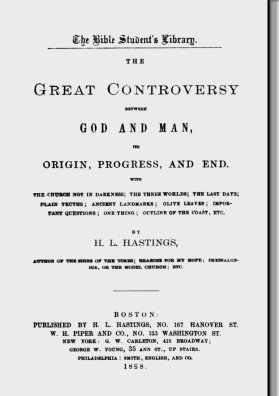
While Ellen White assured her followers that her sweeping cosmic drama was breathed directly into her mind by heavenly messengers, the historical timeline points to a far more mundane, terrestrial source. Long before the Lovett’s Grove vision became enshrined in Adventist folklore, a prominent First-Day Adventist author named Horace L. Hastings had already conceptualized, authored, and distributed a book bearing a nearly identical, highly distinctive title: The Great Controversy Between God and Man: Its Origin, Progress, and Termination.
The chronological intersection of these two works is devastating to the narrative of independent divine revelation. Ellen White allegedly received her panoramic vision on March 14, 1858. Yet, a mere four days later — on March 18, 1858 — a printed review of Hastings’ pre-existing book appeared in James White’s own Review magazine. Given the manual constraints of mid-nineteenth-century typesetting and printing, it is an absolute impossibility for the Whites to have acquired, read, analyzed, and typeset a formal review of Hastings’ book within a ninety-six-hour window. The Whites unquestionably possessed, studied, and admired Hastings' work well before Ellen's trance.3 By the autumn of that very same year, the Whites had rushed their own version of the cosmic conflict into print under the title Spiritual Gifts, Volume 1.
Defenders frequently attempt to minimize this chronological smoking gun by arguing that the literal wording between the two texts often diverges, and that White heavily elaborated on doctrines exclusive to the SDA Church.4 This much is true. However, focusing solely on word-for-word copyism misses the point: the issue here is the systemic co-opting of an entire literary architecture: the great-controversy theme, an epic 6,000-year battle between Christ and Satan. This grand, unifying theme was developed by Hastings, not White.
While the volume of direct, verbatim plagiarism is minimal,5 the overarching thematic structure, the topical sequencing, and the historical trajectory of the two books are staggeringly identical. Ellen White did not need to copy Hastings line-by-line because she did something far more efficient: she used Hastings’ published book as a ready-made outline, a conceptual scaffolding upon which she draped her own sect's dogmas.
The comparative analysis below demonstrates that far from channeling the visions of eternity, White was systematically tracking the chapter titles, historical pivot points, and thematic progressions of an earthly contemporary — even lifting specific, extra-biblical narrative conjectures from Hastings without offering a shred of credit. The topical analysis below shows that White used Hastings' book as a structural blueprint for her own writings:
| Theme | Topic | Ellen White Spiritual Gifts, vol. 1 (1858) |
H.L. Hastings Great Controversy (1858) |
|---|---|---|---|
| Noah and the Flood | Wickedness of the earth | p. 66 | p. 21 |
| God calls Noah to preach | p. 69 | p. 22 | |
| People ignored and mocked Noah | p. 70 | pp. 22-23 | |
| Noah and animals enter ark | p. 72 | p. 23 | |
| Dark clouds fill the sky | p. 73 | p. 23 | |
| Floods from above and below | p. 73 | p. 23 | |
| Lightening bolts flashed | p. 74 | p. 24 | |
| Cities/Buildings destroyed | p. 74 | p. 24 | |
| The lost were "wailing" | p. 74 | p. 24 | |
| The "loftiest" points covered by water | p. 76 | p. 24 | |
| God protected the ark | p. 75 | p. 24 | |
| Babel | Wicked congregate in plain of Shinar | p. 91 | p. 25 |
| Tower of Babel built | p. 92 | p. 25 | |
| God confuses the languages | p. 92 | p. 26 | |
| Builders were unable to communicate | p. 92 | p. 26 | |
| Abraham | Abram called to separate from wicked | p. 93 | p. 27 |
| Lord made promises to Abraham | p. 93 | p. 27 | |
| Jesus | Angels announce Christ's birth | p. 28 | p. 80 |
| John heralds Christ, baptizes people | p. 29 | p. 81 | |
| Mob threatens to throw Jesus from hill | p. 36 | p. 82 | |
| Was abused during the trial | p. 55 | p. 83 | |
| Jesus was "delivered" to be crucified | p. 57 | p. 83 | |
| Cross was laid on His shoulders | p. 58 | p. 83 | |
| Nails hammered in | p. 59 | p. 83 | |
| Hung between thieves | p. 59 | p. 83 | |
| Jews revile Jesus | p. 59 | p. 83 | |
| Given vinegar to drink | p. 60 | p. 83 | |
| Guard placed at the tomb | p. 65 | p. 83 | |
| Guards lied about resurrection | p. 68 | p. 84 | |
| Returns to heaven with "captives" | p. 69 | p. 85 | |
| Early Christianity | Disciples told not to preach in Jesus' name | p. 85 | p. 88 |
| Early Christians were persecuted | p. 103 | p. 95 | |
| Dark Ages | Bible suppressed, covered with error/fables | pp. 109-111 | p. 97 |
| Modern Apostasy | Christian profession avails nothing | p. 126 | p. 109 |
| Modern ministers preach smooth things | p. 127 | p. 125 | |
| Satanic Seances | p. 173 | p. 127 | |
| Covetousness | p. 179 | p. 126 | |
| Shaking God's people | pp. 184, 186 | p. 145 | |
| Return of Christ | Deliverance of the Saints | p. 205 | p. 162 |
| Satan's army attacks the saints | p. 216, 217 | p. 165 | |
| Closing of the Controversy | "...the great controversy was forever ended." p. 218 | "The controversy is closed." p. 166 |
| Theme | Topic | Ellen White Spiritual Gifts, vol. 3 (1864) |
H.L. Hastings Great Controversy (1858) |
|---|---|---|---|
| The Exodus | Dwelled in the land of Goshen | p. 177 | p. 31 |
| New king enslaves Israelites | p. 178 | p. 31 | |
| Moses was born | p. 180 | p. 32 | |
| Hidden in bulrushes | p. 180 | p. 32 | |
| Educated with pharaohs | p. 183 | p. 32 | |
| Dwelt in the desert | p. 187 | p. 32 | |
| Moses and Aaron visit Pharaoh | p. 197 | p. 33 | |
| Pharaoh refuses request | p. 198 | p. 33 | |
| Pharaoh increases burdens on slaves | p. 198 | p. 33 | |
| Plagues fall | pp. 207-221 | pp. 34-35 | |
| Passover observed | pp. 222-228 | p. 36 | |
| Death wail heard at midnight | p. 229 | p. 36 | |
| Pharaoh releases captives | p. 229 | p. 36 | |
| Camped by Red Sea | p. 230 | p. 36 | |
| Pharaoh pursues Israelites | p. 231 | pp. 36-37 | |
| Moses parts the waters | p. 234 | p. 37 | |
| Egyptian army destroyed | p. 235 | p. 39 | |
| Israelites sing to the Lord | p. 236-238 | pp. 40-41 | |
| Other nations are witness to the Exodus | p. 242 | p. 42 |
| Theme | Topic | Ellen White Great Controversy (1888) |
H.L. Hastings Great Controversy (1858) |
|---|---|---|---|
| Destruction of Jerusalem | Apostles preached to Jerusalem | p. 28 | p. 88 |
| God rejects Jewish nation | p. 29 | p. 90 | |
| Christians evacuate Jerusalem | p. 30 | p. 91 | |
| Rome lays siege to Jerusalem | p. 31 | p. 91 | |
| Women ate their own children | p. 32 | p. 92 | |
| City and temple destroyed | pp. 33-35 | p. 92 | |
| Final judgment | Lord has a controversy with the nations | p. 656 | p. 134 |
| Slain shall cover the earth | p. 657 | p. 134 | |
| Son of Man appears in clouds | p. 643 | p. 143 | |
| Wicked turned to stubble | p. 673 | p. 146 | |
| Lake of fire destroys wicked | p. 672 | p. 165 | |
| New Earth | New Jerusalem descends | p. 663 | p. 166 |
| Tree of Life | p. 675 | p. 166 | |
| No light is needed | p. 676 | p. 166 | |
| Righteous unite in songs of praise | p. 678 | p. 167 | |
| Sinners are no more | p. 678 | p. 167 |
In conclusion, while there is minimal direct plagiarism, and while Mrs. White's narrative style differed from Hastings' historical style, and while White expounded at length upon unique SDA doctrines, research shows Mrs. White followed Hastings' structural pattern to a surprising degree, choosing to expound upon virtually all the same topics that Hastings discussed.
Changed Hastings' Conjectures into Divine Facts
Another way to detect Hastings' possible influence on the writings of White is to identify places where Hastings added extra-biblical details and White injected those same ideas into her writings. Many SDAs believe these extra-biblical concepts were "light from the throne of God" received by White in vision, but in reality, they were first conjectured by Hastings in his Great Controversy.
| Topic Not Found in the Bible | H.L. Hastings's Conjecture | Ellen White's Inspiration |
|---|---|---|
| Extra-Biblical The Bible says nothing about Adam and Eve being instructed by God or His Angels |
"We are taught that our first parents received their instructions while in their state of innocency, and even after their transgression, directly from the divine legislator himself." (Great Controversy, 1858, 20) | "I saw that the holy angels often visited the garden, and gave instruction to Adam and Eve concerning their employment, and also taught them concerning the rebellion of Satan and his fall." (Spiritual Gifts, Vol. 1, (1858), 20) |
| Extra-Biblical The Bible does not label the Garden of Eden as paradise |
"...sin that turned paradise into a desert." (Great Controversy, 1858, 17) | "He [Satan] had been shut out of heaven, they out of Paradise." (Spiritual Gifts, Vol. 1, (1858), 22) |
|
Extra-Biblical The Bible does not say whether or not the earth retained its appearance after the curse |
"...the curse has fallen, but still the earth retains its primitive form, and to a great extent, its pristine glory." (The Church not in Darkness, 1864, 10) | "The curse did not change at once the appearance of the earth. It was still rich in the bounty God had provided for it." (Spiritual Gifts, Vol. 3, (1864), 61) |
|
Extra-Biblical The Bible does not say whether or not the wicked ignored the entrance of animals into the Ark |
"The beasts of the earth and fowls of heaven, moved by a strange impulse, come and find refuge with the servant of the Lord. But the scoffing world pass heedlessly on." (Great Controversy, 23) | "Notwithstanding...the unnatural occurrence of the beasts' leaving the forests and fields, and going into the ark... yet they hardened their hearts, and continued to revel and sport over the signal manifestations of divine power." (Spiritual Gifts, Vol. 3, (1864), 69) |
| Extra-Biblical The Bible does not describe what happened to the resurrected saints |
"Earth rejected Christ, but heaven received him; and with him a glorious multitude of captives whom he had delivered from the grasp of death..." (Great Controversy, 1858, 85) | "Angels came to receive the King of glory, and to escort him triumphantly to heaven. ... And as he led the way upward, the multitude of captives who were raised at his resurrection followed." (Spiritual Gifts, Vol. 1, (1858), 77) |
Finally, in 1864, Hastings conjectured that only 5% of Christians were faithful. Three years later, Mrs. White repeated the same conjecture:
| "...of the thousand millions of people [in] this rebellious world, probably not one in twenty are faithful followers of Jesus Christ." (Hastings, The Last Days (1864), 60) |
"I saw that there is not one in twenty that knows what experimental religion is." (White, Testimony for the Church, no. 12 (1867), 1) |
Case Studies
SDA apologists frequently argue that White and Hastings simply drew from the same historical well — that two authors tracking cosmic history would naturally intersect. While that defense holds at a broad, conceptual level, it completely collapses under microscopic textual analysis. The issue is not that they covered the same events; it is that White consistently replicated Hastings’ highly specific linguistic choices, peculiar structural sequencing, and idiosyncratic thematic choices. The case studies below systematically dismantle the "common source" defense. By isolating three chapters where the textual alignment moves past mere coincidence into undeniable literary dependence, it will be demonstrated that White was not merely exploring the same history — she was walking in Hastings' footprints.
Chapter 17 of Spiritual Gifts ("The Great Apostasy") and pp. 95–98 of Hastings
A rigorous, side-by-side textual dissection of Chapter 17 reveals a profound structural synergy and an identical progression of thought.
1. The Identical Five-Phase Micro-Sequence
Both authors track the transition of the early Christian church into the Papal system of the Middle Ages. Stripping away stylistic variations exposes an identical five-phase logical blueprint that dictates the flow of both texts:
| Phase | H. L. Hastings (pp. 95–98) | Ellen G. White (SG Vol. 1, Ch. 17) |
|---|---|---|
| 1. The Failure of Force | Argues that the "fierce winds of persecution" failed to crush the church; instead, the blood of martyrs only caused Christian zeal to expand and multiply. | States that Satan’s initial strategy of violent, open persecution failed to hinder the plan of salvation, as Christians remained faithful unto death. |
| 2. The Shift to Fraud | Asserts that because open warfare backfired, the adversary altered his strategy, introducing worldly prosperity, flattery, and honors to seduce the church. | Tracks the identical tactical pivot: Satan "left his manner of open success, and sought to gain by artifice what he had failed to secure by force." |
| 3. Syncretic Compromise | Coins the famous summary that the church began to "court the world," resulting in a fatal transaction where "Paganism was baptized, and called Christianity." | Describes the exact same mechanism: Heathens "professed to believe," but remained idolaters, while Christians "consented to lower the standard" to meet them. |
| 4. Concrete Idolatry | Points directly to the introduction of physical "images of saints and martyrs" to replace old pagan idols, preserving the spiritual essence of heathenism. | Identifies the immediate visual outcome of the compromise: "Satan led them to receive the customs and manners of the heathen... Images were introduced." |
| 5. Role Inversion | Notes that once the corrupted church gained political ascendancy, the pure church fled into obscurity, and the formerly persecuted group became the new persecutor. | Concludes that the nominal, compromised church assumed the power of the state, turning fiercely against the remaining "pure followers of Jesus." |
2. Granular Thought Correlation: Force vs. Artifice
The synergy between these two texts goes beyond mere chronological alignment; it extends to the internal psychological framing of the cosmic adversary. Notice the precise parallel in how both authors articulate the strategic pivot from physical violence to intellectual and spiritual deception:
Hastings (p. 95-96): "But when he [the adversary] saw that he prevailed nothing... that the loyalty of the saints was firm... he changed his method of assault... Formality took the place of spirituality; pride supplanted humility... and the Church of Christ became the Church of the World."
White (p. 102): "Satan could not hinder the plan of salvation... He therefore left his manner of open success, and sought to gain by artifice what he had failed to secure by force. He ceased his open persecutions, and induced the heathen to receive a part of the Christian religion."
While the vocabulary is not a word-for-word verbatim lift, the intellectual infrastructure is a perfect mirror image. Both texts treat the end of pagan persecution not as a victory for the Gospel, but as a deliberate, tactical retreat engineered by Satan to undermine the church from within.
Summary
The relationship between the two works cannot be dismissed as pure coincidence. The identical five-phase progression of thought demonstrates that both authors were building upon the exact same logical scaffolding.
Chapter 20 of Spiritual Gifts ("The Reformation") and pp. 105–107 of Hastings
Moving from the rise of the apostasy to the birth of the Protestant Reformation, the textual relationship demonstrates a persistent structural lockstep. Here, both authors navigate the collapse of papal supremacy using the exact same narrative sequence, though White systematically condenses Hastings’ macro-historical overview into a highly focused biographical case study of Martin Luther.
1. Structural Synergy: The Macro-to-Micro Translation
The core conceptual alignment rests on how both texts handle the transition from universal spiritual darkness to sudden theological revolt. The structural blueprint matches perfectly, point for point:
| Narrative Pivot | H. L. Hastings (pp. 105–107) | Ellen G. White (SG Vol. 1, Ch. 20) |
|---|---|---|
| The State of the Word | Focuses on institutional suppression: The Bible is legally "locked up in dead languages" to systematically maintain the ignorance of the masses. | Translates the concept into a physical scene: The Bible is hidden away from human sight, completely unknown to the common people. |
| The Catalyst for Revolt | The unchaining, translation, and distribution of the printed text, which immediately shatters the illusion of papal authority. | Dramatizes this exact breakthrough via a single individual: Luther discovers a hidden Latin Bible in a monastery, reads it, and is transformed. |
| The Institutional Backlash | Notes that the sudden diffusion of light shakes the "throne of the Papacy" to its foundations, triggering global ecclesiastic panic. | Localizes the financial reality of that panic: Priests and leaders become furious because Luther's preaching directly threatens their lucrative indulgence revenue. |
2. The Textual Fulcrum: The "Locked Up" Word
The most telling correlation is the shared reliance on the "imprisoned Bible" as the primary plot device driving the historical shift. Both authors frame the entire Reformation not merely as a debate over abstract dogmas, but as a literal jailbreak of divine truth:
Hastings (p. 105): "The word of life was locked up in dead languages, and forbidden to be read by the common people... but when the word of God was translated into the vernacular tongues of Europe... the spell of spiritual despotism was broken."
White (p. 119): "I saw Luther as he found a Bible. He had never seen it before... He read, and his heart was filled with joy... He wondered at the darkness that existed among the people, that they were ignorant of this book."
While Hastings outlines the structural and linguistic cage the medieval church built around the scriptures, White instantly visualizes that exact historical reality through the eyes of a single monk stumbling upon a chained volume. The intellectual infrastructure remains identical: the rediscovery of the text is what legally and spiritually terminates the Dark Ages.
Summary
In this chapter White is firmly operating within Hastings' exact structural framework. She takes his macro-historical pillars — the suppression of the text, the discovery of truth, and the resulting financial/ecclesiastical fury of Rome — and populates them with vivid, ground-level narrative action.
Chapter 21 of Spiritual Gifts ("The Church Gladdened") and pp. 108–110 of Hastings
The structural locking mechanism remains firmly engaged as both authors transition from the triumphs of the Reformation to its tragic epilogue. Both texts execute an identical narrative pivot, tracking how the newly liberated Protestant movement rapidly lost its spiritual fire, surrendered to worldly respectability, and descended into cold formalism.
1. Structural Synergy: From Liberation to Lethargy
Having established the breakthrough of the Reformation in their previous chapters, both authors immediately outline a shared four-stage decline of the post-Reformation church:
| Developmental Step | H. L. Hastings (pp. 108–110) | Ellen G. White (SG Vol. 1, Ch. 21) |
|---|---|---|
| 1. Brief Spiritual Joy | Describes the post-Reformation church escaping the papal "prison house" and rejoicing in scriptural light and liberty. | Mirrors this exact emotional opening: "The church was gladdened, and the light of truth was permitted to shine." |
| 2. Satanic Tactical Pivot | Argues that since open fire failed, the adversary neutralized the church by offering ease, security, and political alliances. | Tracks the identical counter-move: Satan "sought to bring them down to a level with the world, and make them believe as others did." |
| 3. The Rise of Formalism | Diagnoses the internal decay as an adoption of human creeds, sectarianism, and cold rituals. | Identifies the same operational rot: "They began to rely upon human creeds, instead of the word of God." |
2. The Linguistic Anchor: The "Form of Godliness"
The most precise textual correlation in this section is the dual, localized utilization of the exact same Pauline idiom (2 Timothy 3:5) to define the state of post-Reformation Protestantism. Both authors use this biblical phrase to summarize the substitution of spiritual power with institutional respectability:
Hastings (p. 109): "They settled down in fatal security... retaining the form of godliness while denying its power... and they became as intolerant of further progress as the church from which they had separated."
White (p. 123): "They possessed the form of godliness, but denied the power thereof. They became cold, proud, and worldly... Satan had successfully laid his snare to destroy the church."
This is not merely a shared theological observation; it is an identical application of textual diagnosis. Both authors isolate the exact same spiritual mutation: the transition from a dynamic, scripturally driven movement into a static, defensive establishment that mirrors the very system it originally protested against.
Summary
The synergy demonstrates that the ideological scaffolding of both books remains perfectly aligned through the modern era. By utilizing Hastings' exact structural framework and linguistic anchors to describe the spiritual slumber of the Protestant churches, White effectively constructs the necessary historical vacuum that justifies and introduces her next prophetic protagonist: William Miller and the Advent Awakening.
What the Case Study Reveals
The case study identifies exactly what White borrowed from Hastings: the architecture of argument. She borrowed the precise sequence in which ideas are introduced. For example, the specific pivot points at which Satan changes strategy, the exact literary device of the imprisoned Bible as the engine of Reformation, the identical Pauline idiom deployed at the identical moment of narrative diagnosis, and the shared four-stage decline of post-Reformation Protestantism that functions as the indispensable bridge to the next prophetic movement. These are not parallel conclusions reached by independent minds examining the same evidence. These are the fingerprints of a single structural blueprint, reproduced in a different hand. White was stealing the intellectual framework of Hastings' logic and plot.
This matters enormously for one reason: White presented her work as the direct product of divine vision — scenes shown to her by God. But if the visions were genuine, the structural lockstep with Hastings is inexplicable. If the visions were constructed based on Hastings' book, the structural lockstep is inevitable. The evidence accumulated across these three chapters of Spiritual Gifts points decidedly toward the second conclusion.
The Evolution of Great Controversy
The Whites Answer the Call for an "Improved Version"
When the Review and Herald critiqued Hastings' Great Controversy in 1858, the reviewer — almost certainly James White, though possibly Uriah Smith — didn't just critique the volume; he laid down a precise theological blueprint for its correction. The verdict was clear: Hastings had missed the true epicenter of the cosmic battlefield.
And while every one must close the volume with a vivid sense of the manner in which the controversy will close in the triumph of the power and justice of God, and the certainty of this issue, we could wish that the author had dwelt more at length on the points of man's rebellion, and the terms of reconciliation. When he speaks of the way we may approach to 'a more glorious mercy-seat,' of the position of Christ 'in the heavenly places,' and of the 'ark of God's testament' seen in the temple of heaven, we could wish he had reminded the revolters of a certain law that reposes in that ark, beneath that mercy-seat, which is the constitution of God's government, and upon which hinges the whole controversy between him and man.6
The Whites didn't wait around for Hastings to revise his work. They stepped into the gap themselves. A mere six months after that Review went to print, Ellen White published her own answer to Hastings: Spiritual Gifts, Vol. 1 — the foundational seed that would ultimately evolve into The Great Controversy.
A structural analysis reveals that her new book read like a direct, point-by-point execution of James White's editorial wish list.
Improvement #1: Weaponizing the Law
James had publicly lamented that Hastings failed to "remind the revolters of a certain law that reposes in that ark." Ellen corrected this oversight with surgical precision. In her expanded narrative, she anchored the entire cosmic climax around a single, massive theological pillar: Chapter 25, "God's Law Immutable." Where Hastings was silent, White was deafening.
Improvement #2: Mapping Rebellion and Reconciliation
James had also demanded deeper real estate for "the points of man's rebellion, and the terms of reconciliation." Ellen delivered exactly that, dedicating dual, heavyweight chapters to dissecting the anatomy of the cosmic rift:
- Chapter 29: "The Origin of Evil" (exposing the mechanics of the rebellion)
- Chapter 30: "Enmity Between Man and Satan" (defining the terms of engagement and ultimate reconciliation)
To be sure, Ellen White’s version diverged sharply from Hastings' worldview. She re-engineered the narrative by infusing it with her own distinct eschatological framework — including the Three Angels' Messages, the Seal of God, and the Mark of the Beast.
Yet, none of this signature material was actually new. Many of her chapters were recycled directly from her earlier book Experience and Views and her Present Truth articles, both long in print before Spiritual Gifts ever saw a printing press. They owed nothing to her supposed vision at Lovett's Grove. Other material came directly from other Adventist authors:
- The Sanctuary (chapter 27): Concocted by O.R.L. Crosier and Hiram Edson in 1846 to explain away the Disappointment.
- The Investigative Judgment (chapter 35): First proposed by Joseph Bates and later adopted by Uriah Smith in the 1850s. James White finally signed onboard in a Review article on Jan. 29, 1857, nearly a year before Ellen incorporated the idea into her book (page 198).
- The Seventh-day Sabbath (chapters 18, 28, 37): Codified and published by Joseph Bates in 1846 and expanded upon by J.N. Andrews in the Review during the 1850s.
Adventists who purchased Spiritual Gifts expecting fresh revelations from White's celebrated Lovett's Grove vision may have found themselves asking what was actually new about it. Nearly every major doctrinal theme in the book had already been taught, published, and defended by Sabbatarian Adventists long before Spiritual Gifts appeared. The obvious question is difficult to avoid: If the Lovett's Grove vision was a genuine revelation from God, what new information did it reveal?
The Illusion of Novelty
The literary expansion of the Great Controversy narrative over its multi-decade evolution presents a staggering statistical illusion. On paper, the metrics suggest a literal explosion of fresh prophetic insight.
- 1858 (Spiritual Gifts, Vol. 1): 41 chapters | ~48,800 words
- 1884 (Spirit of Prophecy, Vol. 4): 37 chapters | ~136,700 words
- 1888 (The Great Controversy): 42 chapters | ~237,400 words
In the span of just thirty years, the text underwent a massive 386% increase in word count — nearly fivefold more physical volume. Yet, while the page count multiplied, the theological substance remained static.
Nothing novel or unique emerged from Ellen White's subsequent visions to justify this massive expansion. Instead, the yawning gap between the raw 1858 outline and the dense 1888 book was filled by padding the narrative with historical narratives copied directly from non-SDA authors and prophetic interpretations, such as the National Sunday Law, plagiarized from SDA authors such as Uriah Smith, J.N. Andrews, and even her own husband.
These expanded editions did not contain fresh details from her Lovett's Grove revelation. Every prophetic exposition in the book was fully mature, thoroughly debated, and heavily published by pioneering Adventist minds years before they were injected into the 1884 and 1888 expanded texts.
The narrative did not evolve because more details of the visions were revealed; it simply grew wider by absorbing existing material. The growth of the Great Controversy was an exercise in compilation, not progressive revelation. For example, Many of the SDA prophetic teachings inserted into Great Controversy had been published earlier in James White's book Life Incidents (1868). Analysis by Walter Rea revealed that words, sentences, quotations, thoughts, ideas, structures, paragraphs, and even total pages were plagiarized from it.
Interestingly, much of Life Incidents was taken primarily from J. N. Andrews' book published in 1860 entitled The Three Messages of Revelation XIV, 6-12, and particularly The Third Angel's Message and The Two-Horned Beast. Uriah Smith spoke and wrote about a National Sunday Law before it ever found its way into the Great Controversy. It appears the teachings in the Great Controversy originated from the studies of Bates, and later, Andrews and Smith — not the visions of Ellen White. Perhaps these men were the real prophets in the SDA sect.
Sect Leaders grapple with Great Controversy Problems
At the 1919 Conference on the Spirit of Prophecy (the transcript of which mysteriously disappeared and did not surface until it was "discovered" hidden in a vault in 1974), corporate leaders discussed how the material for Great Controversy was garnered from human sources:
B. L. House:- As I understand it, elder J. N. Andrews prepared those historical quotations for the old edition [1888 Great Controversy], and Brother Robinson and Brother Crisler, Professor Prescott and others furnished the quotations for the new edition. Did she write the historical quotations in there?A.G. Daniells:- No. ...
W.W. Prescott:- You are touching exactly the experience through which I went, personally, because you all know that I contributed something toward the revision of Great Controversy. I furnished considerable material bearing upon that question. ... When I talked to W.C. White about it (and I do not know that he is an infallible authority}, he told me frankly that when they got out Great Controversy, if they did not find in her writings any thing on certain chapters to make the historical connections, they took other books, like [Uriah Smith's] Daniel and the Revelation, and used portions of them...
For generations, the official narrative maintained that Ellen White’s pen was guided by visions and heavenly communications. Yet, behind closed doors in 1919, the General Conference President and those responsible for enhancing her books admitted the exact opposite: when her "visions" lacked the necessary data to form a cohesive narrative, her staff simply reached for secular history books, compiled external human sources, and grafted them directly into the text. The fact that this transcript was buried in a vault for over half a century is proof that corporate leadership understood the devastating implications of their own testimony. When laid alongside her 1858 reliance on Hastings, the 1919 transcript completely strips away the myth of exclusive divine dictation, revealing Great Controversy for what it actually is: a highly curated, humanly assembled mosaic of nineteenth-century Protestant literature masquerading as infallible revelation.
This conclusion is supported by the findings of SDA scholar Donald R. McAdams, who studied the plagiarism in the Great Controversy and wrote:
What we find when we examine the historical portions of the Great Controversy is that large sections are selective abridgements and adaptations of historians. Ellen White was not just borrowing paragraphs here and there that she ran across in her reading, but in fact following the historians page after page, leaving out much material, but using their sequence, some of their ideas, and often their words. In the examples I have examined I have found no historical fact in her text that is not in their text. The hand-written' manuscript on John Huss follows the historian so closely that it does not even seem to have gone through an intermediary stage, but rather from the historian's printed page to Mrs. White's manuscript, including historical errors and moral exhortations. The material taken from historians is not an insignificant part, but, if my samples are characteristic, a substantial part of the book.7
McAdams cast considerable doubt on the myth that Ellen White saw the events of the Great Controversy in vision because some of the events she described did not take place the way she claimed:
By more nearly discovering what actually did happen, it can be shown that Ellen, at times, described events inaccurately.8
How can you describe events inaccurately if you are describing what you saw in vision? If White had an inaccurate memory, then how many of her other visions contain similar inaccuracies?
McAdams stated it best when he announced at the special 1980 meeting of SDA leaders in Glendale, California:
If every paragraph in the book Great Controversy, written by Ellen White, was properly footnoted, then every paragraph would have to be footnoted.9
If every paragraph in the entire book needs a footnote, then that means a source for that paragraph existed before her paragraph was published. That means her book was not original but was derived from material that other authors had already published.
Conclusion
Please read the following quote carefully. It is one sentence from Hastings' book that is not found anywhere in Ellen White's Great Controversy:
There is no other light than the Word of God, that sheds a gleam of radiance through the ages of primeval darkness; and none but this that can pierce with its resplendent ray the cloudy curtain that veils the mysterious future.11
Essentially, Hastings is saying, there is no "lesser light." There is one light, and only one light: the written Word of God, the Holy Bible.
While many find the Great Controversy to be an interesting and thought-provoking book, it can hardly be considered an original work.
All of the major themes in the book were developed earlier and written out by other authors, many of them non-SDAs. A considerable part of the book was supplied by W.W. Prescott and put together by editors. It is difficult, if not impossible, to point to any idea or historical fact that actually originated with Ellen White. The only conclusion that can be reached is that if Mrs. White did indeed receive a vision at Lovett's Grove in 1858, it contained no new concepts that had not already been written out by other authors.
See also
6. Unsigned book review published in the March 18, 1858, issue of the Review, vol. 11, #18.
7. Dr. Donald McAdams, unpublished manuscript "Ellen G. White and the Protestant Historians: The Evidence from an Unpublished Manuscript on John Huss", p. 19. See also, Donald McAdams, Shifting View of Inspiration", Spectrum, vol. 10, No. 4, March 1980.
8. Ibid., 44
9. This is supported by the White Estate's former associate director, Dr. Ronald Graybill, who wrote, "My own analysis of Ellen G. White's Luther manuscript supports McAdams' conclusions that in her historical writing Mrs. White usually followed a single source quite closely and did not include any facts not found in her sources." (Graybill, The Power of Prophecy (Baltimore, MD: 1983), 217).
10. Robert Olson, "Ellen G. White's use of Historical Sources in The Great Controversy", Adventist Review, February 23, 1984.
11. H.L. Hastings, Great Controversy (1858), 15.