
Contradictory Testimonies on the Health Reform Institute
By , last updated Nov.
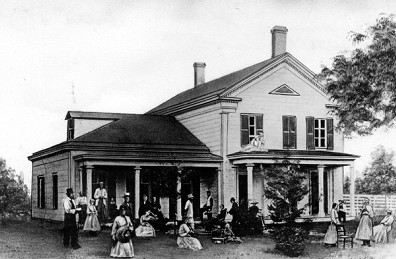
On September 5, 1866, the Western Health Reform Institute was opened in Battle Creek. This building was the fruition of Mrs. White's December 25th, 1865, vision in Rochester, New York, in which she reportedly received a divine directive to establish health reform institutions.
By January of 1867, the Institute was already filled to capacity, and the director wished to expand the institution. The estimated cost of the expansion was $25,000. To get public backing for financing the project, Uriah Smith wrote a letter to Mrs. White on February 5 urging her to convince the faithful flock to invest their hard-earned money in this medical venture:
...a great many are waiting before doing anything to help the Institute, till they see the Testimony and now if it goes out without anything on these points, they will not understand it, and it will operate greatly against the prosperity of the Institution. The present is a most important time in this enterprise, and it is essential that no influence should be lost, which can be brought to bear in its favor.1
Thus prodded, Ellen White manufactured Testimony #11 to promote the raising of funds for the expansion of the Health Institute in Battle Creek:
Here I was shown, was a worthy enterprise for God's people to engage in, one in which they can invest means to His glory in the advancement of His cause.2
It is unknown if she "was shown" by Smith or God, but her faithful followers no doubt believed it to be the latter.
As sect members began pouring in their hard-earned money, construction on the expansion commenced. By August, however, the money had run out and the project was temporarily halted. What happened next is truly shocking. According to J.H. Kellogg, as the project stalled, James White expressed his opposition to expanding the institute because he "was not consulted" ahead of time.3 Thus, James decided to have the beginnings of the Health Institute torn down at a cost of $10,000, which in 2024 dollars, would be $228,136.4 Then, he apparently influenced his wife to write a testimony contradicting her prior testimony:
The brethren at Battle Creek who were especially interested in the Institute knew I had seen that our people should contribute of their means to establish such an institution. They therefore wrote to me that the influence of my testimony in regard to the Institute was needed immediately to move the brethren upon the subject, and that the publication of No. 11 would be delayed till I could write. ... Under these circumstances I yielded my judgment to that of others and wrote what appeared in No. 11 in regard to the Health Institute, being unable then to give all I had seen. In this I did wrong.5
Analysis
Mrs. White said she was unable to write "all I had seen" in testimony #11, but why is that? How long would it have taken her to write that they shouldn't expand the institute? Five minutes? Her explanation makes no sense whatsoever.
At Smith's prodding, Mrs. White initially wrote out a testimony in which she claimed she "was shown" that Seventh-day Adventists should contribute to the "worthy enterprise" of expanding the institute. Then, apparently influenced by her husband—who was wroth about an expansion he was not consulted on—she wrote a testimony admitting she had "yieled my judgment to that of others." Which testimony was written with her yielding to human influence? The one Smith asked for? The one James asked for? Both?
The work which she said God had ordained was torn down at great expense. She freely admitted that her original testimony was the result of human influence, and it is quite obvious the second one was influenced by James. How many more of her "inspired" testimonies were simply the result of James or other SDA leaders prodding her to say something to support their projects or their theology? Whether her testimonies had any divine influence is anyone's guess, but this incident demonstrates that human influences were involved.
See also