Under the Influence Part 2:
W.C. White and the Leading Men Who Influenced Ellen's Writings
By ,
Ellen White, Letter 16, 1893
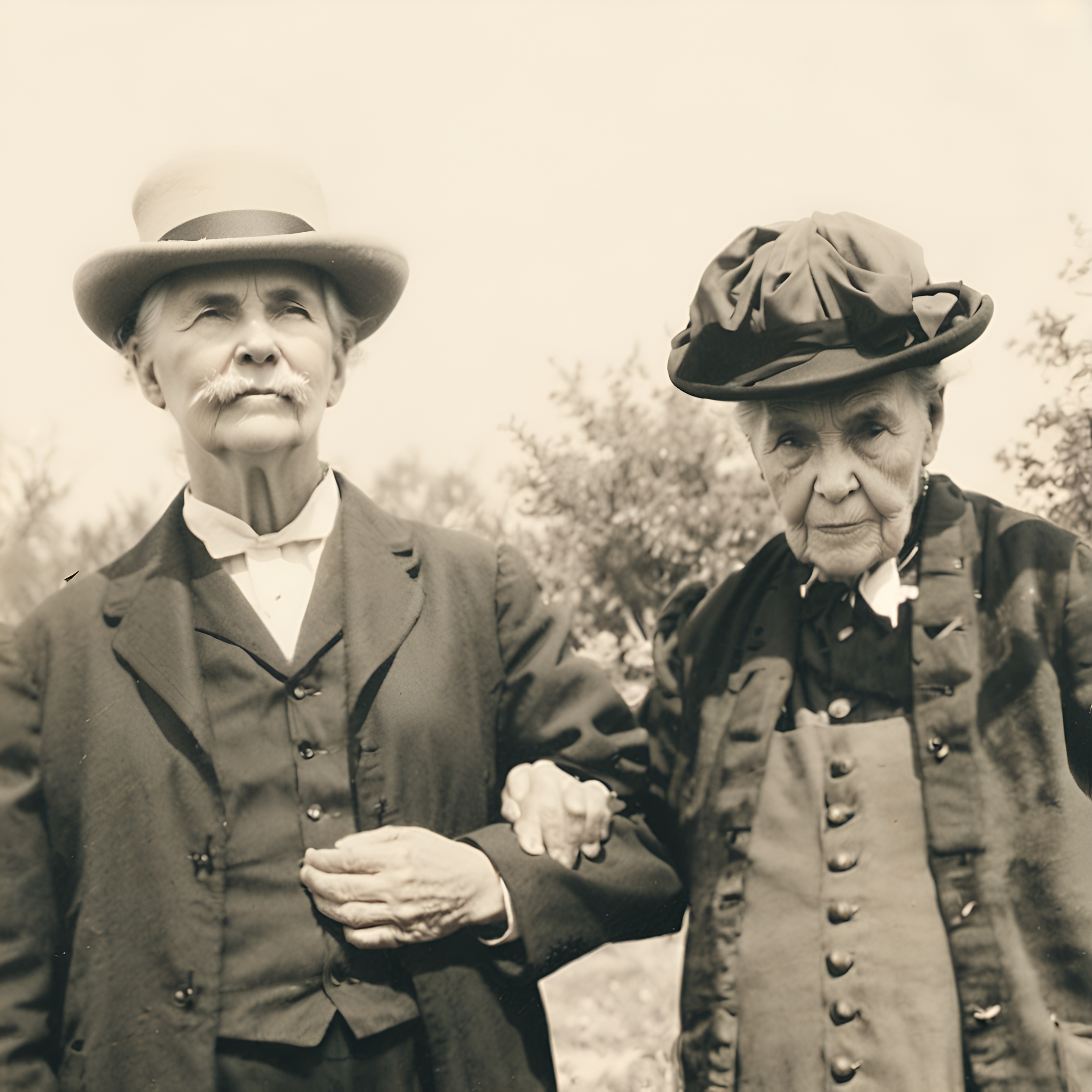
Early in her career, many believed Mrs. White to be under the influence of her husband James. One example of this is the Western Health Reform Institute. Ellen White had written a testimony in favor of expanding the Institute. James apparently disagreed, and some believe he influenced her to write a testimony in which she contradicted her earlier testimony and then admitted, "I yielded my judgment to that of others."1 Over the course of her prophetic career, how many other times did she yield her judgment to others? It appears Ellen White's sons followed in the footsteps of their father and attempted to influence her writings. Thus, from 1888 through the remainder of her life, SDA sect leaders suspected Ellen White was under the influence of Willie. Several potent examples below help to substantiate that view.
The Case of Dr. Burke
After James White passed away, W.C. White became more and more involved in his role as his mother's counselor. For example, it appears Ellen White wrote a testimony at W.C. White's prompting in the case of Dr. W.P. Burke. Burke was a physician at the Saint Helena SDA Sanitarium and was considering resigning. W.C. White wrote a letter to his mother about the situation:
It seems as though he [Burke] needs a little talking to, if you feel like writing him a short letter sometime to encourage him in this matter of loyalty to the Institution I think it would be well. ... I have not much influence with Dr. and you have considerable, therefore I suggest that you write to him.2
Not long afterward, Mrs. White sent a testimony to Burke about staying on the job, writing:
The enemy is at work to lead you away from your post of duty... Just wait, faithful and true, until the Lord releases you.3
Was it really God's will for Burke to stay on that job? Or did Willie influence his mother to write a testimony which Burke received as coming from God without realizing that Willie was the real inspiration behind the testimony?
The Eavesdropping Cook
In 1901, Ellen White and W.C. White were staying overnight in a room at the Indianapolis SDA Sanitarium. Staying in the room next door to them was the sanitarium's cook, Mrs. W.A. Greenlee and her husband. The walls of the sanitarium were thin, and Mrs. Greenlee heard a man come into the room around 5 A.M. and start speaking to Ellen White. It was Willie, who was talking loudly because his mother's hearing had deteriorated. Being curious, Mrs. Greenlee went into the closet so she could eavesdrop better on the conversation. What she heard stunned her. She heard Willie "dictating" to Mrs. White, "telling her what she ought to say to the people, that she ought to advise Bro. Donnell to step down and out like a Christian gentleman."4
Shortly afterward, Ellen White advised the Indiana conference president Donnell to resign, which he did, thinking the advice had come from the Lord. Meanwhile, Mrs. Greenlee kept the incident to herself, until the SDA camp meeting at Greenfield, Indiana, in September. There, she happened to encounter the former president Donnell. She told him what she had overheard, and he began to suspect that Ellen White was under the influence of W.C. White. The story soon got around the camp meeting, and the new president, I.J. Hankins, talked with Greenlee and Donnell, and then wrote to W.C. White for an explanation. Willie replied that he could see how someone "might think that I was planning, advising, and suggesting to mother what she ought to do," but he assured Hankins that he was merely refreshing his mother's memory about what she had said and written earlier, and he was not suggesting "to her any new thoughts."5
As concerning as that explanation sounds, the buzz eventually died down and might have been forgotten, had it not been for several other incidents that transpired in subsequent years.
The Edson White Incident
Ellen White had counselled her son Edson "not to do into debt" with his projects for the Southern Publishing Association.6 Contrary to her counsel, Edson ran up a debt of $25,000, which was a large sum in 1902.7 SDA General Conference president A.G. Daniells wanted to put a stop to Edson's out-of-control spending and he contacted Ellen White with his concerns. The brethren also had additional concerns about Edson's shady fund-raising activities. Ellen White was brought into a meeting and questioned. A stenographer recorded the meeting and below is the transcript of that interview:8
QUESTION: Would you think it best for Edson to insist on the future existence of the Southern Missionary Society as an independent organization?
Mrs. E. G. White: I cannot give countenance to Edson’s operating independently, because I know that he is not a close financier.
QUESTION: Is it God’s will for him to carry the burden of an independent Society and an independent work within the Southern Union Conference, and to do things and to carry burdens that the Union Conference does not feel free to do and to carry; and also to appeal for means in ways that the Union Conference can not approve?
Mrs. E. G. White: No.
Thus, in this meeting, Ellen White clearly states it was not God's will for Edson to operate the Southern Publishing Association as an independent ministry. Edson afterward visited his mother and managed to convince her the institution's money was being well spent. This placed Mrs. White in a difficult position, because she had already stated it was not God's will for Edson to operate the way he was operating. This presented an impossible contradiction. How could it be against God's will before Edson talked with her, and then, afterwards, it was suddenly God's will? Mrs. White reversed her position and then attempted to control the damage by asking W.C. White to retrieve the stenographer's report:
I am instructed to recall it, for it was not the will of the Lord I should stand in any such position. Elder Daniells has a copy, and I must have it; please to do this errand for me.9
If it was not the will of the Lord for her to take the stand that she did, then did elder Daniells influence her? Or did Edson influence her to change her stand?
It seems that Edson harbored some animosity towards his brother Willie over this incident. He may have concluded that W.C. White and Daniells were using his mother to conspire against him. Three years later, when he visited Battle Creek in 1905, he complained openly about W.C. White manipulating his mother during the 1902 incident. This appalled his mother. She fired off at least two letters to him urging him to stop:10
What kind of a move was it that you made in rushing to Battle Creek and saying to those there that W. C. White, your own brother, for whom you should have respect, manipulated my writings? This is just what they needed to use in their councils to confirm them in their position that the testimonies the Lord gives your mother are no longer reliable. ...you do a work to injure your mother’s influence... Not one soul manipulates my writings.
I want to say, Never repeat to another soul as long as you live the words that W. C. White manipulates my writings and changes them. This is just what the devil is trying to make all believe. W. C. White is true as steel to the cause of God, and no lie which is in circulation is of the truth. ... I cannot explain anything except to say, You have greatly hurt my influence as God’s messenger, and may the Lord let you see this terrible mistake. I am trying to keep quiet and not think. God may work for my recovery. But I have no desire to prolong my life when my own son will speak things that would lessen in the least degree his own brother’s influence.
Ellen White was correct when she said not "one soul" manipulated her writings. It was not one, it was many souls! However, W.C. White was certainly gaining a reputation for manipulating her writings more than anyone since James White. Mrs. White only added fuel to the fire when she referred to Willie as her "counselor."11
A large and growing number of people in Battle Creek, including J.H. Kellogg, had surmised that Ellen White's testimonies were being influenced by others, particularly by Willie. One unnamed SDA physician wrote to Ellen asking:
"Does W. C. White influence the testimonies? ... What about W. C. White's influence?" Here the doctor quotes J. Edson White's alleged statements at the Berrien Springs meeting that if W. C. White did not quit tampering with the testimonies the Lord would have to take the prophetic gift from Ellen White. (Edson denied having said this. See J. E. White to EGW, July 24, 1907.)"12
As the person in charge of the editorial staff of Ellen White's books, some SDAs suspected that W.C. White was doing more than just polishing her writings. In 1909, S.N. Haskell complained to Willie about "dropping out of some things" from Ellen White's writings. He claimed this practice was "the cause of some of our best brethren losing confidence in you; because they think you change your mother's writings and call it 'editing.'"13
To conclude, if anyone was in a position to know whether W.C. White was influencing Ellen White, it was Edson White. His admission that Willie was manipulating his mother provides strong evidence that is was indeed happening. Furthermore, the fact that Mrs. White reversed her instruction on the Southern Publishing Association demonstrates that she believed she was not speaking for God when she made her original statement. This supports Edson's contention that she was being manipulated.
The Watson Letter
This incident began in the summer of 1904. At that time, W.O. Palmer was working with Edson White at the Southern Missionary Society. Sensing a great fund-raising opportunity, Palmer went to Grand Junction, Colorado, to raise money for the ministry. Palmer was successful in gathering a substantial offering, including $270 in tithe ($270 in 1905 is $7,886 in 2020 dollars).14 This direct fund-raising approach seemed to work well for Palmer. He later complained that when money was given through the normal channels (the General Conference or the Southern Union Conference), the Southern Missionary Society would "never see a cent of it."15 When G.F. Watson, the president of the Colorado Conference, heard that tithe money from one of his churches was being funnelled directly to Edson's ministry, he was incensed. He wrote a complaint to General Conference president A.G. Daniells in which he told Daniells that he had told Edson, "he had better see that the tithe carried off by W.O. Palmer got back into the Colorado Conference Treasury."16 Daniells forwarded the letters to W.C. White, criticizing the actions of Edson and Palmer, and asking Willie to deal with the situation.17
W.C. White informed his mother of this matter. Meanwhile, in January of 1905, Edson arrived in Elmshaven, and on the 19th he met with Ellen and Willie.18 It is unknown what Edson said to his mother about this matter, but the letter she wrote to Watson three days afterward was certainly favorable to Edson's position. She asked Watson to not get so "stirred up" and to not give "publicity to this matter."19 In the letter she admitted sending her own tithe (and that of others who sent her their tithes) to various ministries she felt needed support.20 Watson was not pleased with Ellen's letter. He described the letter as "spurious" and told Edson directly that he considered it to be "a product of your own evil brain."21 Willie later denied he or Edson had written the actual letter.22
While Mrs. White had admonished Watson to keep the matter private, it was circulated in subsequent years. The letter started to become a threat the income of the SDA conferences. If Ellen White was in favor people directing their tithe money according to their own whim, then that could put a dent in the conference's treasury. To counteract this, it was decided to produce a "testimony" about this subject. The brethren found a statement Ellen had written in the November 10, 1896, issue of Review and Herald and they republished it in Testimonies, volume 9, in 1909:
Let none feel at liberty to retain their tithe, to use according to their own judgment. They are not to use it for themselves in an emergency, nor to apply it as they see fit, even in what they may regard as the Lord’s work.23
This testimony contradicted her own actions and contradicted her prior letter to Watson. This seemed to confirm in Watson's mind that the 1905 letter he received was spurious. In September 1913, Watson told a meeting of ministers that he believed Edson "forged that letter" and he had "no doubt" that "many letters had been sent out which were spurious."24
W.W. Prescott
Professor W.W. Prescott worked closely with W.C. White and Mrs. White. He supplied considerable material for Ellen White's book Great Controversy25 and assisted her bookmaker Marian Davis with parts of the book Desire of Ages. SDA Professor H.C. Lacey explains how Prescott's teachings found their way into Ellen White's book:
"Professor Prescott was tremendously interested in presenting Christ as the great ‘I Am.’ . . . Sr. Marian Davis seemed to fall for it, and lo and behold, when the Desire of Ages came out, there appeared that identical teaching on pages 24 and 25, which I think can be looked for in vain in any of Sr. White’s published works prior to that time.”26
Prescott was a strong believer in the Trinity. Mrs. White and Marian Davis adopted his belief and before long, strong Trinitarian statements began appearing in their books, such as the Desire of Ages.
A.G. Daniells
For over thirty years, Sister White's "heaven-sent" messages instructed her people to eat a vegan diet. Her followers were told that meat, eggs, and dairy products were unhealthy and should be avoided. However, something changed in 1901. Surprisingly, she sent out a testimony taking these items off the banned list:
"When the time comes that it is no longer safe to use milk, cream, butter, and eggs, God will reveal this... No extremes in health reform are to be advocated. The question of using milk and butter and eggs will work out its own problem. At present we have no burden on this line."27
Why did this supposed “light from heaven” regarding restricted food items suddenly lose its urgency? Why did Ellen White abandon her long-standing burden to enforce dietary restrictions after promoting them with such intensity for decades?
The timing is revealing. In 1901, A. G. Daniells was elected president of the SDA Corporation. Daniells was no enthusiast of Ellen White’s health reforms. He openly ate meat and largely disregarded the denomination’s health message.28 Observing Daniells, many other SDA leaders felt emboldened to follow his example. The clear implication was that the Lord was no longer quite as concerned with health reform as had previously been claimed.
With the momentum of denominational leadership now shifting away from veganism, Ellen White adopted the more politically expedient course of retreat. What had once been presented as divinely mandated “light” was quietly reframed as mere “extremes” in health reform and was subsequently set aside.
In another incident in 1907, SDA minister L. C. Sheafe received a testimony from Mrs. White telling him that "Satan has been at work upon your mind."29 As Sheafe read the lengthy letter of rebuke, he surmised that A.G. Daniells had influenced the writing of it. Not long afterward, he confronted Daniells and asked him if he had been writing letters to Sister White about him. Daniells vehemently denied writing to her. The matter rested for several years, but at a conference in October, 1913, held in Washington, D.C., this incident was brought up again before a group of ministers. W. C. White was in attendance and admitted that he received a letter from Daniells regarding Sheafe. He also admitted showing it to his mother who shortly thereafter sent a testimony to Sheafe.30 This further demonstrates that Daniells influenced the writing of Ellen White's testimonies.
Stephen McCullagh31
An Australian minister named McCullagh fully believed in the work of Sister White—until she issued a testimony, either to or concerning an individual, that he knew with certainty to be untrue. McCullagh wrote to Sister White explaining that the testimony was factually incorrect, that she had been misinformed, and that the source of her information was mistaken. She replied by thanking him for the correction and expressing appreciation for being set right.
This admission—that she had relied on incorrect information from others and had used it as authoritative grounds for issuing an undeserved rebuke—profoundly unsettled McCullagh. The realization planted serious doubt in his mind, leading him to resolve to test what was being presented as the “Spirit of Prophecy.”
Sometime later, McCullagh attended a meeting of the sect’s Educational Board in Australia. During the proceedings, several in attendance—among them J. O. Corliss—expressed irritation over what they perceived as W. C. White’s habit of selectively shaping his mother’s writings to serve his own purposes. Corliss, losing patience, made a pointed remark regarding Willie’s conduct.
Following the meeting, McCullagh later spoke privately with Sister White and asked whether her son had given her a report of the discussion. She replied that he had not and urged McCullagh to recount the meeting himself. McCullagh hesitated, suggesting it might be better to wait until W. C. White could relay the information personally. Nevertheless, she insisted, and McCullagh complied.
As he repeated Corliss’s remark, her demeanor changed. Her face darkened with anger, and she declared, “I will make that brother smart for that.” When her son later returned, she confronted him with a detailed account of the meeting and delivered a severe rebuke against the offending brother—yet conspicuously offered no indication that the information had come from a human intermediary rather than divine revelation.
After witnessing several episodes of this nature, McCullagh reached his limit. He subsequently met with A. G. Daniells and other leading figures within the SDA hierarchy and explained why he could no longer conscientiously continue in the work of the denomination.
Courting at SDA Schools
Mrs. White was adamantly opposed to students courting each other at SDA schools. Battle Creek College (now Andrews University) was founded in 1874. Shortly after it opened, Mrs. White wrote a flurry of "heaven-sent" testimonies about how courting amongst the students should be forbidden.
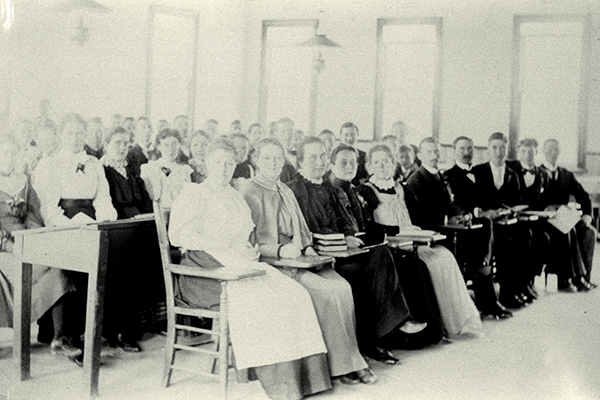
1875 - Those who are possessed of a love-sick sentimentalism, and make their attendance at school an opportunity for courting and exchanging improper attentions, should be brought under the closest restrictions.32
1880 - Students are not sent here to form attachments, to indulge in flirtation or courting, but to obtain an education. Should they be allowed to follow their own inclinations in this respect, the College would soon become demoralized.33
1882 - I do not wish to have you disappointed in regard to Battle Creek. The rules are strict there. No courting is allowed. The school would be worth nothing to students, were they to become entangled in love affairs as you have been. Our College would soon be demoralized.34
Notice that these restrictions have no relation to the age of the students. It is the act of courting that causes students to get entangled in love affairs, distracts them from their studies, and leads to a declining moral state.
In 1885, Mrs. White broadened her anti-courting views to include all SDA institutions:
They [certain school administrators] cannot see any harm in the young people's being in one another's society, paying attention to each other, flirting, courting, marrying and giving in marriage. This is the main engrossment of this time with the worldlings, and genuine Christians will not follow their example, but will come out from all these things and be separate.
In our sanitarium, our college, our offices of publication, and in every mission, the strictest rules must be enforced. Nothing can so effectually demoralize these institutions, and our missions, as the want of prudence and watchful reserve in the association of young men and young women.35
Once again, courting and marrying are discouraged because that is what worldlings do. Such activities have no place in SDA colleges. Nothing was said about courting being acceptable for older students. Any courting whatsoever would "demoralize" the college.
Mrs. White carried the same philosophy into Avondale in Australia:
1893 - Bear in mind that the school is not a place to form attachments for courting, or entering into marriage relations.36
1897 - We would not, could not, allow any courting or forming attachments at the school, girls with young men and young men with girls.37
1899 - Courting is not to be carried on in the school. That is not what you are here for.38
Mrs. White was quite consistent between 1875 and 1899. Courting was prohibited at SDA schools on the following basis:
- It distracted students from their more important studies
- It demoralized students
- It was worldly
The age of the student was never a consideration. After all, a 30-year-old student is just as easily distracted by dating as a 16-year-old student. A 30-year-old student is just as likely to get involved in fornication as a 16-year-old student. It's just as worldly for a 16-year-old to date as it is for a 30-year-old.
Over time, as the number of SDA schools grew, administrators had to compete against non-SDA schools for students. Some students thought Ellen's rules were extreme and would not attend the SDA schools. Some school administrators were also not fond of Ellen's radical restrictions. They began allowing older students—those with a good reputation—to meet with the opposite sex in dorm parlors.39 It appears W.C. White agreed with these administrators that his mother's "heaven-sent" restrictions were too severe. After all, severe restrictions turned off students who might take their educational dollars elsewhere. Thus, in September of 1912, he told his elderly mother:
The strong and unqualified statements in the testimonies regarding this matter refer to and apply chiefly to the schools made up largely of young and immature students.40
It seems that W.C. White decided he knew better what his mother's statements meant than she did. His influence over her appears to have swayed his mother to soften the hard-line stance she had been enunciating for decades in her "heaven-sent" messages. Shortly afterward, in 1913, she came out with a much softer statement that looks as if it was either written by W.C. or else written to suit him:
In all our dealings with students, age and character must be taken into account. We cannot treat the young and the old just alike. There are circumstances under which men and women of sound experience and good standing may be granted some privileges not given to the younger students. The age, the conditions, and the turn of mind must be taken into consideration. We must be wisely considerate in all our work. But we must not lessen our firmness and vigilance in dealing with students of all ages, nor our strictness in forbidding the unprofitable and unwise association of young and immature students.41
Thus, the prohibition in SDA schools against courting was lifted among mature students of good standing, just as W.C. White desired. In the subsequent paragraph, Mrs. White admits that some found her prior testimonies on this subject to be "too severe."42
When C. W. Irwin, president of Pacific Union College, learned of this departure from the “straight line of truth” laid down in Ellen White’s Testimonies, he was stunned. Irwin had previously served at Avondale, where he had rigorously enforced Ellen White’s severe restrictions. He knew firsthand that her rules were not presented as temporary, contextual, or age-dependent. On the subject of courtship, Mrs. White had been described as “firm as a rock.”43
Acting on the conviction that these directives were “heaven-sent,” Irwin had applied them just as vigorously at Pacific Union College. Thus, when W. C. White later discussed Ellen White’s forthcoming book, Counsels on Education, Irwin specifically requested that it include a clear statement on courtship consistent with what she had written at Avondale. When he was subsequently asked to review the chapter on courtship prepared by the brethren, Irwin was taken aback. What he read bore little resemblance to the uncompromising counsel he had long believed to be divinely authoritative:
When the chapter was submitted to Professor Irwin, he was surprised to find that it did not accord with the instruction given to the Avondale school. He wrote to W. C. White that the instruction was “something entirely new” and that he was “at a loss to know how to make it agree with matter which Sister White has written on other occasions.” He inquired whether some new light had been given to her on this point.44
Irwin did not realize that "new light" had been given to Ellen White—from W.C.
The reason supplied by W.C. is that Avondale students tended to be younger than students at other SDA schools. Whether or not this is factual is anyone's guess.45 Regardless, student age had no relation to any of the reasons given by Ellen White for instituting her restrictions. They were all based on reasons unrelated to age. Mrs. White caved into the influence of W.C. White and others who wanted to lift the restrictions, most likely for monetary reasons.
Conclusion
After the 1888 debacle, SDA leaders came to increasinlgy view Ellen White as under the influence of W.C. White. For example, in 1901, Sister White complained that Dr. Kellogg "has no more faith in the Testimonies" because he believed was was being "influenced by my son W. C. White."46 As late as 1907, she grumbled:
When messages come to such, that are not according to their ideas, they say, Sister White is influenced by W. C. White.47
The accusations of undue influence did not come merely from the opponents of Seventh-day Adventism. This article has shown that even some of the proponents of Seventh-day Adventism thought that Ellen White's "inspired" writings were being manipulated by her sons, her literary assistants, and SDA corporate leaders. If true, one must ask, which testimonies were written under the influence?