
The Most Heretical Page
Ellen White Ever Wrote
By , Aug.
Ellen White, Letter 329a, 1905
While sifting through years of diaries and letters to find material for another volume of her Testimonies for the Church, Ellen White assured her granddaughter that her voluminous writings contained "not one heretical sentence." That is an astonishing claim. Across millions of published words, she believed she had not written a single sentence that departed from biblical truth.
Is it true that her writings are devoid of heresy? A single page of Patriarchs and Prophets answers that question.
You have probably never heard of page 354. No Seventh-day Adventist [SDA] pastor preaches from it. It contains no dramatic prophecy, no vision of the last days, no glimpse into heaven. It is simply a mundane description of the daily services of the Hebrew sanctuary. Yet within those two ordinary paragraphs, Ellen White repeatedly contradicts Leviticus, reverses the biblical function of sacrificial blood, and constructs a theology the book of Hebrews explicitly rejects.
This is no careless mistake. This obscure page contains perhaps the greatest concentration of heresy in Ellen White's writings — aside from her shut door visions. More remarkable still, every one of those errors just so happens to reinforce the doctrine of the Investigative Judgment.
The Page in Question
Here are Ellen White's own words:
The showbread was kept ever before the Lord as a perpetual offering. Thus it was a part of the daily sacrifice. It was called showbread, or "bread of the presence," because it was ever before the face of the Lord. It was an acknowledgment of man's dependence upon God for both temporal and spiritual food, and that it is received only through the mediation of Christ. God had fed Israel in the wilderness with bread from heaven, and they were still dependent upon His bounty, both for temporal food and spiritual blessings. Both the manna and the showbread pointed to Christ, the living Bread, who is ever in the presence of God for us. He Himself said, "I am the living Bread which came down from heaven." John 6:48-51. Frankincense was placed upon the loaves. When the bread was removed every Sabbath, to be replaced by fresh loaves, the frankincense was burned upon the altar as a memorial before God.
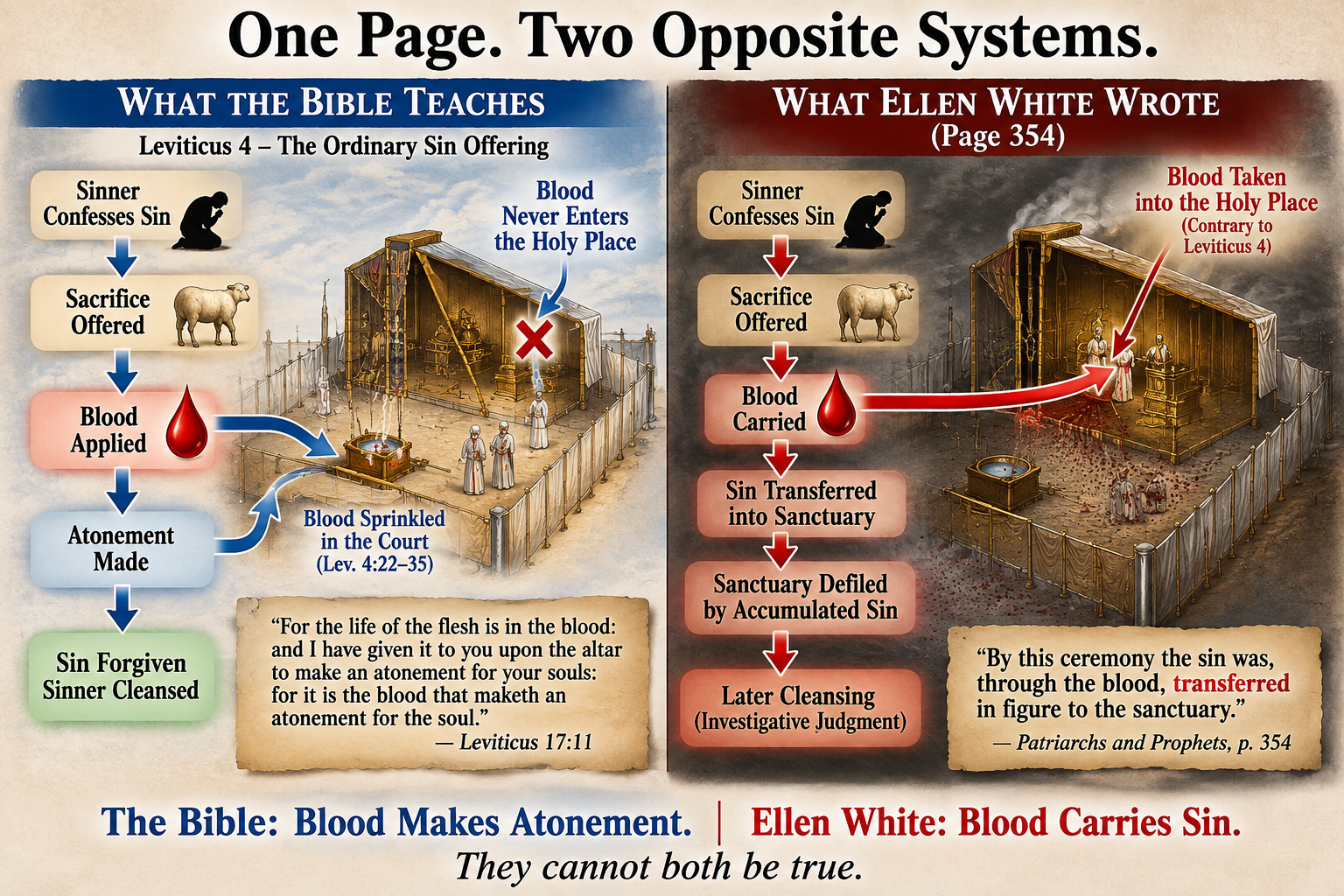
The most important part of the daily ministration was the service performed in behalf of individuals. The repentant sinner brought his offering to the door of the tabernacle, and, placing his hand upon the victim's head, confessed his sins, thus in figure transferring them from himself to the innocent sacrifice. By his own hand the animal was then slain, and the blood was carried by the priest into the holy place and sprinkled before the veil, behind which was the ark containing the law that the sinner had transgressed. By this ceremony the sin was, through the blood, transferred in figure to the sanctuary. In some cases the blood was not taken into the holy place; [See Appendix, note 6.] but the flesh was then to be eaten by the priest, as Moses directed the sons of Aaron, saying, "God hath given it you to bear the iniquity of the congregation." Leviticus 10:17. Both ceremonies alike symbolized the transfer of the sin from the penitent to the sanctuary.1
The passage sounds as though the author had stood beside the altar herself, watching the priests perform their ministry. If that impression is true, the details should match the divine instructions recorded in Leviticus. But do they?
1. The Weekly Bread She Called "Daily"
This is the least consequential mistake on the page, but it exposes a direct contradiction of the biblical text.
Ellen White writes that the showbread "was kept ever before the Lord as a perpetual offering" and concludes: "Thus it was a part of the daily sacrifice."
It was not. The showbread was an exclusively weekly ritual, and Leviticus is explicit on the point:
Every sabbath he shall set it in order before the LORD continually, being taken from the children of Israel by an everlasting covenant (Leviticus 24:8).2
The loaves were baked, set out, and replaced once a week on the Sabbath—never daily. White even stumbles into acknowledging this two sentences later, noting that the loaves were "removed every Sabbath." Yet two sentences prior, she formally categorized that exact service as part of the "daily" sacrifice (the Tamid).
She managed to contradict both the Book of Leviticus and her own writing within the space of sixty words. From here, the errors grow in severity.
2. The Sin Offering Never Entered the Holy Place
On page 354, Ellen White is not describing the annual Day of Atonement or the rare offering for the high priest. She is explicitly describing "the service performed in behalf of individuals." According to her, the priest carried the blood "into the holy place and sprinkled [it] before the veil."
In real life, this did not happen. Ever.
What Leviticus 4 Actually Prescribes
Leviticus 4 is the definitive chapter on sin offerings, and it lays out four separate cases:
| Who Sinned | Offering | Where the Blood Went |
|---|---|---|
| The anointed priest (4:3-12) | Young bull | Into the tabernacle—sprinkled seven times before the veil, applied to the horns of the incense altar |
| The whole congregation (4:13-21) | Young bull | Into the tabernacle—sprinkled seven times before the veil, applied to the horns of the incense altar |
| A ruler (4:22-26) | Male goat | Outside in the courtyard—horns of the altar of burnt offering, remainder poured at its base |
| A common person (4:27-35) | Female goat or lamb | Outside in the courtyard—horns of the altar of burnt offering, remainder poured at its base |
The pattern is unmistakable. Two offerings entered the sanctuary. Two did not. The offerings of ordinary Israelites never crossed the threshold.
When a ruler sinned, "the priest shall take of the blood of the sin offering with his finger, and put it upon the horns of the altar of burnt offering, and shall pour out his blood at the bottom of the altar of burnt offering."3 When a common Israelite sinned, the identical procedure was followed.4 The altar of burnt offering stood in the open courtyard. The priest never crossed the threshold. The blood of the ordinary penitent never entered the Holy Place at all.
Blood was carried inside for exactly two categories of sin—the sin of the anointed priest and the sin of the entire congregation — plus the annual Day of Atonement ritual of Leviticus 16. That is the complete list.
She Reversed the Rule and the Exception
Here is where the error stops being careless and starts being suspicious.
White does acknowledge that there were exceptions. She writes: "In some cases the blood was not taken into the holy place."
Compare that sentence again with Leviticus. She has it precisely backwards. Taking blood into the Holy Place was the rare exception, reserved for two extraordinary circumstances. Leaving the blood in the courtyard was the ordinary rule for every individual Israelite who ever brought a sin offering—which is to say, the overwhelming majority of sin offerings presented at that tabernacle.
White took the exception, declared it the rule, and demoted the actual rule to a parenthetical afterthought. Once that reversal is made, the sanctuary begins filling with the sins of ordinary Israelites — a condition that never exists in Leviticus 4 but is absolutely necessary for the Investigative Judgment.
This is the pivotal move. Once the blood of every ordinary sinner is imagined entering the Holy Place, the sanctuary can be portrayed as gradually accumulating the sins of God's people until a later cleansing becomes necessary.
The Investigative Judgment does not grow out of Leviticus 4. It grows out of Ellen White's reversal of Leviticus 4. Correct that one reversal, and the doctrine collapses entirely.
The Bracket That Gives It Away
Then there is the bracket.
Buried in the middle of Ellen White's description is an editorial insertion: "[See Appendix, note 6.]" The bracket was added later by White Estate editors because they recognized a problem. Readers comparing White's description with Leviticus would immediately notice that the blood of the ordinary sin offering was not carried into the Holy Place.
A truly inspired text would not need an explanatory appendix.
The Appendix Quietly Corrects the Prophet's "Straight Line of Truth"
The appendix does not vindicate Ellen White.
The appendix openly admits what Leviticus says: when the offering was for a ruler or an ordinary Israelite, the blood was not taken into the Holy Place. Only the offerings for the high priest and the whole congregation entered the sanctuary.5
But that is precisely the opposite of what White wrote. She described "the service performed in behalf of individuals" and then stated that "the blood was carried by the priest into the holy place." The appendix quietly replaces her description with the procedure found in Leviticus.
The appendix does not explain White's statement. It corrects it.
3. The Great Inversion: Blood as Pollutant
Everything up to this point has merely prepared the stage for this heretical sentence.
Ellen White writes: "By this ceremony the sin was, through the blood, transferred in figure to the sanctuary." And again, closing the paragraph: "Both ceremonies alike symbolized the transfer of the sin from the penitent to the sanctuary." This is White's own explanation of what the blood accomplished.
In her system, blood is a carrier of guilt. It picks up the sinner's transgression, transports it into the sanctuary, and deposits it there—where it accumulates, defiling the holy place, until the annual Day of Atonement purges the building of a year's worth of accumulated moral filth.
The Bible teaches the exact opposite. Blood does not carry contamination into holy space. Blood is the divinely appointed agency of purification:
For the life of the flesh is in the blood: and I have given it to you upon the altar to make an atonement for your souls: for it is the blood that maketh an atonement for the soul (Lev. 17:11).
And almost all things are by the law purged with blood; and without shedding of blood is no remission (Hebrews 9:22).6
Hebrews argues that Christ's blood opened the way into God's presence. Ellen White's system makes that same blood the mechanism by which sin accumulates there.
Consider the absurdity of White's construction. The instrument of purification becomes the instrument of pollution. God commands His priests to take the blood of an innocent substitute — the most sacred substance in the entire ritual economy, the very thing that makes atonement — and use it to smuggle sin into His own dwelling place. The holiest fluid in Israel becomes a contaminant. The sanctuary, the one place on earth where God's presence rests, becomes progressively filthier every time a sinner repents.
Under White's system, every forgiven sin leaves heaven a little more defiled than before. The sanctuary must therefore be cleansed — not because sinners need further atonement, but because God supposedly allowed His own dwelling place to become contaminated by the very blood He appointed to make atonement. That reversal is not taught by Moses. It is the indispensable premise of the Investigative Judgment. Without a sanctuary filling up with transferred sins, there is nothing left to investigate and nothing left to cleanse.
4. Why Page 354 Had to Be Wrong
To understand why Ellen White needed blood to carry sin into the sanctuary, follow the doctrinal chain backwards.
After the Great Disappointment of October 22, 1844, the Adventist movement faced collapse. An explanation was invented — and later ratified by Ellen White's visions — that Christ had not come to earth at all. He had moved to the Most Holy Place of the heavenly sanctuary to begin the Investigative Judgment.
The explanation immediately encounters a problem. Daniel 8:14 speaks of a sanctuary that must be cleansed. Cleansing presupposes defilement. If nothing has entered the heavenly sanctuary to defile it, there is nothing to cleanse, and the entire explanation is exposed as a hoax.
The Adventist explanation demanded defilement. So where does the defilement come from? Not from Leviticus. It comes from page 354: sin transferred, via blood, from the penitent into the sanctuary, accumulating there until a great Day of Atonement clears the record.
If Leviticus is allowed to speak for itself, the ordinary sin offering never carries blood into the sanctuary, the sanctuary never accumulates the sins of individuals, and the premise underlying the Investigative Judgment vanishes. The doctrine does not merely benefit from White's misreading of Leviticus 4. It depends on it.
Which returns us to that remarkable coincidence noted at the outset. Of all the ways to misunderstand the Hebrew sacrificial system, White happened to misunderstand it in the one specific direction that made her sect's heretical doctrine possible.
Conclusion
Calling a weekly service daily is simply careless. Sending blood into the Holy Place is incompetent. But transforming the blood of atonement into the vehicle by which sin contaminates God's sanctuary is downright heretical.
If the blood of bulls and goats carried sin into the earthly sanctuary instead of making atonement, then the blood of Christ must likewise carry sin into the heavenly sanctuary instead of removing it. Heaven itself becomes progressively defiled by every forgiven sinner, awaiting a later cleansing before redemption can finally be completed. That is the SDA face-saving invention of the Investigative Judgment.
This doctrine is diabolically opposed to Scripture. Hebrews leaves no room for a sanctuary gradually filling with the sins of forgiven believers. Christ entered the heavenly sanctuary "once for all," having "obtained eternal redemption for us" (Heb. 9:12). By one sacrifice He "perfected forever those who are being sanctified" (Heb. 10:1). Nothing remained to be transferred. Nothing remained to accumulate. Nothing remained to be investigated.
Page 354 asks the reader to exchange that finished redemption for a sanctuary still filling with sin and awaiting a later cleansing. That, my friends, is heresy.