
Spirit of Profits:
Ellen White's Fundraising Strategy
By ,
Ellen White, Review and Herald, Dec. 11, 1888

Ellen White spent decades using the imminent return of Christ as a fundraising tool, urging believers to divest their property before the coming "time of trouble" — while that same money was being funneled into permanent hospitals, universities, and land holdings designed to operate for generations. The panic of the apocalypse built the assets of the White empire.
The Rhetoric: Sell Everything, the End Is Near
Ellen White wrote with genuine fire about the urgency of the hour. The end was near. The "time of trouble" was coming. Property would be worthless. Those who clung to their possessions would be crushed by them. These rhetoric was the foundation of her entire financial doctrine.
In one of her earliest and most reprinted financial passages, appearing in Early Writings and later canonized in Counsels on Stewardship, White wrote with prophetic thunder:
Houses and lands will be of no use to the saints in the time of trouble, for they will then have to flee before infuriated mobs, and at that time their possessions cannot be disposed of to advance the cause of present truth. I was shown that it is the will of God that the saints should cut loose from every encumbrance before the time of trouble comes, and make a covenant with God through sacrifice.1
And lest the message be missed, she added a dire warning for those who did not comply:
I saw that if any held on to their property, and did not inquire of the Lord as to their duty, He would not make duty known, and they would be permitted to keep their property, and in the time of trouble it would come up before them like a mountain to crush them, and they would try to dispose of it, but would not be able.2
This property-divestment scheme was central to White's theology. As early as 1849, during a period when her spirit guides were falsely declaring that "time is almost finished," White was commanding the brethren to liquidate everything in support of her ministry:
I saw it was the will of God that the saints should cut loose from every encumbrance — dispose of their houses and lands before the time of trouble comes, and make a covenant with God by sacrifice. I saw they would sell if they laid their property on the altar and earnestly inquired for duty.3
Provoking Resentment
Shameless statements like these would naturally provoke anger and resentment because they went far beyond ordinary religious fundraising appeals. Mrs. White was not merely encouraging generosity — she was pressuring believers into surrendering their homes, lands, savings, and financial security under threat of divine disfavor. Faithful Adventists were told that if they failed to liquidate their property for “the cause,” their possessions would one day “crush them like a mountain.” Such language weaponized fear, guilt, and apocalyptic terror to extract sacrifice from ordinary people.
Many Adventists were poor farmers and working-class families struggling simply to survive. Their farms were their sole source of income. If they sold them, they would have no way to provide for their families. It was an audacious ask.
Not all of the brethren were pleased to be constantly badgered for money or property. One early Adventist, disgusted with the visions calling for donations, decided in 1854 that he wanted no part of it:
I must and will be free of the responsibility of publishing and sending out Ellen's visions to open the hearts of the Br'n to give, and then have that means used so that it would be better to use her own words 'Sunk in the bottom of the Ocean.'4
This man was expressing what many other Adventists were afraid to say: giving money to the Whites was like throwing it away.
Watch White Backpedal
By 1857, it dawned upon the Whites that Christ was not returning quite as fast as Ellen's earlier visions had implied. So Mrs. White began walking back her message. Suddenly, God no longer required Adventists to liquidate the homes they lived in — unless, of course, they were willing to downsize to a cheaper home, in which case the Whites would be happy to collect the difference:
I saw that at present God did not call for the houses his people need to live in, unless expensive houses are exchanged for cheaper ones.5
The contradiction is devastating. In 1849, Mrs. White claimed to see in vision that the end was so imminent that believers should “dispose of their houses and lands” before it was too late. But now, eight years later — and eight years closer to the Second Coming — the urgency mysteriously evaporates. She starts to backpedal. Now, God has apparently decided that Adventists can keep the homes that they need to live in. All she wants now is your second home or your vacation homes. All she wants is your expensive home. You can keep the cheap home you occupy. For now.
Both visions cannot be true. Either the time of trouble was so near in 1849 that Christians needed to divest their property immediately, or it was not. The later revision exposes the earlier “vision” for what it really was: a fraud.
Even more disturbing, in later decades — even nearer the return of Christ — the Whites themselves would own second homes, vacation homes, and expensive homes. Either her earlier visions were fraudulent or else she didn't believe her own visions.
Targets the Wealthy
While Adventists could now keep their homes for the time being, White continued to insist that the wealthy should "cheerfully spend their means to advance his cause" because that "can thwart the design of Satan," and they should "cheerfully let it go" to "advance the cause of truth."6
She insisted the wealthy were to cut loose with at least part of their possessions or risk losing their heavenly calling:
But if those who have of their abundance do not hear his voice, and cut loose from the world, and dispose of a portion of their property and lands, and sacrifice for God, he will pass them by, and call for those who are willing to do anything for Jesus, even to sell their homes to meet the wants of the cause.7
In 1859, she continued her mantra of "give before it's too late," using her visions to convince a man of "considerable means" that God personally wanted his money:
Dear Brother, I saw that the Lord wanted your means which he has lent you. He calls for you to use it to advance His cause. ... I saw that you should work as fast as possible to remove the means which God has lent you from the hands of unbelievers and transfer it to the believers... I saw that the scenes of this earth's history are fast closing. It will soon all be finished, and what is to be done must be done quickly.8
Time is Short — So Give!
In March of 1878, she prodded her followers with a fundraising testimony:
Time is short; hoarded wealth will soon be worthless. When the decree shall go forth that none shall buy or sell except they have the mark of the beast, very much means will be of no avail. God calls for us now to do all in our power to send forth the warning to the world.9
This is a notable false prophecy unless the meaning of the word "soon" has been redefined. While White's warning that "time was short" was still reverberating through the sect, SDA corporate leaders were investing heavily in long-term projects:
- The Battle Creek "Dime Tabernacle" (1878–1879) — The foundation stones were laid August 19, 1878, and construction was completed the next year at a final cost of $26,275. The church — one of the largest auditoriums in Michigan — had a total seating capacity of 3,200.
- The Rural Health Retreat, St. Helena, California (1878) — This sanitarium was founded in the same year as White's property-divestment rhetoric was being published in the sect's paper.
Why were SDAs involved in these large-scale building projects if time was so short?
Nearing the Close of Time?
In the 1880s, Califorina was in the midst of a "gold rush." People were flocking to California to buy cheap land in the hopes of discovering gold. In an 1889 testimony, White admonished a man who was encouraging others to invest in real-estate and mining operations. She felt that these investments were robbing the cause. In her attempt to disaude him, she wrote with urgency: "We are nearing the close of time."10 The implication was that the return of Christ was so near that he should be investing in the cause instead of his future.
Oddly enough, while she was warning others against speculative real-estate investements in mining regions, White purchased several large tracts of acreage in California. If time was so short, why did she invest in land instead of the cause?
Section XIV of Counsels on Stewardship, dedicated entirely to "Wills and Legacies," is a sustained argument for why people should write the SDA corporation into their estates — immediately, not at some deferred future date — because time was short and delay was dangerous.
In 1901, White wrote a letter to the entire Iowa conference, warning them:
It is now too late to cling to worldly treasures. Soon houses and lands will be of no benefit to anyone, for the curse of God will rest more and more heavily upon the earth. The call comes, "Sell that ye have, and give alms." [Luke 12:33.] This message should be faithfully borne—urged home to the hearts of the people, that God's own property may be passed on in offerings to advance His work in the world.11
Her logic is simple:
- Christ's return is imminent.
- Property will be useless and dangerous when He comes.
- Give it to the SDA corporation now.
In subsequent years, the sect went on a buying spree with donor money, purchasing land and constructing massive buildings. While telling others it was "too late" to retain their houses and lands, White turned around and invested that money in large land purchases and long-term, multi-generational construction and business ventures, thereby defying her own logic. It is religious abuse at its worst — using the proven technique of creating an overwhelming sense of fear and urgency, made even more effective when delivered by a super saleswoman dressed in prophetic robes.
Contradicts Plain Bible Teaching
Mrs. White’s financial demands did not merely clash with common sense or expose glaring hypocrisy within her own movement — they stood in direct conflict with the spirit of biblical charity. Again and again, she urged her followers to channel their hard-earned money into the expanding machinery of the sect rather than prioritize the poor, the needy, or struggling families around them. She even laid down explicit rules declaring that tithe funds were to be reserved exclusively for financing the sect’s ministry apparatus:
The tithe is set apart for a special use. It is not to be regarded as a poor fund. It is to be especially devoted to the support of those who are bearing God's message to the world; and it should not be diverted from this purpose.12
White said tithe was not to go to the poor. What does the Bible actually teach about tithe money?
At the end of three years thou shalt bring forth all the tithe of thine increase the same year, and shalt lay it up within thy gates: And the Levite, (because he hath no part nor inheritance with thee,) and the stranger, and the fatherless, and the widow, which are within thy gates, shall come, and shall eat and be satisfied; that the LORD thy God may bless thee in all the work of thine hand which thou doest (Deut. 14:28–29).13
The Bible instructs the Israelites to save up their tithe and disburse it amongst the Levites, foreign visitors, orphans, and widows. If that is not a "poor fund," then what is? A portion was to go to the ministers (the Levites), but the people were also commanded by God to share their tithe with those who were poor and could not support themselves. White's doctrine reversed this — redirecting money explicitly designated by scripture for the vulnerable into the institutional machinery of the SDA corporation.
Similar fund-raising tactics were deployed by White throughout the remainder of her ministry. Sadly, employees of the SDA corporation continue the practice to this day. More than one sermon has been preached wherein the thought is expressed that it is better to give sacrificially now rather than lose everything in the coming time of trouble — which is, of course, imminent.14
What That Money Actually Built
Here is what the sacrificial donations of her followers produced during Ellen White's lifetime. Not temporary relief for the poor. Not food depots or rescue missions. Not shelters for the destitute. Not, in short, the kind of work the New Testament associates with genuine Christian charity. What those donations produced — at White's direction — was a permanent institutional empire, the assets of which survive and flourish years after she urged donors that the end was too near to justify keeping their land.
Consider the timeline of major construction:
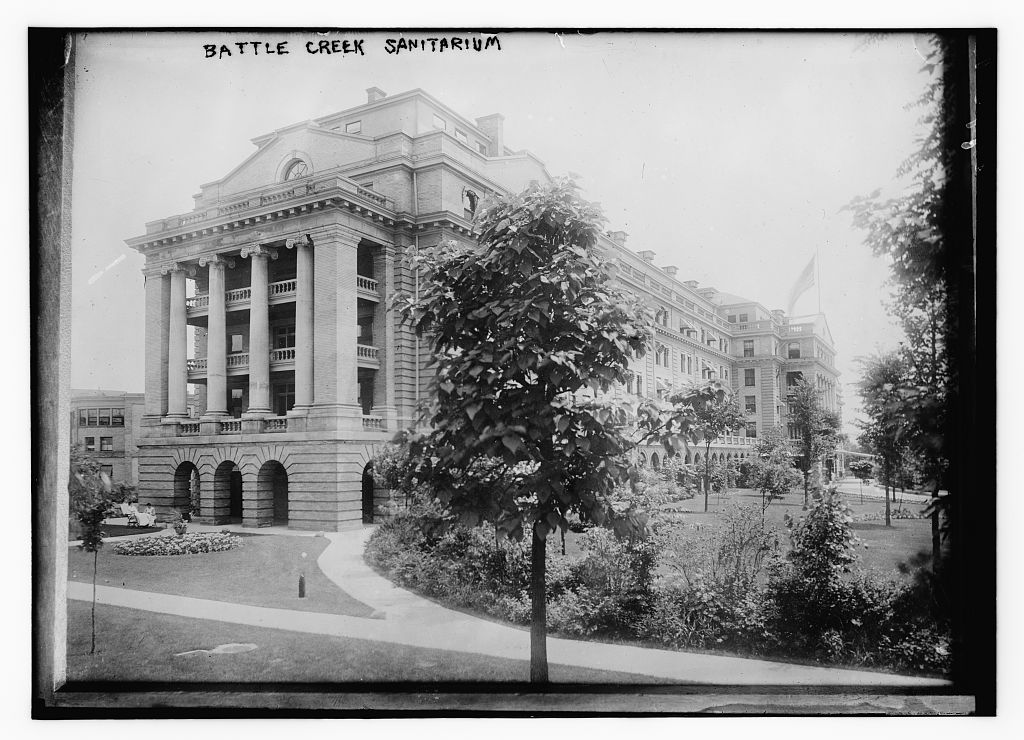
The Battle Creek Sanitarium, founded in 1866 at White's urging, grew to a sprawling complex of more than 30 buildings on 30 acres, capable of accommodating 1,300 guests at its peak, with 800 to 1,000 staff.15 It was not a shelter for the poor. It was a luxury health resort catering to the American elite. By the 1890s and early 1900s, rates at the Battle Creek Sanitarium were well beyond what a working-class family could reasonably afford. Weekly rates commonly ranged from $25 to $75 per week, depending on room and services. Adjusted for inflation, that's roughly $900 to $2,700+ per week in today's dollars. This was at a time when a skilled worker might earn $10–15 per week. For many Americans, one week at the Sanitarium was more than a month's wages. That alone explains that the intended clientele were wealthy. While giving lip service to "medical missionary work," the sanitarium was, in reality, a Gilded Age luxury health resort for the privileged who could afford it.16
The Battle Creek Tabernacle (1879) cost $26,275 — nearly a million dollars in today's money — and was built using a nationwide campaign in which SDA members from across the country mailed in their dimes. The massive "Dime Tabernacle" stood as one of the premier meeting halls in Michigan, seating over 3,000 people.17
The Avondale School in Cooranbong, New South Wales, Australia (1895–1897) was built on 1,500 acres of land purchased for £4,500.18 White simultaneously purchased 40 to 50 acres of adjacent land for her personal use.19 Doesn't seem like she expected "the end" to be coming anytime soon. The school she built through sacrificial offerings from a barely-established Australian church now operates as Avondale University, still teaching students years later.20 The buildings were designed to last forever — funded by people who were told by their prophet that the end was imminent.
The Paradise Valley Sanitarium near San Diego (1904), the Glendale Sanitarium (1905), and most dramatically Loma Linda (1905) followed in rapid succession, all directed by Ellen White's prophetic counsel. Loma Linda alone was 76 acres, purchased for $38,900.21
At a constituency meeting, when the California conference president described the sanitarium as merely a training facility, White interrupted him to correct the record: "This will be the principal training center on the West Coast."22 The "principal training center" for a world whose end was imminent.
Today, Loma Linda University Health employs 18,000 people, operates six hospitals, serves more than a million outpatients annually, and includes eight academic schools.23 The Troesh Medical Campus, opened in 2021, features a 16-story medical tower visible from across the San Bernardino Valley. That new tower alone cost more than most SDA congregations of 1905 could have imagined. That is quite an ironic achievement for a people supposedly expecting the "imminent" return of Christ.
The Arithmetic of Hypocrisy
To appreciate the full weight of this contradiction, consider the following:
In 1905, Ellen White warned her followers in the April 19, 1905 edition of Signs of the Times:
The Lord is soon coming... I feel as if I must cry aloud, "Homeward bound!" We are nearing the time when Christ will come in power and great glory to take His ransomed ones to their eternal home.
Hearing this, many SDAs no doubt rushed out to divest their houses and lands since they would be useless in the coming time of trouble and if they held onto them, that property would "come up before them like a mountain to crush them." That same year, White directed the purchase of Loma Linda, with extensive, long-range plans for development.
In the November 27, 1900 issue of Review and Herald she rebuked those who put the coming of the Lord "five years or ten years or twenty years" into the future. At the same time, she was planning to build institutions to last well beyond that. You do not build "the principal training center on the West Coast" if you believe the Lord is returning next year. You do not train generations of physicians if the generation you are living in is the last one. You do not open a nursing school in December 1905 and a medical school in 1909 if you genuinely believe that the saints will shortly "flee before infuriated mobs."
The only coherent explanation for this contradiction is that the apocalyptic urgency was a fundraising gimmick, not a sincerely held belief. When White wrote that time was short, she meant it as a reason to give. When she planned institutions, she planned them to last for centuries. The donors were told to live as if Christ was coming next year. The institutions were built as if she was hedging her bets, giving lip service to an imminent return while investing massive amounts of donated money in facilities planned to last for generations.
The 1902 Fires
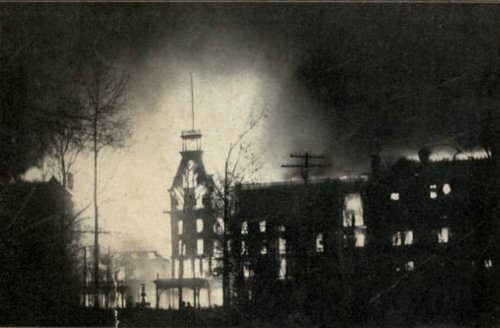
The Battle Creek fires of 1902 provide an especially illuminating window into this contradiction. On February 18, 1902, the Battle Creek Sanitarium burned to the ground.
Just over a year after the fire, on May 31, 1903, a brand-new sanitarium opened on the same site — but twice the size of the old sanitarium. Its opulent amenities included a solarium and palm court, a grand dining room, porches for "fresh air" treatment, and state-of-the-art hydrotherapy and medical facilities. Local newspapers described the new structure as a modern marvel. The building — constructed using steel-reinforced concrete — was designed to last forever and is still standing and in use today. White criticized it, not because of the permanence of the structure, but because she thought the money should have been spent on smaller clinics under SDA corporate control.
On December 30, 1902, the Review and Herald Publishing House conveniently burned down, paving the way for SDA leaders' pre-planned move to Washington, D.C. Rather than refraining from investing in expensive buildings due to the imminent return of Christ, SDA corporate leaders made a huge investment in property and buildings, with Ellen White's full blessing. This was not a modest stopgap until the Lord returned. It laid the foundation for decades of denominational infrastructure.
In 1903, SDAs purchased about 50 acres of land in Takoma Park, Maryland. This land was intended to host multiple institutional structures: the General Conference offices, the Review and Herald Publishing Association buildings, church facilities, and housing for denominational workers. Construction on these facilities was completed by mid-1906.
Once in the Washington area, further investments quickly followed. SDAs built the Washington Sanitarium, which opened in 1907. This institution was not tiny — it became a major regional hospital serving the community for over a century. They also built Washington Training College.
Now here is the revealing part. If the end was truly near, the obvious choice was: do not rebuild. The Lord is coming. Cut loose from every encumbrance. Do not let property become a mountain to crush you.
White's actual response was precisely the opposite. She advocated the Washington institutions with zeal.
Ellen White lived through the 1844 movement and saw firsthand how effective apocalyptic fear-mongering could be at manipulating deluded individuals into parting with their property. She followed this same pattern throughout her career. Members were told that time was too short to be saddled with property. Meanwhile, at her direction, the SDA corporation was investing heavily in land and buildings that assumed decades of operation.
Conclusion
Fans of Ellen White will say the institutions she built do good work today. We agree. Loma Linda University is an outstanding medical institution that has saved countless lives. Avondale University has trained excellent ministers and educators. This is not in dispute. What is in dispute is whether those institutions were built honestly — whether the donors who funded them were told the truth about what they were funding. They were told the world was about to end. They were told their property would be useless. They were told to give now, before the time of trouble came. And their money built institutions that have operated for years and show every sign of operating for more. They were, in the plainest sense, defrauded by the apocalyptic urgency under which their donations were extracted.
Ellen White preached urgency and built permanence. She warned SDAs that property would crush them in the time of trouble, then encouraged them to divest their property and place it into SDA corporate hands where it has been held ever since.
Jesus warned about exactly this kind of religion. He called it whitewashed tombs — beautiful on the outside, full of dead men's bones within. He pronounced His most scorching woes not on prostitutes or tax collectors or Roman soldiers, but on religious leaders who were meticulous in their religious obligations and used those obligations to extract money, prestige, and institutional power from ordinary people who trusted them.
The ordinary SDA who sold their home in 1900 because Ellen White told them property would be useless in the coming time of trouble — that person deserved better. They deserved the religion Jesus actually taught: where the financial language of the New Testament directs money toward the poor, warns against institutionalized religious wealth, and reserves its harshest condemnation for those who dress up greed in the language of God's claims.
What they got instead was Ellen White's fundraising strategy.
See also
- Spirit of Profits: The Ministry of Wealth — Lip service to the poor while building wealth machines and destroying Kellogg's Chicago mission
- Spirit of Profits: Corban — How White's wills doctrine mirrors the practice Jesus condemned in Mark 7
- The Spirit of Profits: Ellen White's Pursuit of the Wessels Family Fortune
- The Spirit of Profits: Ellen White's Shocking Shakedown of the Burwells
- Ellen White: Prophet or Profit? — A comprehensive look at Ellen White's finances and lifestyle