Ellen White's Polished Gems Myth
By ,
SDA Professor Fred Veltman — Ministry Magazine, Dec. 1990
For over a century, the standard Seventh-day Adventist (SDA) response to evidence that Ellen White copied other authors was simple: she didn't — and anyone who said otherwise was an agent of Satan. That position became increasingly untenable during the 1980s under the weight of Walter Rea's The White Lie, Ronald Numbers' Prophetess of Health, and the sect's own internal research.
When that position finally became impossible to defend, SDA apologists changed the argument. Yes, Ellen White copied, they now admit. But God supposedly guided what she copied, showed her what to omit, what to keep, and even inspired improvements that made the borrowed material better than the original.
This is the polished gems theory. It acknowledges that many of Ellen White's most admired passages—her "literary gems"—came from other writers. His defense is simple: she improved them. Like a master jeweler, she took rough gems from other authors, cut them, polished them, and made them shine brighter than before.
It is an intriguing concept. If true, it would transform plagiarism into inspired craftsmanship. Everything now turns on one question: Did Ellen White actually improve what she borrowed?
SDA Last Line of Defense
The leading advocate of the polished gems theory is Jud Lake, professor of homiletics and Adventist studies at Southern Adventist University. He lays out this theory in his chapter on Ellen White's use of extrabiblical sources in the White Estate's The Gift of Prophecy in Scripture and History (2015). His central claim is straightforward: Ellen White borrowed many of her most admired passages from earlier authors but "she improved them and made them her own."1
Even when the borrowing was largely verbatim, Lake argues that White "changed words and added others, modified and reworked the thought, and ultimately improved, enhanced, and made more memorable the gem that had become her own."2
According to Lake, a few uncredited edits were enough to transfer ownership of another author's literary creation to Ellen White.
Lake concludes by appealing to Fred Veltman's well-known summary of the church-funded Desire of Ages study: White's sources were her "slaves," never her "master." He then argues that her overarching theme—the great controversy between Christ and Satan—demonstrates her originality and independence as an author and constitutes her unique contribution to Christian thought.3
The White Estate's defense of Ellen White has moved from "she did not take the jewels" to "yes, she took the jewels, but look how nicely she mounted them." It is the closing argument of a defense attorney who no longer disputes that the jewels were taken. He argues instead that they were so beautifully recut that they now belong to someone else.
Below, this "polished gem" theory will be placed under the jeweler's loupe. Is it a genuine diamond? Or another Whitewash?
Reframing the Question
The question that matters most to SDAs is quite simple:
Was Ellen White receiving divine revelation and putting it in her writings?
That is the claim she made, the SDA sect made, and the publishers of her books made. Yet now, the White Estate has quietly reframed the question into:
Was Ellen White an inspired literary craftsman?
The switch is visible in the White's Estate's vocabulary. Describing White's handling of her sources, Lake explains that she "changed" words and "added" others, "modified" and "reworked" the thoughts, "improved" and "enhanced" the borrowed material.2 Consider this vocabulary: changed, added, modified, reworked, improved, enhanced. Those are not the words of prophecy. They are the words of editing. Not one of these activities requires divine revelation. Every one belongs to the ordinary work of an editor.
No biblical prophet is defended this way. Scripture says that "holy men of God spake as they were moved by the Holy Ghost" (2 Peter 1:21), not that they were guided to what to copy and modify from earlier writers. Once the defense of a prophet rests on editorial skill, the discussion has already shifted away from divine inspiration.
Lake has unintentionally hollowed out the very gift he set out to defend. His strongest argument for the messenger of the Lord is that she excelled at work performed every day by editors, revisers, and copywriters.
Lake has demoted Ellen White from Spirit of Prophecy to Spirit of Revision.
The one question that matters was never whether Ellen White was a talented editor. It was whether God was the source of her writings. The plagiarism scandal has made that question difficult to answer. Once extensive literary dependence is conceded, the debate is no longer about whether she copied, but whether her copying can somehow be reconciled with divine inspiration.
A Compliment That Convicts
Before testing the "improvement" theory, consider what it has already conceded. That concession alone creates a problem the theory cannot solve.
Ellen White did not merely fail to credit her sources. She explicitly, repeatedly, and emphatically denied having any. Regarding her health writings — which, this website has documented thoroughly, were saturated with the words of Jackson, Trall, Gunn, and Fowler — she declared:
My views were written independent of books or of the opinions of others.4
She also wrote:
In these letters which I write, in the testimonies I bear, I am presenting to you that which the Lord has presented to me. I do not write one article in the paper expressing merely my own ideas. They are what God has opened before me in vision — the precious rays of light shining from the throne.5
Later she insisted:
And here I would state that although I am dependent upon the Spirit of the Lord in writing my views as I am in receiving them, yet the words I employ in describing what I have seen are my own, unless they be those spoken to me by an angel, which I always enclose in marks of quotation.6
Near the end of her life she went even further:
...my life has been spent in giving the message with my pen and in speaking before large congregations. It is not I who controls my words and actions at such times.7
Taken together, these statements leave remarkably little room for defense. If the words were her own, delivered and controlled by God, then the borrowed gems are theft and her denials of dependence are lies.
Every borrowed "gem" the White Estate acknowledges becomes evidence against Ellen White's own claims about the origin of her writings. If the gems came from Charles Beecher, William Hanna, Daniel March, and John Harris, then they did not come streaming down from the throne of God, and White's claim that she wrote independent of books was a falsehood. This is precisely the conclusion that SDA Professor Fred Veltman — the sect's own hand-picked plagiarism researcher — could not escape. When asked how to harmonize White's use of sources with her denials, Veltman admitted this was the most serious problem raised by her literary dependence — a problem, he confessed, striking at the very core of her honesty, her integrity, and her trustworthiness.8
Veltman added that neither he nor anyone else, to his knowledge, had a satisfactory answer to that question. Amazingly, after an eight-year study costing SDA tithe-payers a small fortune, the sect's chosen expert concluded that White used her sources deliberately while denying that she used them at all, and that no one had a good explanation for it.9
The "polished gems" theory also fails to explain it. Whether the stolen gems were polished, improved, enhanced, or set in platinum is utterly irrelevant to the question of whether the woman who took them lied about where they came from. She did. Her own defenders now admit it. The lie, therefore, stands proven — by SDA apologists themselves.
Whose Polish Was It?
The polished gem theory relies upon a major assumption:
Ellen White is the one who did the improving.
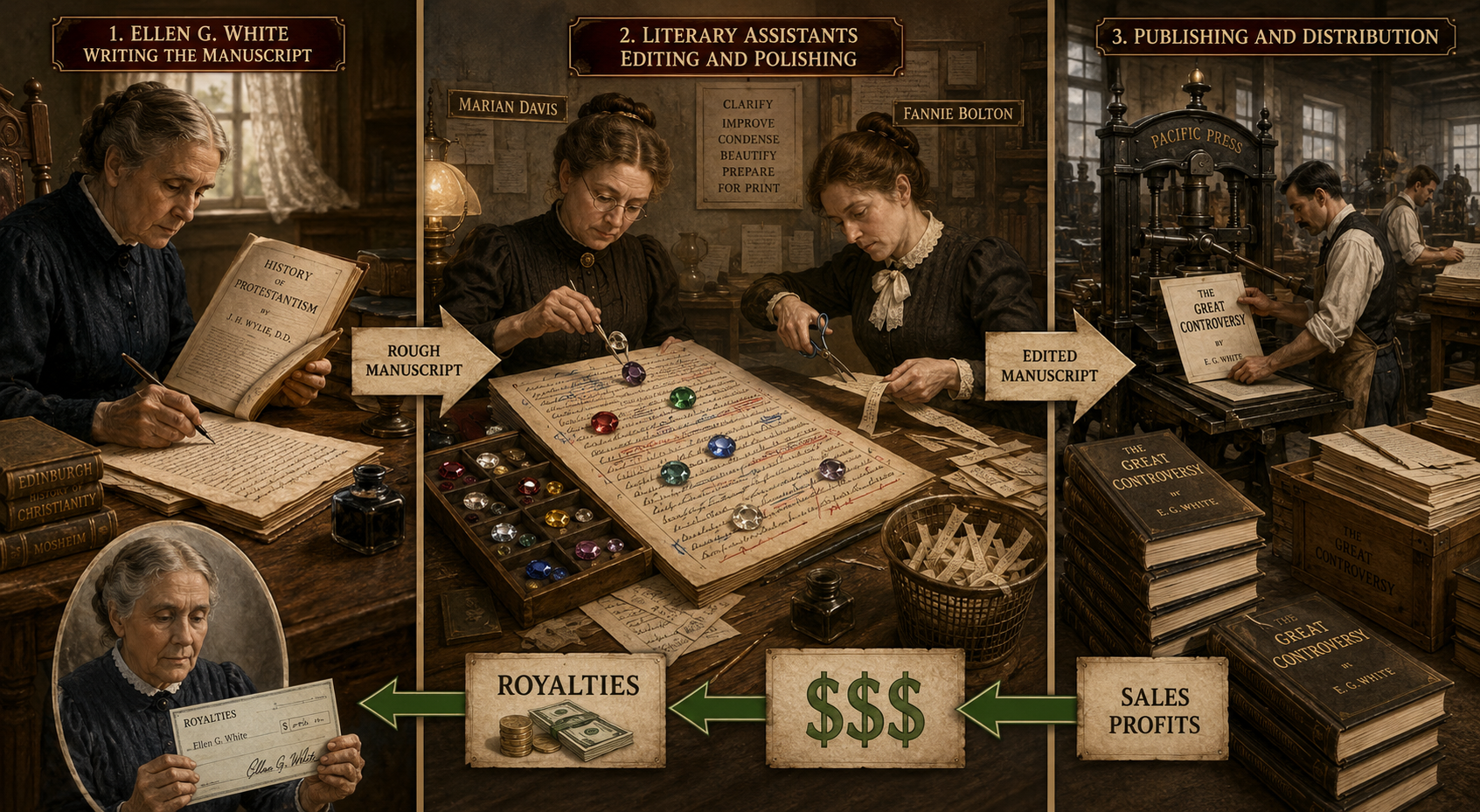
The historical record says otherwise. White commanded a rotating staff of talented literary assistants — Marian Davis, Fannie Bolton, Mary Clough, W.W. Prescott, and others — whose job was to transform her rough, error-riddled manuscripts into publishable prose.
How much of the celebrated "polish" on those gems came from the prophet, and how much from the hired help? The gem theory repeatedly credits White for the polish, but where is the evidence that she, rather than Marian Davis or Fannie Bolton, supplied it? For example, the White Estate cannot produce a single hand-written page of its best-selling book — Steps to Christ.
If others were responsible for much of that literary polish, on what basis can it be credited to Ellen White?
There is no need to speculate about who put on the shine because one of the polishers leaked the real story. Fannie Bolton, in a moment of troubled conscience, described the operation to fellow worker G.B. Starr:
You know Sister White gives the writing to Sister Davis and me morning by morning, in the rough, and we put the polish on, and it all goes out signed "Ellen G. White."10
There is the polish: Davis and Bolton.
Bolton made the same confession to Merritt G. Kellogg:
Most of what I write is published in the Review and Herald as having come from the pen of Sister White, and is sent out as having been written by Sister White under inspiration of God. I want to tell you that I am greatly distressed over this matter for I feel that I am acting a deceptive part.11
And how did the prophetess respond when Kellogg relayed this bit of unwelcome news to her? She snapped, "Fannie Bolton shall never write another line for me," and fired her.12 Consider what is embedded in these words: "Shall never write another line for me." That is a wholesale admission that Bolton was doing more than fixing the prophet's spelling. She was writing "lines," and no doubt entire books.
Bolton was not fired for falsely claiming to write White's material.
She was fired for truthfully claiming to write White's material — and talking about it.
Marian Davis, White's most trusted assistant, operated on an even grander scale. White described Davis as her "bookmaker," explaining that Davis assembled her books by gathering scattered fragments from articles, letters, and manuscripts, selecting whatever made the matter "more forcible," and arranging it into chapters.13 Veltman's own study confirmed that White's books most celebrated for their literary beauty were, structurally speaking, Davis' productions.
When SDA apologists praises the skill with which borrowed gems were selected, arranged, and polished, they may in reality be praising Marian Davis and Fannie Bolton rather than divine inspiration working through Ellen White.
Nor was this limited to polishing sentences. The 1919 Bible Conference transcript shows the same pattern at the level of entire books. When White's writings lacked material, her staff simply reached for other men's books and grafted the content in.14
If any doubt remains about how much of the "polish" originated downstream of the prophet's pen, Ronald Graybill — a trained historian who spent thirteen years inside the White Estate — has removed it. His analysis of White's writings shows that her handwritten manuscripts typically arrived without paragraph divisions, in handwriting so difficult that her transcribers were forced to guess at words, with defective spelling, grammar, and punctuation throughout. Nearly twenty assistants labored to convert this raw material into the polished books the sect reveres.
Graybill's conclusion is one no critic could improve upon: for some of "her" books, the assistant's name could justly have stood on the title page beside Ellen White's.15
Before the White Estate can credit Ellen White with the polish, they must first establish that the polish was hers. The gem theory's entire argument rests upon the assumption that the literary improvements originated with Ellen White. Yet the historical record repeatedly points to the very assistants whose job was to revise, arrange, polish, and even write material published under her name.
The Polishing Operation
If "polish" sounds like a critic's caricature, consider who coined the term in-house. As early as 1876, James White described the production pipeline for his wife's writings in a letter to their son:
We cannot print them [Ellen's writings] until they are written, polished, and have the last touches of the old gentleman's pencil.16
James describes the book-production assembly line: written, polished, then given a final editorial review. "Polish" was not a critic's invention. It was the White family's own term for a routine step in preparing Ellen White's writings for publication.
That same year, White revealed exactly what she expected the polishers to do — by complaining bitterly about one who failed to do it. Of Elder J.H. Waggoner's handling of her copy, she fumed:
I put copy in Elder Waggoner's hand to copy. He just did a miserable job. He did not change anything or improve it at all.17
This complaint is remarkable because it describes "changing" and "improving" as the expected work of an editor. Waggoner's failure was not that he changed too much, but that he "did not change anything or improve it at all." In Ellen White's office, an editor who did not change and improve her copy had, by her own verdict, done "a miserable job."
Changing and improving was not the prophet's miraculous contribution.
It was the job description she assigned to the hired help.
She graded their performance on it. So when Lake gushes that the borrowed gems were "changed," "reworked," "improved," and "enhanced," he is not describing inspiration. He is describing White's employees doing precisely what she demanded of them.
Her hiring standards prove the same point. When Fannie Bolton's health broke down in 1895, White weighed the available replacements and rejected copyist Mary Steward in revealing terms:
Were Fannie able to do the work that she has done in the past, still I would need more workers... I dare not send for Mary Steward. She has not depth of imagination, and could not appreciate the life of an article, or put life and vigor into it in preparing it.18
One does not require "depth of imagination" to correct spelling. One does not "put life and vigor" into an article by fixing grammar. These are the qualifications of a writer, not a copyist. By her own account, White required assistants who could polish her writings with vividness, force, life.
Objections to Polishing
When the polishing became noticeable, objections were raised. During the 1882-1883 reprinting of the Testimonies for the Church, Mary Kelsey White and Marian Davis reworked the "inspired" text so thoroughly that Elder S.N. Haskell protested in a meeting that the two women were substituting "their more polished style" for the prophet's "more abrupt and simple style."19
Significantly, no one in that meeting disputed that the polished style belonged to Mary White and Marian Davis. The debate concerned whether such extensive revision was appropriate for writings presented to White's followers as inspired.
The polisher herself knew exactly how far the work was going. Mary confessed in a letter...
...the fear that we may make too many changes or in some way change the sense haunts me day and night.20
The woman applying the polish lay awake at night fearing she was changing the sense of divinely inspired testimony. That fear only makes sense if the editing was substantive — deep enough to alter meaning, not merely mend commas. No one loses sleep over fixing the prophet's spelling.
A century later, Graybill reviewed the 1882-1883 revisions. He concluded that, grammatically and rhetorically, it was the work of Mary White and Marian Davis that "improved the Testimonies for the Church," rendering the volumes simpler and clearer throughout.21 Later, Graybill went further still: after the revisions, White "comes across as a much more accomplished writer" — and he adds that the contrast is far more pronounced when her handwritten originals are set beside the polished published versions.22 So, the text was polished once on its way from her barely-legible scribblings to the first publication — then polished again in 1882. The literary "gems" that are held up as the fingerprint of an inspired improver had a double coat of whitewash applied by uninspired hands.
The evidence points in one direction. James White described polishing as a routine stage of production. Ellen White expected her assistants to "change" and "improve" her manuscripts. She hired editors for their imagination and ability to give her writing "life and vigor." Contemporary witnesses identified the polished prose as the work of Mary White and Marian Davis, and Graybill reached the same conclusion a century later. This destroys the assumption that Ellen White did the polishing.
Who Applied the Polish?
How can anyone possibly know that Ellen White was even the one applying the polish? Lake presents five side-by-side exhibits pairing some of White's most beloved passages with the sources they came from.23
These exhibits are genuine evidence of exactly one thing: dependence. Each exhibit has two columns. The left column is the source. The right column is the finished product. What the columns prove is that the borrowing happened, which is no longer in dispute. But Lake needs them to prove something else entirely: that Ellen White is the one who transformed the left column into the right. "She improved them" is an attribution claim, and in every scholarly discipline on earth, an attribution claim carries a burden of proof.
Before anyone can credit Ellen White with the improvements, six questions have to be answered:
- Which improvements did Ellen White personally author?
- Which came from Marian Davis, her self-described "bookmaker"?
- Which came from Fannie Bolton, who "put the polish on"?
- Which came from W.W. Prescott, who furnished material by the chapter?
- Which came from a second uncredited source lying open on the same desk?
- And which came from ordinary copy-editing at the publishing house?
A two-column table cannot answer those questions, because the answer lives in the missing third column: who actually made those changes? Lake provides no manuscript trail isolating White's pen from her assistants.
Lake's first exhibit comes from Steps to Christ — the one major book for which no handwritten manuscript survives and the very book Fannie Bolton reportedly claimed she wrote. He observes a borrowed sentence, a changed sentence, and jumps to the conclusion that Ellen White improved it. However, the actual evidence shows only that the text changed. It does not identify whose hand made the changes.
Lake's own showcase undercuts his theory. The famous line, "the greatest want of the world is the want of men," came from one source. White's celebrated addition, "though the heavens fall," came from another source entirely — the centuries-old legal maxim fiat justitia ruat caelum — "Let justice be done, though the heavens fall." Even the improvement turns out to be borrowed. Nor is this a fluke. Researchers have documented White weaving multiple sources within single chapters and even single paragraphs — Hanna here, March there, Harris in between24 — and Veltman himself cautioned that passages his study rated "independent" might lose that rating once more of her reading was surveyed.25
Lake has demonstrated dependence, but he has not demonstrated authorship. Those are two entirely different claims. Every gem he showcases is an unattributed artifact. His exhibits prove the borrowing. They cannot prove that White improved anything. Until SDA apologists produce a methodology that can isolate her hand, the gem theory is not scholarship. It is blind faith.
Huss Manuscript Refutes Gem Theory
The question about the hands between the source and the finished product is resolved by one chapter of The Great Controversy. White's handwritten manuscript for the John Huss chapter is extant. Donald McAdams transcribed it — the first extensive exposure of a rough draft of a major portion of any White book.26 The surviving manuscript answers the question: Who actually made the changes?
Holograph Shows White Plagiarizing
About a third of the way through the surviving manuscript, White copied, almost verbatim, a passage from James Wylie's History of Protestantism summarizing the farewell letter Huss wrote to his friends in Prague — and her own handwriting records the page number of Wylie from which she was copying.27 Not a vision. Not a photographic memory. Not merely an idea copied. An entire page, copied almost verbatim, complete with the source page number — in the prophet's own hand.
The "Improvement" Belongs to Marian Davis
The published chapter's crowning "improvement" can be attributed to Marian Davis. According to Graybill, when Davis reached White's secondhand summary of the farewell letter, she declined to use it at all. Instead she followed Wylie's own footnote to Emile de Bonnechose's Reformers Before the Reformation, located the volume in J.N. Andrews' library in Basel, Switzerland, found the actual text of Huss' farewell letter — far richer and more moving than the summary White had copied — and inserted that long quotation into The Great Controversy, where it fills nearly the whole of page 105.
Marian Discards White's Gems
Donald McAdams carefully analyzed the surviving handwritten manuscripts for the John Huss chapter of The Great Controversy. His findings independently confirm Graybill's account. Marian Davis did far more than polish Ellen White's grammar. According to McAdams, she "played a very significant role in deleting a large amount of original material dealing with the spiritual significance of events and adding additional material from Wylie."28 McAdams then quantified exactly what those editorial decisions meant.29
| Type of Writing | Words in White's Handwritten Manuscript |
Marian Davis' Editing | Words in 1888 Great Controversy |
|---|---|---|---|
| Spiritual (non-historical) | 11,400 words | Deleted all 11,400 words | None |
| Historical Narrative (E.G. White) |
9,600 words (most from Wylie) |
Deleted two-thirds (6,900 words) |
2,700 words |
| Historical Narrative (M. Davis) |
Added 1,100 words (all from Wylie) |
1,100 words | |
| TOTAL | 21,000 words | 18,300 words cut, 1,100 words added |
3,800 words |
The numbers are astonishing. Davis eliminated every word of White's original spiritual commentary. She discarded roughly two-thirds of White's historical narrative as well, then supplemented the surviving material with additional passages from Wylie.
Davis gutted White's entire spiritual diatribe, much of which documents the behind-the-scenes battle between Christ and Satan — the very "great controversy theme" that Lake said was the one way in which Ellen White added value to the Christian world.
For example, White wrote on pages 57-58 of her manuscript of how Satan himself physically "appeared in the Council of Constance" and was there with his angels as "active working agents." No historian reported Satan's personal appearance at the Council of Constance. If this scene originated anywhere, it could only have come from White's supposed visions. Yet this is precisely the material that Davis removed.
Davis edited as though her own story-making mattered more than preserving White's unique contribution.
The Huss chapter was not a polished version of White's manuscript.
It was a complete demolition and reconstruction of White's work.
W.C. White later insisted that his mother's use of historians served only one purpose — to express her revelations in better language:
Of this you may be sure, because I know whereof I speak. Her use of the language of the historians was not for the sake of bringing into the book something that had not been revealed to her, but was an effort to utilize in the best language she could find the description of scenes presented to her...30
W.C. White proposes that Ellen was merely using Wylie to put her visions into better prose. If that is true, then...
- Why remove the very material that supposedly came from vision?
- Why excise White's unique spiritual commentary?
- How could Davis know that the parts she added were compatible with White's divine revelation?
McAdams asked similar tough questions and left the conclusion to his readers.31 The manuscript evidence, however, demands an answer to this question: how could Davis feel so confident about editing White's revelations to such an extent?
In this chapter, there is no version of "improving the gems" that survives the historical facts. The gems are not in the 1888 book. They are in the wastebasket, and Marian Davis put them there.
Chapter Contains No Revelation
McAdams' underlying finding was that the Huss chapter contains "no historical fact" that was not already present in the texts of the historians he examined.32 Not one. Yet White's own introduction to The Great Controversy claims that the Spirit of God had opened to her mind the scenes of the past.33 What was opened to her mind beyond the contents of the source?
It is curious how the publishers muted their claims ten years later in their preface to The Desire of Ages. They claimed no revelations for her at all. They presented her merely as a woman of long experience in the things of God. Yet, that is the book which, by Arthur White's own admission, is "replete with extra-Biblical information."34 The unverifiable embellishments flowed freely, but the revelation claim was quietly withheld. That is not the fingerprint of inspiration. It is the fingerprint of caution — the caution of a writer who had learned by painful experience that her bold claims could be checked against a bookshelf.
Here is what is left after the dust settles:
If the history came from historians, the theology from theologians, the wording from literary sources, the structure from her "bookmaker," and the polish from her assistants — what did God reveal to Ellen White?
Polished to Improve — or Polished to Conceal?
SDA apologists assume that when White changed words, added others, and reworked borrowed thoughts, her motive was to remove error, clarify meaning, and insert nuggets of truth into an uninspired text. However, there is a far less flattering explanation:
The changes made the theft harder to spot.
Which explanation better fits the evidence?
Once again, the testimony comes from inside the syndicate. According to the account of Fannie Bolton's experience published in The Gathering Call, Bolton was copying White's manuscript when she opened one of the source volumes and was shocked to find a paragraph reproduced without any indication of quotation — and, turning the page, found another page altered just enough to avoid a verbatim match.35 The same account reports that Dr. J.H. Kellogg advised revising The Great Controversy precisely to head off a charge of plagiarism. That is not the workshop of a jeweler perfecting gems. It is the workshop of someone altering stolen property so its origin cannot easily be recognized.
The pattern holds across her corpus. D.M. Canright, who knew the Whites personally, observed the systematic word-swapping in her health writings as early as the 1880s.36 Walter Rea documented it across dozens of her books.37 The alterations follow the pattern one would expect if the objective were concealment rather than improvement: synonyms substituted, clauses reordered, two sentences merged into one — changes that add no meaning but diminish recognizability.
This is not inspired literary craftsmanship. This historical evidence points in a more sinister direction. When a writer repeatedly denies using sources, while her staff is found altering borrowed passages and advisers are warning about plagiarism, that points to a fraudulent prophet lacking any real inspiration. Concealment is a far more convincing explanation than inspiration.
"Improved" for Whom?
Now consider what Lake actually means by "improvement." Lake never defines what he means by "improvement." Improved according to whom? SDA theologians? Historians? Ordinary readers? No objective standard is ever stated. Apparently, any change that moves a sentence closer to distinctive SDA doctrine counts as an improvement. But that is not an objective standard.
Even so, a more elegant sentence is not a more truthful sentence. Eloquence and accuracy are independent variables. Polish the wording of an error and you have not corrected the error; you have manufactured a more persuasive one. So even if White's gems glittered, the glitter would tell us nothing about whether the content came from God — which, once again, was the only question on the table.
When one examines Lake's own examples, his celebrated "improvements" fall into two categories — and neither justifies his conclusion.
1. Insertion of Sectarian Dogma
Many of White's alleged upgrades consist of taking a devotional passage written by a mainstream Protestant author and salting it with distinctive SDA doctrines — perfectionism, the investigative judgment, apostate Protestantism, the imminent end-time, the centrality of the Sabbath, the state of the dead, dietary salvation, or the great-controversy framing. To a committed SDA, injecting SDA theology into Charles Beecher's prose naturally looks like improvement. A Mormon might likewise regard a hymn as improved by adding a verse about the golden plates. To the rest of Christendom, it is the opposite: a corruption of the original author's thought, conscripting his eloquence into the service of doctrines he never believed and would have repudiated. Conybeare and Howson were not writing to support a sect teaching that Christ's atonement was not completed on the cross. Whether injecting their sentences with such teachings constitutes an "improvement" is not a literary judgment; it is a theological one, and Lake is simply grading his own prophet with his own sect's answer key.
2. Ease of Reading Improvements
Much of the remaining "polish" amounts to Americanizing British diction and updating the ornate style of authors who wrote decades earlier for a different audience. Modernizing nineteenth-century British prose for American readers was ordinary editorial work — not evidence of divine inspiration. If modernizing outdated prose is evidence of prophetic inspiration, then every competent copy editor is a prophet.
White's "improvements" therefore amount to two things: theological revision and ease-of-reading improvements. Neither requires divine revelation.
White Makes Things Worse, not Better
SDA apologists claim that Ellen White improved her sources. In her health writings, however, the evidence points in the opposite direction: her revisions often made them worse. In her health writings one can watch White take her sources' claims and make them more extreme, more reckless, and more dangerous. Her borrowed health "gems" came from the quack fringe of nineteenth-century medicine — and where her sources speculated, she spoke with divine authority.
Consider tobacco, tea, and coffee. Her language tracks the popular health reformers of the preceding decades, as documented even by pro-White compilers of her source parallels:38
| The Earlier Health Reformers | Ellen White (1864) |
|---|---|
| "Coffee, Green Tea, and ardent spirits; the constant use of which, and Tobacco, are slow but certain poisons at last." — J.C. Gunn (1857) | "Those who use these slow poisons, like the tobacco user, think they cannot live without them..." |
| "Every man who, knowingly and recklessly, brings upon himself disease and death, through the influence of tobacco, is a suicide." — O.S. Fowler (1835) | "They have surely murdered themselves by this slow poison." |
Where did the alleged improvement occur? Fowler, Gunn, Coles, and Alcott presented their claims as the medical opinions of fallible men — which is exactly what they were, and many of those opinions were wrong. White took the identical material and did the one thing guaranteed to make it worse: she stamped it with the authority of God.
Human error presented as human opinion is correctable. Human error presented as divine revelation is fossilized forever. This is the true and consistent "value" White added to her sources. Graybill himself summarized the transformation, acknowledging that White borrowed the material of other authors while "turning the speculations and conjectures of her sources into statements of positive fact."39 That is not polishing a gem. That is taking a guess and forging God's signature on it.
Graybill's later research drove the same blade deeper. His textual history documents that White's borrowing carried her sources' historical errors straight into The Great Controversy itself.40 How does that impact the gem theory? An improver, by definition, discriminates: he keeps what is sound and corrects what is flawed. A copyist reproduces the flaws along with the shine. If an inspired editor had truly been polishing these gems, the cracks would not have passed through intact. The cracks survived the polishing.
The pattern is on full display in her first health book, An Appeal to Mothers (1864). Her source material was the anti-masturbation hysteria literature of Gove, Trall, and Jackson — discredited quackery that terrified a generation with claims that "solitary vice" produced imbecility, disease, and death.41 Her sources at least presented these claims as medical science. White "improved" it by announcing that the matter had been "shown" to her by God as an abomination, and by escalating the penalty from the ruined body to the damned soul, declaring that those who indulged "cannot be Christians."42 Her sources threatened children with the asylum; the prophetess threatened them with hellfire — on the borrowed authority of pseudo-science she claimed came from heaven.
Case Study: When the "Gem" Made It Worse
If the gem theory is correct, the changes Ellen White made should consistently move her sources toward greater truth and accuracy. The historical record of her health teachings shows the opposite. Below are documented cases where Ellen White took a health teaching directly from L.B. Coles — whose Philosophy of Health sat in her library, and whose book she publicly praised as an "excellent work" while copying it without credit43 — and "improved" it by making it more absolute, more sweeping, or more damning. In each case, the alteration is precisely the thing modern medicine has since refuted. Coles qualified. White absolutized.
| L.B. Coles, Philosophy of Health (1851) | Ellen White (1864 and later) | The Escalation |
|---|---|---|
| "...it is not my object, however, to insist on entire abstinence from meats." (p. 52) | "Concerning flesh meat we can all say, Let it alone." (Letter 135, 1902. "Let it alone": An idiom meaning to completely abstain from it.) | White transforms a dietary preference into an unconditional divine prohibition against flesh meats. Coles declined to go that far. |
| "For persons having weak stomachs, and many persons of sedentary habits, two meals a day, rightly distanced, might be preferable." (p. 36) | "In most cases, two meals a day are preferable to three." (Counsels on Diet and Foods, p. 176) | Coles offers a conditional suggestion for one narrow group. White universalizes it into a general rule for nearly everyone. |
| "Sugar is a good article of diet, when used in conjunction with articles containing less nutrition in the same quantity." (p. 60) | "Discard sugar, and eat fruit. ... The idea that we should have sweet cake should be discarded, for it ferments in the stomach, and brings on malaria." (Letter 92, 1898) | White takes an absolute stance against sugar and claims that sweets "bring on malaria" (a complete falsehood); Coles allowed sugar if taken with other food and never claimed it caused malaria. |
| ALCOHOLIC LIQUORS of all kinds, whether strong beer, cider, wine, or brandy, should never be taken except as drugs. (p. 75) | In the sanitarium...the patients must not be given alcohol, tea, coffee, or drugs... (Letter 50, 1900) | White makes the prohibition against alcohol (and tea) absolute in SDA sanitariums but Coles' prohibition makes allowances for health reasons. |
| Black tea will favorably affect a torpid liver; but, when used, it should be taken like other medicines, and relinquished when its object is answered. (p. 82) | It is right that no tea, coffee, or flesh meat be served in our sanitariums. (Letter 213, 1902) | White makes the prohibition against tea absolute in SDA sanitariums but Coles' allowed the sick to drink tea temporarily. |
| "As a general rule, fruit should be taken as a part of the regular dinner. Good, ripe fruit, taken in this way, is beneficial to health." (p. 61) | "It is not well to eat fruit and vegetables at the same meal... better to have the fruit at one meal, and the vegetables at another." (Counsels on Diet and Foods, p. 112) | White invents a restriction with no basis in physiology, which SDAs observed for generations. Coles is correct. |
| "MEDICINES, if used at all, should be the last resort... In recent and acute diseases, medicines may sometimes be of service." (pp. 205-206) . | "...the entire absence of drugs...would make our sanitariums more effectual in restoring the sick to health." (Letter 73a, 1896) | White encourages a wholesale prohibition of drugs in treating the sick while Coles takes a less extreme view. Her condemnation of quinine later cost the lives of SDA missionaries. Coles never condemned quinine. |
The pattern is unmistakable. White takes the most radical and extreme stance possible on various health reforms while Coles is more rational. This is not the profile of an editor improving her raw material; it is the profile of a copyist who understood the rhetoric of her sources but not the reasoning behind it, and who compensated for that gap by turning up the volume.
The most damning example concerns "solitary vice," where even Coles — hardly a moderate on the subject — was the gentler of the two. Coles warned that the practice had "reduced their minds to comparative imbecility, and, in many cases, to complete idiotism."44 White took that already-hysterical claim, applied it by name to the children of her own believers, and added the one thing Coles never dared: eternal damnation. She declared that many children of Sabbath-keeping parents were "ruining soul and body with secret vice" and were "on the direct road to perdition," singling out one boy as "dwarfed, physically and mentally," whose remaining intellect was "of a low order" and who would "eventually become idiotic."45
Consider the contrast in those two passages. Coles offered a bad medical opinion. White took that bad medical opinion, sharpened it into a personal accusation against named children in her own congregation, escalated the penalty from imbecility to perdition, and published it as a message from God. That is the "improvement." That is the polish on the gem.
When White's health writings were scored against the reformers she borrowed from for medical accuracy, White routinely finished below them.46 The plagiarist scored lower than those she plagiarized. That is not polishing a gem. It is tarnishing it.
From Proclaiming to Publishing
Every biblical prophet proclaimed their message to the people for free. Ellen White's books were built to be sold. That difference has profound ramifications.
Scripture records no prophet who sold his writings as a commercial product. Jeremiah wrote a scroll to be proclaimed not published and marketed. Baruch did not edit out Jeremiah's words. He publicly proclaimed the entire scroll — for free.47
Scribes later copied Jeremiah's writings for preservation and public reading but not as a commercial enterprise profiting the prophet or his family. Scribes made copies for synagogues. The revelation was entrusted to the covenant community, not retained as the prophet's literary property. The prophet did not gather royalties, oversee a publishing enterprise, employ assistants to reshape the text, or issue revised versions packed with plagiarized content.
Paul's letters were copied by the churches that received them, but Paul received no royalties. He labored "night and day" so that his preaching would not be mistaken for a livelihood.48 He explicitly rejected the operating model used by White:
We are not, like so many, peddling the word of God (2 Cor. 2:17 NKJV).
The Greek for peddling (kapeleuo) means "to make money by selling anything."49 Another version states:
For we do not market the word of God for profit like so many (2 Cor. 2:17 CSB).
The early church took this so seriously that the Didache instructed congregations to regard a prophet who asked for money with immediate suspicion.50 None of the early Church Fathers was known for selling their writings. This continues the pattern established in the Old Testament: revelation flows from God, through the prophet, into the community, which copies and preserves it. Nowhere does a prophet own their prophecy or attempt to profit from it.
This is not an argument against Christian authors receiving royalties. By White's century, respected Christian authors routinely earned income from their books — Spurgeon and Moody among them. There is nothing inherently suspect about a nineteenth-century author being paid for publishing a book.51 If Ellen White was simply another Christian author, the question would be largely moot. But she and her followers claimed something far greater for her. They placed her on the same level as the biblical prophets. Her books were presented not merely as the reflections of a devout woman, but as messages originating with God Himself. That claim changes everything.
A prophet's obligation is to proclaim what God said no matter what the cost. A publisher's obligation is to make money. Those two obligations are often incompatible. Real prophets often have to convey uncomfortable and unpopular messages. Those messages do not sell well. A prophet who is also a publisher is placed in a compromising position. To meet sales objectives they may need to soften the book's message. This is the fundamental tension. If the revelation is not commercially viable, does the editor preserve it or replace it because readers will prefer something better?
Recall the arithmetic. White's handwritten draft carried 11,400 words of her own spiritual commentary on the Huss story — the very material Lake would call her "unique contribution" — the one thing Wylie did not supply.52 Marian Davis deleted it entirely.
Ask why, and the biblical contrast supplies the only coherent answer. A process built to transmit revelation protects spiritual commentary because that is the entire point of having a prophet. A process built to generate a saleable book keeps whatever reads well and moves the narrative, and discards whatever slows it down. Davis kept Wylie's history, because Wylie already proved that good history sells. White's lengthy spiritual diatribe and visionary insight? Likely not good for sales. That is not the editorial judgment of someone safeguarding revealed truth. It is the editorial judgment of someone assembling a manuscript to sell.
Multiply this decision across two dozen literary assistants, multiple editions, chapters infused with new material to improve readability, and books marketed and sold in the millions, and the picture that emerges contrasts sharply with that of Jeremiah. White built a publishing empire53 — complete with an editor whose job was to cut the vision and keep the history, because history is what the market would buy.
A publishing empire is more interested in profit than prophet.
The Stolen Car with the Shiny New Paint Job
Lake's argument reduces to this:
Taking another person's property is acceptable, provided you improve it.
Lake would never accept this reasoning in any other department of life. If a thief stole Professor Lake's car, gave it a gorgeous new paint job, upgraded the sound system, and then drove it around town telling everyone it was a gift from God, would Lake admire the craftsmanship — or report the theft? He would call the police, and the paint job would not be a defense at trial — it would be evidence that the thief was trying to cover his tracks.
Since Lake is an academic, there is an analogy he will connect to even more readily. Suppose a graduate student at Lake's own university copied forty pages of his dissertation from another scholar — and improved every sentence he took. Modernized the language, clarified the argument, and even added brilliant original material. Then suppose that, when confronted, he denied ever having read the source. Does the committee award him the doctorate for enhancing the material and making it his own? Every accredited university on earth answers that question the same way: the student is expelled. Not because his work wasn't improved — it may well have been — but because the question was never improvement. The issue was never literary quality. It was authorship — and the student's denial seals his fate. Professor Lake extends to his prophet a courtesy that his own institution would not extend to a freshman.
The deeper error is that Lake is grading White against the wrong standard altogether. If it were discovered tomorrow that Shakespeare had lifted half of Hamlet from an uncredited source, no literary scholar would excuse it on the ground that Hamlet is better than the source; genius has never been a defense against plagiarism. But even that comparison flatters White, because Shakespeare never claimed his plays came down from the throne of God. White must be evaluated by the standard she chose for herself: "The words I employ in describing what I have seen are my own." Prophets who plagiarize while denying doing so lack integrity.
Lake's "made it her own" formula deserves special attention. Property does not become "your own" through unauthorized modification. A forger who improves upon the painting he copies has not "made it his own"; he has made a better forgery. The improvement changes neither the ownership nor the deception.
Hiding Behind Ramik — It's Okay to Plagiarize if You Cannot be Prosecuted
In 1981, the SDA corporation — in full damage-control mode after Walter Rea's exposé — hired attorney Vincent Ramik to reframe a debate it was losing. Rea had raised an ethical question: was it honest for the sect to market White's books as revelations from God when it knew they were built from other men's writing? That question is the reason his book is titled The White Lie. Ramik, unsurprisingly, returned a finding favorable to the client paying his fee: he concluded only that White's borrowings would not likely have supported a successful nineteenth-century copyright lawsuit.54 The sect proclaimed this a vindication and considered the matter closed. What had actually happened was a sleight of hand: the ethical question, which the sect could not win, was quietly swapped for a legal one, which it could.
Apologists cornered on the plagiarism charge routinely retreat to Ramik's memo, but copyright infringement and plagiarism are not the same charge. Copyright asks whether an author violated another's legal rights. Plagiarism asks whether an author ethically represented the origin of borrowed language and ideas. Presenting another writer's work as one's own, without attribution, is plagiarism whether or not it is actionable in court. Ramik was never asked the only question that matters here, and apologists who cite him are misdirecting the conversation.
The appeal to Ramik fails for two reasons. First, Ramik was hired to answer a legal question. The central charge against Ellen White has never been that she could have been successfully sued, but that she repeatedly denied her literary dependence while presenting borrowed material as the product of divine revelation. Second, the SDA sect does not present White as someone who merely complied with nineteenth-century copyright law. It presents her as a prophet and moral exemplar guided by the Holy Spirit. "Not indictable" is a strange epitaph for a messenger of the Lord.
A jewel thief is still a thief, even if the stolen gem shines brighter after he polishes it.
Mindless Copying?
Lake announces triumphantly that the research shows White's use of sources does not fit the charge of "mindless copying." But whose charge is that? After thirty-five years at the front lines of Ellen White research, I am not aware of a single serious critic who ever claimed White copied mindlessly. Canright did not claim it. Rea did not claim it. Numbers did not claim it. McAdams did not claim it. The critics' charge has always been the opposite: that White copied intentionally, systematically, and skillfully — and then denied doing it. Veltman's study, the very research Lake cites, confirmed precisely what the critics had long argued: she used her sources consciously and deliberately, her borrowing pervaded even her allegedly eyewitness visionary accounts, and she and her defenders denied the dependence.55
So Lake has constructed a phantom charge, then heroically refuted it, and declared victory. Worse for Lake, his refutation of the imaginary charge proves the real one. Demonstrating that White carefully selected, adapted, and reworked her sources is not a defense. It is evidence of premeditation. In trying to refute the critics, Lake ends up proving their central claim.
The Gem Theory Defenses Collapse
Lake listed several defenses for his gem theory that must be addressed.
The "Only Four Percent" Defense
His first defense is to minimize the plagiarism problem. He turned to a White Estate study that supposedly documented the literary parallels in White's published books and the grand total comes to less than four percent of her corpus.56 Four percent! Practically nothing! This implies that critics are making a fuss over nothing.
Before examining the number, meet the man who helped produce it. In November 1981 — two years before the Estate's study began — Ronald Graybill, associate secretary of the White Estate and soon to be one of the study's two principal authors, stood before the morning worship services of the General Conference and told the sect's corporate leaders that it is impossible to say what percentage of White's writings involve borrowed material. Impossible for two reasons:
- Only a fraction of the many books she owned and read had ever been examined against her writings.
- Her habit of recycling the same material from letters into articles into books makes even the total volume of her writing — the denominator itself — impossible to fix with statistical precision.57
The percentage question was declared unanswerable by the very researcher who then helped answer it. A figure that the author of the study labeled "impossible" to calculate is not believable evidence. It is corporate damage control.
Loyalty can affect judgment. Can the White Estate — an organization that profits almost entirely from customers who believe Ellen White was a true prophet — be trusted to produce an objective assessment of her plagiarism? That would be like asking the Tobacco Industry to assess the dangers of smoking!
Thrives on Ignorance
The White Estate's best defense is ignorance — no one knows the full extent of her plagiarism, and the two SDA researchers who spent the most time looking broadly at her writings, Walter Rea and Ronald Graybill, both found it in every category they examined.
Identifying the full extent of White's borrowing is a genuinely enormous task. Fred Veltman needed eight years just to work through 15 of the 87 chapters of The Desire of Ages. Multiply that across White's roughly 25 million published words and the full nineteenth-century literature available to her, and no one — not the White Estate, not the critics — has ever come close to a complete audit.
The only thing that can be said with certainty is that over the last century, the White Estate has continually adjusted upward the percentage of material that they admit that she copied. Before Walter Rea's research surfaced, SDAs claimed that only a small percentage was plagiarized. One number widely proclaimed by SDAs was that only 2.6% of Desire of Ages was copied.58 Veltman looked at a broader range of sources and found 31.4%. Still, his research only looked at a finite number of books. If more sources were examined, it is likely that percentage would rise even further.
That is the pattern the White Estate cannot escape: every time the scope of inquiry widens, the number goes up.
Four percent is a floor, not a ceiling
The Estate's own description of the study states that it "does not represent a final total," counts only parallels "presently known," and remains "subject to revision" as new sources surface.59 In other words, the figure does not measure how much White copied. It measures how much she has been caught copying. White had 1,300 volumes in her libraries.60 Only a small fraction of these have even been examined for plagiarism. In addition, White kept hundreds, if not thousands, of clippings from magazines and newspapers. This is exactly the limitation Graybill identified in 1981, and exactly why Veltman warned that passages rated "independent" could lose that rating as more of her reading was examined. A shoplifter may steal successfully a hundred times before getting caught. That does not mean he is guilt-free of the 99 times he was not caught.
The counting rules exclude the deepest borrowing
The Estate marked only parallels showing "a clear verbal connection"; thought parallels were deliberately left uncounted.61 Yet Graybill's 1981 summary informed SDA corporate leaders that White borrowed far more than words and phrases: she followed the outlines of her sources' expositions and drew from their facts, illustrations, thoughts, theological concepts, and scriptural and prophetic expositions — and that the borrowing turns up not only in her historical writing but in her prophetic sections and even in her descriptions of the content of specific visions.62 He judged it unwise to assert that any book from her pen — any book at all — would prove free of borrowing. Dependence is more than verbatim lines of copying, as Graybill himself acknowledged:
A focus on individual words and phrases doesn't really handle the question of relationship and dependence. It's not so much a question of whether an author picked up a phrase here or there. It's a question, rather, of whether the author is really in control of the material.63
That is the question that continues to haunt the White Estate.
Watch the denominator
The four percent is produced by averaging the borrowing across her entire indexed corpus — including thousands of pages of personal testimonies where borrowing opportunity is low. The borrowing does not spread evenly; it concentrates precisely in the books the sect prints by the millions and sells for a profit. By the Estate's own table: The Great Controversy — 15.11 percent credited plus 5.05 percent uncredited, a combined one line in every five; Sketches From the Life of Paul — 12.33 percent; Steps to Christ — 6.7 percent.64 Using the Estate's own conversion rate of 85 lines to roughly three pages, the documented parallels in The Great Controversy alone amount to more than 150 pages of other men's words. Even these figures are contested. SDA scholar Don McAdams once suggested that every paragraph in Great Controversy should have been footnoted, and Robert Olsen, former director of the White Estate, wrote:
There was no question in Ellen G. White's mind about the over all inspiration of The Great Controversy, although possibly 50 percent or more of the material in the book was drawn from other sources."65
Furthermore, the crown jewel is missing from the average entirely: The Desire of Ages was excluded from the marking project.66 Removing one of the books with the highest rate of copying from the count helps the Estate get to that four percent figure. That is not measurement. That is dilution.
The percentage is irrelevant to the charge.
White's denials were absolute. "I do not write one article in the paper expressing merely my own ideas." "My views were written independent of books." An absolute claim is falsified by a single counterexample — and the Estate's own audit supplies thousands of them. Fraud is not priced by volume: one forged signature invalidates a will; forty plagiarized pages in a four-hundred-page dissertation is "only ten percent," and the student is expelled just the same. When a bank teller is caught with four percent of the deposits, no one calls it a rounding error.
One final observation: even White's own estate, applying counting rules designed for damage control, still had to concede that one-fifth of the sect's flagship book came from other men's pens. When that is the best the defense audit can produce, the defense audit is a confession.
Empty Explanations
Lake's chapter deploys several supporting defenses to sustain his gem theory. Before answering them one by one, the reader should know that every one of them — including the gem theory itself — was quietly pre-refuted by the White Estate, in-house, in 1981.
At the close of his 1981 presentations to the General Conference leadership, Graybill stood up and summarized what the Estate then knew. Ellen White had read and used non-SDA sources far more extensively than previously understood. She had borrowed outlines, facts, illustrations, theological concepts, and prophetic expositions — and the borrowing reached even her descriptions of the content of specific visions. He reported the handwritten version is usually closer to the literary source than the published version that followed — a difference he attributed to the editing of her literary assistants. And then came the sentence that should have made Lake's chapter impossible to write: Graybill acknowledged that many of "the literary gems found in Mrs. White's writings were borrowed from other authors," and concluded that this fact, combined with the knowledge that her writings were polished by literary assistants, obligates Adventists to avoid suggesting that the literary beauty of her writings is evidence of her divine inspiration.67
The manuscript evidence settles the attribution question: where we can actually watch the process, Ellen White's own hand hugged the source, and it was the assistants who created the distance between the source and the finished product. That distance — the reworking, the rewording, the "improvement" — is the entirety of the evidence for White's inspired touch. The Estate's manuscript record attributes it to her assistants.
The White Estate's associate secretary warned them not to make that argument. Lake made it anyway. His thesis was not merely refuted by the critics. It was refuted in advance by his own side.
What about the other well-worn explanations provided by Lake?
Everyone borrowed in the 19th century"
White's own circle refutes the claim that the 1800s smiled on uncredited borrowing. Uriah Smith rebuked plagiarism in the September 6, 1864, issue of the Review and J.H. Kellogg counseled revising The Great Controversy specifically to head off a plagiarism charge,68. To address the uproar over failure to cite sources in the 1888 edition, the 1911 edition added more credits. Books are not revised to avoid accusations that nobody recognizes. But grant the apologists their standard: judge her by her own era — and by her own words. It was Ellen White who declared "the words I employ in describing what I have seen are my own." By that standard — hers — she stands condemned.
"The Bible Prophets Used Sources Too"
Indeed they did—but they did so openly. Luke began his Gospel by candidly informing his readers that he had carefully investigated the accounts of "many" who had written before him (Luke 1:1-3). Paul quoted pagan poets and explicitly identified them: "as certain also of your own poets have said" (Acts 17:28). There was no deception, no pretense that borrowed material had descended directly from heaven. Their integrity lay in their transparency.
The comparison with Ellen White therefore collapses under its own weight. If her books were research projects assembled from historians, commentators, and literary assistants, then they should be presented honestly as such — not as the product of supernatural visions. Lake cannot have it both ways. He cannot defend White as a careful compiler while simultaneously insisting that her books originated through divine revelation. The more her dependence on human sources is emphasized, the less necessary her visions become.
The irony is even greater. The Ellen G. White Estate itself acknowledges that White revised historical details when better historical sources became available.69 That is exactly what responsible historians do. It is not what one would expect of a prophet writing under divine guidance. Editors revise research. Historians correct sources. But revelations from God do not require historical updates every time better scholarship appears.
"Only her thoughts were inspired, not her words"
This is not a fringe apologetic; it is the sect's official position, stated by its highest corporate officer. General Conference president Neal Wilson told the denomination outright: "God inspires people, not words."70,71 However, even this defense cannot survive the fact that the thoughts were borrowed too: outlines, prophetic expositions, contents of visions, theology, history, health reforms, and the great controversy theme. In 1909, White herself torched this defense, claiming "It is not I who controls my words" — a claim of verbal control, from the prophet's own pen, that her defenders must now also explain away.
"She didn't conceal it"
White read her sources openly, lent her books, even recommended them to others. But reading in public is not confessing dependence. The charge was never that she hid her reading; it is that she denied her copying — and no amount of public page-turning makes "my views were written independent of books" true. Nor can open reading explain what Graybill reported in 1981: borrowed material embedded in her descriptions of what she claimed to have seen in vision.72 One may research a history chapter in full view of others; one does not "research" the contents of one's own heavenly visions in another man's book.
White's endorsement of Conybeare and Howson months before releasing her own book on Paul told readers the source was excellent; it did not tell them her book reproduced it. When the reproduction was noticed, Sketches From the Life of Paul was quietly allowed to go out of print, never to be republished in her lifetime73 — a strange fate for an innocent and profitable book.
The apologists lean here on Robert Olson's survey concluding that "most" of her denials present no problem when read in context.74 That is hard to reconcile with Fred Veltman's confession that neither he nor anyone else had a satisfactory answer to those very denials. Veltman obviously knew Olson, and yet Veltman said that no one else had a "satisfactory answer." That must mean that Olson's answer was unsatisfactory. Besides, who was better qualified to answer this question? Olson — a White Estate bureaucrat? Or Veltman, the man who had spent the last eight years agonizing over the plagiarism?
"An angel told her to gather the gems."
Like a "Hail-Mary" pass at the end of a football game, the final defense is the most extraordinary. Blame it on her spirit guide! In 1933, W.C. White finally revealed that his mother had been divinely assured she would find "precious gems of truth expressed in acceptable language" in her reading, and would receive heavenly help to harvest them.75 No such authorization was ever claimed in her lifetime — the very lifetime she spent denying that her views owed anything to books. The dilemma is merciless. Either the angel story is a posthumous fabrication, manufactured by the estate once the borrowing could no longer be denied — or it is true, and God ordered his angels to harvest the language of other books while His messenger publicly swore she wrote independent of books, making heaven itself a partner in the deception.
And a housekeeping note on Lake's chapter itself: among the possible explanations for the borrowing, it offers Roger Coon's suggestion of "a subconscious exercise of a possible photographic memory" — then, a few pages later, quotes Veltman's finding that the parallels "were not the result of accident or 'photographic memory.'"76 The chapter refutes itself and does not appear to notice. When a defense contradicts its own witnesses, the conclusion is obvious.
The "Unique Contribution" That Wasn't
Lake saves his strongest claim for last: Ellen White's great controversy theme was evidence of her originality and her unique contribution to Christian thought.
This claim survives only until the historical record is consulted. The cosmic-conflict theme was ancient long before Ellen White was born; John Milton built Paradise Lost upon it two centuries earlier. And the specific packaging — a book-length survey of the age-long war between God and Satan from Eden to the end — was published under the very title The Great Controversy by first-day Adventist H.L. Hastings in early 1858, before Ellen White published a word of her own version.77 White's alleged "unique contribution to Christian thought" had already appeared in print before she ever published her own version.
Suppose, for the sake of argument, that the great controversy theme really was White's unique, God-given insight. Then why did expressing it require hundreds of paragraphs borrowed from uninspired men? A God capable of revealing an original theme is presumably capable of supplying original words to express it. The apologist cannot have it both ways. Either the theme came by revelation, in which case its dependence on hundreds of borrowed passages demands explanation, or it was assembled from literary sources, precisely as McAdams argued.
As for Veltman's celebrated metaphor that the sources were her "slaves" and never her "master" — it is strangely appropriate. A slaveholder is one who takes another man's labor without consent, without payment, claims its fruits as his own, and then profits from it.
Conclusion: The Trilemma
It is encouraging to see the defenders of Ellen White finally concede that she borrowed extensively from other authors. But having admitted the obvious, we are now being asked to admire the inspired craftsmanship. The evidence presented in this article points elsewhere. The celebrated "improvements" cannot be reliably attributed to Ellen White, often belonged to her assistants, often served to obscure her copying, and, in important cases, made her sources demonstrably worse rather than better.
Once the borrowing is admitted, only three possibilities remain.
Possibility one: Ellen White personally authored the improvements. The evidence stands against it, and it cannot be demonstrated, because no methodology exists that can isolate her hand from her assistants, her editors, and her second sources. The entire thesis rests on this possibility, and yet no attempt was made to prove it.
Possibility two: her assistants authored the improvements. Then the celebrated polish is ordinary human editorial labor, the prophet's contribution shrinks to supplying rough drafts built out of other men's books, and "inspiration" becomes impossible to locate in the finished text — let alone verify. This is the possibility the testimony of Bolton, Davis, the documented 1882 polishing of the Testimonies, and the 1919 conference supports.
Possibility three: the improvements came from still other uncredited authors. Then the celebrated "improvements" were borrowed as well, and the gem theory collapses entirely.
The White Estate's published defense answers the wrong question. The issue was never whether Ellen White improved borrowed material; it was whether she truthfully represented its origin. Every door leads out of the prophet's office and into the editing room. Which returns us to the only question that ever mattered:
If the history came from historians, the theology from theologians, the wording from literary sources, the structure from her "bookmaker," and the polish from her assistants, then what exactly did God reveal to Ellen White?
A defense of a prophet that removes her from her prophetic role to that of an inspired editor is not a defense at all. It is an eulogy.
A polished gem is still a stolen gem. A repainted car is still a stolen car. And a "testimony from the Lord" assembled out of other people's books, buffed by hired assistants, altered to escape detection, and marketed to trusting believers as light shining directly from the throne of God, is still exactly what Veltman's own eight-year investigation found it to be: a practice that strikes at the heart of Ellen White's honesty, her integrity, and therefore her trustworthiness.